Cloud Culture Clash Creates Opportunities

In my opinion, one of the biggest challenges facing companies like Dell, my employer, is how to help package and deliver this thing called cloud into the market.  I recently had the opportunity to watch and listen to customers try to digest the concept of PaaS.
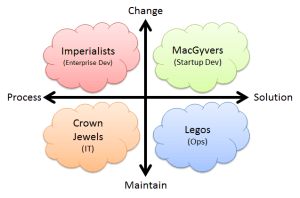
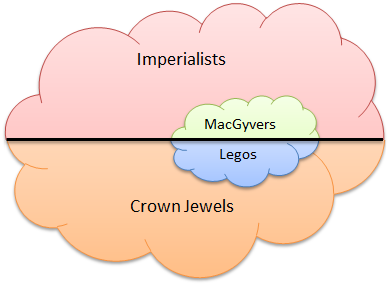
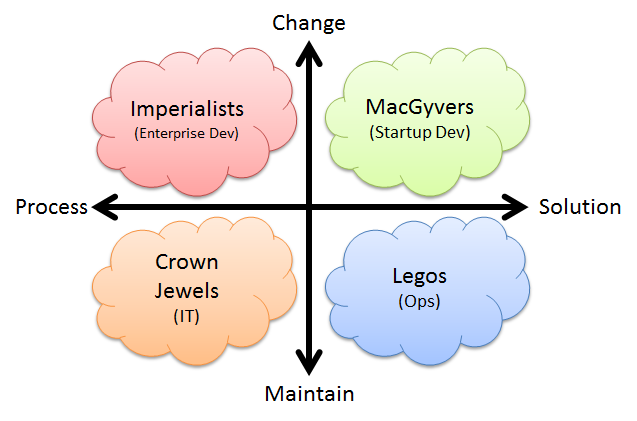
While not surprising, the technology professionals in the room split into across four major cultural camps: enterprise vs. start-up and dev vs. ops.  Because I have a passing infatuation with pastel cloud shaped quadrant graphs, I was able to analyze the camps for some interesting insights.

The camps are:

  1. Imperialists:  These enterprise type developers are responsible for adapting their existing business to meet the market.  They prefer process oriented tools like Microsoft .Net and Java that have proven scale and supportability.
  2. MacGyvers: These startup type developers are under the gun to create marketable solutions before their cash runs out.  They prefer tools that adapt quick, minimize development time and community extensions.
  3. Crown Jewels: These enterprise type IT workers have to keep the email and critical systems humming.  When they screw up everyone notices.  They prefer systems where they can maintain control, visibility, or (better) both.
  4. Legos: These start-up type operations jugglers are required to be nimble and responsive with shoestring budgets.   They prefer systems that they can change and adapt quickly.  They welcome automation as long as they can maintain control, visibility, or (better) both.

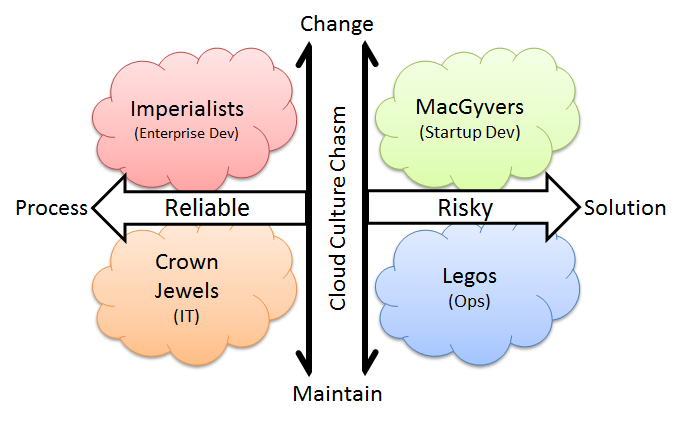
This graph is deceiving because it underplays the psychological break caused by willingness to take risks.  This break creates a cloud culture chasm. 
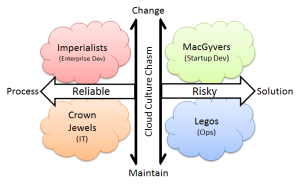
On one side, the reliable Imperialists want will mount a Royal Navy flotilla to protect the Crown Jewels in a massive show of strength.  They are concerned about the security and reliability of cloud technologies.

On the other side, the MacGyvers are working against a ticking time bomb to build a stealth helicopter from Legos they recovered from Happy Meals™.  They are concerned about getting out of their current jam to compile another day.

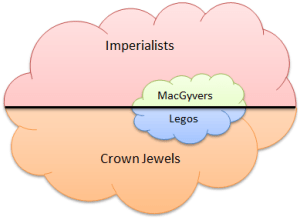
Normally Imperialists simply ignore the MacGyvers or run down the slow ones like yesterday’s flotsam.  The cloud is changing that dynamic because it’s proving to be a dramatic force multiplier in several ways:

  1. Lower cost of entry – the latest cloud options (e.g. GAE) do not charge anything unless you generate traffic.  The only barrier to entry is an idea and time.
  2. Rapid scale – companies can fund growth incrementally based on success while also being able to grow dramatically with minimal advanced planning.
  3. Faster pace of innovation – new platforms, architectures and community development has accelerated development.  Shared infrastructure means less work on back office and more time on revenue focused innovation.
  4. Easier access to customers – social media and piggy backing on huge SaaS companies like Facebook, Google or SalesForce bring customers to new companies’ front doors.  This means less work on marketing and sales and more time on revenue focused innovation.

The bottom line is that the cloud is allowing the MacGyvers to be faster, stronger, and more innovative than ever before.  And we can expect them to be spending even less time polishing the brass in the back office because current SaaS companies are working hard to help make them faster and more innovative.
For example, Facebook is highly incented for 3rd party applications to be innovative and popular not only because they get a part of the take, but because it increases the market strength of their own SaaS application.

So the opportunity for Imperialists is to find a way for employee and empower the MacGyvers.  This is not just a matter of buying a box of Legos: the strategy requires tolerating enabling embracing a culture of revenue focused innovation that eliminates process drag.  My vision does not suggest a full replacement because the Imperialists are process specialists.  The goal is to incubate and encapsulate cloud technologies and cultures.

So our challenge is more than picking up cloud technologies, it’s understanding the cloud communities and cultures that we are enabling.
Cloud Gravity & Shards

This post is the final post laying out a rethinking of how we view user and buyer motivations for public and private clouds.

In part 1, I laid out the “magic cube” that showed a more discrete technological breakdown of cloud deployments (see that for the MSH, MDH, MDO, UDO key).  In part 2, I piled higher and deeper business vectors onto the cube showing that the cost value of the vertices was not linear.  The costs were so unequal that they pulled our nice isometric cube into a cone.

The Cloud Gravity Well

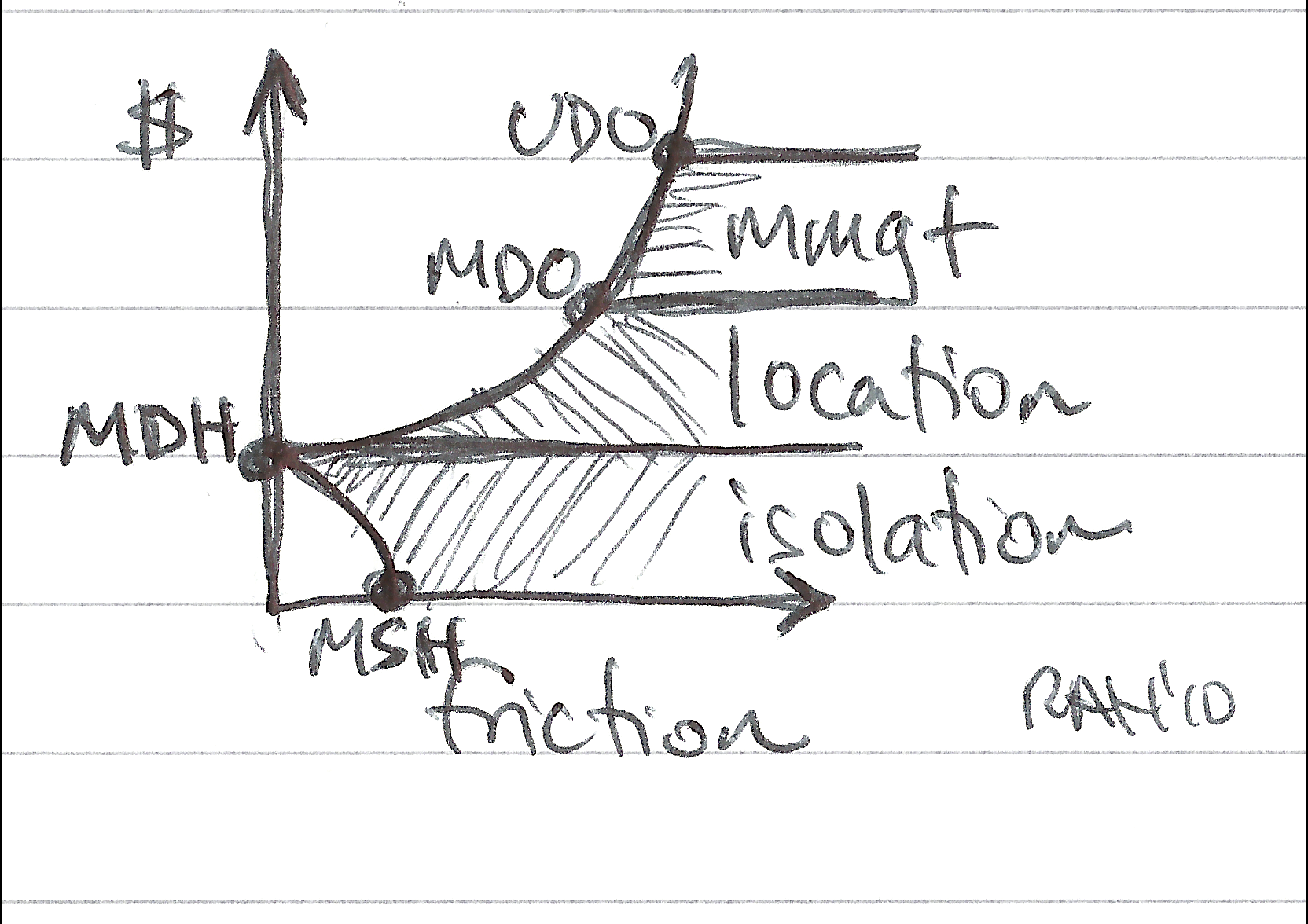
To help make sense of cloud gravity, I’m adding a qualitative measure of friction.

Friction represents the cloud consumer’s willingness to adopt the requirements of our cloud vertices.  I commonly hear people say they are not willing to put sensitive data “in the cloud” or they are worried about a “lack of security.”  These practical concerns create significant friction against cloud adoption; meanwhile, being able to just “throw up” servers (yuck!) and avoiding IT restrictions make it easy (low friction) to use clouds.

Historically, it was easy to plot friction vs. cost.  There was a nice linear trend where providers simply lowered cost to overcome friction.  This has been fueling the current cloud boom.

The magic cube analysis shows another dynamic emerging because of competing drivers from management and isolation.  The dramatic saving from outsource management are inhibited by the high friction for giving up data protection, isolation, control, and performance minimums.  I believe that my figure, while pretty, dramatically understates the friction gap between dedicated and shared hosting.  This tension creates a non-linear trend in which substantial customer traction will follow the more expensive offerings.  In fact, it may be impossible to overcome this friction with pricing pressure.

I believe this analysis shows that there’s a significant market opportunity for clouds that have dedicated resources yet are still managed and hosted by a trusted 3rd party.  On the other hand, this gravity well could turn out to be a black hole money pit.  Like all cloud revolutions, the timid need not apply.

Post Script: Like any marketing trend, there must be a name.  These clouds are not “private” in the conventional sense and I cringe at using “hybrid” for anything anymore.  If current public clouds are like hotels (or hostels) then these clouds are more like condos or managed community McMansions.  I think calling them “cloud shards” is very crisp, but my marketing crystal ball says “try again.”  Suggestions?

Cloud Business Vectors

In part 1 of this series, I laid out the “magic cube” that describes 8 combinations for cloud deployment.  The cube provides a finer grain understanding than “public” vs. “private” clouds because we can now clearly see that there are multiple technology axis that create “private IT” that can be differentiated. 

 The axis are: (detailed explanation)

  • X. Location: Hosted vs. On-site
  • Y. Isolation: Shared vs. Dedicated
  • Z. Management: Managed vs. Unmanaged

Cloud Cost Model

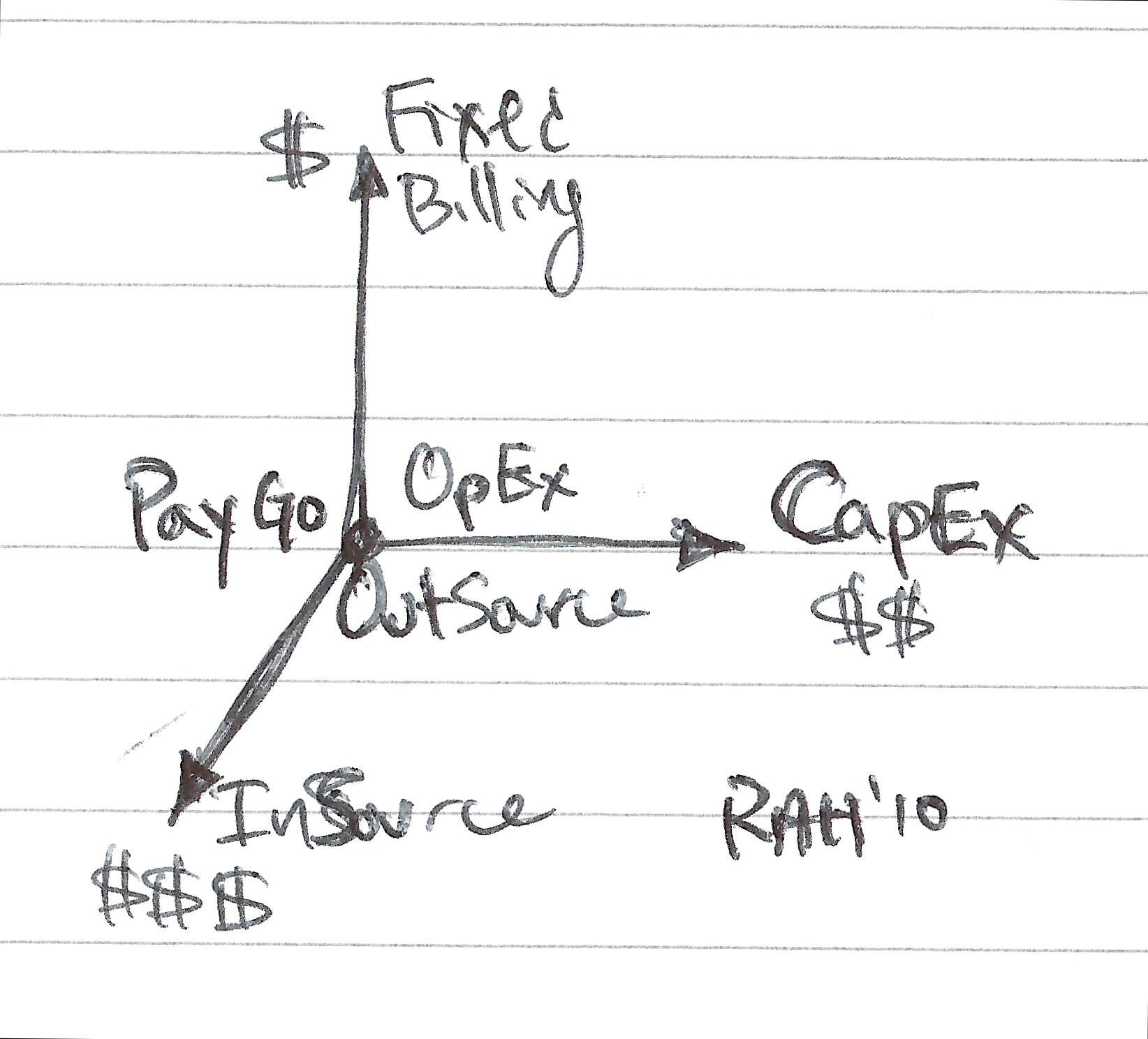
In this section, we take off our technologist pocket protectors and pick up our finance abacus.  The next level of understanding for the magic cube is to translate the technology axis into business vectors.  The business vectors are:

X. Capitalization:  OpEx vs. CapEx.  On the surface, this determines who has ownership of resource, but the deeper issue is if the resource is an investment (capital) or consumable (operations).   Unless you’re talking about a co-lo cage, hosting models will be consumable because the host is leveraging (in the financial sense) their capital into operating revenue.

Y. Commitment: PayGo vs. Fixed.  Like a cell phone plan, you can pay for what you use (Pay-as-you-go) or lock-in to a fixed contract.  Fixed is generally pays a premium based on volume even though the per unit cost may be lower.  In my thinking, the fixed contract may include dedicated resource guarantees and additional privacy.

Z. Management: Insource vs. Outsource.  Don’t over think this vector, but remember I not talking about off shoring!  If you are directly paying people to manage your cloud then you’ve insourced management.  If the host provides services, process or automation that reduces hiring requirements then you’re outsourcing it IT.  It’s critical to realize that you can’t employee fractional people.  There are fundamental cloud skillsets and tools that must be provided to operate a cloud (including, not limited to DevOps).

THE 3 VECTORS ARE NOT EQUAL!

If you were willing to do some cerebral calisthenics about these vectors then you realized that they are not equal cost weights.  Let’s look at them from least to most.

  1. The commitment vector is very easy to traverse this vector in either direction.  It’s well established human behavior that we’ll pay more for to be more predictable, especially if that means we get more control or privacy.  If I had had a dollar for everyone who swoons over cloud bursting I’d go buy that personal jet pack.
  2. The capitalization vector has is part of the driver to cloud as companies (and individuals) seek to avoid buying servers up front.  It also helps that clouds let you buy factional servers and “throw away” servers that you don’t need.  While these OpEx aspects of cloud are nice, servers are really not that expensive to lease or idle.  Frankly, it’s the deployment and management of those assets that drives the TCO way up for CapEx clouds, but that’s not this vector so move along.
  3. The management vector is the silverback gorilla standing in the corner of our magic cube.  Acquiring and maintaining the operations expertise is a significant ongoing expense.  In many cases, companies simply cannot afford to adequately cover the needed skills and this severely limits their ability to use technology competitively.  Hosts are much better positioned to manage cloud infrastructure because they enjoy economies of scale distributed between multiple customers.  This vector is heavily one directional – once you fly without that critical Ops employee in favor of a host doing the work, it is unlikely you’ll hire that role.

The unequal cost weights pull our cube out of shape.  They create a strong customer pull away from the self-managed & CapEx vertices and towards outsourced & OpEx.  I think of this distortion as a cloud gravity well that pulls customers down from private into public clouds. 

That’s enough for today.  You’ll have to wait for the gravity well analysis in part 3.

Clouds & Water (Blog Action Day)

Today Change.org is coordinating Blog Action Day 2010 to raise awareness about Water.  It is widely reported (and worth repeating) that scarcity of clean water is more likely to impact your daily life than scarcity of energy, food, shelter or other basic human rights.

Water scarcity has little impact in my daily life.  <shameless plug>While The new cloud servers my employer, Dell, sells consume less power and thereby less cooling water; these efficiencies do relatively little to impact people’s access to fresh water.</shameless plug>

However, waste is a huge impact.  Since Americans are water, food and energy hogs, we are also in the position of wasting disproportionate amount of these limited resources.  I believe that we commit this waste unconsciously without any real gauge on its volume or impact.  Imagine the impact to your driving behavior if you had to fill your gas tank up a cup of gas at a time (64), water your lawn from a 5 gallon bucket (30+) or refill your toilet with a table-spoon (409!).

The key to addressing waste in the land of plenty is to measure and show impacts.  I believe that people abhor waste when they see it.  Our challenge is not to change people, but to show them in real terms the consequences of their choices.

For example, just having an MPG calculator on our cars has changed the way that we drive them.  I am personally disappointed with how little useful feedback these gauges provide, but it’s a start.

One of the things I like about Cloud Computing is that we want to measure and reduce waste.  We get mad about waste: wasted computer time, wasted equipment, wasted power, and especially wasted time.

As we make strides to make computing and information more personal and mobile, I believe we need to include ways to show people data about the choices that they are making.  So next time you water your lawn or flush your toilet, this about what it would mean if you had the haul that water in a bucket up from a well.  Sound crazy?  That’s status quo for more people than those of us that enjoy indoor plumbing.

Blog Action Day: 10/15

In a few days, I’ll participate in Blog Action Day 2010.  I did this before from my RAVolt.com EV blog.
This year’s topic, Water, is not directly relevant to the types of Clouds that I’m working with; however, it would make me very sad to think that we can create hyper-scale social media game platforms for lonely laptop wielding suburbanites while not putting a drop of effort into fundamental issues.  I’m sure I can conjure a tirade about it in the next few days…stay tuned.

Shaken or stirred? Cloud Cocktail leads to insights

Part of my perfessional & personal mission is to kick over mental ant hills.  In the cloud space, I believe that people are trying way too hard to define cloud into neat little buckets.  That leads me to try and reorient around new visualizations.  The purpose of doing this is to strip away historical thought patterns that limit our ability to envision future patterns (meaning: attitude adjustment).

The Cloud Cocktail

With that overly erudite preamble, here’s a tasty potion that I mixed up for you to enjoy on your way to real libations at ACL.

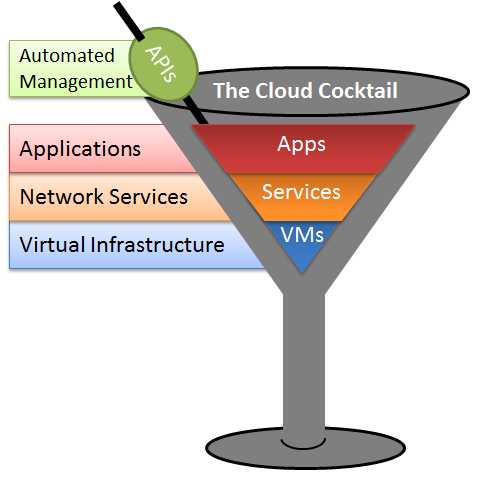
The technologies underlying cloud are complex; however, the core components for cloud are simple: applications, networked services and virtualized infrastructure.  These three components in varying proportions garnished with management APIs form the basis for all cloud solutions. 

This cocktail napkin sketch of a cloud may appear sparse, but it provides the key insights that drive a vision for how to adapt and respond to clouds’ rapid metamorphosis.  It would be ideal to point to a single set of technologies and declare that it is a Cloud; unfortunately, cloud is a transformation, not an end-state.