Seattle Cloud Camp, Dec 2010

While I was in Seattle for Azure training preparing for Dell’s Azure Appliance , Dave @McCrory suggested that we also attend the Seattle Cloud Camp (SCC Tweets).  This event was very well attended (200 people!).  With heavy attendance by Amazon (at their HQ), Microsoft (in the ‘hood), and Google, there was a substantial cloud vendor presence (>25% from those vendors alone).  Notable omission: VMware.

My reflection about the event by segment.

Opening Sessions:

  • Most of the opening sessions were too light for the audience.  I thought we were past the “what is cloud” level, sigh.
  • Of note, the Amazon security presentation by Steve Rileywas fun and entertaining.
  • Picking on a Dell competitor specifically: calling your cloud solution “WAS” is a branding #fail (not that DCSWA much is better).

Unpanel of self-appointed cloud extroverts experts:

  • The unpanel covered some decent topics (@adronbh captured them on twitter), unfortunately none of the answers really stood out to me.  Except for NoSQL.
  • The unpanel discussion about NoSQL drew 2 answers.  1) It’s not NoSQL, it’s eventually consistent instead of strictly consistent.  (note: I’ve been calling it “Storage++”) 2) We’ll see more and more choices in this area as we tune the models for utility then we’ll see some consolidation.  The suggestion was that NoSQL would follow the same explosion/contraction pattern of SQL databases.

Session on Cloud APIs (my suggested topic)

  • The Cloud API topic was well attended (30+).  The vast overwhelming majority or the attendees were using Amazon.
  • There was some interest in having “standard” APIs for cloud functions was not well received because it was felt to stifle innovation.  We are still to early.
  • It was postulated but not generally agreed that cloud aggregation (DeltaCloud, RightScale, etc) is workable.  This was considered a reason to not require standard clouds.
  • CloudCamp sponsor, Skytap, has their own API.  These APIs are value added and provide extra abstraction levels.
  • It was said that there are a LOT (50 now, 500 soon) smaller hosts that want to enter the cloud space.  These hosts will need an API – some are inventing their own.
  • I brought up the concept discussed at OpenStack that the logical abstraction for cloud network APIs is a “vlan.”  This created confusion because some thought that I meant actual 802.1q tags.  NO!  I just meant that is was the ABSTRACTION of a VLAN connecting VMs together.
  • There was agreement from the clouderati in the room that cloud networking was f’ed up, but most people were not ready to discuss.
  • Cloud APIs have some basics that are working (semantics around VMs) but still have lots of wholes.  Notably: networking, application, services, and identity)

Session on Google App Engine (GAE)

  • GAE is got a lot going on, especially in the social/mobile space.
  • Do not think a lack of news about GAE means that they are going slow, it’s just the opposite.  It looks like they are totally kicking ass with a very focused strategy.  I suspect that they are just waiting for the market to catch-up.
  • GAE understands what a “platform” really is.  They talk about their platform as the SERVICES that they are offering.  The code is just code.  The services are impressive and include identity, mail, analysis, SQL (business only), map (as in Map-Reduce), prediction (yes, prediction!), storage, etc.  The total list was nearly 20 distinct services.
  • GAE compared them selves to Azure, not Amazon.

OpenStack Day 2 Aspiration: Dreaming & Breathing

Between partnering meetings, I bounced through biz and tech sessions during Day 2 of the OpenStack conference (day 1 notes).   After my impression summary, I’m including some succinct impressions, pictures, and copies of presentations by my Dell team-mates Greg Althaus & Brent Douglas.

Clouds on the road to Bexar
My overwhelming impression is a healthy tension between aspirational* and practical discussions.  The community appetite for big broad and bodacious features is understandably high: cloud seems on track as a solution for IT problems but there are is still an impedance mismatch between current apps and cloud capabilities.
As service providers ASPire to address these issues, some OpenStack blue print discussions tended to digress towards more forward-looking or long-term designs.  However, watching the crowd, there was also a quietly heads down and pragmatic audience ready to act and implement.  For this action focused group, delivering working a cloud was the top priority.  The Rackers and Nebuliziers have product to deploy and will not be distracted from the immediate concerns of living, breathing shippable code.
I find the tension between dreaming aspiration (cloud futures) and breathing aspiration (cloud delivery) necessary to the vitality of OpenStack.
[Day 3 update, these coders are holding the floor.  People who are coding have moved into the front seats of the fishbowl and the process is working very nicely.]
Specific Comments (sorry, not linking everything):
  • Cloud networking is a mess and there is substantial opportunity for innovation here.  Nicira was making an impression talking about how Open vSwitch and OpenFlow could address this at the edge switches.  interesting,  but messy.
  • I was happy with our (Dell’s) presentations: real clouds today (Bexas111010DataCenterChanges) and what to deploy on (Bexar111010OpenStackOnDCS).
  • SheepDog was presented as a way to handle block storage.  Not an iSCSI solution, works directly w/ KVM.  Strikes me as too limiting – I’d rather see just using iSCSI.  We talked about GlusterFS or Ceph (NewDream).  This area needs a lot of work to catch up with Amazon EBS.  Unfortunately, persisting data on VM “local” disks is still the dominate paradigm.
  • Discussions about how to scale drifted towards aspirational.
  • Scalr did a side presentation about automating failover.
  • Discussion about migration from Eucalyptus to OpenStack got side tracked with aspirations for a “hot” migration.  Ultimately, the differences between network was a problem.  The practical issue is discovering the meta data – host info not entirely available from the API.
  • Talked about an API for cloud networking.  This blue print was heavily attended and messy.  The possible network topologies present too many challenges to describe easily.  Fundamentally, there seems consensus that the API should have a very very simple concept of connecting VM end points to a logical segment.  That approach leverages the accepted (but out dated) VLAN semantic, but implementation will have to be topology aware.  ouch!
  • Day 3 topic Live migration: Big crowd arguing with bated breath about this.  The summary “show us how to do it without shared storage THEN we’ll talk about the API.”
Executive Tweet:  #OpenStack getting to down business.  Big dreams.  Real problems.  Delivering Code.
 
Note: I nominate Aspirational for 2010 buzzword of the year.

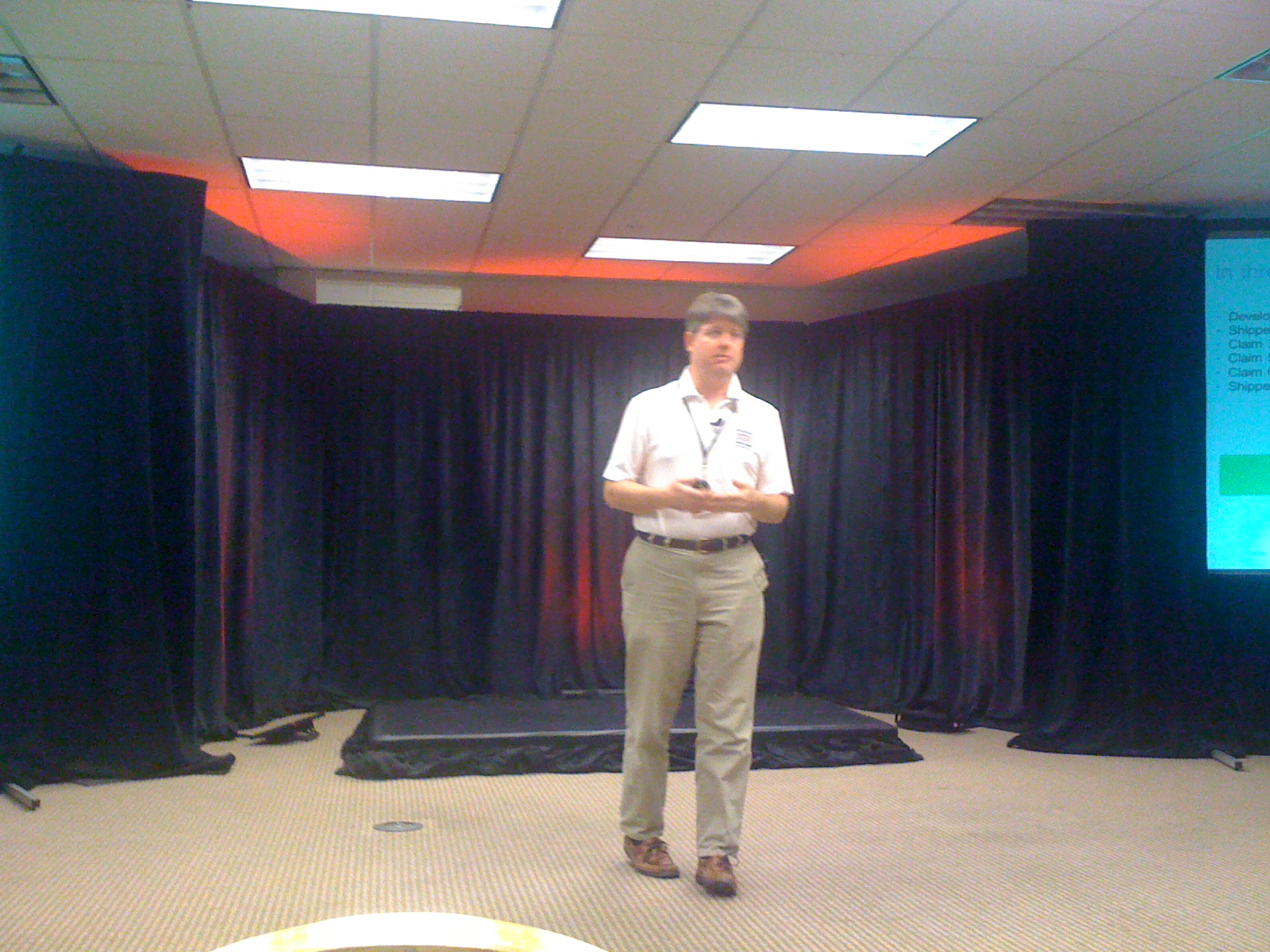
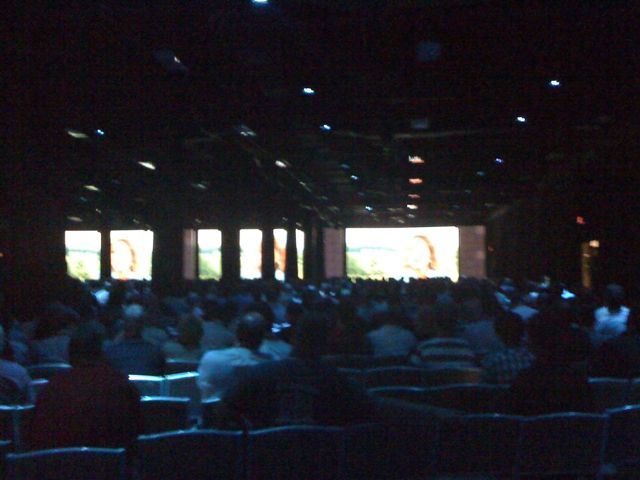
Greg PresentingBig Crowd on Day 1

OpenStack Bexar Design Summit Day 1

Yesterday, Dell sent me to be part of our OpenStack vanguard for the design summit.  The conference is fascinating and productive for the content of the sessions and even more interesting for the hallway meetings.

It’s obvious looking at the board composition that RackSpace and NASA Nova are driving  most of the development; however, the is palpable community interest and enthusiasm.  Participants and contributors showed up in force at this event.

RackSpace and NASA leadership provides critical momentum for the community.  Code is the smallest part of their contribution, their commitment to run the code at scale in production is the magic rocket fuel powering OpenStack. I’ve had many conversations with partners and prospects planning to follow RackSpace into production with a 3-6 month lag.

Beyond that primary conference arc, my impressions:

  • Core vendors like Citrix, Dell, Canonical are signing up to do primary work for the code base.  They are taking ownership for their own components in the stack.
  • Universally, people comment about the speed of progress and amount of code being generated.  Did I mention that there is a lot of code being written.
  • Networking is still a major challenge.  OpenStack (with Citrix’s Xen support) is driving Open vSwitchas a replacement for iptables management.
  • IPv6 gets lackadaisical treatment in the US, but is urgent in Japan/Asia where their core infrastructure is ALREADY IPv6.  Their frustration to get attention here should be a canary in the cloud mine (but is not).  They proposed a gateway model where VMs have dual addresses: IPv4 gets NATed while IPv6 is a pass-through. Seems to me that the going IPv6 internal is the real solution.
  • Cloud bursting is still too fuzzy a thing to talk about in a big group.  The session about it covered so many use-cases that we did not accomplish anything.  Some people wanted to talk about cloud API proxy while others (myself included) wanted to talk about managing apps between clouds.  My $0.02 is that vendors like RightScale solve the API proxy issue so it’s the networking issues that need focus.  We need to get back to the use-cases!

Executive Tweet: #openstack: Partners & Code = great progress.  Networking = needs more love

Other notes:

Austin Cloud User Group, Tuesday 7/27 6pm

Many thanks to Bill Jacaruso @ Pervasive.com (DataCloud2) for keeping the cloud camp fever burning.  Sadly, I can’t make it on Tuesday.

Here’s what Bill said:cloud networking

We were so encouraged by the participation in CloudCamp Austin here at our office a couple of weeks ago that we’re kicking off an Austin Cloud User Group!  CloudCamp showed us that there’s a smart, engaged, passionate community of cloud technologists in Austin and we’d like to give folks a chance to get together F2F on a regular basis to swap ideas, showcase innovative cloud initiatives, and build connections. 

Here’s the proposed agenda for a kickoff session on Tuesday, July 27:

Agenda

  • 6:00 – 6:20 : Meet and greet with pizza and soft drinks
  • 6:20 – 6:40 :  Round-the-room – introduce yourself, what you’re doing and plan to do on the cloud
  • 6:40 – 7:20 : Organizational discussion – how often to meet?  When?  What format?

Interested?  Register at http://austincloudusergroup.eventbrite.com/

http://groups.google.com/group/austin-cug

CloudCamp Austin 2010, see you there

Dell‘s a sponsor and I’ll be heading out to help spread some cloud luv.

See: Live twitter updates

CloudCamp Austin, Jun 10, 2010

About CloudCamp:

CloudCamp is an unconference where early adopters of Cloud Computing technologies exchange ideas. With the rapid change occurring in the industry, we need a place where we can meet to share our experiences, challenges and solutions. At CloudCamp, you are encouraged to share your thoughts in several open discussions, as we strive for the advancement of Cloud Computing. End users, IT professionals and vendors are all encouraged to participate.

Register for CloudCamp Austin, Jun 10, 2010

CloudCamp Date/Time:
June 10th,  5:30pm – 10:00pm