Clouds & Water (Blog Action Day)

Today Change.org is coordinating Blog Action Day 2010 to raise awareness about Water.  It is widely reported (and worth repeating) that scarcity of clean water is more likely to impact your daily life than scarcity of energy, food, shelter or other basic human rights.
Water scarcity has little impact in my daily life.  <shameless plug>While The new cloud servers my employer, Dell, sells consume less power and thereby less cooling water; these efficiencies do relatively little to impact people’s access to fresh water.</shameless plug>

However, waste is a huge impact.  Since Americans are water, food and energy hogs, we are also in the position of wasting disproportionate amount of these limited resources.  I believe that we commit this waste unconsciously without any real gauge on its volume or impact.  Imagine the impact to your driving behavior if you had to fill your gas tank up a cup of gas at a time (64), water your lawn from a 5 gallon bucket (30+) or refill your toilet with a table-spoon (409!).

The key to addressing waste in the land of plenty is to measure and show impacts.  I believe that people abhor waste when they see it.  Our challenge is not to change people, but to show them in real terms the consequences of their choices.

For example, just having an MPG calculator on our cars has changed the way that we drive them.  I am personally disappointed with how little useful feedback these gauges provide, but it’s a start.

One of the things I like about Cloud Computing is that we want to measure and reduce waste.  We get mad about waste: wasted computer time, wasted equipment, wasted power, and especially wasted time.

As we make strides to make computing and information more personal and mobile, I believe we need to include ways to show people data about the choices that they are making.  So next time you water your lawn or flush your toilet, this about what it would mean if you had the haul that water in a bucket up from a well.  Sound crazy?  That’s status quo for more people than those of us that enjoy indoor plumbing.
Blog Action Day: 10/15

In a few days, I’ll participate in Blog Action Day 2010.  I did this before from my RAVolt.com EV blog.
This year’s topic, Water, is not directly relevant to the types of Clouds that I’m working with; however, it would make me very sad to think that we can create hyper-scale social media game platforms for lonely laptop wielding suburbanites while not putting a drop of effort into fundamental issues.  I’m sure I can conjure a tirade about it in the next few days…stay tuned.

Shaken or stirred? Cloud Cocktail leads to insights

Part of my perfessional & personal mission is to kick over mental ant hills.  In the cloud space, I believe that people are trying way too hard to define cloud into neat little buckets.  That leads me to try and reorient around new visualizations.  The purpose of doing this is to strip away historical thought patterns that limit our ability to envision future patterns (meaning: attitude adjustment).

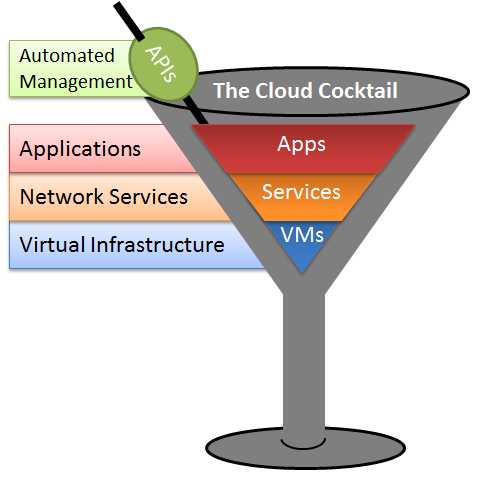
The Cloud Cocktail

With that overly erudite preamble, here’s a tasty potion that I mixed up for you to enjoy on your way to real libations at ACL.

The technologies underlying cloud are complex; however, the core components for cloud are simple: applications, networked services and virtualized infrastructure.  These three components in varying proportions garnished with management APIs form the basis for all cloud solutions. 

This cocktail napkin sketch of a cloud may appear sparse, but it provides the key insights that drive a vision for how to adapt and respond to clouds’ rapid metamorphosis.  It would be ideal to point to a single set of technologies and declare that it is a Cloud; unfortunately, cloud is a transformation, not an end-state. 

New Media = multiple audiences, simulateously

Danah Boyd‘s insights about the social impact of social media constantly astonish me.  Here recent social steganography post has interesting implications for all of us operating in the topsy-turvey mixed-up world of professional personal branding.

I was interested to think of how differently we process public information and easily ignore parts that don’t make sense to us.  Perhaps a blended word, “confuscation,”  would be an easier word to grok than steganography?

Factoring multiple reader’s perspectives into writing (or presenting) is a crucial part of my daily job.  As my team works to include cloud strategy within Dell, understanding the listener’s frame of reference is essential to communicating the message.  For me, this means framing cloud services & software into units & hardware concepts.

In many ways, I think we have a greater challenge overcoming unintended steganography then learning how to enhance it.  Perhaps as we get more deliberate at it, we’ll become better at limiting the unintended confuscation.

Alert the villagers, it’s Frankencloud!

I’m growing more and more concerned about the preponderance of Frankencloud offerings that I see being foisted into the market place (no, my employer, Dell, is not guiltless).  Frankenclouds are “cloud solutions” that are created by using duct tape, twine, wishful marketing brochures, and at least 4 marginally cloud enabled products.
The official Frankencloud recipe goes like this:

  • Take 1 product that includes server virtualization (substitutions to VMware at your own risk)
  • Take 1 product that does storage virtualization (substitutions to SAN at your own risk)
  • Take 1 product that does network virtualization (substitutions to VLANs at your own risk)
  • Take 1 product that does IT orchestration (your guess is as good as any)
  • Take 1 product that does IT monitoring
  • Take 1 product that does Virtualization monitoring
  • Recommended: an unlimited Pizza budget for your IT Ops team

Combine the ingredients at high voltage in a climate conditioned environment.  Stir in a seriously large amounts of consulting services, training, and Red Bull.  At the end of this process, you will have your very own Frankencloud!

Frankenclouds are notoriously difficult to maintain because each part has its own version life cycle.  More critically, they also lack a brain.

Unfortunately, there are few alternatives to the Frankencloud today.  I think that the alternatives will rewrite the rules that Ops uses to create clouds.  Here are the rules that I think help drive a wooden stake through the heart of the Frankencloud (yeah, I mixed monsters):

  • not assume that server virtualization == cloud. 
  • simple, simple and simpler than that
  • focus on applications (need to write more about DevOps)
  • start with networking, not computation
  • assume that software containers are replaced, not upgraded

What do you think we can do to defeat Frankenclouds?

Shared Nothing Virtual Cluster

A while back (2004), Dave McCrory and Patent can protect or trap good ideasI patented an interesting curosity that we called the Shared Nothing Virtual Cluster.  Basically, the idea is to use OS RAID 1 on a VM but to have the VHDs split between physical hosts.  If the host died, the VM could be restarted on a the second host using the RAID mirror.

It was an interesting idea, but seemed less than ideal because everyone was running to SAN storage and falling madly (insanely?) in love with vMotion.

Now that we’re looking towards clouds that beyond SAN scale, the idea of mixing DAS and NAS to create instant redundancy for VMs may suddenly have more value.

Of course, Sugient owns the patent now…

Please wake up, Identity trumps Privacy

Or when reputation matters, privacy can be poisonous

I think that privacy online is a lost cause, and should be a lost cause.  Face it, you’re privacy is completely and totally compromised by advertisers, search engines, social networks, cable providers and the government.  They have the tools and motivation to figure out who you are and what you are doing.  It’s not personal.  They need to do this because you refuse to pay for the services that they provide.  That’s the deal we’ve made with the devil and it seems to be working out pretty well for the service providers.

I see trouble on the horizon and it’s not about your online privacy – it’s about your online identity.

Trustable identity is what’s missing online.  It’s the confidence that I am the person using my credit card.  Confidence that I am the person making funny (not insulting) comments to my friend’s Facebook feed.   Confidence that emails to my child’s teacher is from me.

I know that I’m not anonymous when I walk into a book store, visit my children at school, or hang out at the pool and that’s OK with me.  Why should I expect my online experience to be any different?  In fact, I want my online identity to be even more locked in a solid.  I would be horrified if someone posing as me vandalized someone’s car but that damage could be repaired.  What if someone choose to attack my online identities?  How could I repair that damage?  It would be devastating.

For your whole life (and the last few years online), you’ve been working hard to build your reputation.

A few months ago, the Westlake Picayune, our local newspaper, called my wife to get her response to accusations that were made anonymously on the paper’s website.  The allegations were false and the paper admitted that to my wife; however, they still asked her to respond and left the posts online.  It infuriates me when someone unwilling to be identified can hurt someone’s reputation.  That same person would not stand up in a public meeting and dump vitriol on the crowd, but they hide behind the false cloak of online anonymity and rant.

So I suggest that we need better identity protection online.  Once we have real identity then we can handle privacy defensibly and pragmatically in the limited cases where it really matters.  For example, we’ll know who is accessing our private medical records not just that there was an anonymous breach.  Even better, we should be able to trust that that we can authorize specific people to look at them.  Without real identity, that type of authorization is a farce at best.

I expect that we’re only one major Facebook hacking scandal away from real identity legislation.  Think of the Sarah Palin email hack – it would not require too much more than that to set things in motion.

Getting identity right is not easy, but it won’t happen until we get the priorities right: identity trumps privacy.