Fast Talk: Creating Operating Environments that Span Clouds and Physical Infrastructures

This short 15-minute talk pulls together a few themes around composability that you’ll see in future blogs where I lay out the challenges and solutions for hybrid DevOps practices.  Like any DevOps concept – it’s a mix of technology, attitude (culture) and process.

Our hybrid DevOps objective is simple: We need multi-infrastructure Amazon equivalence for ops automation.

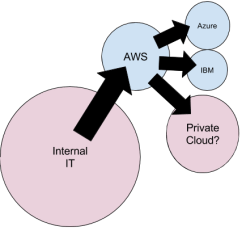
IT perspective of AWSHere’s the summary:

  • Hybrid Infrastructure is new normal
  • Amazon is the Ops benchmark
  • Embrace operations automation
  • Invest in making IT composable


Want to listen to it?  Here’s the voice over:


Problems with the “Give me a Wookiee” hybrid API

Greg Althaus, RackN CTO, creates amazing hybrid DevOps orchestration that spans metal and cloud implementations.  When it comes to knowing the nooks and crannies of data centers, his ops scar tissue has scar tissue.  So, I knew you’d all enjoy this funny story he wrote after previewing my OpenStack API report.  

“APIs are only valuable if the parameters mean the same thing and you get back what you expect.” Greg Althaus

The following is a guest post by Greg:

While building the Digital Rebar OpenStack node provider, Rob Hirschfeld tried to integrate with 7+ OpenStack clouds.  While the APIs matched across instances, there are all sorts of challenges with what comes out of the API calls.  

The discovery made me realize that APIs are not the end of interoperability.  They are the beginning.  

I found I could best describe it with a story.

I found an API on a service and that API creates a Wookiee!

I can tell the API that I want a tall or short Wookiee or young or old Wookiee.  I test against the Kashyyyk service.  I consistently get a 8ft Brown 300 year old Wookiee when I ask for a Tall Old Wookiee.  

I get a 6ft Brown 50 Year old Wookiee when I ask for a Short Young Wookiee.  Exactly what I want, all the time.  

My pointy-haired emperor boss says I need to now use the Forest Moon of Endor (FME) Service.  He was told it is the exact same thing but cheaper.  Okay, let’s do this.  It consistently gives me 5 year old 4 ft tall Brown Ewok (called a Wookiee) when I ask for the Tall Young Wookiee.  

This is a fail.  I mean, yes, they are both furry and brown, but the Ewok can’t reach the top of my bookshelf.  

The next service has to work, right?  About the same price as FME, the Tatooine Service claims to be really good too.  It passes tests.  It hands out things called Wookiees.  The only problem is that, while size is an API field, the service requires the use of petite and big instead of short and tall.  This is just annoying.  This time my tall (well big) young Wookiee is 8 ft tall and 50 years old, but it is green and bald (scales are like that).  

I don’t really know what it is.  I’m sure it isn’t a Wookiee.  

And while she is awesome (better than the male Wookiees), she almost froze to death in the arctic tundra that is Boston.  

My point: APIs are only valuable if the parameters mean the same thing and you get back what you expect.


One Cloud, Many Providers: The OpenStack Interop Challenge

We want OpenStack to work as a universal cloud API but it’s hard!  What’s the problem? 

Clouds DownThis post, written before the Tokyo Summit but not published, talks about how we got here without a common standard and offers some pointers.  At the Austin Summit, I’ve got a talk on hybrid Open Infrastructure Wednesday @ 2:40 where I talk specifically about solutions.  I’ve been working on multi-infrastructure hybrid – that means making ops portable between OpenStack, Google, Amazon, Physical and other options.

The Problem: At a fundamental level, OpenStack has yet to decide if it’s an infrastructure (IaaS) product or a open software movement.

Is there a path to be both? There are many vendors who are eager to sell you their distinct flavor of OpenStack; however, lack of consistency has frustrated users and operators. OpenStack faces internal and external competition if we do not address this fragmentation. Over the next few paragraphs, we’ll explore the path the Foundation has planned to offer users a consistent core product while fostering its innovative community.

How did we get down this path?  Here’s some background how how we got here.

Before we can discuss interoperability (interop), we need to define success for OpenStack because interop is the means, not the end. My mark for success is when OpenStack has created a sustainable market for products that rely on the platform. In business plan speak, we’d call that a serviceable available market (SAM). In practical terms, OpenStack is successful when businesses targets the platform as the first priority when building integrations over cloud behemoths: Amazon and VMware.

The apparent dominance of OpenStack in terms of corporate contribution and brand position does not translate into automatic long term success.  

While apparently united under a single brand, intentional technical diversity in OpenStack has lead to incompatibilities between different public and private implementations. While some of these issues are accidents of miscommunication, others were created by structural choices inherent to the project’s formation. No matter the causes, they frustrate users and limit the network effect of widespread adoption.

Technical diversity was both a business imperative and design objective for OpenStack during formation.

In order to quickly achieve critical mass, the project needed to welcome a diverse and competitive set of corporate sponsors. The commitment to support operating systems, multiple hypervisors, storage platforms and networking providers has been essential to the project’s growth and popularity. Unfortunately, it also creates combinatorial complexity and political headaches.

With all those variables, it’s best to think of interop as a spectrum.  

At the top of that spectrum is basic API compatibility and the boom is fully integrated operation where an application could run site unaware in multiple clouds simultaneously.  Experience shows that basic API compatibility is not sufficient: there are significant behavioral impacts due to implementation details just below the API layer that must also be part of any interop requirement.  Variations like how IPs are assigned and machines are initialized matter to both users and tools.  Any effort to ensure consistency must go beyond simple API checks to validate that these behaviors are consistent.

OpenStack enforces interop using a process known as DefCore which vendors are required to follow in order to use the trademark “OpenStack” in their product name.

The process is test driven – vendors are required to pass a suite of capability tests defined in DefCore Guidelines to get Foundation approval. Guidelines are published on a 6 month cadence and cover only a “core” part of OpenStack that DefCore has defined as the required minimum set. Vendors are encouraged to add and extend beyond that base which then leads for DefCore to expand the core based on seeing widespread adoption.

What is DefCore?  Here’s some background about that too!

By design, DefCore started with a very small set of OpenStack functionality.  So small in fact, that there were critical missing pieces like networking APIs from the initial guideline.  The goal for DefCore is to work through the coabout mmunity process to expand based identified best practices and needed capabilities.  Since OpenStack encourages variation, there will be times when we have to either accept or limit variation.  Like any shared requirements guideline, DefCore becomes a multi-vendor contract between the project and its users.

Can this work?  The reality is that Foundation enforcement of the Brand using DefCore is really a very weak lever. The real power of DefCore comes when customers use it to select vendors.

Your responsibility in this process is to demand compliance from your vendors. OpenStack interoperability efforts will fail if we rely on the Foundation to enforce compliance because it’s simply too late at that point. Think of the healthy multi-vendor WiFi environment: vendors often introduce products on preliminary specifications to get ahead of market. For success, OpenStack vendors also need to be racing to comply with the upcoming guidelines. Only customers can create that type of pressure.

From that perspective, OpenStack will only be as interoperable as the market demands.

That creates a difficult conundrum: without common standards, there’s no market and OpenStack will simply become vertical vendor islands with limited reach. Success requires putting shared interests ahead of product.

That brings us full circle: does OpenStack need to be both a product and a community?  Yes, it clearly does.  

The significant distinction for interop is that we are talking about a focus on the user community voice over the vendor and developer community.  For that, OpenStack needs to focus on product definition to grow users.

I want to thank Egle Sigler and Shamail Tahir for their early review of this post.  Even beyond the specific content, they have helped shape my views on this topics.  Now, I’d like to hear your thoughts about this!  We need to work together to address Interoperability – it’s a community thing.
OpenStack Brief Histories: Austin 2011 and DefCore

These two short items are sidebars for my “One Cloud, Many Providers: The OpenStack Interp Challenge” post.  They provide additional context for the more focused question in the post: “At a fundamental level, OpenStack has yet to decide if it’s an infrastructure product or a open software movement. Is there a path to be both?” 

Background 1: OpenStack, The Early Days

How did we get here?  It’s worth noting that 2011 OpenStack was structured as a heterogenous vendor playground.  At the inaugural OpenStack summit in Austin when the project was just forming around NASA’s Nova and Rackspace’s Swift projects, monolithic cloud stacks were a very real threat.  VMware and Amazon were the de facto standards but closed and proprietary.  The open alternatives, CloudStack (Cloud.com), Eucalyptus and OpenNebula were too tied to single vendors or lacking in scale.  Having a multi-vendor, multi-contributor project without a dictatorial owner was a critical imperative for the community and it continues to be one of the most distinctive OpenStack traits.

Background 2:  DefCore, The Community Interoperability Process

What is DefCore?  The name DefCore is a portmanteau of the committee’s job to “define core” functions of OpenStack.  The official explanation says “DefCore sets base requirements by defining 1) capabilities, 2) code and 3) must-pass tests for all OpenStack products. This definition uses community resources and involvement to drive interoperability by creating the minimum standards for products labeled OpenStack.”  Fundamentally, it’s an OpenStack Board committee with membership open to the community.  In very practical terms, DefCore picks which features and implementation details of OpenStack are required by the vendors; consequently, we’ve designed a governance process to ensure transparency and, hopefully, prevent individual vendors from exerting too much influence.

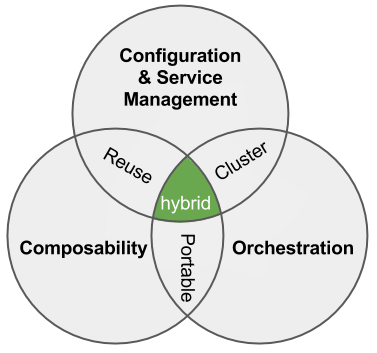
Hybrid DevOps: Union of Configuration, Orchestration and Composability

Steven Spector and I talked about “Hybrid DevOps” as a concept.  Our discussion led to a ‘there’s a picture for that!’ moment that often helped clarify the concept.  We believe that this concept, like Rugged DevOps, is additive to existing DevOps thinking and culture.  It’s about expanding our thinking to include orchestration and composability.

Hybrid DevOps 3 components (1)Here’s our write-up: Hybrid DevOps: Union of Configuration, Orchestration and Composability

Is Hybrid DevOps Like The Tokyo Metro?

I LOVE OPS ANALOGIES!  The “Hybrid DevOps = Tokyo Metro” really works because it accepts that some complexity is inescapable.  It would be great if Tokyo was a single system, but it’s not.  Cloud and infrastructure are the same – they are not a single vendor system and going to converge.

With that intro…Dan Choquette writes how DevOps at scale like a major city’s subway system? Both require strict processes and operational excellence to move a lot of different parts at once. How else? If you had …

Source: Is Hybrid DevOps Like The Tokyo Metro?

Is Hybrid DevOps Like The Tokyo Metro?

By Dan Choquette

Is DevOps at scale like a major city’s subway system? Both require strict processes and operational excellence to move a lot of different parts at once. How else?

If you had the pleasure of riding the Tokyo Metro, you might agree that it’s an interesting – and confusing experience (especially if you need to change lines!) All totaled, there are 9 lines, roughly 180+ stations with a daily ridership of almost 7 million people!

tokyo subway

A few days ago, I had a conversation with a potential user deploying Kubernetes with Contrail networking on Google Cloud repeatedly in a build/test/dev scenario. The other conversation was around the need to provision thousands of x86 bare metal servers once to twice a week with different configurations and networking with the need to ultimately control their metal as they would a cloud instance in AWS. Cool stuff!

Since we here at RackN believe Hybrid DevOps is a MUST for Hybrid IT (after all, we are a start-up and have bet our very lives on such a thing so we REALLY believe it!) I thought about how Hybrid DevOps compares to the Tokyo Metro (earlier that day I read about Tokyo in the news and the mind wandered). In my attempt to draw the parallel, below is an SDLC DevOps framework that you have seen 233 times before in blogs like this one.

devops

In terms of process, I’m sure you can notice how similar it is to the Metro, right?

<crickets>

<more crickets>

When both operate as they should, they are the epitome of automation, control, repeat-ability and reliability. In disciplined, automated at-scale DevOps environments it does have some similarity to the Ginza or Tozai line. You have different people (think apps) of all walks of life boarding a train needing to get somewhere and need to follow steps in a process (maybe the “Pusher” is the scrum or DevOps governance tool but we’ll leave that determination for the end). However, as I compare it to Hybrid DevOps, the Tokyo Metro is not hybrid-tolerant. With subways, if a new subway car is added, tracks are changed, or a new station is added instantaneously to better handle congestion everything stops or turns into a logistical disaster. In addition, there is no way of testing how it will all flow before hand. There will be operational glitches and millions of angry customers will not reach their destination in a timely fashion- or at all.

The same is metaphorically true for Hybrid DevOps in Hybrid IT. In theory, the Hybrid DevOps pipeline includes build/test/dev and continuous integration/deployment for all platforms, business models, governance models, security and software stacks in which are dependent with the physical/IaaS/container underlay. Developers and operators need to test against multiple platforms (cloud, VM and metal) and in order to realize value, assimilate into production rapidly while at the same time frequently adjusting to changes of all kinds. They also require the ability to layer multiple technologies and security policies into an operational pipeline which in turn has hundreds of moving parts which require precise configuration settings to be made in a sequenced, orchestrated manner.

At RackN, in order to continuously test, integrate, deploy and manage complex technologies in a Hybrid IT scenario is critical to a successful adoption in production. The most optimal way to accomplish that is to have in place a central platform than can govern Hybrid DevOps at scale that can automate, orchestrate and compose allthe necessary configurations and components in a sequenced fashion. Without one, hap-hazard assembly and lack of governance erodes the overall process and leads to failure. Just like the “Pusher” on the platform, without governance both the Tokyo Metro and a Hybrid DevOps model at scale being used for a Hybrid IT use case leads to massive delays, dissatisfied customers and chaos.

pusher


Hybrid & Container Disruption [Notes from CTP Mike Kavis’ Interview]

Last week, Cloud Technology Partner VP Mike Kavis (aka MadGreek65) and I talked for 30 minutes about current trends in Hybrid Infrastructure and Containers.

leadership-photos-mike

Mike Kavis

Three of the top questions that we discussed were:

  1. Why Composability is required for deployment?  [5:45]
  2. Is Configuration Management dead? [10:15]
  3. How can containers be more secure than VMs? [23:30]

Here’s the audio matching the time stamps in my notes:

  • 00:44: What is RackN? – scale data center operations automation
  • 01:45: Digital Rebar is… 3rd generation provisioning to manage data center ops & bring up
  • 02:30: Customers were struggling on Ops more than code or hardware
  • 04:00: Rethinking “open” to include user choice of infrastructure, not just if the code is open source.
  • 05:00: Use platforms where it’s right for users.
  • 05:45: Composability – it’s how do we deal with complexity. Hybrid DevOps
  • 06:40: How do we may Ops more portable
  • 07:00: Five components of Hybrid DevOps
  • 07:27: Rob has “Rick Perry” Moment…
  • 08:30: 80/20 Rule for DevOps where 20% is mixed.
  • 10:15: “Is configuration management dead” > Docker does hurt Configuration Management
  • 11:00: How Service Registry can replace Configuration.
  • 11:40: Reference to John Willis on the importance of sequence.
  • 12:30: Importance of Sequence, Services & Configuration working together
  • 12:50: Digital Rebar intermixes all three
  • 13:30: The race to have orchestration – “it’s always been there”
  • 14:30: Rightscale Report > Enterprises average SIX platforms in use
  • 15:30: Fidelity Gap – Why everyone will hybrid but need to avoid monoliths
  • 16:50: Avoid hybrid trap and keep a level of abstraction
  • 17:41: You have to pay some “abstraction tax” if you want to hybrid BUT you can get some additional benefits: hybrid + ops management.
  • 18:00: Rob gives a shout out to Rightscale
  • 19:20: Rushing to solutions does not create secure and sustained delivery
  • 20:40: If you work in a silo, you loose the ability to collaborate and reuse other works
  • 21:05: Rob is sad about “OpenStack explosion of installers”
  • 21:45: Container benefit from services containers – how they can be MORE SECURE
  • 23:00: Automation required for security
  • 23:30: How containers will be more secure than containers
  • 24:30: Rob bring up “cheese” again…
  • 26:15: If you have more situationalleadership-photos-mike awareness, you can be more secure WITHOUT putting more work for developers.

  • 27:00: Containers can help developers worry about as many aspects of Ops
  • 27:45: Wrap up

What do you think?  I’d love to hear your opinion on these topics!

Composability is Critical in DevOps: let’s break the monoliths

This post was inspired by my DevOps.com Git for DevOps post and is an evolution of my “Functional Ops (the cake is a lie)” talks.

git_logo2016 is the year we break down the monoliths.  We’ve spent a lot of time talking about monolithic applications and microservices; however, there’s an equally deep challenge in ops automation.

Anti-monolith composability means making our automation into function blocks that can be chained together by orchestration.

What is going wrong?  We’re building fragile tightly coupled automation.

Most of the automation scripts that I’ve worked with become very long interconnected sequences well beyond the actual application that they are trying to install.  For example, Kubernetes needs etcd as a datastore.  The current model is to include the etcd install in the install script.  The same is true for SDN install/configuation and post-install test and dashboard UIs.  The simple “install Kubernetes” quickly explodes into a kitchen sink of related adjacent components.

Those installs quickly become fragile and bloated.  Even worse, they have hidden dependencies.  What happens when etcd changes.  Now, we’ve got to track down all the references to it burried in etcd based applications.  Further, we don’t get the benefits of etcd deployment improvements like secure or scale configuration.

What can we do about it?  Resist the urge to create vertical silos.

It’s temping and fast to create automation that works in a very prescriptive way for a single platform, operating system and tool chain.  The work of creating abstractions between configuration steps seems like a lot of overhead.  Even if you create those boundaries or reuse upstream automation, you’re likely to be vulnerable to changes within that component.  All these concerns drive operators to walk away from working collaboratively with each other and with developers.

Giving up on collaborative Ops hurts us all and makes it impossible to engineer excellent operational tools.  

Don’t give up!  Like git for development, we can do this together.

Kubernetes 18+ ways – yes, you can have it your way

By Rob Hirschfeld

Lately, I’ve been talking about the general concept of hybrid DevOps adding composability, orchestration and services to traditional configuration. It’s time add a concrete example because the RackN team is deliving it with Digital Rebar and Kubernetes.

So far, we enabled a single open platform to install over 18 different configurations of Kubernetes simply by changing command line flags [videos below].

By taking advantage of the Digital Rebar underlay abstractions and orchestration, we are able to use open community installation playbooks for a wide range of configurations.

So far, we’re testing against:

  • Three different clouds (AWS, Google and Packet) not including the option of using bare metal.
  • Two different operating systems (Ubuntu and Centos)
  • Three different software defined networking systems (Flannel, Calico and OpenContrail)

Those 18 are just the tip of the iceberg that we are actively testing. The actual matrix is much deeper.

BUT THAT’S AN EXPLODING TEST MATRIX!?! No. It’s not.

The composable architecture of Digital Rebar means that all of these variations are isolated. We are not creating 18 distinct variations; instead, the system chains options together and abstracts the differences between steps.

That means that we could add different logging options, test sequences or configuration choices into the deployment with minimal coupling of previous steps. This enables operator choice and vendor injection in a way to allows collaboration around common components. By design, we’ve eliminated fragile installation monoliths.

All it takes is a Packet, AWS or Google account to try this out for yourself!