What foo is “contribution” to open source? Mik Kersten & Tasktop @ SXSW

Nested

How do we really know who influences most in a software project?  We can easily track code commits, but there are more bits to the project than the commits.

I had the good fortune to attend Mik Kersten’s Code Graph presentation at SXSW last week. Mik started the Eclipse Mylyn project and went on to found Tasktop. Both are built on the very intriguing concepts that software development production (aka work) is organized around tasks.

His premise is that organizing around tasks provides a more manageable and actionable view of a project than a more traditional application life-cycle management (ALM) approaches.  I’m a sucker for any presentation about lean development process that includes references to both DevOps and industrial engineering (I have an MS in IE), but Mik surprised me by taking his code graph concept to a whole ‘nutha level.

The software value chain is much deeper than just the people who write code. Mik’s approach included managers, testers and operators in the interaction graphs for his projects.

By including all of the ALM artifacts in the analysis, you get a much richer picture of the influencers for a project.

For example, the development manager may never show up as a code committer; however, they are hugely influential in which work gets prioritized. If your graph includes who is touching the work assignments and stories then the manager’s influence jumps out immediately. That knowledge would completely change how and who you may interact with a team. It effectively brings a shadow contributor into the light.

The same is true for QA members who are running tests and opening defects and operators who are building deployment scripts. Ideally, it should include users who exercise different parts of the applications capabilities.

Mik’s graphs clearly showed the influence impact of managers because they touched all of the story cards for the project.  The people who own the story cards are the most potent influencers in a project, yet they are invisible in code repositories!

I would love to see an impact graph for a software project that equally reflected the wide range of contributions that people make to its life-cycle.  This type of information helps rebalance the power in a project.

Industrial engineering legend W.E. Demming‘s advice is to look at production as a system.  Finding ways to show everyone’s contributions is an important step towards bringing lean processes fully into software manufacturing.

Creating Communities: the intersection between Twitter celebrities and open source

calvin_leeOne of the unexpected perks of my Chevy SXSW experience was access to some real social media celebrities such as Josh Estrin, Calvin LeeKristin Brandt, Doug MoraSamantha Needham and Jennie Chen.  They are all amazing, fun, wicked smart and NOT INTO CLOUD COMPUTING.

While I already knew Samantha (via Dell) and Jennie (via TechRanch), all of Chevy’s guests brought totally different perspectives to Chevy’s SXSW team ranging from pop culture  and mommies to hypermilers and gearheads.

The common thread is that we are all looking to engage our communities.

We each wanted to find something that would be interesting for our very different audiences to discuss.  That meant using our experiences at SXSW, Chevy and with each other to start a conversation within our communities.  We need good content as a seed but the goal is to drive the interaction.

Josh was the most articulate about this point saying that he measured his success when his followers talked to each other more than to him.   Being able to create content that engages people to do that is a true talent.

Calvin’s focus was more on helping people connect.  He felt successful when he was able to bring people together through his extended network. In those cases and others, the goals and challenges of a social media celebrity were remarkably similar to those helping lead open source projects.

In building communities, you must measure success in member communication and interaction.

If you are intent on being at the center of the universe then your project cannot grow; however, people also need celebrities to bring them together.  The amazing thing about the the people I met at SXSW through Chevy is that they managed to both attract the attention needed to build critical mass and get out of the way so communities could form around them. That’s a skill that we all should practice and foster.

PS: I also heard clearly that “I ate …” tweets are some of their most popular.  Putting on my collaboration hat: if you’re looking to engage a community then food is the most universal and accessible discussion topic.  Perhaps I’ll have to eat crow on that one.  

SXSW Volt hard to give up – this is the EV that my family wants me to buy

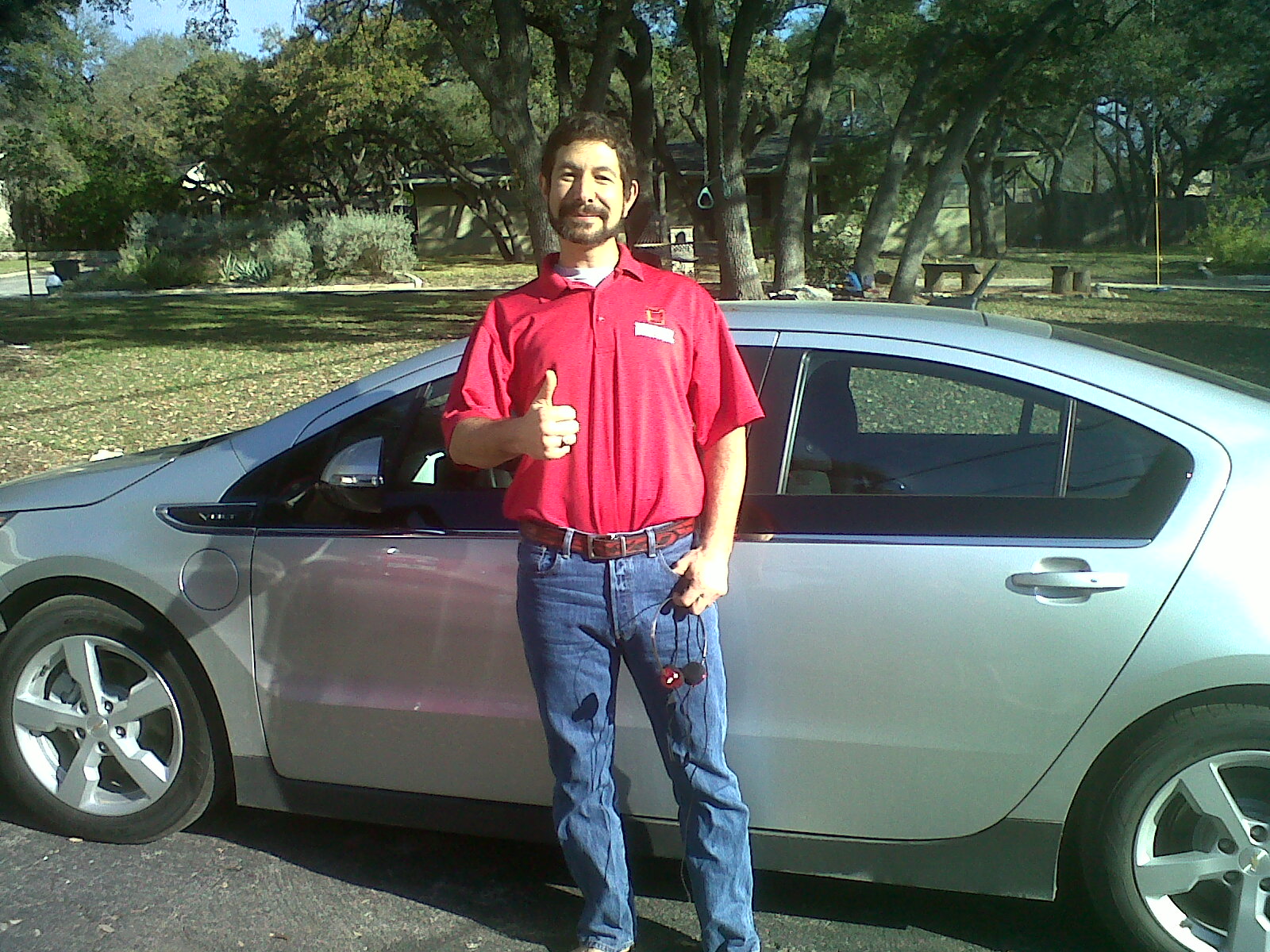
my volt and I

Today Chevy took my SXSW loaner Volt back to the dealership in the cloud.  While I was already inclined toward the Volt, I was much more impressed that I expected.  Frankly, the fact that the Volt and my home-conversion RAVolt both have a 30 mile range made the Volt seem like a pretend EV on the surface.  Yet, the Volt proved it was a full EV and more.

The Volt is a very solid electric car with the all torque and feel I was expecting.

Since the Volt was delivered without a charge, my first day in the car relied on the gas hybrid feature.  Even on gas, I was getting >40 MPG.  While I would have preferred to get the Volt fully charged, it was an important lesson for me to see it perform as a gas fueled car first.

Once I got it charged, I was able to drive nearly all my trips electric only.  That included my 30+ mile commute.  The magic of the Volt is that I never worried about running out of charge.  As an EV driver who has had close scrapes, that is a truly liberating experience.

I enjoyed playing with the Volt’s drive system.  I managed to find an accurate power input/output gauge on the dash instrumentation (the center console view is mainly a pretty animation for passengers).  I was able to extend my electric range using feedback from the more accurate gauge.  In addition, the built-in tutorial explained that I could use the PRNDL “low gear” in traffic.  Low gear activated behaviors in the Volt that made it more efficient AND EASIER to drive in traffic than conventional gas cars.  I was also intrigued by how efficiently the Volt used its gas generator – it used some smarts so the generator ran as little of possible.  Of course, I also enjoyed the acceleration of the electric motor 🙂

In addition to the power train, I found the fit and finish of the Volt to be very satisfying.  The electronics were effective, interior comfortable and handling responsive.  While it did not pretend to be a luxury car, the Volt does not feel like a econobox either.

One note: if you are considering a Volt then plan on a 220 charger.  Relying on charging from household power is simply not practical.  Using 220, you can charge quickly at night when power is cheapest/cleanest to generate.

Helping redefine “what is a car” on Chevy tours at SXSWi

I’m at SWSW as a guest of Chevy and enjoying the benefits of behind the scenes tours and access.  On Friday, the Volt team toured me and a collection of bloggers and journalists through the Pecan Street project and GM’s customer interaction center.

At one point, Colin Rowan compared the relatively long cell phone adoption (they first appeared  in 1973) to the likely ramp of electric cars and green homes.  Doug Moran from GearDiary pointed out the weakness of this comparison.  Cell phones are inexpensive with short life-cycles while cars are expensive durables.

However, Cell phones stopped being phones around 2007 when iPhone adoption exploded.  Smart phones are not phones – they are mobile platforms.  In fact, they are lousy phones when compared to cell phones.

Comparing electric cars to gas cars is more like comparing smart phones to dumb phones!

While both electric and gas cars can be used for transportation, electric cars have the potential to become energy transportation platforms.

You cannot use the energy stored in your car’s gas tank for anything but moving the car around.  Further, you can only get more gas from a very small set of vendors.

Electric cars are fundamentally different – the energy stored in the car’s batteries can be apply to nearly any application you want from transportation to lighting to computing to heating and refrigeration.  Further, you can get more energy for your car from nearly any source (local solar and wind or grid power).  For a hybrid like the Volt, the options are even broader because it includes gas to electricity generation.

From this perspective, electric cars are an energy mobility platform.

We need to accept that we are living in a world with unreliable power distribution due to weather, peak demand and/or carbon tax.   In this type of situation, cars with batteries are as fundamentally different from gas cars as smart phones are to rotary POTS phone.

PS: For more extra credit reading, check out the Vehicle to Grid concept

5 things keeping DevOps from playing well with others (Chef, Crowbar and Upstream Patterns)

Sharing can be hardSince my earliest days on the OpenStack project, I’ve wanted to break the cycle on black box operations with open ops. With the rise of community driven DevOps platforms like Opscode Chef and Puppetlabs, we’ve reached a point where it’s both practical and imperative to share operational practices in the form of code and tooling.

Being open and collaborating are not the same thing.

It’s a huge win that we can compare OpenStack cookbooks. The real victory comes when multiple deployments use the same trunk instead of forking.

This has been an objective I’ve helped drive for OpenStack (with Matt Ray) and it has been the Crowbar objective from the start and is the keystone of our Crowbar 2 work.

This has proven to be a formidable challenge for several reasons:

  1. diverging DevOps patterns that can be used between private, public, large, small, and other deployments -> solution: attribute injection pattern is promising
  2. tooling gaps prevent operators from leveraging shared deployments -> solution: this is part of Crowbar’s mission
  3. under investing in community supporting features because they are seen as taking away from getting into production -> solution: need leadership and others with join
  4. drift between target versions creates the need for forking even if the cookbooks are fundamentally the same -> solution: pull from source approaches help create distro independent baselines
  5. missing reference architectures interfere with having a stable baseline to deploy against -> solution: agree to a standard, machine consumable RA format like OpenStack Heat.

Unfortunately, these five challenges are tightly coupled and we have to progress on them simultaneously. The tooling and community requires patterns and RAs.

The good news is that we are making real progress.

Judd Maltin (@newgoliath), a Crowbar team member, has documented the emerging Attribute Injection practice that Crowbar has been leading. That practice has been refined in the open by ATT and Rackspace. It is forming the foundation of the OpenStack cookbooks.

Understanding, discussing and supporting that pattern is an important step toward accelerating open operations. Please engage with us as we make the investments for open operations and help us implement the pattern.

SXSWi bound thanks to GM & Chevy Volt

I’ll be blogging from SXSWi over the next few days as a guest of the Chevy Volt team AND they’ve given me a Volt to drive for the week (disclaimer: total cash value of $1150).  I’ve been in Austin for over 10 years and find it ironic that my electric car past gets me to event instead of my cloud or software work.  Either way, I’m delighted to attend.

RAVolt maiden 037Yes, I have electric car construction experience…

About 6 years ago before the first days of $4 gas, I took on the entrepreneurial/science project of converting an electric car (a 96 RAV4) to run on batteries.   The result proved clearly that there was no sustainable business in converting gas cars to electric because the mechanics are different enough to require purpose-built design.

My conversion project, the RAVolt, is still in daily use with over 3,000 electric miles.  I never intended it to be a show car – my goal was to be time and cash effective so it uses the most time-tested components: lead acid batteries, 18 hp elevator motor and a forklift DC control system.   With a 30 minute range, it has limited utility.

And now, I find myself in the market for a new car AND being given a Volt for the week.  The Volt was on my short list to consider (I drive a Honda Fit now) along with the Tesla S, Leaf and Smart.  This topic deserves it’s own post.

For the next few days, I’m going to wallow in the SXSWi nerdfest and enjoy experimenting with a production class electric car.  I will, of course, be sharing my experiences and observations about both here and on twitter.  Both are subjects of long-standing interest.

Disclaimer: Chevy has provided me with a SXSWi pass and Volt use ($1150 value).  They have asked for nothing in return and I have made no commitments for favorable comments.  Further, my employer, Dell, is aware of this arrangement with Chevy.  My opinions are my own.

Installing SSD + Windows8 = Blank Primary Monitor (fixable!)

2012-10-28_12-44-51_691I could not find the solution to this easily, so I’m leaving a breadcrumb trail here… I did not keep the links so I cannot give proper attribution but will try to pay it forward.

Short version: Try HDMI/VGA output if your Win8 primary monitor is blank.  Then update the BIOS.

Long version:

I decided to update my wife’s Dell Inspiron N5110 laptop to an SSD and Windows 8.  Sadly, the machine’s factory config had a very slow HDD and that was impacting the system’s total performance.  Replacing the HDD with an SSD required major surgery to the laptop – it is not for the faint of heart.

After installing the SSD and installing Windows 8 (painless!) the system booted though the splash screen and turned off the display.  Yes, it simply went completely blank.

I stumbled upon a tip that suggested that the system was working but using the HDMI output.  That proved correct.  I was able to complete the configuration using HDMI and/or VGA monitors.

Even after completing and updating the monitor (still blank) was clearly working because the BIOS screens and splash screen worked on the monitor.  Deleting the Video Card from Devices did NOT work.

Ultimately, I found a site that recommended updating the BIOS (was A09, now A11 from 11/2012).  The BIOS update corrected the problem.

I should have known to update the BIOS and firmware before starting the upgrade.  I hope you learn from my experience.

Oh…. the SSD+Win8 made an AMAZING performance difference.  It’s like a brand new 10x faster laptop and an excellent investment.  I’ve become a bit of a Linux appologist; however, I was pleasantly surprised to find Windows 8 to be very usable once I learned the latest hot-key assignments (Search on Win key -> Win+F).