Running with scissors > DefCore “must-pass” Road Show Starts [VIDEOS]

The OpenStack DefCore committee has been very active during this cycle turning the core definition principles into an actual list of “must-pass” capabilities (working page).  This in turn gives the community something tangible enough to review and evaluate.

Capabilities SelectionTL;DR!  We appreciate those in the community who have been patient enough to help define and learn the process we’re using the make selections; however, we also recognize that most people want to jump to the results.

This week, we started a “DefCore roadshow” with the goal of learning how to make this huge body of capabilities, process and impact easier to digest (draft write-up for review & Troy Toman’s notes).  So far we’ve had two great sessions on this topic.  We took notes and recorded at both meetups (San Francisco & Austin).

My takeaways of these initial meetups are:

  • Jump to the Capabilities right away, the process history is not needed up front
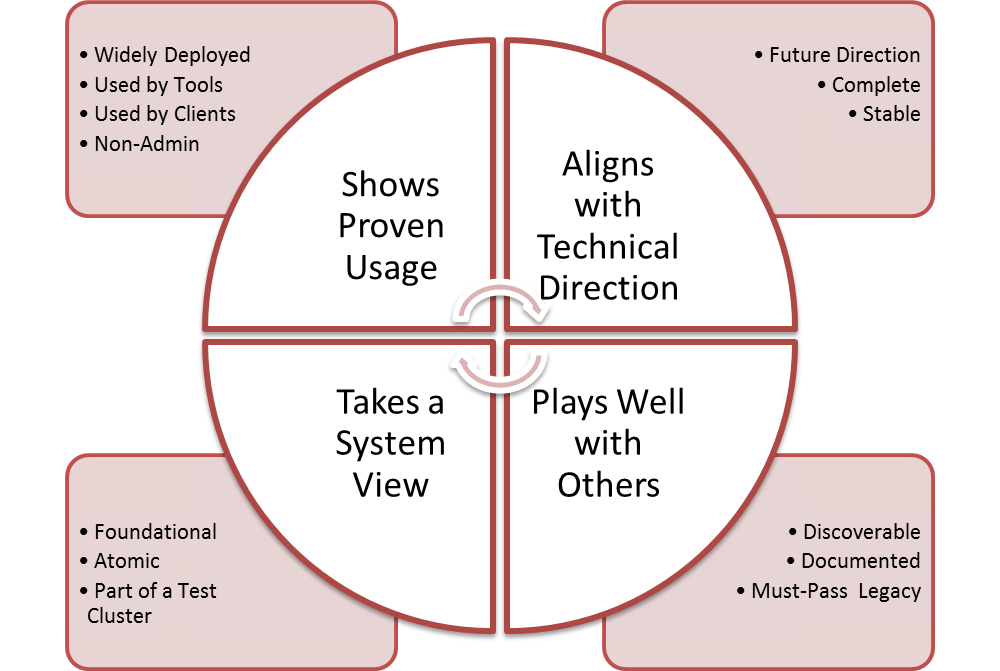
  • You need more graphics – specifically, one for the selection criteria (what do you think of my 1st attempt?)
  • Work from some examples of scored capabilities
  • Include some specific use-cases with a user, 2 types of private cloud and a public cloud to help show the impact

Overall, people like what they are hearing.  It makes sense and decisions are justified.

We need more feedback!  Please help us figure out how to explain this for the broader community.

OpenStack Board Elections: What I’ll do in 2014: DefCore, Ops, & Community

Rob HirschfeldOpenStack Community,

The time has come for you to choose who will fill the eight community seats on the Board (ballot links went out Sunday evening CST).  I’ve had the privilege to serve you in that capacity for 16 months and would like to continue.  I have leadership role in Core Definition and want to continue that work.

Here are some of the reasons that I am a strong board member:

  • Proven & Active Leadership on Board – I have been very active and vocal representing the community on the Board.  In addition to my committed leadership in Core Definition, I have played important roles shaping the Gold Member grooming process and trying to adjust our election process.  I am an outspoken yet pragmatic voice for the community in board meetings.
  • Technical Leader but not on the TC – The Board needs members who are technical yet detached from the individual projects enough to represent outside and contrasting views.
  • Strong User Voice – As the senior OpenStack technologist at Dell, I have broad reach in Dell and RedHat partnership with exposure to a truly broad and deep part of the community.  This makes me highly accessible to a lot of people both in and entering the community.
  • Operations Leadership – Dell was an early leader in OpenStack Operations (via OpenCrowbar) and continues to advocate strongly for key readiness activities like upgrade and high availability.  In addition, I’ve led the effort to converge advanced cookbooks from the OpenCrowbar project into the OpenStack StackForge upstreams.  This is not a trivial effort but the right investment to make for our community.
  • And there’s more… you can read about my previous Board history in my 2012 and 2013 “why vote for me” posts or my general OpenStack comments.

And now a plea to vote for other candidates too!

I had hoped that we could change the election process to limit blind corporate affinity voting; however, the board was not able to make this change without a more complex set of bylaws changes.  Based on the diversity and size of OpenStack community, I hope that this issue may no longer be a concern.  Even so, I strongly believe that the best outcome for the OpenStack Board is to have voters look beyond corporate affiliation and consider a range of factors including business vs. technical balance, open source experience, community exposure, and ability to dedicate time to OpenStack.

How are we picking the OpenStack DefCore “must pass” tests?

Fancy ElephantThis post comes with a WARNING LABEL… THE FOLLOWING SELECTION CRITERIA ARE PRELIMINARY TO GET FEEDBACK AND HELP VALIDATE THE PROCESS.
UPDATE 5/7/14 > see the OFFICIAL version.
ORIGINAL TEXT

As part of the DefCore work, we have the challenge of taking all the Tempest tests and figuring out which ones are the “must-pass” tests that will define core (our note pages).  We want to have a very transparent and objective process for picking the tests so we need to have well defined criteria and a selection process.

Figuring out the process will be iterative.  The list below represents a working set of selection criteria that are applied to the tests.  The DefCore committee will determine relative weights for the criteria after the tests have been scored because it was clear in discussion that not all of these criteria should have equal weight.
Once a test passes the minimum criteria score and becomes “must-pass” the criteria score does not matter – the criteria are only used for selecting tests. As per the Core principles, passing all “must-pass” test will be required to be considered core.
So what are these 13 preliminary criteria (source)?
1. Test is required stable for >2 releases (because things leaving Core are bad)
  • the least number/amount of must pass tests as possible (due to above)
  • but noting that the number will increase over time
  • least amount of change from current requirements as possible (nova, swift 2 versions)
  • (Acknowledge that deprecation is punted for now, but can be executed by TC)
2. Where the code being tested has an designed area of alternate implementation (extension framework) as per the Core Principles, there should be parity in capability tested across extension implementations
  • Test is not configuration specific (test cannot meet criteria if it requires a specific configuration)
  • Test does not require an non-open extension to pass (only the OpenStack code)
3. Capability being tested is Service Discoverable (can be found in Keystone and via service introspection) – MONTY TO FIX WORDING around REST/DOCS, etc.
  • Nearly core or “compatible” clouds need to be introspected to see what’s missing
  • Not clear at this point if it’s project or capability level enforced.  Perhaps for Elephant it’s project but it should move to capability for later
4A, 4B & 4C. Candidates are widely used capabilities
  • 4A favor capabilities that are supported by multiple public cloud providers and private cloud products
    • Allow the committee to use expert judgement to promote capabilities that need to resolve the “chicken-and-egg”
    • Goals are both diversity and quantity of users
  • 4B. Should be included if supported by common tools (Ecosystem products includes)
  • 4C. Should be included if part of common libraries (Fog, Apache jclouds, etc)
5. Test capabilities that are required by other must-pass tests and/or depended on by many other capabilities
6. Should reflect future technical direction (from the project technical teams and the TC)
  • Deprecated capabilities would be excluded (or phased out)
  • This could potentially become a “stick” if used incorrectly because we could force capabilities
7. Should be well documented, particularly the expected behavior.
  • includes the technical references for others in the project as well as documentation for the users and or developers accessing the feature or functionality
8. A test that is a must-pass test should stay a must-pass test (makes must-pass tests sticky release per release)
9. A test for a Capability with must-pass tests is more likely to be considered must-pass
10 Capabilities is unique and cannot be build out of other must-pass capabiliies
  • Candidates favor capabilities that users cannot implement if given the presence of other capabilities
  • consider the pain to users if a cloud doesn’t have the capability – not so much pain if they can run it themselves
  • “Unique capabilities that cannot be build out of other must-pass capabilities should not be considered as strongly”
11. Tests do not require administrative right to execute
We expect these criteria to change based on implementation experience and community input; however, we felt that further discussion without implementation was getting diminishing returns.  It’s import to remember that all of the criteria are not equal, they will have relative weights to help drive tune the results.
OpenStack Core Definition (DefCore) Progress in 6 key areas

DefCore Elephant Cycle

I’m excited to report about the OpenStack Board progress on defining OpenStack core.  At the Hong Kong summit, Joshua McKenty and I were asked to chair a new standing committee, now known as DefCore, to define “OpenStack Core” based on the core principles that we determined over the last 6 months (aka “the spider”).

Joshua and I took on the challenge with gusto and I’m proud to say that we’ve already made significant progress against an aggressive timeline to have the pilot must-pass tests for Havana defined before the Juno Summit in April 2014.  It’s important to remember that we’re moving from a project based definition of core to test-driven capabilities because this best addresses our interoperability objectives.

In the 8 weeks since the summit, we’ve had six very productive meetings (etherpads for Prep, DefCore.1, DefCore.2, Criteria 1 and 2) with detailed notes and recorded content. Here’s my summary of our results so far:

  1. An Aggressive Timeline for having pilot Havana must-pass tests approved by the Juno summit in May 2014.  That drives the schedule backward toward a preliminary list in March.  Once we have a pilot list for Havana, we expect to have Ice House done +90 days and Juno done at the Paris summit.

  2. Test Selection Criteria a preliminary set of 14 criteria (needs a stand alone post) that will be used to quantitatively score the current 700+ tests.  We also agreed to use a max 100 point weighting system for the criteria.  The weights and score requirement iteratively once we have done a first scoring pass.  Our objective is to make must-pass test selection as objective and transparent as possible (post with details).

  3. Distinction between Capability & Test is important because we recognize that individual tests may validate multiple capabilities and individual capabilities may have multiple tests.  Our hope is to present the results in terms of capabilities not individual tests.

  4. Holding Off on Bylaws Changes needed to clarify how OpenStack manage core definition.  It was widely expected that the DefCore committee would have to make changes to the OpenStack bylaws; however, we believe we can proceed without rushing changes.  We have an active subcommittee preparing changes in advance of the next DefCore cycle.

  5. Program vs. Project Definition efforts are needed to help take pressure off requests to have “projects promoted to core status” and how the OpenStack trademark is used for projects.  We are trying to clarify OpenStack Programs (e.g.: OpenStack™ Compute) carry to the trademark while OpenStack Projects (e.g.: Nova and Glace) are members of those programs and do not carry the OpenStack trademark directly.  Consequently, we’d expect people to say “OpenStack Compute Project Nova” instead of “OpenStack Nova.”  This approach addresses several issues that impact DefCore Board activities around trademark, core and brand.

  6. RefStack Development and Use Cases provide the framework for community reporting of test results.  We consider this infrastructure critical to getting community input about must-pass tests and also sharing interoperability information.  This effort is just beginning and needs help from the community.

For all this progress, we are only starting!  We’ve cleared the blocks preventing implementation and that will expose a new set issues to discuss.  Look for us to start applying the criteria to tests in the next months.  That will quickly expose the strengths and weaknesses of our criteria set.  We’ve also got to make progress on Program vs. Project and start RefStack coding.

We want community participation!  Please let us know what you think.