12 Predictions for ’16: mono-cloud ambitions die as containers drive more hybrid IT

I expect 2016 to be a confusing year for everyone in IT.  For 2015, I predicted that new uses for containers are going to upset cloud’s apple cart; however, the replacement paradigm is not clear yet.  Consequently, I’m doing a prognostication mix and match: five predictions and seven items on a “container technology watch list.”

TL;DR: In 2016, Hybrid IT arrives on Containers’ wings.

Considering my expectations below, I think it’s time to accept that all IT is heterogeneous and stop trying to box everything into a mono-cloud.  Accepting hybrid as current state unblocks many IT decisions that are waiting for things to settle down.

Here’s the memo: “Stop waiting.  It’s not going to converge.”

2016 Predictions

  1. Container Adoption Seen As Two Stages:  We will finally accept that Containers have strength for both infrastructure (first stage adoption) and application life-cycle (second stage adoption) transformation.  Stage one offers value so we will start talking about legacy migration into containers without shaming teams that are not also rewriting apps as immutable microservice unicorns.
  2. OpenStack continues to bump and grow.  Adoption is up and open alternatives are disappearing.  For dedicated/private IaaS, OpenStack will continue to gain in 2016 for basic VM management.  Both competitive and internal pressures continue to threaten the project but I believe they will not emerge in 2016.  Here’s my complete OpenStack 2016 post?
  3. Amazon, GCE and Azure make everything else questionable.  These services are so deep and rich that I’d question anyone who is not using them.  At least one of them simply have to be part of everyone’s IT strategy for financial, talent and technical reasons.
  4. Cloud API becomes irrelevant. Cloud API is so 2011!  There are now so many reasonable clients to abstract various Infrastructures that Cloud APIs are less relevant.  Capability, interoperability and consistency remain critical factors, but the APIs themselves are not interesting.
  5. Metal aaS gets interesting.  I’m a big believer in the power of operating metal via an API and the RackN team delivers it for private infrastructure using Digital Rebar.  Now there are several companies (Packet.net, Ubiquity Hosting and others) that offer hosted metal.

2016 Container Tech Watch List

I’m planning posts about all these key container ecosystems for 2016.  I think they are all significant contributors to the emerging application life-cycle paradigm.

  1. Service Containers (& VMs): There’s an emerging pattern of infrastructure managed containers that provide critical host services like networking, logging, and monitoring.  I believe this pattern will provide significant value and generate it’s own ecosystem.
  2. Networking & Storage Services: Gaps in networking and storage for containers need to get solved in a consistent way.  Expect a lot of thrash and innovation here.
  3. Container Orchestration Services: This is the current battleground for container mind share.  Kubernetes, Mesos and Docker Swarm get headlines but there are other interesting alternatives.
  4. Containers on Metal: Removing the virtualization layer reduces complexity, overhead and cost.  Container workloads are good choices to re-purpose older servers that have too little CPU or RAM to serve as VM hosts.  Who can say no to free infrastructure?!  While an obvious win to many, we’ll need to make progress on standardized scale and upgrade operations first.
  5. Immutable Infrastructure: Even as this term wins the “most confusing” concept in cloud award, it is an important one for container designers to understand.  The unfortunate naming paradox is that immutable infrastructure drives disciplines that allow fast turnover, better security and more dynamic management.
  6. Microservices: The latest generation of service oriented architecture (SOA) benefits from a new class of distribute service registration platforms (etcd and consul) that bring new life into SOA.
  7. Paywall Registries: The important of container registries is easy to overlook because they seem to be version 2.0 of package caches; however, container layering makes these services much more dynamic and central than many realize.  (more?  Bernard Golden and I already posted about this)

What two items did not make the 2016 cut?  1) Special purpose container-focused operating systems like CoreOS or RancherOS.  While interesting, I don’t think these deployment technologies have architectural level influence.  2) Container Security via VMs. I’m seeing patterns where containers may actually be more secure than VMs.  This is FUD created by people with a vested interest in virtualization.

Did I miss something? I’d love to know what you think I got right or wrong!
2015 Container Review

It’s been a banner year for container awareness and adoption so we wanted to recap 2015.  For RackN, container acceleration is near to our heart because we both enable and use them in fundamental ways.   Look for Rob’s 2016 predictions on his blog.

The RackN team has truly deep and broad experience with containers in practical use.  In the summer, we delivered multiple container orchestration workloads including Docker Swarm, Kubernetes, Cloud Foundry, StackEngine and others.  In the fall, we refactored Digital Rebar to use Docker Compose with dramatic results.  And we’ve been using Docker since 2013 (yes, “way back”) for ops provisioning and development.

To make it easier to review that experience, we are consolidating a list of our container related posts for 2015.

General Container Commentary

RackN & Digital Rebar Related

My OpenStack 2016 Analysis: Continue Core, Stop Confusing Ecosystem, Change Hybrid Approach

Note: I’ve served on the OpenStack Foundation board since its formation.  There I’ve led the “define the core” DefCore efforts.  I’m on the 2016 ballot for another term.

I love using end-of-year posts to reflect (2015, I got 6 of 7!) and try to set direction (OpenStack needed to prioritize).  This year, I wanted to use a simple “Continue, Stop, Change” format that I’ve used for employee reviews in the past.  These three items reflect how I think OpenStack needs to respond to the industry in 206.

Continue: Focus on Core

OpenStack adoption continues around the legacy projects that traditionally define it for most users.  A lot of work and focus is needed around those projects including better representation of user, operator and product interests.

Towards that end, we’ve made amazing progress on DefCore implementation and I’m excited about the discussions that it’s been generating.  It’s driving pragmatic decisions about what is required (running a vm?) and how to verify compliance.  It’s also driving conceptual thinking around OpenStack principles and ecosystem priorities.

DefCore’s focus on using community tests to define OpenStack creates a very concrete and defensible standard.  Ultimately, it comes back to users and operators demanding compliance for the work to remain meaningful.

Overall, To focus on core function, OpenStack needs to empower new groups within the community.  Expanding the role of the Product Group, Operators, and User Committee are key to giving a voice to these constituents.

OpenStack core must transition into a consistent platform or it risks becoming irrelevant.

Stop: Confusing The Ecosystem

I’m concerned about the “big tent” governance change puts OpenStack into conflict with both community vendors and the larger cloud market.  I believe we’re creating an echo chamber of OpenStack on OpenStack focus that forces adjacent efforts (like software defined network, storage and container orchestration) to be either inside or outside the community circle.  While that artificially grows the apparent contributor base, it creates artificial walls between OpenStack and the dominate cloud platforms.

Let me illustrate using my own company, RackN.  We create cross-platform devops orchestration based on an open source project, Digital Rebar.  We consider ourselves to be part of the OpenStack community and have supported deploying the core.  We also provision bare metal and deploy Kubernetes, Docker Swarm and Cloud Foundry.  That has apparent conflicts with big tent Ironic and Magnum projects.  Does that make RackN competitive with OpenStack or not?

It hurts OpenStack when competitive alignment is unclear because vendors, users and operators are uncertain about where to make investments.  In the end, users will choose simpler alternatives.

I believe the Board needs to define the OpenStack ecosystem strategy in a clear and actionable way.  If re-elected, that will be my Board priority for 2016.

Change: Hybrid Approach

My top 2016 prediction (post coming) is that we accept “hybrid IT as the new normal.”  That means that we stop driving towards an IT mono-culture and start working towards tools that embrace heterogeneity.  Along those lines, OpenStack needs to evaluate our relative position and strengths in a hybrid cloud landscape.

Interoperability between OpenStack implementations is important because it reduces friction; however, we need to expand our thinking to ensure interoperability with other platforms.  That does not mean simply cloning the AWS APIs!  It means that we need to consider users and operator needs against a spectrum of private and public infrastructures.

A broader hybrid approach also suggests that duplicating cloud-locked adjacent services (e.g. Cloud Formation vs. Heat) does not address user needs.

I am advocating that OpenStack encourage a cloud-neutral ecosystem, outside of the OpenStack tent, that work across a wide range of platforms.  That leads to user choice and creates a truly open platform. 

And, of course, more Community Discussion!

I want to thank the many people who participated in a heated twitter discussion in advance of this post.  There are many great ideas and counter-points covered in that lengthy dialog.

Do you have an opinion about what to OpenStack should stop, accelerate or change?  I’d love to hear it!

¡Sí, Sí! That’s a Two Hundred Node Metal Docker Swarm Deployment

Today, RackN and Ubiquity Hosting announced a 200 node Docker Swarm deployment on hosted bare metal.

Leveraging the current Digital Rebar core and the RackN Swarm workload, this reference deployment was automatically configured using the same components that also work on a desktop VM deployment. That high fidelity deployment allows operators to start learning quickly on small systems then grow to AWS and if warranted, potentially smoothly transition to scale metal.

This deployment represents RackN starting a new chapter with Digital Rebar because it demonstrates a commitment deploy on any infrastructure: cloud, metal or something in between.

The RackN team started this journey with a “composable ops” vision that allows operators to mix and match. That spans both vendor physical resources and software components such as operating systems, software defined networking and platforms. In the 200 node Swarm cluster, physical infrastructure is provisioned by Ubiquity Hosting not Digital Rebar or RackN.  Historically, RackN focused on private infrastructure.  Now, users get the option of best-in-class metal deployment without having to own the infrastructure.

We experienced the futility of making Ops homogeneous and declared defeat.

Accepting that each data center has individual Ops was pivotal. Digital Rebar embraces heterogeneity at the most fundamental architectural level. Our system approach and unique composable abstractions allow users to make deployments portable between any infrastructure with existing tooling and operational processes. Portability means that we can both eliminate the fidelity gap as we scale and between deployments.

When multiple scales and sites can share deployment automation, we can finally work together on addressing critical operational issues like scale, high availability and upgrade

This 200 node deployment demonstrates more than scale and the deployment of the latest Docker technology. It is a milestone on the path toward sharable production operations.

Operators, they don’t want to swim Upstream

Operators Dinner 11/10

Nov 10, Palo Alto Operators Dinner

Last Tuesday, I had the honor of joining an OpenStack scale operators dinner. Foundation executives, Jonathan Bryce and Lauren Sell, were also on the guest list so talk naturally turned to “how can OpenStack better support operators.” Notably, the session was distinctly not OpenStack bashing.

The conversation was positive, enthusiastic and productive, but one thing was clear: the OpenStack default “we’ll fix it in the upstream” answer does not work for this group of operators.

What is upstreaming?  A sans nuance answer is that OpenStack drives fixes and changes in the next community release (longer description).  The project and community have a tremendous upstream imperative that pervades the culture so deeply that we take it for granted.  Have an issue with OpenStack?  Submit a patch!  Is there any other alternative?

Upstreaming [to trunk] makes perfect sense considering the project vendor structure and governance; however, it is a very frustrating experience for operators.   OpenStack does have robust processes to backport fixes and sustain past releases and documentation; yet, the feeling at the table was that they are not sufficiently operator focused.

Operators want fast, incremental and pragmatic corrections to the code and docs they are deploying (which is often two releases back).  They want it within the community, not from individual vendors.

There are great reasons for focusing on upstream trunk.  It encourages vendors to collaborate and makes it much easier to add and expand the capabilities of the project.  Allowing independent activity on past releases creates a forward integration mess and could make upgrades even harder.  It will create divergence on APIs and implementation choices.

The risk of having a stable, independently sustained release is that operators have less reason to adopt the latest shiny release.  And that is EXACTLY what they are asking for.

Upstreaming is a core value to OpenStack and essential to our collaborative success; however, we need to consider that it is not the right answer to all questions.  Discussions at that dinner reinforced that pushing everything to latest trunk creates a significant barrier for OpenStack operators and users.

What are your experiences?  Is there a way to balance upstreaming with forking?  How can we better serve operators?

More Signal & Less Noise: my OpenStack Tokyo Restrospective

We’re building real business on OpenStack. This seems especially true in Asia where the focus is on using the core not expanding it. At the same time, we’ve entered the “big tent” era where non-core projects are proliferating.

Let’s explore what’s signal and what’s noise … but before we start, here are quick links to my summit videos:

wpid-20151030_100229.jpg

OpenStack summits are really family reunions. While aunt and uncles (Vendors) are busying showing off, all the cousins (Projects) are getting re-acquainted. Like any family it’s fun, competitive, friendly and sometimes dysfunctional.

Signal: Global Users and Providers

There are real deployments of OpenStack and real companies building businesses around the code base. I’ve been pleasantly surprised by the number of people quietly making OpenStack work. Why quietly? It’s still more of a struggle than it should be.

Signal: Demand for Heterogeneous and Interop Environments

There’s no such thing as a mono-lithic cloud. Even within the community, Monty’s Shade API normalizer, is drawing attention. More broadly, everyone is using multiple cloud platforms and the trend accelerates due to container portability.

Signal: Container Workloads

Containers are dominating the cloud discussion for good reasons. They are pushing into OpenStack at the top (Platform), bottom (Deployment) and side (Scheduler). While OpenStack must respond architecturally, it’s not clear yet if it can pivot from virtualization focused to something broader fast enough (Mesos?).

Signal: Ansible

The lightweight DevOps tool seems to be winning the popularity contest. It may not be the answer to all problems, but it’s clearly part of helping solve a lot of them. Warning: Ansible complexity explodes on multi-tiered, scale and upgrade orchestration.

Signal: DefCore and Product Working Group (PWG)

Both efforts have crossed from a concept into decision-making bodies within the community. The work is far from over. DefCore needs users to demand compliance from vendors. Product WG needs developers to demand their management sign on to PWG roadmaps.

Noise: Distro vs Service Argument

There are a lot of ways to consume OpenStack. None of them are wrong but some are more aligned with individual vendor strategies than others. Saying one way to run OpenStack is more right is undermining our overall operability and usability objectives.

Noise: Contributor Metrics

We’ve created a very commit economy and summits are vendors favorite time to brag about their dedication to community via upstreaming. These metrics are incomplete at best and potentially destructive to the health of the project as vendors compete to win the commit race instead of the quality and ecosystem race.

Noise: Big Tent

We’ve officially entered the “big tent” era of OpenStack. This governance change was lead by the Technical Committee to address how we manage projects; however, there are broader user, operator, vendor and ecosystem implications. Unfortunately, even within the community, the platform implications of a loosely governed, highly inclusive community not completely understood.

Overall, I left Tokyo enthusiastic about OpenStack’s future as a platform and community; however, I also see that we have not structured how we mingle platform, community and ecosystem. This is especially true because OpenStack is just a part in the much broader cloud market and work outside OpenStack is continue to disrupt our plans. As a Board member, I’ll hoping to start a discussion about this and want to hear your opinions.

To avoid echo chamber, OpenStack must embrace competitive cloud ecosystem

wpid-20151023_100533.jpg
Japanese Bullet Train View

I was in Japan before the Tokyo summit on a bullet train to Kyoto watching the mix of heavy industry and bucolic mountains pass by. That scene reflects an OpenStack duality: we want to be both a dominant platform delivering core cloud services and an open source values driven collective.

First, I fundamentally believe in the success of OpenStack as the open virtual infrastructure management platform.

I believe that we have solved the virtual compute/storage/network problem sufficiently to become the de facto open IaaS platform. While not perfect, the technologies are sufficient assuming we continue to improve ease of use and operational hardening. Pursing that base capability is my primary motivation for DefCore work.

I don’t believe that the OpenStack community is, or should try to become, the authority on “all things cloud.”

In the presence of Amazon, VMware, Microsoft and Google, we cannot make that claim with any degree of self-respect. Even newcomers like DigitalOcean have an undeniable footprint and influence. Those vendor platforms drive cloud ecosystems and technologies which foster fast innovation because there is no friction to joining their ecosystems and they are sufficiently large and stable enough to represent a target market. We’ve seen clear signs from Rackspace, HP and others that platform diversity improves cloud strength.

I continue to think we (OpenStack) spend too much time evaluating what is “in” or “out” of the project and too little time talking about what’s “on,” “under” and “with” the project like Kubernetes, Mesos, Docker, SDN, Hadoop and Ceph. That type of thinking creates distance between OpenStack efforts and the majority of the market.

What motivates the drive to an all open captive community? It’s the reasonable concern that critical parts of the infrastructure will become pay-to-play. For example, what if a non-OpenStack alternative to Heat Orchestration gained popularity for OpenStack implementers. Perhaps something that ran on Amazon also. That would create external pressure that would drive internal priorities. These “non-OpenStack” products would then have influence without having to contribute back to upstream.

Can we afford to have external entities driving internal priorities? Hell yes, that’s what customer adoption looks like.

OpenStack does not own the market sufficiently to create cloud echo chamber. The next wave of cloud innovation (my money is on container platforms) will follow the path of least resistance and widest adoption. We need to embrace that these innovations will not all be inside our community so that we can welcome them as part of our ecosystem. The community needs to find peace with that.

Faster, Simpler AND Smaller – Immutable Provisioning with Docker Compose!

Nearly 10 TIMES faster system resets – that’s the result of fully enabling an multi-container immutable deployment on Digital Rebar.

Docker ComposeI’ve been having a “containers all the way down” month since we launched Digital Rebar deployment using Docker Compose. I don’t want to imply that we rubbed Docker on the platform and magic happened. The RackN team spent nearly a year building up the Consul integration and service wrappers for our platform before we were ready to fully migrate.

During the Digital Rebar migration, we took our already service-oriented code base and broke it into microservices. Specifically, the Digital Rebar parts (the API and engine) now run in their own container and each service (DNS, DHCP, Provisioning, Logging, NTP, etc) also has a dedicated container. Likewise, supporting items like Consul and PostgreSQL are, surprise, managed in dedicated containers too. All together, that’s over nine containers and we continue to partition out services.

We use Docker Compose to coordinate the start-up and Consul to wire everything together. Both play a role, but Consul is the critical glue that allows Digital Rebar components to find each other. These were not random choices. We’ve been using a Docker package for over two years and using Consul service registration as an architectural choice for over a year.

Service registration plays a major role in the functional ops design because we’ve been wrapping datacenter services like DNS with APIs. Consul is a separation between providing and consuming the service. Our previous design required us to track the running service. This worked until customers asked for pluggable services (and every customer needs pluggable services as they scale).

Besides being a faster to reset the environment, there are several additional wins:

  1. more transparent in how it operates – it’s obvious which containers provide each service and easy to monitor them as individuals.
  2. easier to distribute services in the environment – we can find where the service runs because of the Consul registration, so we don’t have to manage it.
  3. possible to have redundant services – it’s easy to spin up new services even on the same system
  4. make services pluggable – as long as the service registers and there’s an API, we can replace the implementation.
  5. no concern about which distribution is used – all our containers are Ubuntu user space but the host can be anything.
  6. changes to components are more isolated – changing one service does not require a lot of downloading.

Docker and microservices are not magic but the benefits are real. Be prepared to make architectural investments to realize the gains.

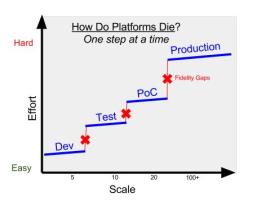
How do platforms die? One step at a time [the Fidelity Gap]

The RackN team is working on the “Start to Scale” position for Digital Rebar that targets the IT industry-wide “fidelity gap” problem.  When we started on the Digital Rebar journey back in 2011 with Crowbar, we focused on “last mile” problems in metal and operations.  Only in the last few months did we recognize the importance of automating smaller “first mile” desktop and lab environments.

A fidelityFidelity Gap gap is created when work done on one platform, a developer laptop, does not translate faithfully to the next platform, a QA lab.   Since there are gaps at each stage of deployment, we end up with the ops staircase of despair.

These gaps hide defects until they are expensive to fix and make it hard to share improvements.  Even worse, they keep teams from collaborating.

With everyone trying out Container Orchestration platforms like Kubernetes, Docker Swarm, Mesosphere or Cloud Foundry (all of which we deploy, btw), it’s important that we can gracefully scale operational best practices.

For companies implementing containers, it’s not just about turning their apps into microservice-enabled immutable-rock stars: they also need to figure out how to implement the underlying platforms at scale.

My example of fidelity gap harm is OpenStack’s “all in one, single node” DevStack.  There is no useful single system OpenStack deployment; however, that is the primary system for developers and automated testing.  This design hides production defects and usability issues from developers.  These are issues that would be exposed quickly if the community required multi-instance development.  Even worse, it keeps developers from dealing with operational consequences of their decisions.

What are we doing about fidelity gaps?  We’ve made it possible to run and faithfully provision multi-node systems in Digital Rebar on a relatively light system (16 Gb RAM, 4 cores) using VMs or containers.  That system can then be fully automated with Ansible, Chef, Puppet and Salt.  Because of our abstractions, if deployment works in Digital Rebar then it can scale up to 100s of physical nodes.

My take away?  If you want to get to scale, start with the end in mind.

Introducing Digital Rebar. Building strong foundations for New Stack infrastructure

digital_rebarThis week, I have the privilege to showcase the emergence of RackN’s updated approach to data center infrastructure automation that is container-ready and drives “cloud-style” DevOps on physical metal.  While it works at scale, we’ve also ensured it’s light enough to run a production-fidelity deployment on a laptop.

You grow to cloud scale with a ready-state foundation that scales up at every step.  That’s exactly what we’re providing with Digital Rebar.

Over the past two years, the RackN team has been working on microservices operations orchestration in the OpenCrowbar code base.  By embracing these new tools and architecture, Digital Rebar takes that base into a new directions.  Yet, we also get to leverage a scalable heterogeneous provisioner and integrations for all major devops tools.  We began with critical data center automation already working.

Why Digital Rebar? Traditional data center ops is being disrupted by container and service architectures and legacy data centers are challenged with gracefully integrating this new way of managing containers at scale: we felt it was time to start a dialog the new foundational layer of scale ops.

Both our code and vision has substantially diverged from the groundbreaking “OpenStack Installer” MVP the RackN team members launched in 2011 from inside Dell and is still winning prizes for SUSE.

We have not regressed our leading vendor-neutral hardware discovery and configuration features; however, today, our discussions are about service wrappers, heterogeneous tooling, immutable container deployments and next generation platforms.

Over the next few days, I’ll be posting more about how Digital Rebar works (plus video demos).