Last week, Cloud Technology Partner VP Mike Kavis (aka MadGreek65) and I talked for 30 minutes about current trends in Hybrid Infrastructure and Containers.

Mike Kavis
Three of the top questions that we discussed were:
- Why Composability is required for deployment? [5:45]
- Is Configuration Management dead? [10:15]
- How can containers be more secure than VMs? [23:30]
Here’s the audio matching the time stamps in my notes:
- 00:44: What is RackN? – scale data center operations automation
- 01:45: Digital Rebar is… 3rd generation provisioning to manage data center ops & bring up
- 02:30: Customers were struggling on Ops more than code or hardware
- 04:00: Rethinking “open” to include user choice of infrastructure, not just if the code is open source.
- 05:00: Use platforms where it’s right for users.
- 05:45: Composability – it’s how do we deal with complexity. Hybrid DevOps
- 06:40: How do we may Ops more portable
- 07:00: Five components of Hybrid DevOps
- 07:27: Rob has “Rick Perry” Moment…
- 08:30: 80/20 Rule for DevOps where 20% is mixed.
- 10:15: “Is configuration management dead” > Docker does hurt Configuration Management
- 11:00: How Service Registry can replace Configuration.
- 11:40: Reference to John Willis on the importance of sequence.
- 12:30: Importance of Sequence, Services & Configuration working together
- 12:50: Digital Rebar intermixes all three
- 13:30: The race to have orchestration – “it’s always been there”
- 14:30: Rightscale Report > Enterprises average SIX platforms in use
- 15:30: Fidelity Gap – Why everyone will hybrid but need to avoid monoliths
- 16:50: Avoid hybrid trap and keep a level of abstraction
- 17:41: You have to pay some “abstraction tax” if you want to hybrid BUT you can get some additional benefits: hybrid + ops management.
- 18:00: Rob gives a shout out to Rightscale
- 19:20: Rushing to solutions does not create secure and sustained delivery
- 20:40: If you work in a silo, you loose the ability to collaborate and reuse other works
- 21:05: Rob is sad about “OpenStack explosion of installers”
- 21:45: Container benefit from services containers – how they can be MORE SECURE
- 23:00: Automation required for security
- 23:30: How containers will be more secure than containers
- 24:30: Rob bring up “cheese” again…
- 26:15: If you have more situational
 awareness, you can be more secure WITHOUT putting more work for developers.
 - 27:00: Containers can help developers worry about as many aspects of Ops
- 27:45: Wrap up
What do you think? I’d love to hear your opinion on these topics!
 2016 is the year we break down the monoliths. We’ve spent a lot of time talking about monolithic applications and microservices; however, there’s an equally deep challenge in ops automation.
 I’ve struggled with the term “underlay” for infrastructure of a long time. At
  I believe that application should drive the infrastructure, not the reverse. I’ve heard may times that the “infrastructure should be invisible to the user.” Unfortunately, lack of abstraction and composibility make it difficult to code across platforms. I like the term “
 So, what is open infrastructure? It’s not about running on open source software. It’s about creating platform choice and control. In my experience, that’s what defines open for users (and developers are not users).
 Over the last two months, the RackN team redefined “heterogeneous” infrastructure in
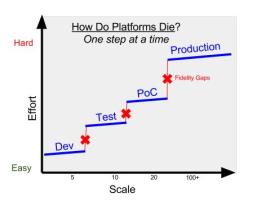 gap is created when work done on one platform, a developer laptop, does not translate faithfully to the next platform, a QA lab. Since there are gaps at each stage of deployment, we end up with the ops staircase of despair.
 Rob Hirschfeld