The Tao of Agile: focus on delivery while still dreaming BIG

This post is a continuation of the Agile Strategy post.

So, how do we get into the right frame of mind for roadmapping?

You must embrace the Tao of Planning.

There are two conflicting principles behind roadmapping: you must keep thinking out of the box while keeping work deliverable. Neither of these principles is difficult in isolation. The challenge is the keep them in balance and to make sure that the whole team is included.

For my team, we struggle to find group times when we can do some big thinking. The challenge is not the thinking – it’s the TEAM aspect of working on strategy together. Our sprint planning needs to focus on the “keeping work deliverable” objective; consequently, there is precious little time in planning to have big ideas. To make the meeting duration manageable, planning meetings should have a tactical focus. Unfortunately, that leaves a strategy gap.

So, where does a team go to dream?

I wish I had a clear answer to this problem. Ideally, sprint review meetings should extend into deep thinking about where things could go. Strategy during Review is a natural extension because a review mindset should be forward looking. Reviews help us think about how we’re going to use what we delivered and the audience should bring external perspectives. If we could do this then it would be very empowering and exciting during review.

That’s why it’s important to celebrate, play, reflect and pause. All work and no play leaves a team that makes very dull products

Note: the Agile decorations that I use are: Sprint Planning (commits that plan) -> Stand-up (daily sync meeting -> Review (demo/sprint close) -> Retrospective / Hats (team feedback, improvement).
Agile takes discipline: having a strategy means saying “no” more than saying “yes”

With the Crowbar release behind us, it’s time for my team at Dell to do some Capital “P” Planning. Planning for us includes both tactical (next release) and strategic (the releases beyond the one after next), but each type of planning looks very different. I’m going to call it “roadmapping” because planning means something specific and tactical in Agile.

I love roadmapping but I’m a pain to roadmap with because I’m a ruthless prioritizer.

When I sit down for roadmapping, I always do it from a 1 to N list without ties. That means that when marketing asks for a new feature (double the foo on the bar!) we put it on the list relative to other work that needs to get done. If you add something at the top then something else will fall off the bottom. Effectively, we’re using the list to say no to a lot of great ideas. This is essential because “the great is the enemy of the good (Voltaire).” It’s hard, but that’s the cold reality of delivering product.

The most important part of strategy is figuring out what to push down to make room for the precious few yes items.

Successful roadmapping is negotiating the splitting of big ideas into smaller ones. Decomposition is a circular process because one compromise may require another, but one change may force a cascading assumption fault. If you get too emotionally committed to one feature or subset then you’re going to slow down the process. It’s vital to approach roadmapping in free fall.

As always, my advice is to not mix meeting objectives. If you need more strategy then you’ve got to make time for it.

Interested in more…stay tuned for Agile Tao: balancing tactics & strategy

How we use Rally for Agile: it’s about going off the reservation to Rob some Banks.

Dell’s corporate choice of Agile Planning tool is Rally (if you’re wondering, my recommendation on Agile planning tools is ThoughtWorks’ Mingle). This post is rather detailed about how we use Rally, but hopefully useful more broadly. I should mention that I’ve been using Rally since 2005, so I know the tool pretty well. Our objective is to not spend time maintaining Rally (or, as we call it “feeding the Rally Monkey”) while still getting usable burn downs for our releases.
We do NOT use Rally to plan very more than 2 iterations in advance. Even if the tool made planning further easy, I would still recommend against it. I feel strongly that it’s better to have generally defined stories (aka Features or Epics) with general estimates that we call “BANKS.” Our work process is to create a wiki page for each feature that contains information about the goals for the feature and holds documentation for it as the work progresses. The wiki becomes the persistent place for the story, not our planning tool. We even embed [[wiki names]] into the story names to simplify linking.

Our planning process works like this: we create a placeholder story for each feature that we want and attach it to the release that we are working on. These features get a “BANK” suffix because they are the place holder and we put the story point estimate into these stories. You can ALWAYS see the remaining effort estimates by looking at the BANK stories remaining for the sprint. These banks are never assigned to a sprint – they are our backlog. We also maintain the priority order for these banks so we know which ones to work on first.

Before planning, marketing and engineering review the list together and make sure that our priorities are correct. If a story is finished, then we’ll accept the story. If an estimate changes, we may increase it. We NEVER lower the estimates unless the work scope changes! Reducing estimates create graphing artifacts in Rally. If we finish early, then the story is accepted and we burn off the remaining points (which shows as a progress jump towards completing the release).

On planning day, we go to the backlog and pick out the highest priority bank story. We then create another story with the same [[wiki name]] feature in the title and without the BANK suffix. We estimate the story points for this effort and remove that amount from the BANK story. Doing this credit/debit entry ensures that the release estimate remains the same. REPEATING: by removing points from the BANK story when we create a story for work in the sprint we keep the release estimate the same. This is VERY IMPORTANT if you want to show a burn up without creating a lot of stories in advance. Creating detailed stories in advance is a huge waste of time (queue the sound of a giant time sucking vortex vacuum machine). If you are doing this, stop. Really, you can stop because it is a huge waste of time on the scale of passing budget legislation in Congress.

In Rally, we do ALL of our sprint planning from the Track…Releases page (filter set to “defined” stories). This allows us to quickly see and edit the BANK stories that are in our backlog. When we want to talk about requirements or acceptance criteria, we pop over to the feature wiki page. This makes sure that we collect information across sprints. It also allows us to cross reference easily. The new stories are assigned to the sprint and we assign tasks/people to the story. We’ll continue this until we’ve assigned 100% of our team’s velocity for the sprint. At that point, we review the story point estimates and make sure that our time estimate aligns with the points (for us, 1 point ≈ 4 days). If they don’t match then we’ll adjust BOTH the story and the bank so the total is maintained.

If this sounds complicated then you’re reading it correctly. I’ve found this approach is much clearer, faster and simpler than the “right” way to do backlog planning with Rally. At the end of the sprint we accept stories and it shows a release burn up. If a BANK goes to zero then the release scope will show an increase every time we create a new story towards that feature. We do not delete BANK, we only accept them. If you’re BANK is 0 and the feature is not complete then your estimate was wrong. That is good information to track and the increasing in release scope is an accurate reflection of your backlog.

Wow – this post ended up with a lot of very technical Rallyisms. I’d be interested in hearing how you’re using the tool or what you think of these recommendations.

Big Questions? Big Answers with Dell BigData solution (plus Crowbar gets RHEL)

In my enthusiasm for all things Dell + OpenStack, I have neglected to talk about my team’s interesting Big Data work with Apache Hadoop.  Hadoop is a suite of open source projects for analyzing large data sets of unstructured data.  Initially, Hadoop centered around use of the map-reduce algorithm; however, it’s grown way beyond that as the community has worked to solve problems related to data storage, discovery, and scheduling.

Big Data clouds are well suited to my team because the model (non-redundant/cloud) and scale (hyper) of their deployments.  It should be no surprise that builders of analysis clouds have the same goals (maximizing operational ROI per compute unit) as builders of other types of clouds.

Our Hadoop solution relies on the same core principles (CloudOps) and technologies (Crowbar) as our OpenStack solution.  Like our other cloud solutions, we are working closely with a proven leader: Cloudera.  Now that we’ve formally announced our solution and partnership, I can talk a about what we’re doing on the Big Data front.

One extra thing that I’m proud to announce, we’ll be adding Red Hat Enterprise Linux (RHEL) support to Crowbar to support our Hadoop solution.  This support is not just at the node level: we are making Crowbar admin run on either platform too!  This is significant for two reasons:

  1. It expands the number of platforms and support options for Crowbar users
  2. It provides the framework to support more varieties of node operating environment (e.g.: XenServer, BSD, DRDOS, etc)

For more information, check out:

Crowbar build, build, run notes on project Github Wiki

Now that Crowbar has a Dell sponsored listserv and Wiki, I’m encouraging people to use those resources.

We are still adding to the wiki, but it’s got the basics covered.

Here are the links to get started:

Build Sledgehammer, the Crowbar discovery image / build prerequisite

Note: This content has been copied to the Crowbar Wiki.
Victor “got your back” Lowther, CI & build automation czar on our team at Dell, spent a lot of time cleaning up the open source build to make it MUCH easier.  The latest build only requires ONE server for all components.  To make it repeatable and fast, I’m using a hosted VM from Rackspace Cloud.
Here are the steps that you should follow (cool: if you build before the prereqs are in place, the script will tell you what’s missing).
Note: You must build the discovery image (build_sledgehammer.sh) before building Crowbar.  This image does not change very often, so it’s helpful to cache it somewhere (like in the Crowbar cache where it normally lives) and save time.
  1. Starting from a Rackspace Cloud Ubuntu 10.10 image (512 RAM is OK, $0.03/hr)
  2. Get libraries for git, RPM, & Ruby: apt-get install git rpm ruby
  3. Get the sledgehammer repo: git clone git://github.com/dellcloudedge/crowbar-sledgehammer.git
  4. Go to sledgehammer: cd crowbar-sledgehammer
  5. Download the CentOS image: curl -o ../CentOS-5.6-x86_64-bin-DVD-1of2.iso http://mirror.cs.vt.edu/pub/CentOS/5.6/isos/x86_64/CentOS-5.6-x86_64-bin-DVD-1of2.iso
    1. takes some time (10+ mins) even in the cloud
  6. Tell the build where to look for the CentOS image: CENTOS_ISO=~/CentOS-5.6-x86_64-bin-DVD-1of2.iso ./build_sledgehammer.sh
    1. you may need to change the path of the image if you did not put it in your home directory
    1. wait a long time while magic happens and the tar gets created
    2. check out the tar ball in the /bin directory!
  7. Create the cache location for Sledgehammer: mkdir -p ~/.crowbar-build-cache
  8. Move the the cache location: cd ~/.crowbar-build-cache
  9. Extract the Sledgehammer tar: tar xzvf ~/crowbar-sledgehammer/bin/sledgehammer-tftpboot.tar.gz 
Or, use the tar copy that I’ve cached it on zehicle.com!  Then you can start at step 8.
Now you can build crowbar as per instructions (duplicated below)
  1. cd ~
  2. git clone git://github.com/dellcloudedge/crowbar.git
  3. apt-get update
  4. apt-get install build-essential mkisofs debootstrap
  5. crowbar/build_crowbar.sh
    1. kicks off a long download to create the cache (first time only!)
    2. look in the home directory for the openstack-dev.iso

Of course, you still need to INSTALL CROWBAR (as root, /tftpboot/ubuntu_dvd/extra/install) after you use the ISO to boot a VM.  Instructions on that shortly…

Why I love erlang – a mini recursive JSON parser

As a mental break and to support my erlang version of Cucumber (“BravoDelta”), I spent a little time building out a JSON parser.

Some notes before the code:

  • I could have done it without the case statements (using pattern matching in the functions) but I felt the code was not as readable and there were some cases where I needed the RAW input.
  • I used records because it was important to return BOTH the list and the remaining text.  It also improves the readability if you follow know the syntax (#json = new record, JSON#json = existing)
  • Has minimal error checking – fails = good in a BDD tool
  • Assumed that keys are “safe” words (don’t really need quotes)

Here’s the code.  Enjoy!

Note 2013-11-15: Here’s the active source for this on github.

-export([json/1]).
-record(json, {list=[], raw=[]}).
-record(jsonkv, {value=[], raw=[]}).
% handles values that are quoted (this one ends the quote)
json_value_quoted(Value, [$" | T]) ->
  #jsonkv{value=Value, raw=T};

json_value_quoted(Value, [Next | T]) ->
  json_value_quoted(Value ++ [Next], T).

% returns JSON Key Values with remaining JSON
json_value(Value, RawJSON) ->
  [Next | T] = RawJSON, 
  case Next of
    $: -> throw('unexpected token');
    ${ -> J = json(RawJSON),                                  % recurse to get list
            #jsonkv{value=J#json.list, raw=J#json.raw};  
    $, -> #jsonkv{value=string:strip(Value), raw=RawJSON};    % terminator, return
    $} -> #jsonkv{value=string:strip(Value), raw=RawJSON};    % terminator, return
    $" -> json_value_quoted(Value, T);                        % run to next quote,exit
    _ -> json_value(Value ++ [Next], T)                       % recurse
  end.
% parses the Key Value pairs (KVPs) based on , & } delimiters
json(JSON, Key) ->
  [Next | T] = JSON#json.raw,
  case {Next, T} of
    {$", _} -> json(JSON#json{raw=T}, Key);        % ignore
    {${, _} -> json(#json{raw=T}, []);             % start new hash
    {$,, _} -> json(JSON#json{raw=T}, []);         % add new value
    {$:, _} -> KV = json_value([], T),  % get value for key
            List = lists:merge(JSON#json.list, [{string:strip(Key), KV#jsonkv.value}]),
            json(#json{list=List, raw=KV#jsonkv.raw}, []);  % add new KVP
    {$}, []} -> JSON#json.list;                    %DONE!
    {$}, _} -> JSON#json{raw=T};                   %List parse, but more remains!
    {_, _} -> json(JSON#json{raw=T}, Key ++ [Next])  % add to key
  end.
% entry point
json(RawJSON) ->
  json(#json{raw=RawJSON}, []).

OSCON preso: how Dell Crowbar brings DevOps to OpenStack Cloud (“No Soup for You!”)

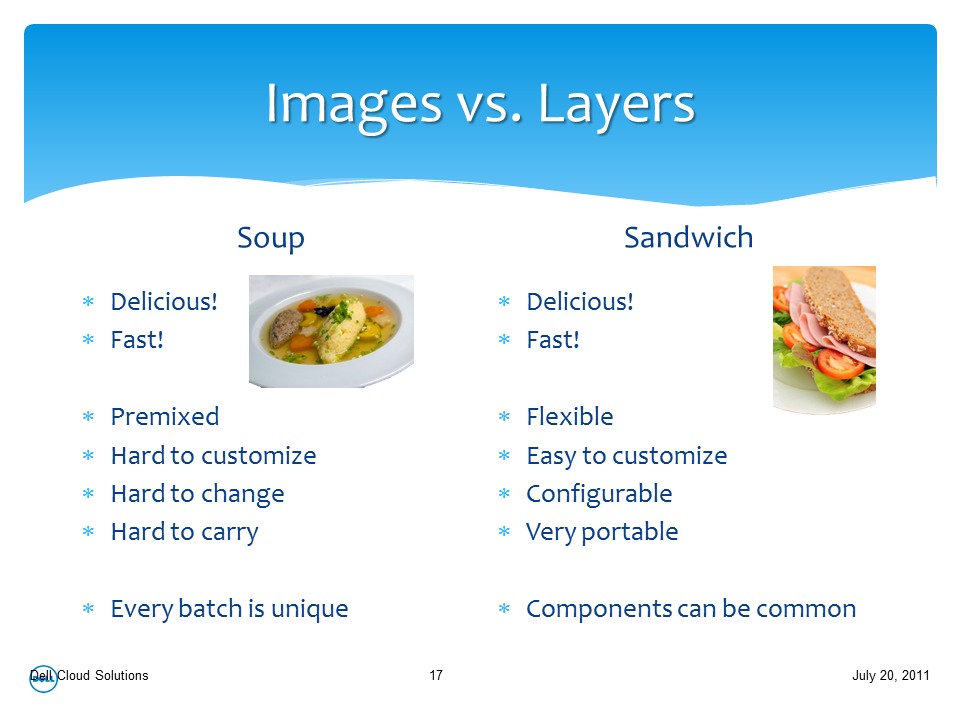
Today I presented about how Crowbar + DevOps + OpenStack = CloudOps.   The highlight of the presentation (to me, anyway) is the Images vs Layers analogy of Soup vs Sandwiches.  I hope it helps explain why we believe that a DevOps approach to Cloud is essential to success.

Here’s the preso: OSCON 07 2011

I’ll add a link to the videos when they are available.

Videos about Crowbar, CloudOps, and Dell OpenStack Cloud

I’m not usually a big fan of launch videos (too much markitecture); however, these turned out to be nice and meaty.  The meaty part explains why it looks like I’m about to eat a big sandwich in the last video.  yum!

  • What is Crowbar: Dell Crowbar Software Overview  

Continue reading

Crowbar build using Ubuntu 10.10 vm on Rackspace Cloud from Github Repo

Our OpenStack team at Dell (especially Victor Lowthor) has been working hard with the public Crowbar repos to make it possible for the community to build their own version of a Crowbar ISO.   When you build the ISO, you’ll be downloading a whole bunch (that’s the technical term) of open source licensed components to make it work: we’re trying to maintain a list of licenses on the Github wiki.

To make sure that it was possible for mortals, I signed up for a Ubuntu 10.10 VM (512 Mb RAM, $0.03/hr) at RackSpace Cloud.  I did this from a non-Dell to ensure that it was as independent from our source as possible.

Once I had my vm, there were just a few steps to follow (these are NOT verbatim):

  • apt-get install debootstrap, mkisofs, git, build-essential packages
  • git clone git://github.com/dellcloudedge/crowbar.git
  • Got the results from a sledgehammer build (a fresh sledgehammer tarball) and extracted it into $HOME/.crowbar-build-cache/tftpboot, which is where build_crowbar.sh expects to find it cached.
    • NOTE: I’m not ready to document sledgehammer builds yet, but I will tell you that you’d need a CentOS VM.
  • In the crowbar directory, ran ./build_crowbar.sh
  • The build will pull down all the packages that you need and cache them to the VM.  Subsequent builds will be much faster!

The end result of the build is an “openstack-dev.iso” that will install Crowbar with the OpenStack barclamps (here’s how to do it on VMs).  Just for fun, I copied _my build_ output ISO off the build VM and to my web server.

Please let me know if you have problems with this process, we want people to try Crowbar!

$$ Note: Turn off your VM when you’re done so you don’t incur extra expenses.  Since this process only took about 2 hours, the whole build cost me less than a dime.  Which is good, since I was building it on “my own dime” anyway.