Introducing the OpenStack Spider Graph: untangling our web of interdependencies

This post is #2 in a series about “what is core.”

peaceOne of the OpenStack Foundation’s most fundamental responsibilities is to define “what is core” for the OpenStack project.  A simple yet urgent question with profound implications for the project’s success; consequently, it’s no surprise that finding a consensus answer has been a thorny problem.   In fact, the answer (it’s 42, of course) is so convoluted that we had to step back establish common ground before we could proceed. I’m proud to say that we’ve made substantial progress towards establishing a framework for the discussion.   

This post (#2) is about the process we followed.  My next post (#3) is about what we learned.  Next, we want to engage the community in discussing the baseline positions (post #4) that make up the framework.   The challenge in discussion was that the Board (and Community) lacked common baseline.  When one person talked about commercial extensions to core another would insist that core always be open.  There are compatible statements; yet, we’d often talk past each other because the question was simply too big and fuzzy.
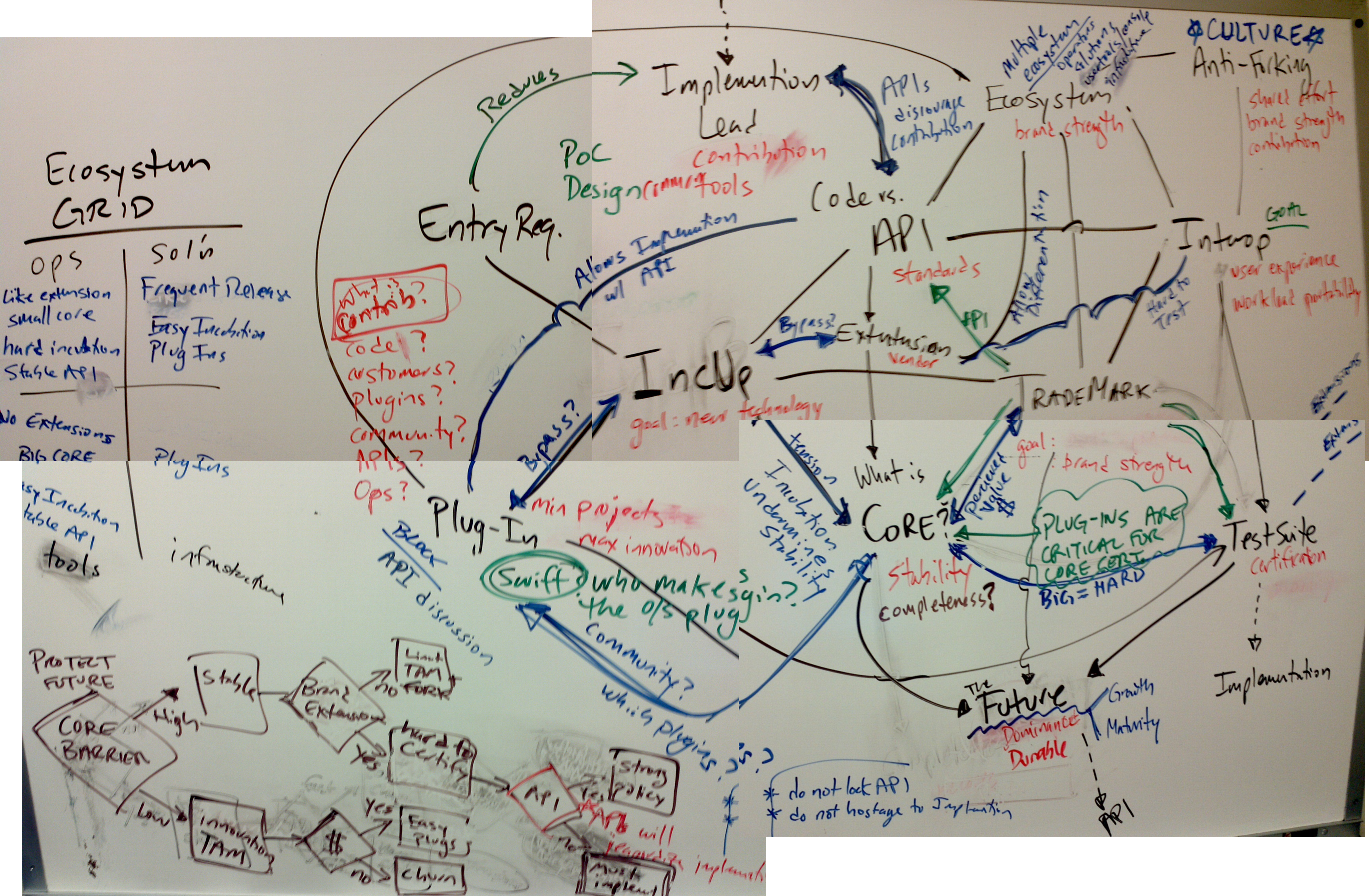
spider boardAlan Clark, Foundation Board Chairman, and I took on the task of breaking the logjam by decomposing the problem.  We used a multilayered mind map that I called the “spider” chart (yes, it’s a misnomer).  In constructing the spider, we first flagged out issue areas (the nodes) and added goals (red text) for each issue area.  Next we linked connected nodes together to form a graph.  We added blue text on connections where goals were opposed or in tension and green text where goals were aligned.

Note: Some of our text is controversial – it was our objective to find the tension.  If you are looking at the image, we also created some grid and flow charts to test the map.

We did not time capture the spider so it’s impossible to sweep back and see how the ideas progressed.  In general, we started at the center from “IncUp Discussion” which was the TC and Board’s collaboration, led by Alan, to define the process by which projects are promoted from incubation to integrated projects.

Some topics were easy like “API vs Implementation” and “Trademark” while “Implementation Led” and “Plug-ins” were more difficult.  Some clarification on those two items is worthwhile:

Implementation Led describes the OpenStack community for starting from working implementations rather than designing an API.  In my experience, this pattern serves the community well as long as we accept that APIs and implementations in incubated projects will take time to mature.   Using this approach gets us out of prolonged design by committee spirals.  It has serious pitfalls also – there’s no milk and honey approach. Plug-ins represented a big pot of politics in the community that was part of the challenge in defining what is core.  The obvious issue is that not all core projects use plug-ins and the ones that do take different approaches.  Even so, we felt that the concept of multiple implementations with a single API was a significant part of the opportunity (and challenge) for OpenStack core.

Ultimately, we decomposed the spider graph into the following table that shows some of our thoughts in raw form.  I’ll discuss the actual insights in my next post (#3) Continue reading
Crowbar lays it all out: RAID & BIOS configs officially open sourced

MediaToday, Dell (my employer) announced a plethora of updates to our open source derived solutions (OpenStack and Hadoop). These solutions include the latest bits (Grizzly and Cloudera) for each project. And there’s another important notice for people tracking the Crowbar project: we’ve opened the remainder of its provisioning capability.

Yes, you can now build the open version of Crowbar and it has the code to configure a bare metal server.

Let me be very specific about this… my team at Dell tests Crowbar on a limited set of hardware configurations. Specifically, Dell server versions R720 + R720XD (using WSMAN and iIDRAC) and C6220 + C8000 (using open tools). Even on those servers, we have a limited RAID and NIC matrix; consequently, we are not positioned to duplicate other field configurations in our lab. So, while we’re excited to work with the community, caveat emptor open source.

Another thing about RAID and BIOS is that it’s REALLY HARD to get right. I know this because our team spends a lot of time testing and tweaking these, now open, parts of Crowbar. I’ve learned that doing hard things creates value; however, it’s also means that contributors to these barclamps need to be prepared to get some silicon under their fingernails.

I’m proud that we’ve reached this critical milestone and I hope that it encourages you to play along.

PS: It’s worth noting is that community activity on Crowbar has really increased. I’m excited to see all the excitement.

What makes OpenStack meaningful to the market?

THIS POST IS #2 IN A SERIES ABOUT “WHAT IS CORE.”

What gives a project a strong core? 

A strong project has utility, community, and longevity.

TelescopeUtility, community and longevity are the fundamental objectives of any project or product.  It must do something that people find useful (utility).  It’s not enough for one person to like the project, there must be a market (community).  And that useful and popular work must be sustainable over multiple “generations” (longevity).

These goals are basic.  The challenge is finding the right rules to keep OpenStack in the sustainable project zone.  Unfortunately, as an open source project, the OpenStack Foundation ultimately has very little real power (like hiring flocks of developers) to enforce use or maintenance of the code base.

The Foundation’s tools are velocity, culture, and brand.  Understanding “what is core” hones these tools to ensure they are effective.

Velocity – the rate of progress and quality of the code base.  A project at sufficient velocity is not worth forking or duplicating.  The fact that >1000 developers companies are contributing and 100s of companies are deploying OpenStack makes it profitable to remain in our community.   Make no mistake: being part of a community takes effort so there must be a return on that investment.  The foundation must ensure that commercial entities find an ROI from their participation.

Culture – open source culture strongly encourages sharing and collaboration.  I have seen that culture as a more potent force than the legalese and licenses.  While a strong culture reinforces itself, a toxic culture will rot a project like ice cream in the summerCulture maintenance is a chief foundation objective and includes fostering new users, documentation, orderly interactions and co-opetitive collaboration.

Brand – when all else fails, OpenStack can use legal means to define our brand.  This is the weakest of all the tools because the strength of the defense is only as good as the brand.  If we allow the OpenStack brand (sometimes we say it’s mark) to become weak or diluted then people have little reason to support velocity or culture.

An important insight when looking at these three control levers is that they are very different between individuals and corporations.  While individuals may highly motivated by culture they are not as motivated by brand; conversely, corporations are highly motivated by brand and compliance and minimally by culture.

As the OpenStack Foundation Board takes up the “what is core” question, we must be cognizant of the duality between individual and corporate interests.  OpenStack must be both meaningful culturally to individuals and strong brand-wise to corporations.   Both are needed to sustain OpenStack’s velocity.

READ POST IS #2: SPIDER CHART

my lean & open source reading list – recommendations welcome!

Cube Seat

I think it’s worth pulling together a list of essential books that I think should be required reading for people on Lean & open source teams (like mine):

  • Basis for the team values that we practice: The Five Dysfunctions of a Team: A Leadership Fable Patrick Lencioni (amazon)
  • This is a foundational classic for team building:  Peopleware: Productive Projects and Teams (Second Edition) Tom DeMarco (amazon)
  • This novel is good primer for lean and devops The Phoenix Project: A Novel About IT, DevOps, and Helping Your Business Win Gene Kim and George Spafford & Kevin Behr (amazon)
  • Business Focus on Lean: The Lean Startup: How Today’s Entrepreneurs Use Continuous Innovation to Create Radically Successful Businesses Eric Ries (amazon)
  • Foundational (and easy) reading about Lean: The Goal: A Process of Ongoing Improvement Eliyahu M. Goldratt (amazon)
  • One of my favorites on Lean / Agile: Implementing Lean Software Development: From Concept to Cash Mary Poppendieck (amazon)
  • Should be required reading for open source (as close to “Open Source for Dummies as you can get): The Cathedral & the Bazaar: Musings on Linux and Open Source by an Accidental Revolutionary Eric S. Raymond (amazon)
  • Culture Change Liquid Leadership: From Woodstock to Wikipedia–Multigenerational Management Ideas That Are Changing the Way We Run Things Brad Szollose (amazon)
  • More Team Building – this one is INTERACTIVE! http://www.strengthsfinder.com/home.aspx

There are some notable additions, but I think this is enough for now.  I’m always looking for recommendations!  Please post your favorites in the comments!

OpenStack leaders learning by humility, doing and being good partners

With the next OpenStack Board meeting on Thursday (5/30/13 agenda) and Mark McLoughlin’s notes crossing my desk, I was reminded of still open discussion topics around OpenStack leadership.  Reminder: except for executive sessions, OpenStack Board Meetings are open (check agenda for details).

2013-03-11_20-01-50_458

Many of the people and companies involved in OpenStack are new to open source projects. Before OpenStack, I had no direct experience building a community like we’ve built together with OpenStack or I’ve been leading with Crowbar. There is no Collaborative Open Source Communities for Dummies book (I looked).

I am not holding myself, OpenStack or Crowbar up as shining examples of open source perfection. Just the opposite, we’ve had to learn the hard way about what works and what fails. I attribute our successes to humility to accept feedback and willingness to ask for help.

But being successful in the small (like during OpenStack Cactus) is different than where we are heading.  In the small, everyone was an open source enthusiast and eager collaborator.  In the large, we should be asking the question “how will we teach people to join and build an open source community?”

The answer is that collaboration must be modeled by the OpenStack leadership.

At the Summit, I was talking with fellow board director Sean Roberts (Yahoo!) and I think he made this point very simply:

“Being in open source is a partnership. If you don’t bring something to the partnership then you’re a user not a partner. We love users but we need to acknowledge the difference.” (Sean Roberts, OpenStack Director)

OpenStack will succeed by building a large base of users; consequently, we need our leaders to be partners in the community.

From orphans to open source, data matters

TMF ChildrenMy wife’s day job helps Indian orphans through the Miracle Foundation here in Austin. On the surface, our jobs are very different; however, there is lately more and more intersection in both form and substance. It was not always like that, initially the Miracle Foundation primary engagement had been an emotional appeal: “look, these orphans are sad, they need you. Did we mention that they are orphans?”

Joking aside, there are plenty of kind people who want to help children; however, there are a lots of worthy causes with equally strong appeal. The question is how do you pick which one? Donors/Contributors want one that is both emotionally appealing and effective.

While radically different in human impact, both of raising orphans and building open source rely heavily on personal engagement and passion for success. Just like non-profits, there are many open source projects that want you to invest your time in installing and contributing to their most worthy technology.

About 18 months ago, the Miracle Foundation pivoted their strategy from tending individual children towards cultivating whole orphanages (the “NEST program”, video below). They started tracking things like how much milk and fruit each child ate and if they had been vaccinated. They connected observable data like hemoglobin levels of children to their ability to pay attention in school. They were even aware of additional days girls spent in school just because they got monthly hygiene products.

NEST Spider Graph

Used with Permission, The Miracle Foundation

With this new program, the Miracle Foundation can tell you exactly how much benefit each child will receive from each dollar. These are real results derived from collecting real data, and the results are powerful.

The children the Miracle Foundation nurtures are going from subsistence to flourishing. This is not happening because people care more about these children than before. It is happening because someone is keeping the data and making sure that the support they give gets the results they want. This in turn helps donors (become one) feel confident that their emotional response is delivering tangible improvements. Both are essential to TMF’s mission.

Open source projects have a similar gestalt.

People and companies contributing time and resources to a project want to both believe in the technology and see tangible metrics to validate adoption. Open source transparency makes it easier to find active projects and people are engaged contributors, but it can be harder to determine if the project is having broader impact.

For OpenStack, these tangible metrics began to surface in the last few days. Before the summit, Stephano Muffulli, community manager, launched the OpenStack Activity Board to show commit and quality data for the project. Last Monday, Tim Bell & Ryan Lane presented the results of the first user survey which showed how and what users are adopting for OpenStack.

If you like seeing this type of data driven behavior then vote with your keyboard and become part of an active open source project. For non-profits like the Miracle Foundation, voting is even easier – you just need a credit card to join in their Mothers’ Day campaign. Your mom may not understand anything you add to open source, but she can understand when you help orphans.

Continue reading

OpenStack’s next hurdle: Interoperability. Why should you care?

SXSW life size Newton's Cradle

SXSW life size Newton’s Cradle

The OpenStack Board spent several hours (yes, hours) discussing interoperability related topics at the last board meeting.  Fundamentally, the community benefits when uses can operate easily across multiple OpenStack deployments (their own and/or public clouds).

Cloud interoperability: the ability to transfer workloads between systems without changes to the deployment operations management infrastructure.

This is NOT hybrid (which I defined as a workload transparently operating in multiple systems); however it is a prereq to achieve scalable hybrid operation.

Interoperability matters because the OpenStack value proposition is all about creating a common platform.  IT World does a good job laying out the problem (note, I work for Dell).  To create sites that can interoperate, we have to some serious lifting:

At the OpenStack Summit, there are multiple chances to engage on this.   I’m moderating a panel about Interop and also sharing a session about the highly related topic of Reference Architectures with Monty Tayor.

The Interop Panel (topic description here) is Tuesday @ 5:20pm.  If you join, you’ll get to see me try to stump our awesome panelists

  • Jonathan LaCour, DreamHost
  • Troy Toman, Rackspace
  • Bernard Golden,  Enstratius
  • Monty Taylor, OpenStack Board (and HP)
  • Peter Pouliot, Microsoft

PS: Oh, and I’m also talking about DevOps Upgrades Patterns during the very first session (see a preview).

Creating Communities: the intersection between Twitter celebrities and open source

calvin_leeOne of the unexpected perks of my Chevy SXSW experience was access to some real social media celebrities such as Josh Estrin, Calvin LeeKristin Brandt, Doug MoraSamantha Needham and Jennie Chen.  They are all amazing, fun, wicked smart and NOT INTO CLOUD COMPUTING.

While I already knew Samantha (via Dell) and Jennie (via TechRanch), all of Chevy’s guests brought totally different perspectives to Chevy’s SXSW team ranging from pop culture  and mommies to hypermilers and gearheads.

The common thread is that we are all looking to engage our communities.

We each wanted to find something that would be interesting for our very different audiences to discuss.  That meant using our experiences at SXSW, Chevy and with each other to start a conversation within our communities.  We need good content as a seed but the goal is to drive the interaction.

Josh was the most articulate about this point saying that he measured his success when his followers talked to each other more than to him.   Being able to create content that engages people to do that is a true talent.

Calvin’s focus was more on helping people connect.  He felt successful when he was able to bring people together through his extended network. In those cases and others, the goals and challenges of a social media celebrity were remarkably similar to those helping lead open source projects.

In building communities, you must measure success in member communication and interaction.

If you are intent on being at the center of the universe then your project cannot grow; however, people also need celebrities to bring them together.  The amazing thing about the the people I met at SXSW through Chevy is that they managed to both attract the attention needed to build critical mass and get out of the way so communities could form around them. That’s a skill that we all should practice and foster.

PS: I also heard clearly that “I ate …” tweets are some of their most popular.  Putting on my collaboration hat: if you’re looking to engage a community then food is the most universal and accessible discussion topic.  Perhaps I’ll have to eat crow on that one.  

5 things keeping DevOps from playing well with others (Chef, Crowbar and Upstream Patterns)

Sharing can be hardSince my earliest days on the OpenStack project, I’ve wanted to break the cycle on black box operations with open ops. With the rise of community driven DevOps platforms like Opscode Chef and Puppetlabs, we’ve reached a point where it’s both practical and imperative to share operational practices in the form of code and tooling.

Being open and collaborating are not the same thing.

It’s a huge win that we can compare OpenStack cookbooks. The real victory comes when multiple deployments use the same trunk instead of forking.

This has been an objective I’ve helped drive for OpenStack (with Matt Ray) and it has been the Crowbar objective from the start and is the keystone of our Crowbar 2 work.

This has proven to be a formidable challenge for several reasons:

  1. diverging DevOps patterns that can be used between private, public, large, small, and other deployments -> solution: attribute injection pattern is promising
  2. tooling gaps prevent operators from leveraging shared deployments -> solution: this is part of Crowbar’s mission
  3. under investing in community supporting features because they are seen as taking away from getting into production -> solution: need leadership and others with join
  4. drift between target versions creates the need for forking even if the cookbooks are fundamentally the same -> solution: pull from source approaches help create distro independent baselines
  5. missing reference architectures interfere with having a stable baseline to deploy against -> solution: agree to a standard, machine consumable RA format like OpenStack Heat.

Unfortunately, these five challenges are tightly coupled and we have to progress on them simultaneously. The tooling and community requires patterns and RAs.

The good news is that we are making real progress.

Judd Maltin (@newgoliath), a Crowbar team member, has documented the emerging Attribute Injection practice that Crowbar has been leading. That practice has been refined in the open by ATT and Rackspace. It is forming the foundation of the OpenStack cookbooks.

Understanding, discussing and supporting that pattern is an important step toward accelerating open operations. Please engage with us as we make the investments for open operations and help us implement the pattern.

double Block Head with OpenStack+Equallogic & Crowbar+Ceph

Block Head

Whew….Yesterday, Dell announced TWO OpenStack block storage capabilities (Equallogic & Ceph) for our OpenStack Essex Solution (I’m on the Dell OpenStack/Crowbar team) and community edition.  The addition of block storage effectively fills the “persistent storage” gap in the solution.  I’m quadrupally excited because we now have:

  1. both open source (Ceph) and enterprise (Equallogic) choices
  2. both Nova drivers’ code is in the open at part of our open source Crowbar work

Frankly, I’ve been having trouble sitting on the news until Dell World because both features have been available in Github before the announcement (EQLX and Ceph-Barclamp).  Such is the emerging intersection of corporate marketing and open source.

As you may expect, we are delivering them through Crowbar; however, we’ve already had customers pickup the EQLX code and apply it without Crowbar.

The Equallogic+Nova Connector

block-eqlx

If you are using Crowbar 1.5 (Essex 2) then you already have the code!  Of course, you still need to have the admin information for your SAN – we did not automate the configuration of the storage system, but the Nova Volume integration.

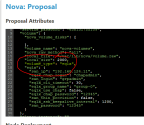
We have it under a split test so you need to do the following to enable the configuration options:

  1. Install OpenStack as normal
  2. Create the Nova proposal
  3. Enter “Raw” Attribute Mode
  4. Change the “volume_type” to “eqlx”
  5. Save
  6. The Equallogic options should be available in the custom attribute editor!  (of course, you can edit in raw mode too)

Want Docs?  Got them!  Check out these > EQLX Driver Install Addendum

Usage note: the integration uses SSH sessions.  It has been performance tested but not been tested at scale.

The Ceph+Nova Connector

block-ceph

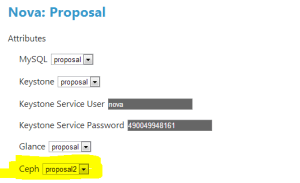
The Ceph capability includes a Ceph barclamp!  That means that all the work to setup and configure Ceph is done automatically done by Crowbar.  Even better, their Nova barclamp (Ceph provides it from their site) will automatically find the Ceph proposal and link the components together!

Ceph has provided excellent directions and videos to support this install.