The 451 Group Cloudscape report strikes chord misses harmony (DevOps, Hybrid Cloud, Orchestration)

It’s impossible to resist posting about this month’s  451 Group Cloudscape report when it calls me out by name as a leading cloud innovator:

… ProTier founders Dave McCrory and Rob Hirschfeld. ProTier [note: now part of Quest] was, indeed, the first VMware ecosystem vendor to be tracked by The 451 Group. In the face of a skeptical world, these entrepreneurs argued that virtualization needed automation in order to realize its full potential, and that the test lab was the low-hanging fruit. Subsequent events have more than vindicated their view (pg. 33).

It’s even better when the report is worth reading and offers insights into forces shaping the industry.  It’s nice to be “more than vindicated” on an amazing journey we started over 10 years ago!

Rather than recite 451’s points (hybrid cloud = automation + orchestration + devops + pixie dust), I’d rather look at the problem different way as a counterpoint.

The problem is “how do we deal with applications that are scattered over multiple data centers?”

I do not think orchestration is the complete answer.  Current orchestration is too focused on moving around virtual machines (aka workloads).

Ultimately, the solution lies in application architecture; however, I feel that is also a misdirection because cloud is redefining what an “application architecture” means.

Applications are a dynamic mix of compute, storage, and connectivity.

We’re entering an age when all of these ingredients will be delivered as elastic services that will be managed by the applications themselves.  The concept of self management is an extension of DevOps principles that fuse application function and deployment. There are missing pieces, but I’m seeing the innovation moving to fill those gaps.

If you want to see the future of cloud applications then look at the network and storage services that are emerging.  They will tell you more about the future than orchestration.


Cote & Rob interview: Crowbar+OpenStack Summit/Conference Reflections (40 mins)

I’m working on a larger post about the OpenStack Summit around API Implementation vs. Specification. You can have a preview of that AND A LOT OF OTHER STUFF (OpenStack, Crowbar, lunch) in this 40 minute interview w/ Michael Cote.

Setting: Dell World
Interview w/ @Cote at the Hilton Hotel Lobby on 6th street in Austin.

I know that Cote’s post does not have a time marker for easy navigation; however, I added them to help guide your navigation in the interview (link for audio) if you want to jump around.

  • 0:00 Introductions
  • 1:00 OpenStack
    • 1:00 Essex Conference – what is it, naming conventions
    • 2:45 Diablo is adding projects from incubation (Keystone, Dashboard,Quantum,
    • 5:30 OpenStack vs. Amazon – “OpenStack has ambitions.” We see it as a “platform for innovation.”
    • 6:30 OpenStack is a competitor for Amazon. It implements the EC2 APIs.
    • 7:30 How are people managing the evolving nature?
    • 8:20 We’re going to see OpenStack in production for the next release based on what we see in our deal flow.
    • 9:00 Every user that comes on adds momentum
    • 9:30 Rackspace setting up the OpenStack foundation is a reflection of the speed of adoption
    • 11:15 Our message is “we’re doing it, we’re in the field.” We are very hands on
    • 11:15 We chose early on to focus on helping deployment to help drive adoption
    • 12:00 “Our first test for partners is: Are you contributing back to the community?”
    • 12:44 The community told us “if you are participating then you are going to open source.” Our commits for OpenStack are live and in the open on our github.
    • 13:40 Why Github? We’re happy with it.
    • 14:20 OpenStack is using Gerrit because they have a gated trunk. They are migrated to Github
    • 15:20 APIs have been a big topic for OpenStack
    • 16:00 Do you track who is forking and following? Yes. We also have a listserv. We are trying to do a better job managing the Crowbar community. We know we need to do a better job.
    • 17:30 OpenStack is defined by its Implementation. That’s “an effective way to move the project forward quickly;” however, we’re getting to a point where people want to use alternate implementations.
    • 19:20 Implementation vs Specification is like the SOAP vs REST debate
    • 20:05 This is something the community needs to wrestle with
    • 21:45 Specification would allow the efforts to scale. The more people consume the API, the more people care about how it operates
    • 22:30 “Bugs can become the API”
    • 23:10 Asia and Europe are very active. We are seeing a ton of activity overseas.
  • 23:30 Crowbar
    • 24:00 Crowbar arose out of our need to deploy cloud software regardless of customer infrastructure
    • 24:45 We would show up and the customer needed all this cloud infrastructure. We created Crowbar because we always needed this
    • 26:00 We extended Chef because we had to do the initial bring-up including BIOS and RAID
    • 26:45 We added a state machine and an orchestration layer
    • 27:45 Updating the system is a huge component. Every month you may be upgrading the infrastructure!
    • 28:30 In our lab, we build whole clouds multiple times a day
    • 29:45 Crowbar is the “cloud unboxer”
    • 30:00 We modularized Crowbar with barclamps. Hadoop and OpenStack are a series of barclamps. Over 5 for each
    • 31:00 Barclamps are applied as layers. We are using that as a term to define DevOps
    • 31:15 We are using Crowbar to help message that we understand DevOps
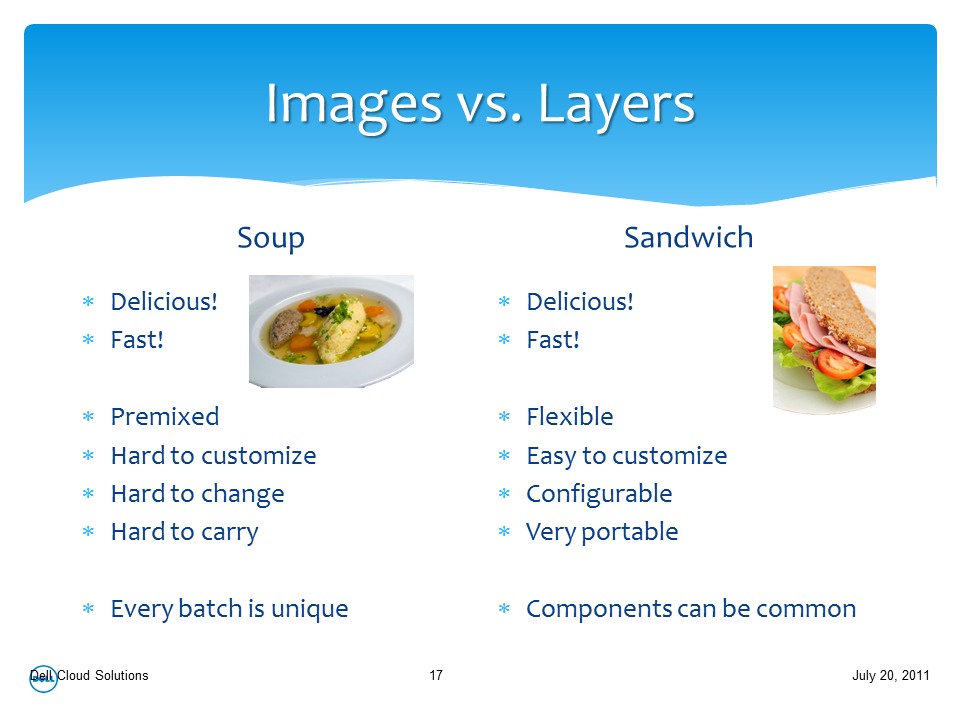
    • 31:45 Soup vs Sandwich analogy – Images are like soup while DevOps is like a sandwich.
    • 32:45 If you don’t want something in a 1000 server deployment, DevOps lets you make a small change. Gives you flexibility.
    • 33:45 We added Cloud Foundry
    • 34:00 We’ve made it so easy with barclamps that partners are coming to us with ideas for barclamps. It’s like “changing the meat for the sandwich.”
    • 34:30 Dreamhost Ceph team created a barclamp and was actually running a majority of the Crowbar demos at the OpenStack conference
  • 35:25 What’s the future for Crowbar?
    • 35:30 More aspects of the infrastructure as open source
    • 35:45 More Hardware
    • 36:00 Multiple operating systems at the same time (XenServer, ESX, etc)
    • 36:30 Larger scale
    • 36:50 More types of infrastructure: storage & network
    • 37:40 Scalr shout out
    • 38:00 We know we need to collaborate more with our community
    • 38:30 The first step is to download it and try. Read my blog and sign up for the list serve
    • 39:00 CROWBAR IS NOT DELL SPECIFIC – we are working with people who want to create support for other vendor’s hardware. This benefits Dell.
    • 39:40 We don’t pretend that our customers are single vendor


Crowbar modularized: latest changes that make clouds even easier to create, update, and maintain

In the last week, my team at Dell completed a major refactoring of Crowbar that significantly improves our ability to bring in community contributions and field customizations.  Today, we merged it into Crowbar’s public repo(s).

From the very first versions, our objective for Crowbar was to create the fastest and most reliable cloud deployments. Along the way, we realized Crowbar’s true potential lay in embracing DevOps as an operational model for maintaining clouds. That meant building up cloud deployments in layers from pieces that we call barclamps (extensions of Chef cookbooks). Our first version, centered on OpenStack Cactus, leveraged barclamps but was still created as a single system. This unified system was a huge step forward in cloud deployments, but did not live up to our CloudOps vision of continuous delivery.

In this version, each Crowbar barclamp is an independent delivery unit that can be integrated before, while or after installing Crowbar.

The core of the change is each barclamp, including the most core ones, are stored in independent code repositories. Putting the code into distinct repos means that each barclamp can have its own life cycle, its own maintainer site and its own dependency tree. This modularization allows customers to manage their Crowbar deployments with a very fine brush: they may choose to customize parts of the system, they could lock components to specific tag and they can bring in barclamps from other vendors.

While the core barclamps are automatically integrated into the Crowbar build using git submodules; other barclamps are installed into the system as needed. This allows you to pull in the suite of OpenStack barclamps at build time or to wait until your Crowbar system is running before installing. Once you install a barclamp, you are able to retrieve an updated barclamp and reapply it to the system.

This feature gives you the ability to 1) choose exactly what you want to include and 2) perform field updates to a live Crowbar system.

Let’s look at some examples:

  1. The Cloud Foundry barclamp can be sourced Cloud Foundry instead of bundled into the Crowbar repository. This allows the team working on the cloud application to take ownership for their own deployment. As a continuous delivery proponent, I believe strongly that the development team should be responsible for ensuring that their code is deployable (refer to my OpenStack “Deployer API” blue print attempting to codify this).
  2. DreamHost, maintainers of Ceph Storage, can maintain their own local barclamp repos for OpenStack that are cloned from our community Swift barclamp. This allows them to innovate and customize OpenStack deployments for their business and choose which updates to merge back to the community.
  3. Rackspace Cloud Builders can work on the most leading edge OpenStack features and maintaining workable deployments on branches. As the code stabilizes, they simply merge in their changes.
  4. Dell BIOS and RAID barclamps only support the PowerEdge C line today. When we offer PowerEdge R support, you will be able to install or update the barclamps to add that capability. If another hardware vendor creates a barclamp for their hardware then you can install that into your existing system.

I believe that these changes to Crowbar are a huge step forwards on our journey of creating a community supportable Open Operations framework. I hope that you are as excited as I am about these changes.

I encourage you to take the first step by trying out Crowbar and, ultimately, writing your own barclamps.

Post Scripts:

  • In addition to the modularization, the updated code includes RHEL as a deployment platform. At present, you must choose to be either RHEL or Ubuntu at build time.
  • We have enhanced the network barclamp to describe connections as more abstract connections, called conduits, between nodes. This is a powerful change, but requires some understanding before you start making changes.
  • We have only begun testing the change as of 9/12, we expect the system to be fully stabilized by 10/3. If you are not willing to deal with bugs then I recommend building the Crowbar “v1.0” tag (or using the ISOs from our July launch).

Cloudcast interview with Dell Cloud Solutions Team (quotes with time stamps)

Lloyds BarbershopTheCloudcast.net – Thank you for such a great series of questions. Wow, nearly 36+ minutes of cloudicious interview about the work my team at Dell is doing!

Thanks to our hosts for putting together a great series! They are:

Highlights from Episode 16: Dell, Dude you’re getting a cloud

  • 3:40 JBG “we are listening to our customers tell us what they want to accomplish”
  • 4:40 RAH “humility is part of [what we’re] doing … cloud is about learning and collaboration”
  • 6:40 RAH “OpenStack filled a niche. It was the first open source community cloud. … Not just open source, its open community.”
  • 7:15 RAH “We’re beyond critical mass. We’re seeing acceleration… we are transitioning into a community development.”
  • 7:30 RAH “It’s accelerating. It happening so fast.”
  • 8:00 RAH “We felt it was really important for people to be able to use it. We felt that it was important to get away from just people developing into people using. “
  • 8:57 – RAH “Cloud is not just one thing. You have to have all the pieces.”
  • 10: 15 – RAH “Cloud is always ready, never finished”
  • 10:50 – RAH “OpenStack is an alternative to public cloud including hosting providers seeking to offer their own cloud”
  • 12:40 – AD “Dell has been in the Big data space for many years now”
  • 20:15 – JBG “There’s a legacy of great partnerships that we leverage”
  • 20:48 – JBG “Conflicts have not come up because we are focused on the customer”
  • 21:30 – RAH “Shout out to Greg Althaus for solving these problems in such an elegant way. And we rewrote it 3 times”
  • 22:02 – RAH “Crowbar started from our frustration of bringing up a cloud quickly … so we took a DevOps approach.”
  • 22:41 – RAH “You had to have a system view AND a boot strapping view simultaneously”
  • 23:50 – JBG “Crowbar was born out of necessity because we were setting up and blowing away our clouds over and over and over again. “
  • 24:40 – JBG “We realized there were not many people thinking about all the pieces before OpenStack was installed”
  • 25:20 – RAH “We don’t think customers have all the answers before we show up. This is not unique to OpenStack.”
  • 28:20 – JBG “We’re seeing the community pick up Crowbar as a way to deploy”

OSCON preso: how Dell Crowbar brings DevOps to OpenStack Cloud (“No Soup for You!”)

Today I presented about how Crowbar + DevOps + OpenStack = CloudOps.   The highlight of the presentation (to me, anyway) is the Images vs Layers analogy of Soup vs Sandwiches.  I hope it helps explain why we believe that a DevOps approach to Cloud is essential to success.

Here’s the preso: OSCON 07 2011

I’ll add a link to the videos when they are available.

Substituting Action for Knowledge – adopting “ready, fire, aim” as a strategy (and when to run like hell)

Today my mother-in-law (a practicing psychiatrist) was bemoaning the current medical practice of substituting action for knowledge. In her world, many doctors will make rapid changes to their patients’ therapy. Their goal is to address the issues immediately presented (patient feels sad so Dr prescribes antidepressants) rather than taking time to understand the patients’ history or make changes incrementally and measure impacts. It feels like another example of our cultural compulsion to fix problems as quickly as possible.

Her comments made me question the core way that I evangelize!

Do Lean and Agile substitute action for knowledge? No. We use action to acquire knowledge.

The fundamental assumption that drives poor decision-making is that we have enough information to make a design, solve a problem or define a market. Lean and Agile’s more core tenet is that we must attack this assumption. We must assume that we can’t gather enough information to fully define our objective. The good news, is that even without much analysis we know a lot! We know:

  • roughly what we want to do (road map)
  • the first steps we should take (tactics)
  • who will be working on the problem (team members)
  • generally how much effort it will take (time & team size)
  • who has the problem that we are trying to solve (market)

We also know that we’ll learn a lot more as we get closer to our target. Every delay in starting effectively pushed our “day of clarity” further into the future. For that reason, it is essential that we build a process that constantly reviews and adjusts its targets.

We need to build a process that acquires knowledge as progress is made and makes rapid progress.

In Agile, we translate this need into the decorations of our process: reviews for learning, retrospectives for adjustments, planning for taking action and short iterations to drive the feedback loop.  Agile’s mantra is “ready, fire, aim, fire, aim, fire, aim, …” which is very different from simply jumping out of a plane without a parachute and hoping you’ll find a haystack to land in.

For cloud deployments, this means building operational knowledge in stages.  Technology is simply evolving too quickly and best practices too slowly for anyone to wait for a packaged solution to solve all their cloud infrastructure problems.  We tried this and it does not work: clouds are a mixture hardware, software and operations.  More accurately, clouds are an operational model supported by hardware and software.

Currently, 80% of cloud deployment effort is operations (or “DevOps“).

When I listen to people’s plans about building product or deploying cloud, I get very skeptical when they take a lot of time to aim at objects far off on the horizon.  Perhaps they are worried that they will substitute action for knowledge; however, I think they would be better served to test their knowledge with a little action.

My MIL agrees – she sees her patients frequently and makes small adjustments to their treatment as needed.  Wow, that’s an Rx for Agile!