June 2 – Weekly Recap of All Things Site Reliability Engineering (SRE)

Welcome to the weekly post of the RackN blog recap of all things SRE. If you have any ideas for this recap or would like to include content please contact us at info@rackn.com or tweet Rob (@zehicle) or RackN (@rackngo)

SRE Items of the Week

RackN and our Co-Founder and CEO Rob Hirschfeld openly called for a significant change to the OpenStack and Kubernetes communities in his VMBlog.com post, How is OpenStack so dead AND yet so very alive to SREs?

“We’re going to keep solving problems in and around the OpenStack community.  I’m excited to see the Foundation embracing that mission.  There are still many hard decisions to make.  For example, I believe that Kubernetes as an underlay is compelling for operators and will drive the OpenStack code base into a more limited role as a Kubernetes workload (check out my presentation about that at Boston).  While that may refocus the coding efforts, I believe it expands the relevance of the open infrastructure community we’ve been building.

Building infrastructure software is hard and complex.  It’s better to do it with friends so please join me in helping keep these open operations priorities very much alive.”

To provide more information on this idea, Rob posted a new blog, OpenStack’s Big Pivot: our suggestion to drop everything and focus on being a Kubernetes VM management workload.

“Sometimes paradigm changes demand a rapid response and I believe unifying OpenStack services under Kubernetes has become an such an urgent priority that we must freeze all other work until this effort has been completed.”

This proposal has caused significant readership for a typical RackN blog as well as on social media so Rob has posted a 2nd post to further the proposal. (re)Finding an Open Infrastructure Plan: Bridging OpenStack & Kubernetes.

It’s essential to solve these problems in an open way so that we can work together as a community of operators.”

As you would expect, RackN is very interested in your thoughts on this proposal and its impact not only on the OpenStack and Kubernetes communities but also how it can transform the ability of IT infrastructure teams to deploy complex technologies in a reliable and scalable manner.

Please contact @zehicle and @rackngo to join the conversation.
_____________

Using Containers and Kubernetes to Enable the Development of Object-Oriented Infrastructure: Brendan Burns GlueCon Presentation

Is SRE a Good Term?
Interview with Rob Hirschfeld (RackN) and Charity Majors (Honeycomb) at Gluecon 2017


_____________

UPCOMING EVENTS

Rob Hirschfeld and Greg Althaus are preparing for a series of upcoming events where they are speaking or just attending. If you are interested in meeting with them at these events please email info@rackn.com.

Velocity : June 19 – 20 in San Jose, CA

OTHER NEWSLETTERS

SRE Weekly (@SREWeekly)Issue #74

(re)Finding an Open Infrastructure Plan: Bridging OpenStack & Kubernetes

TL;DR: infrastructure operations is hard and we need to do a lot more to make these systems widely accessible, easy to sustain and lower risk.  We’re discussing these topics on twitter…please join in.  Themes include “do we really have consensus and will to act” and “already a solved problem” and “this hurts OpenStack in the end.”  

pexels-photo-229949I am always looking for ways to explain (and solve!) the challenges that we face in IT operations and open infrastructure.  I’ve been writing a lot about my concern that data center automation is not keeping pace and causing technical debt.  That concern led to my recent SRE blogging for RackN.

It’s essential to solve these problems in an open way so that we can work together as a community of operators.

It feels like developers are quick to rally around open platforms and tools while operators tend to be tightly coupled to vendor solutions because operational work is tightly coupled to infrastructure.  From that perspective, I’m been very involved in OpenStack and Kubernetes open source infrastructure platforms because I believe the create communities where we can work together.

This week, I posted connected items on VMblog and RackN that layout a position where we bring together these communities.

Of course, I do have a vested interest here.  Our open underlay automation platform, Digital Rebar, was designed to address a missing layer of physical and hybrid automation under both of these projects.  We want to help accelerate these technologies by helping deliver shared best practices via software.  The stack is additive – let’s build it together.

I’m very interested in hearing from you about these ideas here or in the context of the individual posts.  Thanks!

Cybercrime for Profit!? Five reasons why we need to start driving much more dynamic IT Operations

Author’s call to action: if you think you already know this is a problem, then why do we keep reliving it?  We’re doing our part open with Digital Rebar and we need more help to secure infrastructure using foundational automation.

There’s a frustrating cyberattack driven security awareness cycle in IT Operations.  Exploits and vulnerabilities are neither new nor unexpected; however, there is a new element taking shape that should raise additional alarm.pexels-photo-169617.jpeg

Cyberattacks are increasingly profit generating and automated.

The fundamental fact of the latest attacks is that patches were available.  The extensive impact we are seeing is caused by IT Operations that relies on end-of-life components and cannot absorb incremental changes.  These practices are based on dangerous obsolete assumptions about perimeter defense and long delivery cycles.

It’s not just new products using CI/CD pipelines and dynamic delivery: we must retrofit all IT infrastructure to be constantly refreshed.

We simply cannot wait because the cybersecurity challenges are accelerating.  What’s changed in the industry?  There is a combination of factors driving these trends:

  1. Profit motive – attacks are not simply about getting information, they are profit centers made simpler with hard to trace cryptocurrency.
  2. Shortening windows – we’re doing better at finding, publishing and fixing issues than ever in the open.  That cycle assumes that downstream users are also applying the fixes quickly.  Without downstream adoption, the process fails to realize key benefit.
  3. Automation and machine learning – the attackers are using more and more sophisticated automation to find and exploit vulnerabilities.  Expect them to use machine learning to make it even more effective.
  4. No perimeter – our highly interconnected and mobile IT environments eliminate the illusion of a perimeter defense.  This not just a networking statement: our code bases and service catalogs are built from many outside sources that often have deep access.
  5. Expanding surface area – finally, we’re embedding and connected more devices every second into our infrastructure.  Costs are decreasing while capability increases.  There’s no turning back from that, we we should expect an ongoing list of vulnerabilities.

No company has all the answers for cybersecurity; however, it’s clear that we cannot solve this cybersecurity at the perimeter and allowing the interior to remain static.

The only workable IT posture starts with a continuously deployed and updated foundation.

Companies typically skip this work because it’s very difficult to automate in a cross-infrastructure and reliable way.  I’ve been working in this space for nearly two decades and we’re just delivering deep automation that can be applied in generalized ways as part of larger processes.  The good news is that means that we can finally start discussing real shared industry best practices.

Thankfully, with shared practices and tooling, we can get ahead of the attackers.

RackN focuses exclusively on addressing infrastructure automation in an open way.  We are solving this problem from the data center foundations upward.  That allows us to establish security practice that is both completely trusted and constantly refreshed.  It’s definitely not the only thing companies need to do, but that foundation and posture helps drive a better defense.

I don’t pretend to have complete answers to the cyberattacks we are seeing, but I hope they inspire us to more security discipline.  We are on the cusp of a new wave of automated and fast exploits.

Let us know if you are interested in working with RackN to build a more dynamic infrastructure.

May 5 – Weekly Recap of All Things Site Reliability Engineering (SRE)

Welcome to the weekly post of the RackN blog recap of all things SRE. If you have any ideas for this recap or would like to include content please contact us at info@rackn.com or tweet Rob (@zehicle) or RackN (@rackngo)

SRE Items of the Week

RackN Announcement
[PRESS RELEASE] RackN Ends DevOps Gridlock in Data Center  

Today we announced the availability of Digital Rebar Provision, the industry’s first cloud-native physical provisioning utility.  We’ve had this in the Digital Rebar community for a few weeks before offering support and response has been great! READ MORE
_
______

Cloud Native PHYSICAL PROVISIONING? Come on! Really?!
 By Rob Hirschfeld

Today, RackN announce very low entry level support for Digital Rebar Provisioning – the RESTful Cobbler PXE/DHCP replacement.  Having a company actually standing behind this core data center function with support is a big deal; however…

We’re making two BIG claims with Provision: breaking DevOps bottlenecks and cloud native physical provisioning.  We think both points are critical to SRE and Ops success because our current approaches are not keeping pace with developer productivity and hardware complexity. READ MORE

RackN @ DevOpsDays Austin

IMG_0810

Slides from Rob Hirschfeld’s talk – The Server Cage Match

SRE vs DevOps vs Cloud Native: The Server Cage Match by Rob Hirschfeld

I don’t believe in DevOps shaming. Our community seems compelled to correct use of DevOps as an adjective for tools, teams and teapots. The frustration is reasonable: DevOps clearly taps into head space for both devs and operators who see a brighter automated future together. For example, check out this excellent DevOps discourse by Cindy Sridharan.

As an industry, we crave artificial conflict so it’s natural to try and distill site reliability engineering (SRE), DevOps and cloud native into warring factions when they are not. They all share a focus on Lean process. READ MORE

SRE News

What is DevOps? By Cindy Sridharan @copyconstruct  
https://medium.com/@cindysridharan/what-is-devops-5b0181fdb953

It happened again this week.

At this Wednesday’s Prometheus meetup I was hosting, I asked one of the attendees what he did for work.

He looked at me briefly before he barked one word in reply — DevOps — and then promptly made a beeline for the pizza at the back of the room. READ MORE
________

An Influx of Kubernetes Installers Raises Questions Around Conformance
https://thenewstack.io/kubernetes-installer-explosion-natural-enthusiasm/

For the Kubecon Europe last month, industry observer Joseph Jacks pulled together a list of over SIXTY (yes, 60) Kubernetes installers and services. This wealth of variation that made itself known as the conference, happily, kicked off a conformance effort to ensure that users get a consistent experience. I’m a strong believer that clear conformance builds ecosystems and have deep experience working on that from my OpenStack DefCore efforts.

In short, conformance is not a vendor issue: it’s a user experience and ecosystem issue.  READ MORE

UPCOMING EVENTS

Rob Hirschfeld and Greg Althaus are preparing for a series of upcoming events where they are speaking or just attending. If you are interested in meeting with them at these events please email info@rackn.com.

OpenStack Summit : May 8 – 11, 2017 in Boston, MA  

  • OpenStack and Kubernetes. Combining the best of both worlds – Kubernetes Day

Interop ITX : May 15 – 19, 2017 in Las Vegas, NV during    Open Source IT Summit – Tuesday, May 16, 9:00 – 5:00pm  

  • 3:15 – 4:05pm OpenStack and Kubernetes
  • 4:05 – 5:00pm Kubernetes for All

Gluecon : May 24 – 25, 2017 in Denver, CO

  • Surviving Day 2 in Open Source Hybrid Automation – May 23, 2017 : Rob Hirschfeld and Greg Althaus

OTHER NEWSLETTERS

SRE Weekly (@SREWeekly)Issue #70

RackN Ends DevOps Gridlock in Data Center [Press Release]

Today we announced the availability of Digital Rebar Provision, the industry’s first cloud-native physical provisioning utility.  We’ve had this in the Digital Rebar community for a few weeks before offering support and response has been great!

DR ProvisionBy releasing their API-driven provisioning tool as a stand-alone component of the larger Digital Rebar suite, RackN helps DevOps teams break automation bottlenecks in their legacy data centers without disrupting current operations. The stand-alone open utility can be deployed in under 5 minutes and fits into any data center design. RackN also announced a $1,000 starter support and consulting package to further accelerate transition from tools like Cobbler, MaaS or Stacki to the new Golang utility.

“We were seeing SREs suffering from high job turnover,” said Rob Hirschfeld, RackN founder and CEO. “When their integration plans get gridlocked by legacy tooling they quickly either lose patience or political capital. Digital Rebar Provision replaces the legacy tools without process disruption so that everyone can find shared wins early in large SRE initiatives.”

The first cloud-native physical provisioning utility

Data center provisioning is surprisingly complex because it’s caught between cutting edge hardware and arcane protocols and firmware requirements that are difficult to disrupt.  The heart of the system is a fickle combination of specific DHCP options, a firmware bootstrap environment (known as PXE), a very lightweight file transfer protocol (TFTP) and operating system specific templating tools like preseed and kickstart.  Getting all these pieces to work together with updated APIs without breaking legacy support has been elusive.

By rethinking physical ops in cloud-native terms, RackN has managed to distill out a powerful provisioning tool for DevOps and SRE minded operators who need robust API/CLI, Day 2 Ops, security and control as primary design requirements. By bootstrapping foundational automation with Digital Rebar Provision, DevOps teams lay a foundation for data center operations that improves collaboration between operators and SRE teams: operators enjoy additional control and reuse and SREs get a doorway into building a fully automated process.

A pragmatic path without burning downing the data center

“I’m excited to see RackN providing a pragmatic path from physical boot to provisioning without having to start over and rebuild my data center to get there.” said Dave McCrory, an early cloud and data gravity innovator.  “It’s time for the industry to stop splitting physical and cloud IT processes because snowflaked, manual processes slow everyone down.  I can’t imagine an easier on-ramp than Digital Rebar Provision”

The RackN Digital Rebar is making it easy for Cobbler, Stacki, MaaS and Forman users to evaluate our RESTful, Golang, Template-based PXE Provisioning utility.  Interested users can evaluate the service in minutes on a laptop or engage with RackN for a more comprehensive trail with expert support.  The open Provision service works both independently and as part of Digital Rebar’s full life-cycle hybrid control.

Scontactee specific features at http://rackn.com/provision/drsa.

Want help starting on this journey?  Contact us and we can help.

Cloud-first Physical Provisioning? 10 ways that the DR is in to fix your PXE woes.

image

Why has it been so hard to untie from Cobbler? Why can’t we just REST-ify these 1990s Era Protocols? Dealing with the limits of PXE, DHCP and TFTP in wide-ranging data centers is tricky and Cobbler’s manual pre-defined approach was adequate in legacy data centers.

Now, we have to rethink Physical Ops in Cloud-first terms. DevOps and SRE minded operators services that have need real APIs, day-2 ops, security and control as primary design requirements.

The Digital Rebar team at RackN is hunting for Cobbler, Stacki, MaaS and Forman users to evaluate our RESTful, Golang, Template-based PXE Provisioning utility. Deep within the Digital Rebar full life-cycle hybrid control was a cutting-edge bare metal provisioning utility. As part of our v3 roadmap, we carved out the Provisioner to also work as a stand-alone service.

Here’s 10 reasons why DR Provisioning kicks aaS:

  1. Swagger REST API & CLI. Cloud-first means having a great, tested API. Years of provisioning experience went into this 3rd generation design and it shows. That includes a powerful API-driven DHCP.
  2. Security & Authenticated API. Not an afterthought, we both HTTPS and user authentication for using the API. Our mix of basic and bearer token authentication recognizes that both users and automation will use the API. This brings a new level of security and control to data center provisioning.
  3. Stand-alone multi-architecture Golang binary. There are no dependencies or prerequisites, plus upgrades are drop in replacements. That allows users to experiment isolated on their laptop and then easily register it as a SystemD service.
  4. Nested Template Expansion. In DR Provision, Boot Environments are composed of reusable template snippets. These templates can incorporate global, profile or machine specific properties that enable users to set services, users, security or scripting extensions for their environment.
  5. Configuration at Global, Group/Profile and Node level. Properties for templates can be managed in a wide range of ways that allows operators to manage large groups of servers in consistent ways.
  6. Multi-mode (but optional) DHCP. Network IP allocation is a key component of any provisioning infrastructure; however, DHCP needs are highly site dependant. DR Provision works as a multi-interface DHCP listener and can also resolve addresses from DHCP forwarders. It can even be disabled if your environment already has a DHCP service that can configure a the “next boot” provider.
  7. Dynamic Provisioner templates for TFTP and HTTP. For security and scale, DR Provision builds provisioning files dynamically based on the Boot Environment Template system. This means that critical system information is not written to disk and files do not have to be synchronized. Of course, when you need to just serve a file that works too.
  8. Node Discovery Bootstrapping. Digital Rebar’s long-standing discovery process is enabled in the Provisioner with the included discovery boot environment. That process includes an integrated secure token sequence so that new machines can self-register with the service via the API. This eliminates the need to pre-populate the DR Provision system.
  9. Multiple Seeding Operating Systems. DR Provision comes with a long list of Boot Environments and Templates including support for many Linux flavors, Windows, ESX and even LinuxKit. Our template design makes it easy to expand and update templates even on existing deployments.
  10. Two-stage TFTP/HTTP Boot. Our specialized Sledgehammer and Discovery images are designed for speed with optimized install cycles the improve boot speed by switching from PXE TFTP to IPXE HTTP in a two stage process. This ensures maximum hardware compatibility without creating excess network load.

Digital Rebar Provision is a new generation of data center automation designed for operators with a cloud-first approach. Data center provisioning is surprisingly complex because it’s caught between cutting edge hardware and arcane protocols embedded in firmware requirements that are still very much alive.

We invite you to try out Digital Rebar Provision yourself and let us know what you think. It only takes a few minutes. If you want more help, contact RackN for a $1000 Quick Start offer.

LinuxKit and Three Concerns with Physical Provisioning of Immutable Images

DR ProvisionAt Dockercon this week, Docker announced an immutable operating system called LinuxKit which is powered by a Packer-like utility called Moby that RackN CTO, Greg Althaus, explains in the video below.

For additional conference notes, check out Rob Hirschfeld’s Dockercon retro blog post.

Three Concerns with Immutable O/S on Physical

With a mix of excitement and apprehension, the RackN team has been watching physical deployment of immutable operating systems like CoreOS Container Linux and RancherOS.  Overall, we like the idea of a small locked (aka immutable) in-memory image for servers; however, the concept does not map perfectly to hardware.

Note: if you want to provision these operating systems in a production way, we can help you!

These operating systems work on a “less is more” approach that strips everything out of the images to make them small and secure.  

This is great for cloud-first approaches where VM size has a material impact in cost.  It’s particularly matched for container platforms where VMs are constantly being created and destroyed.  In these cases, the immutable image is easy to update and saves money.

So, why does that not work as well on physical?

First:  HA DHCP?!  It’s not as great a map for physical systems where operating system overhead is pretty minimal.  The model requires orchestrated rebooting of your hardware.  It also means that you need a highly available (HA) PXE Provisioning infrastructure (like we’re building with Digital Rebar).

Second: Configuration. That means that they must rely on having cloud-init injected configuration.  In a physical environment, there is no way to create cloud-init like injections without integrating with the kickstart systems (a feature of Digital Rebar Provision).  Further, hardware has a lot more configuration options (like hard drives and network interfaces) than VMs.  That means that we need a robust and system-by-system way to manage these configurations.

Third:  No SSH.  Yes another problem with these minimal images is that they are supposed to eliminate SSH.   Ideally, their image and configuration provides everything required to run the image without additional administration.  Unfortunately, many applications assume post-boot configuration.  That means that people often re-enable SSH to use tools like Ansible.  If it did not conflict with the very nature of the “do-not configure-the-server” immutable model, I would suggest that SSH is a perfectly reasonable requirement for operators running physical infrastructure.

In Summary, even with those issues, we are excited about the positive impact this immutable approach can have on data center operations.

With tooling like Digital Rebar, it’s possible to manage the issues above.  If this appeals to you, let us know!

Hey Dockercon, let’s get Physical!

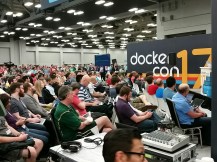
IMG_20170419_121918Overall, Dockercon did a good job connecting Docker users with information.  In some ways, it was a very “let’s get down to business” conference without the open source collaboration feel of previous events.  For enterprise customers and partners, that may be a welcome change.

Unlike past Dockercons, the event did not have major announcements or a lot of non-Docker ecosystem buzz.  That said, I miss that the event did not have major announcements or a lot of non-Docker ecosystem buzz.

One item that got me excited was an immutable operating system called LinuxKit which is powered by a Packer-like utility called Moby (ok, I know it does more but that’s still fuzzy to me).

RackN CTO, Greg Althaus, was able to turn around a working LinuxKit Kubernetes demo (VIDEO) overnight.  This short video explains Moby & LinuxKit plus uses the new Digital Rebar Provision in an amazing integration.

Want to hear more about immutable operating systems?  Check out our post on RackN’s site about three challenges of running things like LinuxKit, CoreOS Container Linux and RancherOS on metal.

Oh, and YES, that was my 15-year-old daughter giving a presentation at Dockercon about workplace diversity.  I’ll link the video when they’ve posted them.

https://www.slideshare.net/KateHirschfeld/slideshelf

April 21 – Weekly Recap of All Things Site Reliability Engineering (SRE)

Welcome to the weekly post of the RackN blog recap of all things SRE. If you have any ideas for this recap or would like to include content please contact us at info@rackn.com or tweet Rob (@zehicle) or RackN (@rackngo)

SRE Items of the Week

DigitalRebar Provision deploy Docker’s LinuxKit Kubernetes


_____________

Install Digital Rebar PXE Provision on a Mac OSX System and Test Boot using Virtual Box


_____________

Packet Pushers 333 Automation & Orchestration in Networking
http://packetpushers.net/podcast/podcasts/show-333-orchestration-vs-automation/

While the discussion is all about NETWORK DevOps, they do a good job of decrying WHY current state of system orchestration is so sad – in a word: heterogeneity.  It’s not going away because the alternative is lock-in.  They also do a good job of describing the difference between automation and orchestration; however, I think there’s a middle tier  of resource “scheduling” that better describes OpenStack and Kubernetes.

Around 5:00 minutes into the podcast, they effectively describe the composable design of Digital Rebar and the rationale for the way that we’ve abstracted interfaces for automation.  If you guys really do want to cash in by consulting with it (at 10 minutes), just contact Rob H.
_____________

Digital Magazine Launch: Increment On-Call
https://increment.com/on-call/

Increment is dedicated to covering how teams build and operate software systems at scale, one issue at a time. In this, our inaugural issue, we focus on industry best practices around on-call and incident response.
_____________

Need PXW? Try out this Cobbler Replacement
https://robhirschfeld.com/2017/04/11/provision-preview/ 

INTRO
We wanted to make open basic provisioning API-driven, secure, scalable and fast.  So we carved out the Provision & DHCP services as a stand alone unit from the larger open Digital Rebar project.  While this Golang service lacks orchestration, this complete service is part of Digital Rebar infrastructure and supports the discovery boot process, templating, security and extensive image library (Linux, ESX, Windows, … ) from the main project.

TL;DR: FIVE MINUTES TO REPLACE COBBLER?  YES.

The project APIs and CLIs are complete for all provisioning functions with good Swagger definitions and docs.  After all, it’s third generation capability from the Digital Rebar project.  The integrated UX is still evolving.
_____________

UPCOMING EVENTS

Rob Hirschfeld and Greg Althaus are preparing for a series of upcoming events where they are speaking or just attending. If you are interested in meeting with them at these events please email info@rackn.com.

DevOpsDays Austin : May 4-5, 2017 in Austin TX  

OpenStack Summit : May 8 – 11, 2017 in Boston, MA  

  • OpenStack and Kubernetes. Combining the best of both worlds – Kubernetes Day  

Interop ITX : May 15 – 19, 2017 in Las Vegas, NV

Gluecon : May 24 – 25, 2017 in Denver, CO

  • Surviving Day 2 in Open Source Hybrid Automation – May 23, 2017 : Rob Hirschfeld and Greg Althaus

OTHER NEWSLETTERS

SRE Weekly (@SREWeekly)Issue #68

April 14 – Weekly Recap of All Things Site Reliability Engineering (SRE)

Welcome to the weekly post of the RackN blog recap of all things SRE. If you have any ideas for this recap or would like to include content please contact us at info@rackn.com or tweet Rob (@zehicle) or RackN (@rackngo). 

SRE Items of the Week

Continuous Discussions (#c9d9) Episode 66: Scaling Agile and DevOps in the Enterprise Watch Rob Hirschfeld in this Electric Cloud Podcast held on 4/11.

On the Continuous Discussions (#c9d9) podcast the discussion was on Scaling Agile and DevOps in the Enterprise.

  • What’s between scaling Agile and scaling DevOps?
  • What are some learnings and patterns for scaling Agile, that can be applied for starting and scaling a DevOps transformation in the enterprise?

Podcast Video Link: https://www.youtube.com/watch?v=uffUoX-O3g8
_____________

Rob Hirschfeld on Containers, Private Clouds, GIFEE, and the Remaining “Underlay Problem”
Rob Hirschfeld Q&A with Gene Kim on ITRevolution

INTRO
Back in October of 2016, I was at OpenStack Conference in Barcelona and ran into a long-time friend, Rob Hirschfeld. He surprised me by talking about a problem domain that we have had discussions about for years, reframing it as “the data center underlay problem.”

His provocative statement was that while OpenStack solves many problems, it didn’t address the fundamental challenges of how to run things like OpenStack on actual physical infrastructure. This is a problem domain that is being radically redefined by the container ecosystem.

This is a problem that Rob has been tirelessly working on for nearly a decade, and it was interesting to get his perspective on the emerging ecosystem, including OpenStack, Kubernetes, Mesos, containers, private clouds in general (which include Azure Stack), etc.  I thought it would be useful to share this with everyone.
_____________

Need PXE? Try out this Cobbler Replacement
Rob Hirschfeld Blog (https://robhirschfeld.com)

INTRO
We wanted to make open basic provisioning API-driven, secure, scalable and fast.  So we carved out the Provision & DHCP services as a stand alone unit from the larger open Digital Rebar project.  While this Golang service lacks orchestration, this complete service is part of Digital Rebar infrastructure and supports the discovery boot process, templating, security and extensive image library (Linux, ESX, Windows, … ) from the main project.

TL;DR: FIVE MINUTES TO REPLACE COBBLER?  YES.

The project APIs and CLIs are complete for all provisioning functions with good Swagger definitions and docs.  After all, it’s third generation capability from the Digital Rebar project.  The integrated UX is still evolving.
_____________

Open Source Collaboration: The Power of No & Interoperability
Christopher Ferris, IBM OpenTech

INTRO
It’s a common misconception that open source collaboration means saying YES to all ideas; however, the reality of successful projects is the opposite.

Permissive open source licenses drive a delicate balance for projects. On one hand, projects that adopt permissive licenses should be accepting of contributions to build community and user base. On the other, maintainers need to adopt a narrow focus to ensure project utility and simplicity. If the project’s maintainers are too permissive, the project bloats and wanders without a clear purpose. If they are too restrictive then the project fails to build community.

It is human nature to say yes to all collaborators, but that can frustrate core developers and users.

For that reason, stronger open source projects have a clear, focused, shared vision.  Historically, that vision was enforced by a benevolent dictator for life (BDFL); however, recent large projects have used a consensus of project elders to make the task more sustainable.  These roles serve a critical need: they say “no” to work that does not align with the project’s mission and vision.  The challenge of defining that vision can be a big one, but without a clear vision, it’s impossible for the community to sustain growth because new contributors can dilute the utility of projects.  [author’s note: This is especially true of celebrity projects like OpenStack or Kubernetes that attract “shared glory” contributors]
_____________

UPCOMING EVENTS
Rob Hirschfeld and Greg Althaus are preparing for a series of upcoming events where they are speaking or just attending. If you are interested in meeting with them at these events please email info@rackn.com.

DockerCon 2017 : April 17 – 20, 2017 in Austin, TX
DevOpsDays Austin : May 4-5, 2017 in Austin TX
OpenStack Summit : May 8 – 11, 2017 in Boston, MA  

  • OpenStack and Kubernetes. Combining the best of both worlds – Kubernetes Day  

Interop ITX : May 15 – 19, 2017 in Las Vegas, NV

Gluecon : May 24 – 25, 2017 in Denver, CO

  • Surviving Day 2 in Open Source Hybrid Automation – May 23, 2017 : Rob Hirschfeld and Greg Althaus

OTHER NEWSLETTERS

SRE Weekly (@SREWeekly)Issue #67