Need PXE? Try out this Cobbler Replacement

DR Provision

Operators & SREs – we need your feedback on an open DHCP/PXE technical preview that will amaze you and can be easily tested right from your laptop.

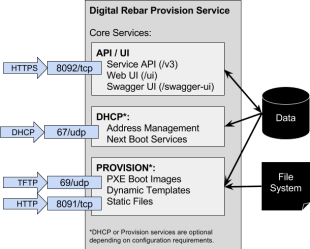
We wanted to make open basic provisioning API-driven, secure, scalable and fast.  So we carved out the Provision & DHCP services as a stand alone unit from the larger open Digital Rebar project.  While this Golang service lacks orchestration, this complete service is part of Digital Rebar infrastructure and supports the discovery boot process, templating, security and extensive image library (Linux, ESX, Windows, … ) from the main project.

TL;DR: FIVE MINUTES TO REPLACE COBBLER?  YES.

The project APIs and CLIs are complete for all provisioning functions with good Swagger definitions and docs.  After all, it’s third generation capability from the Digital Rebar project.  The integrated UX is still evolving.

Here’s a video of the quick install process.


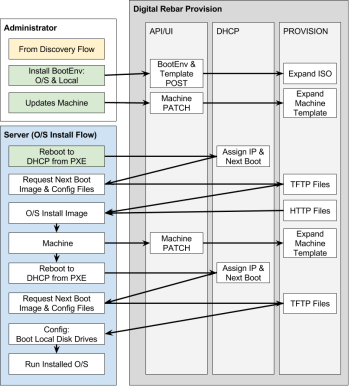
Here are some examples from the documentation:

core_servicesinstall_discovered

Containers, Private Clouds, GIFEE, and the Underlay Problem

ITRevoluion

Gene Kim (@RealGeneKim) posted an exclusive Q&A with Rob Hirschfeld (@zehicle) today on IT Technology: Rob Hirschfeld on Containers, Private Clouds, GIFEE, and the Remaining “Underlay Problem.” 

Questions from the post:

  • Gene Kim: Tell me about the landscape of docker, OpenStack, Kubernetes, etc. How do they all relate, what’s changed, and who’s winning?
  • GK: I recently saw a tweet that I thought was super funny, saying something along the lines “friends don’t let friends build private clouds” — obviously, given all your involvement in the OpenStack community for so many years, I know you disagree with that statement. What is it that you think everyone should know about private clouds that tell the other side of the story?
  • GK: We talked about how much you loved the book Site Reliability Engineering: How Google Runs Production Systems by Betsy Beyer, which I also loved. What resonated with you, and how do you think it relates to how we do Ops work in the next decade?
  • GK: Tell me what about the work you did with Crowbar, and how that informs the work you’re currently doing with Digital Rebar?

Read the full Q&A here.

Accelerating Community Ops on Kubernetes in Hybrid Style

Preface: RackN is looking for SRE teams who are enthusiastic about accelerating Kubernetes on-premises in a long term operational way that can be shared and reused across the community.

kubernetesWe’re excited to see and be part of the community progress towards enterprise-ready Kubernetes operations on both cloud and on-premises.  The RackN team is excited to be part of multiple groups establishing patterns with shareable/reusable automation. I strongly recommend watching (or, better, collaborating in) these efforts if you are deploying Kubernetes even at experimental scale.

We’ve worked hard to make shared community ops work accessible, repeatable and multi-platform without compromising scale or security.

The RackN team has been enthusiastic supporters of Kubernetes since the 1.0 launch with our first deployments going back to June 2015 with updates for 1.2, 1.3 and now 1.5. I’m excited to report that fully converged the composable Digital Rebar approach with the Kubernetes Kargo Ansible. Our 1.2 efforts leveraged the Kargo predecessor “Kubespray.” This integration brings the parallel hybrid operation and node-by-node function of Digital Rebar with the Ansible community efforts around Kargo.

Composable design is a key element the RackN focus on SRE automation because it allows ecosystem

That allows a fully integrated deploy where Digital Rebar stages the environment and then use Kargo directly from upsteam to install Kubernetes. Post-deployment, Digital Rebar is able to extend the cluster with packages like Helm, Deis, Dashboard and others.

Since Digital Rebar supports parallel deployments, it’s possible to fully exercise the options enabled by Kargo simultaneously for development and testing.  Benefits????

For example, you can built-test-destroy coordinated Kubernetes installs on Centos, Redhat and Ubuntu as part of an automation pipeline. Unlike client side approaches like Terraform or Ansible, our infrastructure allows transparent monitoring of the deployments including Slack integration.

Flexibility is also important between users because Ops variation is both a benefit and a cost.

A key Digital Rebar design goal is for users to explore useful variation and still share operational best practices. We are proving that shared community automation can support many different scenarios including variation between between clouds, physical, operating system, networking and container engine.

If we cannot manage this variation in a consistent way then we’re doomed to operational fragmentation (like OpenStack has endured).

We’re inviting you to check out our open work supporting the Kubernetes Ops community. As Rob Hirschfeld says, looking for “Day 2” minded operators who want to make sure that we are always able to share Kubernetes best practices.

What does it take to Operate Open Platforms? Answers in Datanauts 72

Did I just let OpenStack ops off the hook….?  Kubernetes production challenges…?  

ix34grhy_400x400I had a lot of fun in this Datanauts wide ranging discussion with unicorn herders Chris Wahl and Ethan Banks.  I like the three section format because it gives us a chance to deep dive into distinct topics and includes some out-of-band analysis by the hosts; however, that means you need to keep listening through the commercial breaks to hear the full podcast.

Three parts?  Yes, Chris and Ethan like to save the best questions for last.

In Part 1, we went deep into the industry operational and business challenges uncovered by the OpenStack project. Particularly, Chris and I go into “platform underlay” issues which I laid out in my “please stop the turtles” post. This was part of the build-up to my SRE series.

In Part 2, we explore my operations-focused view of the latest developments in container schedulers with a focus on Kubernetes. Part of the operational discussion goes into architecture “conceits” (or compromises) that allow developers to get the most from cloud native design patterns. I also make a pitch for using proven tools to run the underlay.

In Part 3, we go deep into DevOps automation topics of configuration and orchestration. We talk about the design principles that help drive “day 2” automation and why getting in-place upgrades should be an industry priority.  Of course, we do cover some Digital Rebar design too.

Take a listen and let me know what you think!

On Twitter, we’ve already started a discussion about how much developers should care about infrastructure. My opinion (posted here) is that one DevOps idea where developers “own” infrastructure caused a partial rebellion towards containers.

Why is RackN advancing OpenStack on Kubernetes?

Yesterday, RackN CEO, Rob Hirschfeld, described the remarkable progress in OpenStack on Kubernetes using Helm (article link).  Until now, RackN had not been willing to officially support OpenStack deployments; however, we now believe that this approach is a game changer for OpenStack operators even if they are not actively looking at Kubernetes.

We are looking for companies that want to join in this work and fast-track it into production. If this is interesting, please contact us at sre@rackn.com.

Why should you sponsor? Current OpenStack operators facing “fork-lift upgrades” should want to find a path like this one that ensures future upgrades are baked into the plan. This approach provide a fast track to a general purpose, enterprise grade, upgradable Kubernetes infrastructure.

Here is Rob’s Demo

Rob’s Original Blog Post

RackN revisits OpenStack deployments with an eye on ongoing operations. I’ve been an outspoken skeptic of a Joint OpenStack Kubernetes Environment because I felt that the technical hurdles of cloud native architecture would prove challenging.

I was wrong: I underestimated how fast these issues could be addressed.

… read the rest at Beyond Expectations: OpenStack via Kubernetes Helm (Fully Automated with Digital Rebar) — Rob Hirschfeld

Shouldn’t we have Standard Automation for Commodity Infrastructure?

sre-seriesOur focus on SRE series continues… At RackN, we see a coming infrastructure explosion in both complexity and scale. Unless our industry radically rethinks operational processes, current backlogs will escalate and stability, security and sharing will suffer.

bookAn entire chapter of the Google SRE book was dedicated to the benefits of improving data center provisioning via automation; however, the description was abstract with a focus on the importance of validation testing and self-healing. That lack of detail is not surprising: Google’s infrastructure automation is highly specialized and considered a competitive advantage.

Shouldn’t everyone be able to do this?

After all, data centers are built from the same basic components with the same protocols.

Unfortunately, the stack of small (but critical) variations between these components makes it very difficult to build a universal solution. Reasonable variations like hardware configuration, vendor out-of-band management protocol, operating system, support systems and networking topologies add up quickly. Even Google, with their tremendous SRE talent and time investments, only built a solution for their specific needs.

To handle this variation, our SRE teams bake assumptions about their infrastructure directly into their automation. That’s expedient because there’s generally little operational reward for creating generic solutions for specific problems. I see this all the time in data centers that have server naming conventions and IP address schemes that are the automation glue between their tools and processes. While this may be a practical tactic for integration, it is fragile and site specific.

Hard coding your operational environment into automation has serious downsides.

First, it creates operational debt [reference] just like hard coding values in regular development. Please don’t mistake this as a call for yak shaving provisioning scripts into open ended models! There’s a happy medium where the scripts can be robust about infrastructure like ips, NIC ordering, system names and operating system behavior without compromising readability and development time.

Second, it eliminates reuse because code that works in one place must be forked (or copied) to be used again.  Forking creates a proliferation of truth and technical debt.  Unlike a shared script, the forked scripts do not benefit from mutual improvements.  This is true for both internal use and when external communities advance.  I have seen many cases where a company’s decision to fork away from open source code to “adjust it for their needs” cause them to forever lose the benefits accrued in the upstream community.

Consequently, Ops debt is quickly created when these infrastructure specific items are coded into the scripts because you have to touch a lot of code to make small changes. You also end up with hidden dependencies

However, until recently, we have not given SRE teams an alternative to site customization.

Of course, the alternative requires some additional investment up front.  Hard coding and forking are faster out of the gate; however, the SRE mandate is to aggressively reduce ongoing maintenance tasks wherever possible.  When core automation is site customized, Ops loses the benefits of reuse both internally and externally.

That’s why we believe SRE teams work to reuse automation whenever possible.

rebar-1Digital Rebar was built from our frustration watching the OpenStack community struggle with exactly this lesson.  We felt that having a platform for sharing code was essential; however, we also observed that differences between sites made it impossible to share code.  Our solution was to isolate those changes into composable units.  That isolation allowed us take a system integration view that did not break when inevitable changes were introduced.

If you are interested in breaking out of the script customization death spiral then review what the RackN team has done with Digital Rebar.

Even if you don’t use the code, the approach could save your SRE team a lot of heartburn down the road.  Of course, if you do want to use it then just contact us at sre@rackn.com.

Surgical Ansible & Script Injections before, during or after deployment.

I’ve been posting about the unique composable operations approach the RackN team has taken with Digital Rebar to enable hybrid infrastructure and mix-and-match underlay tooling.  The orchestration design (what we call annealing) allows us to dynamically add roles to the environment and execute them as single role/node interactions in operational chains.

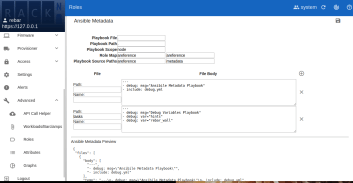
ansiblemtaWith our latest patches (short demo videos below), you can now create single role Ansible or Bash scripts dynamically and then incorporate them into the node execution.

That makes it very easy to extend an existing deployment on-the-fly for quick changes or as part of a development process.

You can also run an ad hoc bash script against one or groups of machines.  If that script is something unique to your environment, you can manage it without having to push it back upsteam because Digital Rebar workloads are composable and designed to be safely integrated from multiple sources.

Beyond tweaking running systems, this is fastest script development workflow that I’ve ever seen.  I can make fast, surgical iterative changes to my scripts without having to rerun whole playbooks or runlists.  Even better, I can build multiple operating system environments side-by-side and test changes in parallel.

For secure environments, I don’t have to hand out user SSH access to systems because the actions run in Digital Rebar context.  Digital Rebar can limit control per user or tenant.

I’m very excited about how this capability can be used for dev, test and production systems.  Check it out and let me know what you think.


Digital Rebar Training Videos

We’re excited to announce an updated set of Digital Rebar training videos.  In response to requests to go beyond the simple Quick Start guide, we created a dedicated training channel and have been producing 15 minute tutorials on a wide range of topics.

Want us to cover a topic?  Just ask us on Gitter!


In some cases, these videos contain information that has not made it into documentation yet.  Our documentation is open source, we’d love to incorporate your notes to help make the experience easier for the next user.

Thanks!

Provisioned Secure By Default with Integrated PKI & TLS Automation

Today, I’m presenting this topic (PKI automation & rotation) at Defragcon  so I wanted to share this background more broadly as a companion for that presentation.  I know this is a long post – hang with me, PKI is complex.

Building automation that creates a secure infrastructure is as critical as it is hard to accomplish. For all the we talk about repeatable automation, actually doing it securely is a challenge. Why? Because we cannot simply encode passwords, security tokens or trust into our scripts. Even more critically, secure configuration is antithetical to general immutable automation: it requires that each unit is different and unique.

Over the summer, the RackN team expanded open source Digital Rebar to include roles that build a service-by-service internal public key infrastructure (PKI).

untitled-drawingThis is a significant advance in provisioning infrastructure because it allows bootstrapping transport layer security (TLS) encryption without having to assume trust at the edges.  This is not general PKI: the goal is for internal trust zones that have no external trust anchors.

Before I explain the details, it’s important to understand that RackN did not build a new encryption model!  We leveraged the ones that exist and automated them.  The challenge has been automating PKI local certificate authorities (CA) and tightly scoped certificates with standard configuration tools.  Digital Rebar solves this by merging service management, node configuration and orchestration.

I’ll try and break this down into the key elements of encryption, keys and trust.

The goal is simple: we want to be able to create secure communications (that’s TLS) between networked services. To do that, they need to be able to agree on encryption keys for dialog (that’s PKI). These keys are managed in public and private pairs: one side uses the public key to encrypt a message that can only be decoded with the receiver’s private key.

To stand up a secure REST API service, we need to create a private key held by the server and a public key that is given to each client that wants secure communication with the server.

Now the parties can create secure communications (TLS) between networked services. To do that, they need to be able to agree on encryption keys for dialog. These keys are managed in public and private pairs: one side uses the public key to encrypt a message that can only be decoded with the receiver’s private key.

Unfortunately, point-to-point key exchange is not enough to establish secure communications.  It too easy to impersonate a service or intercept traffic.  

Part of the solution is to include holder identity information into the key itself such as the name or IP address of the server.  The more specific the information, the harder it is to break the trust.  Unfortunately, many automation patterns simply use wildcard (or unspecific) identity because it is very difficult for them to predict the IP address or name of a server.   To address that problem, we only generate certificates once the system details are known.  Even better, it’s then possible to regenerate certificates (known as key rotation) after initial deployment.

While identity improves things, it’s still not sufficient.  We need to have a trusted third party who can validate that the keys are legitimate to make the system truly robust.  In this case, the certificate authority (CA) that issues the keys signs them so that both parties are able to trust each other.  There’s no practical way to intercept communications between the trusted end points without signed keys from the central CA.  The system requires that we can build and maintain these three way relationships.  For public websites, we can rely on root certificates; however, that’s not practical or desirable for dynamic internal encryption needs.

So what did we do with Digital Rebar?  We’ve embedded a certificate authority (CA) service into the core orchestration engine (called “trust me”).  

The Digital Rebar CA can be told to generate a root certificate on a per service basis.  When we add a server for that service, the CA issues a unique signed certificate matching the server identity.  When we add a client for that service, the CA issues a unique signed public key for the client matching the client’s identity.  The server will reject communication from unknown public keys.  In this way, each service is able to ensure that it is only communicating with trusted end points.

Wow, that’s a lot of information!  Getting security right is complex and often neglected.  Our focus is provisioning automation, so these efforts do not cover all PKI lifecycle issues or challenges.  We’ve got a long list of integrations, tools and next steps that we’d like to accomplish.

Our goal was to automate building secure communication as a default.  We think these enhancements to Digital Rebar are a step in that direction.  Please let us know if you think this approach is helpful.

Three reasons why Ops Composition works: Cluster Linking, Services and Configuration (pt 2)

In part pt 1, we reviewed the RackN team’s hard won insights from previous deployment automation. We feel strongly that prioritizing portability in provisioning automation is important. Individual sites may initially succeed building just for their own needs; however, these divergences limit future collaboration and ultimately make it more expensive to maintain operations.

aid1165255-728px-install-pergo-flooring-step-5-version-2If it’s more expensive isolate then why have we failed to create shared underlay? Very simply, it’s hard to encapsulate differences between sites in a consistent way.

What makes cluster construction so hard?

There are a three key things we have to solve together: cross-node dependencies (linking), a lack of service configuration (services) and isolating attribute chains (configuration).  While they all come back to thinking of the whole system as a cluster instead of individual nodes. let’s break them down:

Cross Dependencies (Cluster Linking) – The reason for building a multi-node system, is to create an interconnected system. For example, we want a database cluster with automated fail-over or we want a storage system that predictably distributes redundant copies of our data. Most critically and most overlooked, we also want to make sure that we can trust cluster members before we share secrets with them.

These cluster building actions require that we synchronize configuration so that each step has the information it requires. While it’s possible to repeatedly bang on the configure until it converges, that approach is frustrating to watch, hard to troubleshoot and fraught with timing issues.  Taking this to the next logical steps, doing upgrades, require sequence control with circuit breakers – that’s exactly what Digital Rebar was built to provide.

Service Configuration (Cluster Services) – We’ve been so captivated with node configuration tools (like Ansible) that we overlook the reality that real deployments are intertwined mix of service, node and cross-node configuration.  Even after interacting with a cloud service to get nodes, we still need to configure services for network access, load balancers and certificates.  Once the platform is installed, then we use the platform as a services.  On physical, there are even more including DNS, IPAM and Provisioning.

The challenge with service configurations is that they are not static and generally impossible to predict in advance.  Using a load balancer?  You can’t configure it until you’ve got the node addresses allocated.  And then it needs to be updated as you manage your cluster.  This is what makes platforms awesome – they handle the housekeeping for the apps once they are installed.

Digital Rebar decomposition solves this problem because it is able to mix service and node configuration.  The orchestration engine can use node specific information to update services in the middle of a node configuration workflow sequence.  For example, bringing a NIC online with a new IP address requires multiple trusted DNS entries.  The same applies for PKI, Load Balancer and Networking.

Isolating Attribute Chains (Cluster Configuration) – Clusters have a difficult duality: they are managed as both a single entity and a collection of parts. That means that our configuration attributes are coupled together and often iterative. Typically, we solve this problem by front loading all the configuration. This leads to several problems: first, clusters must be configured in stages and, second, configuration attributes are predetermined and then statically passed into each component making variation and substitution difficult.

Our solution to this problem is to treat configuration more like functional programming where configuration steps are treated as isolated units with fully contained inputs and outputs. This approach allows us to accommodate variation between sites or cluster needs without tightly coupling steps. If we need to change container engines or networking layers then we can insert or remove modules without rewriting or complicating the majority of the chain.

This approach is a critical consideration because it allows us to accommodate both site and time changes. Even if a single site remains consistent, the software being installed will not. We must be resilient both site to site and version to version on a component basis. Any other pattern forces us to into an unmaintainable lock step provisioning model.

To avoid solving these three hard issues in the past, we’ve built provisioning monoliths. Even worse, we’ve seen projects try to solve these cluster building problems within their own context. That leads to confusing boot-strap architectures that distract from making the platforms easy for their intended audiences. It is OK for running a platform to be a different problem than using the platform.
In summary, we want composition because we are totally against ops magic.  No unicorns, no rainbows, no hidden anything.

Basically, we want to avoid all magic in a deployment. For scale operations, there should never be a “push and prey” step where we are counting on timing or unknown configuration for it to succeed. Those systems are impossible to maintain, share and scale.

I hope that this helps you look at the Digital Rebar underlay approach in a holistic why and see how it can help create a more portable and sustainable IT foundation.