double Block Head with OpenStack+Equallogic & Crowbar+Ceph

Block Head

Whew….Yesterday, Dell announced TWO OpenStack block storage capabilities (Equallogic & Ceph) for our OpenStack Essex Solution (I’m on the Dell OpenStack/Crowbar team) and community edition.  The addition of block storage effectively fills the “persistent storage” gap in the solution.  I’m quadrupally excited because we now have:

  1. both open source (Ceph) and enterprise (Equallogic) choices
  2. both Nova drivers’ code is in the open at part of our open source Crowbar work

Frankly, I’ve been having trouble sitting on the news until Dell World because both features have been available in Github before the announcement (EQLX and Ceph-Barclamp).  Such is the emerging intersection of corporate marketing and open source.

As you may expect, we are delivering them through Crowbar; however, we’ve already had customers pickup the EQLX code and apply it without Crowbar.

The Equallogic+Nova Connector

block-eqlx

If you are using Crowbar 1.5 (Essex 2) then you already have the code!  Of course, you still need to have the admin information for your SAN – we did not automate the configuration of the storage system, but the Nova Volume integration.

We have it under a split test so you need to do the following to enable the configuration options:

  1. Install OpenStack as normal
  2. Create the Nova proposal
  3. Enter “Raw” Attribute Mode
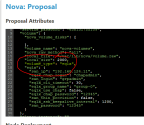
  4. Change the “volume_type” to “eqlx”
  5. Save
  6. The Equallogic options should be available in the custom attribute editor!  (of course, you can edit in raw mode too)

Want Docs?  Got them!  Check out these > EQLX Driver Install Addendum

Usage note: the integration uses SSH sessions.  It has been performance tested but not been tested at scale.

The Ceph+Nova Connector

block-ceph

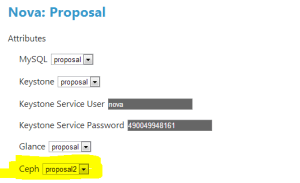
The Ceph capability includes a Ceph barclamp!  That means that all the work to setup and configure Ceph is done automatically done by Crowbar.  Even better, their Nova barclamp (Ceph provides it from their site) will automatically find the Ceph proposal and link the components together!

Ceph has provided excellent directions and videos to support this install.

The Atlantic magazine explains why Lean process rocks (and saves companies $$)

GearsI’m certain that the Atlantic‘s Charles Fishman was not thinking software and DevOps when he wrote the excellent article about “The Insourcing Boom.”  However, I strongly recommend reading this report for anyone who is interested in a practical example of the inefficiencies of software lean process (If you are impatient, jump to page 2 and search for toaster).

It’s important to realize that this article is not about software! It’s an article about industrial manufacturing and the impact that lean process has when you are making stuff.  It’s about how US companies are using Lean to make domestic plants more profitable than Asian ones.  It turns out that how you make something really matters – you can’t really optimize the system if you treat major parts like a black box.

When I talk about Agile and Lean, I am talking about proven processes being applied broadly to companies that want to make profit selling stuff. That’s what this article is about

If you are making software then you are making stuff! Your install and deploy process is your assembly line. Your unreleased code is your inventory.

This article does a good job explaining the benefits of being close to your manufacturing (DevOps) and being flexible in deployment (Agile) and being connected to customers (Lean).  The software industry often acts like it’s inventing everything from scratch. When it comes to manufacturing processes, we can learn a lot from industry.

Unlike software, industry has real costs for scrap and lost inventory. Instead of thinking “old school” perhaps we should be thinking of it as the school of hard knocks.

Open Source is The Power of We (Blog Action Day)

This post is part of a world wide “blog action day” where thousands of bloggers post their unique insights about a single theme. For 2012, it’s the “power of we is as a celebration of people working together to make a positive difference in the world, either for their own communities or for people they will never meet half way around the world.”

I’ve choosing open source software because I think that we are establishing models for building ideas collaboratively that can be extended beyond technology into broader use. The way we solve open source challenges translates broadly because we are the tool makers of the global interaction.

I started using open source¹ as a way to solve a problem; I did not understand community or how groups of loosely connected people came together to create something new. Frankly, the whole process of creating free software seemed to be some hybrid combination of ninja coders and hippy hackers. That changed when I got involve on the ground floor of the OpenStack project (of which I am now a Foundation board member).

I was not, could not have been, prepared for the power and reality of community and collaboration that fuels OpenStack and other projects. We have the same problems as any non-profit project except that we are technologists: we can make new tools to solve our teaming and process problems.

It is not just that open source projects solve problems that help people. The idea of OpenStack and Hadoop being used by medical researches to find cures for cancer is important; however, the learning how to build collaboratively is another critical dimension. Our world is getting more connected and interconnected by technology, but the actual tools for social media are only in their earliest stages.

Not only are the tools evolving, the people using the tools are changing too! We are training each other to work together in ways that were beyond our imagine even 10 years ago. It’s the combination of both new technology and new skills that is resetting the rules for collaboration.

Just a few years ago, open source technology was considered low quality, risky and fringe. Today, open source projects like OpenStack and Hadoop are seen as more innovative and equally secure and supportable compared to licensed products. This transformation represents a surprising alignment and collaboration between individuals and entities that would normally be competing. While the motivation for this behavior comes from many sources, we all share the desire to do collaborative effectively.

I don’t think that we have figured out how to really do this the best way yet. We are making progress and getting better and better. We are building tools (like etherpad, wikis, irc, twitter, github, jenkins, etc) that improve collaboration. We are also learning building a culture of collaboration.

Right now, I’m on a train bound for the semi-annual OpenStack summit that brings a world wide audience together for 4½ days of community work. The discussions will require a new degree of openness from people and companies that are normally competitive and secretive about product development. During the summit, we’ll be doing more than designing OpenStack, we will be learning the new skills of working together. Perhaps those are the most important deliverables.

Open source projects combination of both new technologies and new skills creates the Power of We.

——————

PS¹: Open source software is a growing class of applications in which the authors publish the instructions for running the software publicly so that other people can use the software. Sometimes (but not always) this includes a usage license that allows other people to run the software without paying the author royalties. In many cases, the author’s motivation is that other users will help them test, modify and improve the software so that improves more quickly than a single creator could do alone.

Growing the Dell OpenStack / Hadoop / Crowbar Team

Big companies often do things that are unexpected and interesting, but they don’t always recognize and nurture it. Fortunately, that is not the case for my team at Dell. Our team is expanding and, consequently, we’ve got job openings at all levels to fill.

We are looking for people with a passion for open source, collaboration and delivering product. Our cultural legacy is start-ups and software with a fair amount of operations, networks, hardware and “get-it-done” tossed in. We’re picky about fit and work culture too.

If you’re up for being part of our team then check out the listings below and see if one appeals to you:

  • Software Engineering Sr Manager
  • Software Development Principal Engineer / Architect
  • Sr Solutions Strategy and Planning Manager
  • Sr Technical Product Manager
  • Software Development Sr. Engineer
  • Sr. Test Engineer

We’re looking for people with Linux and Cloud Experience. Agile/Lean process is a huge help. The positions are for Austin or Nashua (near Boston) but don’t let location stop you from applying.

Dell’s careers site has lots of more details, bullet lists and legal boiler plate. I will update this post when have direct job ref #s.

Until then, if you send me (first_last@dell) a resume then I’ll make sure they get to the hiring manager.

Hadoop Crowbar released to open source! (plus AN HOUR of videos!)

I’m proud to announce that my team at Dell has open sourced our Apache Hadoop barclamps!  This release follows our Dell | Cloudera Hadoop Solution open source commitment from Hadoop World earlier this month.

As part of this release, we’ve created nearly AN HOUR of video content showing the Hadoop Barclamps in action, installing Crowbar (on CentOS), building Crowbar ISOs in the cloud and specialized developer focused builds.

If you want to talk to the Crowbar team.  We’re attending events in Boston 11/29, Seattle 11/30, and Austin 12/8.

Here are links to the videos:

More Hadoop perspectives from Dell:  Joseph George on what it means and  Barton George‘s backgrounder about barclamps.

WHIR Webinar Notes: Prying Open the Cloud with Dell Crowbar & OpenStack

Panelists: Me (@zehicle) & Joseph B. George (@jbgeorge), Director, Cloud and Big Data Solutions, Dell

Moderator: Liam Eagle (@theWHIR) , Editor-in-Chief, Web Host Industry Review

Wow, this Webinar was an hour of OpenStack insights (see the whole thing). If you don’t have the hour then you can use my time line nodes to jump to what you want to hear.

  • 2:50: Presentation Starts (introductions are over)
  • 3:40: Joseph coins the word “dynormous” for dynamic & large scale clouds
  • 4:40: Customers want to know how they are going to maintain a cloud
  • 4:50: Customers don’t want a 9 month cycle for features, want it faster. DevOps gives us the flexibility to meet our customer needs as quickly as they want to.
  • 7:11: Massive scalability… their (Rackspace & NASA) business is about scale
  • 8:00: Rackspace and NASA started from the beginning to build a community
  • 8:50: We have the data that this has staying power
  • 10:10: We see a lot of companies joining in the community
  • 11:56: Shout out to Opscode Chef
  • 12:40: From bare metal to a fully functioning cloud in under 2 hours. Crowbar allows you to introduce new elements into the environment
  • 13:40: Crowbar leverages our experience with cloud deployments
  • 14:33: Dell was the only provider there from day 1. We have the most experience.
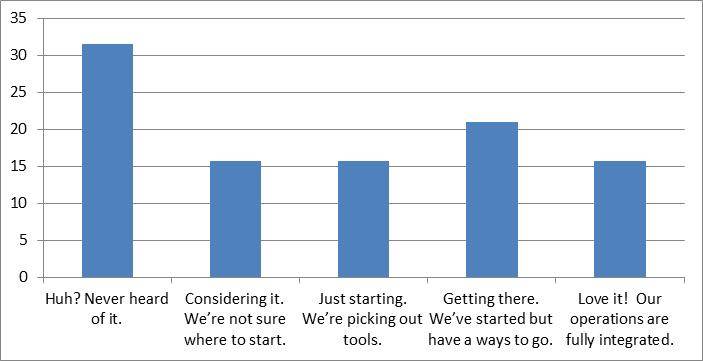
  • 17:27: DevOps Poll
  • 18:40: DevOps is a significant trend that you should consider. Hosters have a lot of operational chops.
  • 19:34: There are a lot of right ways to do cloud. You need to pick what’s best for your business model
  • 20:23: We could get hardware and software, but operational expertise was missing.
  • 21:33: We’re more making the complexity of a cloud go away. We are getting our customers a head start. We are chipping away at the learning curve.
  • 22:05: The cloud is always ready, never finished. Cloud is an ongoing operational environment: DevOps!
  • 23:30: Crowbar bakes a lot of operational experience into the deployment.
  • 25:17: Core tenant of DevOps: there is no single OpenStack image. Cloud is too complex. We build it in layers.
  • 26:26: Before you deploy, you can change the configuration.
  • 27:30: Barclamps are modules that execute a function. We are inviting community participation
  • 28:40: Crowbar process view – Crowbar is a “PXE state machine” is a very simplified description.
  • 29:57: You can go through a tuning cycle where you can get it working, make sure it’s right, flush and reset. That ensures you have an automated system.
  • 30:34: Screen shots with descriptions
  • 33:25: Event the core state machine that runs Crowbar is deployed as a barclamp
  • 35:00: You can download OpenStack and install it yourself from our github. We don’t want to talk about OpenStack, we want to DO OpenStack.
  • Poll Results (see to the right)
  • 38:00: Online resources
  • 40:00: Question 1: Timeline for RHEL. Answer: RHEL is part of Hadoop, will make it into OpenStack by end of year (or sooner based on market demand)
  • 42:17: Question 2: What led Dell to get involved in OpenStack? Answer: It’s about experience. We like being able to fix and change if we needed. There is a lot of active community
  • 45:30: Question 3: How does a hardware maker play with open source software? Answer: It’s a solution for us. We wanted to make sure that people cloud deploy the software. Adding DevOps takes it to another level.
  • 48:00 Question 4: What elements of Diablo are most exciting? Answer: Keystone (centralized authentication) is a big deal. Networking changes that “bust the top” of the networking hurdles.
  • 50:25: Question 5: Where is OpenStack going long term? Answer: We’re pleasantly surprised about how much it’s picked up. We’ll see more standards in the community. We have high hopes for OpenStack and have invested heavily. We’ll see more as-a-service capabilities to build on a common infrastructure: both open and commercial.
  • 52:47: Question 6: What’s the biggest barrier to operating at scale? Answer: learning how to operate is the biggest hurdle. We took a learning approach to help customers get started. We are hosting a training with Rackspace.
  • 55:00: Question 7: Where does Dell and Rackspace overlap? Answer: We see Rackspace Cloud Builders that the premier experts. Dell Services is involved with all of it. Dell takes the phone call and deals with our customers directly.

Build Sledgehammer, the Crowbar discovery image / build prerequisite

Note: This content has been copied to the Crowbar Wiki.
Victor “got your back” Lowther, CI & build automation czar on our team at Dell, spent a lot of time cleaning up the open source build to make it MUCH easier.  The latest build only requires ONE server for all components.  To make it repeatable and fast, I’m using a hosted VM from Rackspace Cloud.
Here are the steps that you should follow (cool: if you build before the prereqs are in place, the script will tell you what’s missing).
Note: You must build the discovery image (build_sledgehammer.sh) before building Crowbar.  This image does not change very often, so it’s helpful to cache it somewhere (like in the Crowbar cache where it normally lives) and save time.
  1. Starting from a Rackspace Cloud Ubuntu 10.10 image (512 RAM is OK, $0.03/hr)
  2. Get libraries for git, RPM, & Ruby: apt-get install git rpm ruby
  3. Get the sledgehammer repo: git clone git://github.com/dellcloudedge/crowbar-sledgehammer.git
  4. Go to sledgehammer: cd crowbar-sledgehammer
  5. Download the CentOS image: curl -o ../CentOS-5.6-x86_64-bin-DVD-1of2.iso http://mirror.cs.vt.edu/pub/CentOS/5.6/isos/x86_64/CentOS-5.6-x86_64-bin-DVD-1of2.iso
    1. takes some time (10+ mins) even in the cloud
  6. Tell the build where to look for the CentOS image: CENTOS_ISO=~/CentOS-5.6-x86_64-bin-DVD-1of2.iso ./build_sledgehammer.sh
    1. you may need to change the path of the image if you did not put it in your home directory
    1. wait a long time while magic happens and the tar gets created
    2. check out the tar ball in the /bin directory!
  7. Create the cache location for Sledgehammer: mkdir -p ~/.crowbar-build-cache
  8. Move the the cache location: cd ~/.crowbar-build-cache
  9. Extract the Sledgehammer tar: tar xzvf ~/crowbar-sledgehammer/bin/sledgehammer-tftpboot.tar.gz 
Or, use the tar copy that I’ve cached it on zehicle.com!  Then you can start at step 8.
Now you can build crowbar as per instructions (duplicated below)
  1. cd ~
  2. git clone git://github.com/dellcloudedge/crowbar.git
  3. apt-get update
  4. apt-get install build-essential mkisofs debootstrap
  5. crowbar/build_crowbar.sh
    1. kicks off a long download to create the cache (first time only!)
    2. look in the home directory for the openstack-dev.iso

Of course, you still need to INSTALL CROWBAR (as root, /tftpboot/ubuntu_dvd/extra/install) after you use the ISO to boot a VM.  Instructions on that shortly…

Virtualizing #OpenStack Nova: looking at the many ways to skin the CAcTus (#KVM v #XenServer v #ESX)

<service bulletin> Server virtualization is not cloud: it is a commonly used technology that creates convenient  resource partitions for cloud operations and infrastructure as a service providers. </service bulletin>

OpenStack claims support for nearly every virtualization platform on the market.  While the basics of “what is virtualization” are common across all platforms, there are important variances in how these platforms are deployed.   It is important to understand these variances to make informed choices about virtualization platforms. 

Your virtualization model choice will have deep implications on your server/networking choice, deployment methodology and operations infrastructure.

My focus is on architecture not specific hypervisors so I’m generalizing to just three to make the each architecture description more concrete:

  1. KVM (open source) is highly used by developers and single host systems
  2. XenServer (open/freemium) leads public cloud infrastructure (Amazon EC2, Rackspace Cloud, and GoGrid)
  3. ESX/vCenter (licensed) leads enterprise virtualized infrastructure

Of course, there are many more hypervisors and many different ways to deploy the three I’m referencing.
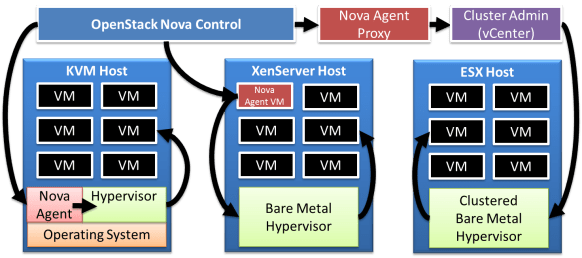
This picture shows all three options as a single system.  In practice, only operators wishing to avoid exposure to RESTful recreational activities would implement multiple virtualization architectures in a single system.   Let’s explore the three options:

OS + Hypervisor (KVM) architecture deploys the hypervisor a free standing application on top of an operating system (OS).  In this model, the service provider manages the OS and the hypervisor independently.  This means that the OS needs to be maintained, but is also allows the OS to be enhanced to better manage the cloud or add other functions (share storage).  Because they are least restricted, free standing hypervisors lead the virtualization innovation wave.

Bare Metal Hypervisor (XenServer) architecture integrates the hypervisor and the OS as a single unit.  In this model, the service provider manages the hypervisor as a single unit.  This makes it easier to support and maintain the hypervisor because the platform can be tightly controlled; however, it limits the operator’s ability to extend or multi-purpose the server.   In this model, operators may add agents directly to the individual hypervisor but would not make changes to the underlying OS or resource allocation.

Clustered Hypervisor (ESX + vCenter) architecture integrates multiple servers into a single hypervisor pool.  In this model, the service provider does not manage the individual hypervisor; instead, they operate the environment through the cluster supervisor.  This makes it easier to perform resource balancing and fault tolerance within the domain of the cluster; however, the operator must rely on the supervisor because directly managing the system creates a multi-master problem.  Lack of direct management improves supportability at the cost of flexibility.  Scale is also a challenge for clustered hypervisors because their span of control is limited to practical resource boundaries: this means that large clouds add complexity as they deal with multiple clusters.

Clearly, choosing a virtualization architecture is difficult with significant trade-offs that must be considered.  It would be easy to get lost in the technical weeds except that the ultimate choice seems to be more stylistic.
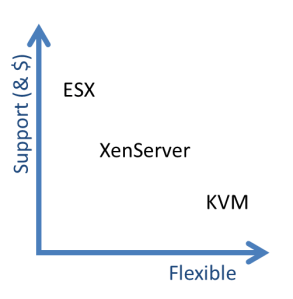
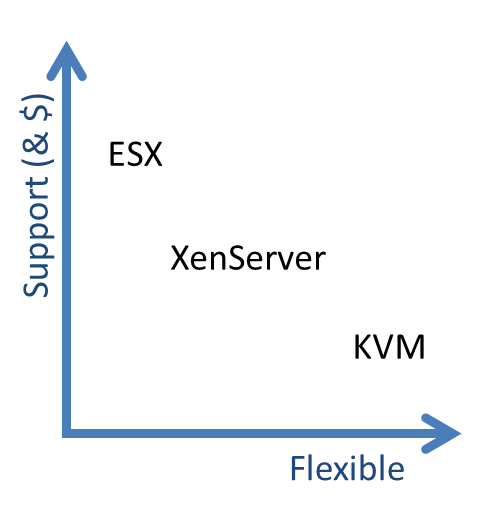
Ultimately, the choice of virtualization approach comes down to your capability to manage and support cloud operations.  The Hypervisor+OS approach maximum flexibility and minimum cost but requires an investment to build a level competence.  Generally, this choice pervades an overall approach to embrace open cloud operations.  Selecting more controlled models for virtualization reduces risk for operations and allows operators to leverage (at a price, of course) their vendor’s core competencies and mature software delivery timelines.

While all of these choices are seeing strong adoption in the general market, I have been looking at the OpenStack community in particular.  In that community, the primary architectural choice is an agent per host instead of clusters.  KVM is favored for development and is the hypervisor of NASA’s Nova implementation.  XenServer has strong support from both Citrix and Rackspace. 

Choice is good: know thyself.

OpenStack Design Conference Observations (plus IPv6 thread)

I’m not going to post OpenStack full conference summary because I spent more time talking 1 on 1 with partners and customers than participating in sessions.  Other members of the Dell team (@galthaus) did spend more time (I’ll see if he’ll post his notes).

I did lead an IPv6 unconference and those notes are below.

Overall, my observations from the conference are:

  • A constantly level of healthy debate.  For OpenStack to thrive, the community must be able to disagree, discuss and reach consensus.   I saw that going in nearly every session and hallway.  There were some pitched battles with forks and branches but no injuries.
  • Lots of adopters.  For a project that’s months old, there were lots of companies that were making plans to use OpenStack in some way.
  • Everyone was in a rush.  There’s been something of a log jam for decision making because the market is changing so fast companies seem to delay committing waiting for the “next big thing.”
  • Service Providers and implementers were out in force.
  • IPv6 is interesting to a limited audience, but consistently injected.

While IPv6 deserves more coverage here, I thought it would be worthwhile to at least preserve my notes/tweets from the IPv6 unconference discussion (To IP or not to IPv6? That will be the question.) at the OpenStack Design Summit.

NOTE: My tweets for this topic are notes, not my own experience/opinions

  • RT @opnstk_com_mgr #openstack unconference in camino real today < #IPv6 session going now – good size crowd
  • #NTT has IPv6 for VMs and tests for IPv6. If you set the mac, then you will know what the address will be.
  • it will be helpful to break out VMs to multiple networks – could have a VM on both IPv6 & IPv4
  • @zehicle @sjensen1850 (Dell) if IPv6 100% then may break infrastructure products – inside, easier to stay v4
    • you don’t want to paint yourself into a corner – IPv6 should not become your major feature requirement
  • typing IPv6 address not that hard to remember. DNS helps, but not required if you want to get to machines.
  • using IPv6 not hard – issue is the policy to do it. Until it’s forced. We need to find a path for DUAL operation.
  • chicken/egg problem. Our primary job is to make sure it works and is easy to adopt.
    • we are missing information on what options we have for transforms
  • where is the responsibility to do the translation? floating IP scheme needs to be worked out. IPv6 can make this easier.
  • idea, IPv6 should be the default. Fill gap with IPv4 as a Service? Floating needs NAT – v4aaS is LB/Proxy
  • unconference session was great! Good participation and ideas. Lots of opinions.

We had a hallway conversation after the unconference about what would force the switch.  In a character, it’s $.

Votes for IPv6 during the keynote (tweet: I’d like to hear from audience here if that’s important to them. RT to vote).  Retweeters: