Over the summer, the RackN team took a radical step with our previous Ansible Kubernetes workload install: we broke it into pieces. Why? We wanted to eliminate all “magic happens here” steps in the deployment.
 The result, DR Kompos8, is a faster, leaner, transparent and parallelized installation that allows for pluggable extensions and upgrades (video tour). We also chose the operationally simplest configuration choice: Golang binaries managed by SystemDGolang binaries managed by SystemD.
Why decompose and simplify? Let’s talk about our hard earned ops automation battle scars that let to composability as a core value:
Back in the early OpenStack days, when the project was actually much simpler, we were part of a community writing Chef Cookbooks to install it. These scripts are just a sequence of programmable steps (roles in Ops-speak) that drive the configuration of services on each node in the cluster. There is an ability to find cross-cluster information and lookup local inventory so we were able to inject specific details before the process began. However, once the process started, it was pretty much like starting a dominoes chain. If anything went wrong anywhere in the installation, we had to reset all the dominoes and start over.
Like a dominoes train, it is really fun to watch when it works. Also, like dominoes, it is frustrating to set up and fix. Often we literally were holding our breath during installation hoping that we’d anticipated every variation in the software, hardware and environment. It is no surprise that the first and must critical feature we’d created was a redeploy command.
It turned out the the ability to successfully redeploy was the critical measure for success. We would not consider a deployment complete until we could wipe the systems and rebuild it automatically at least twice.
What made cluster construction so hard? There were a three key things: cross-node dependencies (linking), a lack of service configuration (services) and isolating attribute chains (configuration).
We’ll explore these three reasons in detail for part 2 of this post tomorrow.
Even without the details, it easy to understand that we want to avoid all magic in a deployment.
For scale operations, there should never be a “push and prey” step where we are counting on timing or unknown configuration for it to succeed. Likewise, we need to eliminate “it worked from my desktop” automation too. Those systems are impossible to maintain, share and scale. Composed cluster operations addresses this problem by making work modular, predictable and transparent.
 We think Kubernetes is an awesome way to run applications at scale! Unfortunately, there’s a bootstrapping problem: we need good ways to build secure & reliable scale environments around Kubernetes. While some parts of the platform administration leverage the platform (cool!), there are fundamental operational topics that need to be addressed and questions (like upgrade and conformance) that need to be answered.
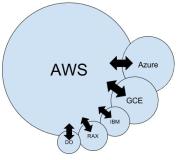 Even if you are not an AWS fan,
 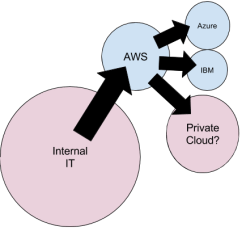 Here’s the summary:
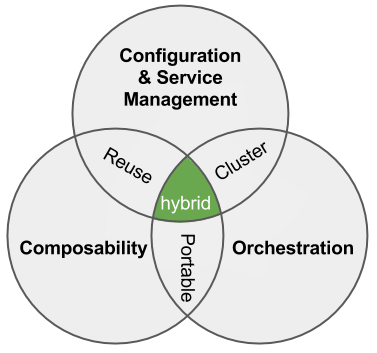 Here’s our write-up:
 awareness, you can be more secure WITHOUT putting more work for developers.
 2016 is the year we break down the monoliths. We’ve spent a lot of time talking about monolithic applications and microservices; however, there’s an equally deep challenge in ops automation.
 Rob Hirschfeld