Crowbar 2 Status Update > I can feel the rumble of the engines

two

Crowbar Two

While I’ve been more muted on our Crowbar 2 progress since our pivot back to CB1 for Grizzly, it has been going strong and steady.  We took advantage of the extra time to do some real analysis about late-binding, simulated annealing, emergent services and functional operations that are directly reflected in Crowbar’s operational model (yes, I’m working on posted explaining each concept).

We’re planning Crowbar 2 hack-a-thon in Hong Kong before the OpenStack Ice House Summit (11/1-3).  We don’t expect a big crowd on site, but the results will be fun to watch remote and it should be possible to play along (watch the crowbar list for details).

In the mean time, I wanted to pass along this comprehensive status update by Crowbar’s leading committer, Victor Lowther:

It has been a little over a month since my last status report on
Crowbar 2.0, so now that we have hit the next major milestone
(installing the OS on a node and being able to manage it afterwards),
it is time for another status report.

Major changes since the initial status report:

* The Crowbar framework understands node aliveness and availability.
* The Network barclamp is operational, and can manage IPv4 and IPv6 in
  the same network.
* delayed_jobs + a stupidly thin queuing layer handle all our
  long-running tasks.
* We have migrated to postgresql 9.3 for all our database needs.
* DHCP and DNS now utilize the on_node_* role hooks to manage their
  databases.
* We support a 2 layer deployment tree -- system on top, everything
  else in the second layer.
* The provisioner can install Ubuntu 12.04 on other nodes.
* The crowbar framework can manage other nodes that are not in
  Sledgehammer.
* We have a shiny installation wizard now.

In more detail:

Aliveness and availability:

Nodes in the Crowbar framework have two related flags that control
whether the annealer can operate on them.

Aliveness is under the control of the Crowbar framework and
encapsulates the framework's idea of whether any given node is
manageable or not.  If a node is pingable and can be SSH'ed into as
root without a password using the credentials of the root user on
the admin node, then the node is alive, otherwise it is dead.
Aliveness is tested everytime a jig tries to do something on a node
-- if a node cannot be pinged and SSH'ed into from at least one of
its addresses on the admin network, it will be marked as
dead.  When a node is marked as dead, all of the noderoles on that
node will be set to either blocked or todo (depending on the state of
their parent noderoles), and those changes will ripple down the
noderole dependency graph to any child noderoles.

Nodes will also mark themselves as alive and dead in the course of
their startup and shutdown routines.

Availability is under the control of the Crowbar cluster
administrators, and should be used by them to tell Crowbar that it
should stop managing noderoles on the node.  When a node is not
available, the annealer will not try to perform any jig runs on a
node, but it will leave the state of the noderoles alone.

A node must be both alive and available for the annealer to perform
operations on it.

The Network Barclamp:

The network barclamp is operational, with the following list of
features:

* Everything mentioned in Architecture for the Network Barclamp in
  Crowbar 2.0
* IPv6 support.  You can create ranges and routers for IPv6 addresses
  as well as IPv4 addresses, and you can tell a network that it should
  automatically assign IPv6 addresses to every node on that network by
  setting the v6prefix setting for that network to either:
  * a /64 network prefix, or
  * "auto", which will create a globally unique RFC4193 IPv6 network
    prefix from a randomly-chosen 40 bit number (unique per cluster
    installation) followed by a subnet ID based on the ID of the
    Crowbar network.
  Either way, nodes in a Crowbar network that has a v6prefix will get
  an interface ID that maps back to their FQDN via the last 64 bits of
  the md5sum of that FQDN. For now, the admin network will
  automatically create an RFC4193 IPv6 network if it is not passed a
  v6prefix so that we can easily test all the core Crowbar components
  with IPv6 as well as IPv4.  The DNS barclamp has been updated to
  create the appropriate AAAA records for any IPv6 addresses in the
  admin network.

Delayed Jobs and Queuing:

The Crowbar framework runs all jig actions in the background using
delayed_jobs + a thin queuing layer that ensures that only one task is
running on a node at any given time.  For now, we limit ourselves to
having up to 10 tasks running in the background at any given time,
which should be enough for the immediate future until we come up with
proper tuning guidelines or auto-tuning code for significantly larger
clusters.

Postgresql 9.3:

Migrating to delayed_jobs for all our background processing made it
immediatly obvious that sqlite is not at all suited to handling real
concurrency once we started doing multiple jig runs on different nodes
at a time. Postgresql is more than capable of handling our forseeable
concurrency and HA use cases, and gives us lots of scope for future
optimizations and scalability.

DHCP and DNS:

The roles for DHCP and DNS have been refactored to have seperate
database roles, which are resposible for keeping their respective
server roles up to date.  Theys use the on_node_* roles mentioned in
"Roles, nodes, noderoles, lifeycles, and events, oh my!" along with a
new on_node_change event hook create and destroy DNS and DHCP database
entries, and (in the case of DHCP) to control what enviroment a node
will PXE/UEFI boot into.  This gives us back the abiliy to boot into
something besides Sledgehammer.

Deployment tree:

Until now, the only deployment that Crowbar 2.0 knew about was the
system deployment.  The system deployment, however, cannot be placed
into proposed and therefore cannot be used for anything other than
initial bootstrap and discovery.  To do anything besides
bootstrap the admin node and discover other nodes, we need to create
another deployment to host the additional noderoles needed to allow
other workloads to exist on the cluster.  Right now, you can only
create deployments as shildren of the system deployment, limiting the
deployment tree to being 2 layers deep.

Provisioner Installing Ubuntu 12.04:

Now, we get to the first of tqo big things that were added in the last
week -- the provisioner being able to install Ubuntu 12.04 and bring
the resulting node under management by the rest of the CB 2.0
framework.  This bulds on top of the deployment tree and DHCP/DNS
database role work.  To install Ubuntu 12.04 on a node from the web UI:

1: Create a new deployment, and add the provisioner-os-install role to
that deployment.  In the future you will be able to edit the
deployment role information to change what the default OS for a
deployment should be.
2: Drag one of the non-admin nodes onto the provisioner-os-install
role.  This will create a proposed noderole binding the
provisioner-os-install role to that node, and in the future you would
be able to change what OS would be installed on that node by editing
that noderole before committing the deployment.
3: Commit the snapshot.  This will cause several things to happen:
  * The freshly-bound noderoles will transition to TODO, which will
    trigger an annealer pass on the noderoles.
  * The annealer will grab all the provisioner-os-install roles that
    are in TODO, set them in TRANSITION, and hand them off to
    delayed_jobs via the queuing system.
  * The delayed_jobs handlers will use the script jig to schedule a
    reboot of the nodes for 60 seconds in the future and then return,
    which will transition the noderole to ACTIVE.
  * In the crowbar framework, the provisioner-os-install role has an
    on_active hook which will change the boot environment of the node
    passed to it via the noderole to the appropriate os install state
    for the OS we want to install, and mark the node as not alive so
    that the annealer will ignore the node while it is being
    installed.
  * The provisioner-dhcp-database role has an on_node_change handler
    that watches for changes in the boot environment of a node.  It
    will see the bootenv change, update the provisioner-dhcp-database
    noderoles with the new bootenv for the node, and then enqueue a
    run of all of the provisioner-dhcp-database roles.
  * delayed_jobs will see the enqueued runs, and run them in the order
    they were submitted.  All the runs sholuld happen before the 60
    seconds has elapsed.
  * When the nodes finally reboot, the DHCP databases should have been
    updated and the nodes will boot into the Uubntu OS installer,
    install, and then set their bootenv to local, which will tell the
    provisioner (via the provisioner-dhcp-database on_node_change
    hook) to not PXE boot the node anymore.
  * When the nodes reboot off their freshly-installed hard drive, they
    will mark themselves as alive, and the annealer will rerun all of
    the usual discovery roles.
The semi-astute observer will have noticed some obvious bugs and race
conditions in the above sequence of steps.  These have been left in
place in the interest of expediency and as learning oppourtunities for
others who need to get familiar with the Crowbar codebase.

Installation Wizard:

We have a shiny installation that you can use to finish bootstrapping
your admin node.  To use it, pass the --wizard flag after your FQDN to
/opt/dell/bin/install-crowbar when setting up the admin node, and the
install script will not automatically create an admin network or an
entry for the admin node, and logging into the web UI will let you
customize things before creating the initial admin node entry and
committing the system deployment.  

Once we get closer to releasing CB 2.0, --wizard will become the default.

7 takeaways from DevOps Days Austin

Block Tables

I spent Tuesday and Wednesday at DevOpsDays Austin and continue to be impressed with the enthusiasm and collaborative nature of the DOD events.  We also managed to have a very robust and engaged twitter backchannel thanks to an impressive pace set by Gene Kim!

I’ve still got a 5+ post backlog from the OpenStack summit, but wanted to do a quick post while it’s top of mind.

My takeaways from DevOpsDays Austin:

  1. DevOpsDays spends a lot of time talking about culture.  I’m a huge believer on the importance of culture as the foundation for the type of fundamental changes that we’re making in the IT industry; however, it’s also a sign that we’re still in the minority if we have to talk about culture evangelism.
  2. Process and DevOps are tightly coupled.  It’s very clear that Lean/Agile/Kanban are essential for DevOps success (nice job by Dominica DeGrandis).  No one even suggested DevOps+Waterfall as a joke (but Patrick Debois had a picture of a xeroxed butt in his preso which is pretty close).
  3. Still need more Devs people to show up!  My feeling is that we’ve got a lot of operators who are engaging with developers and fewer developers who are engaging with operators (the “opsdev” people).
  4. Chef Omnibus installer is very compelling.  This approach addresses issues with packaging that were created because we did not have configuration management.  Now that we have good tooling we separate the concerns between bits, configuration, services and dependencies.  This is one thing to watch and something I expect to see in Crowbar.
  5. The old mantra still holds: If something is hard, do it more often.
  6. Eli Goldratt’s The Goal is alive again thanks to Gene Kims’s smart new novel, The Phoenix project, about DevOps and IT  (I highly recommend both, start with Kim).
  7. Not DevOps, but 3D printing is awesome.  This is clearly a game changing technology; however, it takes some effort to get right.  Dell brought a Solidoodle 3D printer to the event to try and print OpenStack & Crowbar logos (watch for this in the future).

I’d be interested in hearing what other people found interesting!  Please comment here and let me know.

OpenStack’s next hurdle: Interoperability. Why should you care?

SXSW life size Newton's Cradle

SXSW life size Newton’s Cradle

The OpenStack Board spent several hours (yes, hours) discussing interoperability related topics at the last board meeting.  Fundamentally, the community benefits when uses can operate easily across multiple OpenStack deployments (their own and/or public clouds).

Cloud interoperability: the ability to transfer workloads between systems without changes to the deployment operations management infrastructure.

This is NOT hybrid (which I defined as a workload transparently operating in multiple systems); however it is a prereq to achieve scalable hybrid operation.

Interoperability matters because the OpenStack value proposition is all about creating a common platform.  IT World does a good job laying out the problem (note, I work for Dell).  To create sites that can interoperate, we have to some serious lifting:

At the OpenStack Summit, there are multiple chances to engage on this.   I’m moderating a panel about Interop and also sharing a session about the highly related topic of Reference Architectures with Monty Tayor.

The Interop Panel (topic description here) is Tuesday @ 5:20pm.  If you join, you’ll get to see me try to stump our awesome panelists

  • Jonathan LaCour, DreamHost
  • Troy Toman, Rackspace
  • Bernard Golden,  Enstratius
  • Monty Taylor, OpenStack Board (and HP)
  • Peter Pouliot, Microsoft

PS: Oh, and I’m also talking about DevOps Upgrades Patterns during the very first session (see a preview).

5 things keeping DevOps from playing well with others (Chef, Crowbar and Upstream Patterns)

Sharing can be hardSince my earliest days on the OpenStack project, I’ve wanted to break the cycle on black box operations with open ops. With the rise of community driven DevOps platforms like Opscode Chef and Puppetlabs, we’ve reached a point where it’s both practical and imperative to share operational practices in the form of code and tooling.

Being open and collaborating are not the same thing.

It’s a huge win that we can compare OpenStack cookbooks. The real victory comes when multiple deployments use the same trunk instead of forking.

This has been an objective I’ve helped drive for OpenStack (with Matt Ray) and it has been the Crowbar objective from the start and is the keystone of our Crowbar 2 work.

This has proven to be a formidable challenge for several reasons:

  1. diverging DevOps patterns that can be used between private, public, large, small, and other deployments -> solution: attribute injection pattern is promising
  2. tooling gaps prevent operators from leveraging shared deployments -> solution: this is part of Crowbar’s mission
  3. under investing in community supporting features because they are seen as taking away from getting into production -> solution: need leadership and others with join
  4. drift between target versions creates the need for forking even if the cookbooks are fundamentally the same -> solution: pull from source approaches help create distro independent baselines
  5. missing reference architectures interfere with having a stable baseline to deploy against -> solution: agree to a standard, machine consumable RA format like OpenStack Heat.

Unfortunately, these five challenges are tightly coupled and we have to progress on them simultaneously. The tooling and community requires patterns and RAs.

The good news is that we are making real progress.

Judd Maltin (@newgoliath), a Crowbar team member, has documented the emerging Attribute Injection practice that Crowbar has been leading. That practice has been refined in the open by ATT and Rackspace. It is forming the foundation of the OpenStack cookbooks.

Understanding, discussing and supporting that pattern is an important step toward accelerating open operations. Please engage with us as we make the investments for open operations and help us implement the pattern.

Don’t complicate my cloud! It’s just infrastructure with an API

Getty MazeI’ve been “in cloud” for over 13 years (@dmcrory and I submitted patents using it starting in 2001) and I’m continually amazed at how complicated people want to make it.

For my role at Dell, I’m continually invited to seasons of meetings to define cloud, cloud architecture and cloud strategy. The reason these meetings go on and on is that everyone wants to make cloud complicated when it’s really very simple.

Cloud is infrastructure with an API.

That’s it. Everything else is just a consequence of having infrastructure with an API because API provides the ability to provide remote control.

What else do people try to lump into cloud?  Here are some of my topic cloud obfuscators:

  • (inter)network.  Yes, networks make an API interesting.  They are just an essential component but they are not cloud.  Most technologies are interesting because of networks: can we stop turning everything networked into cloud?  Thanks to nonsensical mega-dollar marketing campaigns, I despair this is a moot point.
  • as-a-service.  That’s another way of saying “accessible via an API.”  We have many flavors of Platform, Data, Application, Love or whatever as a Service.  That means they have a API.  Infrastructure as a Service (IaaS) is a cloud.
  • virtualization.  VMs were the first good example of hardware with an API; however, we had virtual containers (on Mainframes!) long before we had “cloud.”    They make cloud easier but they are not cloud.
  • pay-as-you-go (service pricing).  This is a common cloud requirement but it’s really a business model.  If someone builds a private cloud then it is still a cloud.

  • multi-tenant.  Another common requirement where we expect a cloud to be able to isolate users.  I agree that this is a highly desirable attribute of a good API implementation; however, it’s not essential to a cloud.  For example, most public clouds do not have true network isolation model.
  • elastic demand.  IMHO, another word for API driven provisioning.
  • live migration.  This is a cool feature often implemented on top of virtualization, but it’s not cloud.  We were doing live migrate with shared storage and clusters before anyone heard of cloud.   I don’t think this is cloud at all but someone out there does so I included it in the list.
  • security.  Totally important consideration and required for deployments large and small, but not presence/lack does not make something cloud.

We start talking about these points and then forget the whole API thing.  These items are important, but they do not make it “a cloud.”  When Dave McCrory and I first discussed API Infrastructure as “cloud,” it was driven by the fact that you could hide the actual infrastructure behind the API.  The critical concept was that the API allowed a you to manage a server anywhere from anywhere.

When Amazon offered the first EC2 service, it had to be a cloud because the servers were remote. It was not a cloud because it was on the internet; plenty of other companies were offering hosted servers. It was a cloud because their offering allowed required operators to use and API to interact with the infrastructure.  I remember that EC2’s lack of UI (and SLA) causing many to predict it would be a failure; instead, it sparked a revolution.

I’m excited now because we’re entering a new generation of cloud where Infrastructure APIs include networking and storage in addition to compute.  Mix in some of the interesting data and network services and we’re going to have truly dynamic and powerful clouds.  More importantly, we going to have some truly amazing applications.

What do you think?  Is API a sufficient definition of cloud in your opinion?

PS: Yes, if you have a physical server/network/store that is completely controllable by an API then you’ve got a cloud on your hands.

My Dilemma with Folsom – why I want to jump to G

When your ship sailsThese views are my own.  Based on 1×1 discussions I’ve had in the OpenStack community, I am not alone.

If you’ve read my blog then you know I am a vocal and active supporter of OpenStack who is seeking re-election to the OpenStack Board.  I’m personally and professionally committed to the project’s success. And, I’m confident that OpenStack’s collaborative community approach is out innovating other clouds.

A vibrant project requires that we reflect honestly: we have an equal measure of challenges: shadow free fall Dev, API vs implementation, forking risk and others.  As someone helping users deploy OpenStack today, I find my self straddling between a solid release (Essex) and a innovative one (Grizzly). Frankly, I’m finding it very difficult to focus on Folsom.

Grizzly excites me and clearly I’m not alone.  Based on pace of development, I believe we saw a significant developer migration during feature freeze free fall.

In Grizzly, both Cinder and Quantum will have progressed to a point where they are ready for mainstream consumption. That means that OpenStack will have achieved the cloud API trifecta of compute-store-network.

  • Cinder will get beyond the “replace Nova Volume” feature set and expands the list of connectors.
  • Quantum will get to parity with Nova Network, addresses overlapping VM IPs and goes beyond L2 with L3 feature enablement like  load balancing aaS.
  • We are having a real dialog about upgrades while the code is still in progress
  • And new projects like Celio and Heat are poised to address real use problems in billing and application formation.

Everything I hear about Folsom deployment is positive with stable code and significant improvements; however, we’re too late to really influence operability at the code level because the Folsom release is done.  This is not a new dilemma.  As operators, we seem to be forever chasing the tail of the release.

The perpetual cycle of implementing deployment after release is futile, exhausting and demoralizing because we finish just in time for the spotlight to shift to the next release.

I don’t want to slow the pace of releases.  In Agile/Lean, we believe that if something is hard then we do should it more.  Instead, I am looking at Grizzly and seeing an opportunity to break the cycle.  I am looking at Folsom and thinking that most people will be OK with Essex for a little longer.

Maybe I’m a dreamer, but if we can close the deployment time gap then we accelerate adoption, innovation and happy hour.  If that means jilting Folsom at the release altar to elope with Grizzly then I can live with that.

Do Be Dense! Dell C8000 unit merges best of bladed and rackable servers

“Double wide” is not a term I’ve commonly applied to servers, but that’s one of the cool things about this new class of servers that Dell, my employer, started shipping today.

My team has been itching for the chance to start cloud and big data reference architectures using this super dense and flexible chassis. You’ll see it included in our next Apache Hadoop release and we’ve already got customers who are making it the foundation of their deployments (Texas Adv Computing Center case study).

If you’re tracking the latest big data & cloud hardware then the Dell PowerEdge C8000 is worth some investigation.

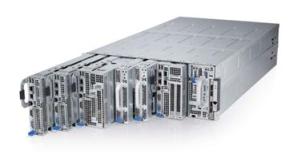
Basically, the Dell C8000 is a chassis that holds a flexible configuration of compute or storage sleds. It’s not a blade frame because the sleds minimize shared infrastructure. In our experience, cloud customers like the dedicated i/o and independence of sleds (as per the Bootstrapping clouds white paper). Those attributes are especially well suited for Hadoop and OpenStack because they support a “flat edges” and scale out design. While i/o independence is valued, we also want shared power infrastructure and density for efficiency reasons. Using a chassis design seems to capture the best of both worlds.

The novelty for the Dell PowerEdge C8000 is that the chassis are scary flexible. You are not locked into a pre-loaded server mix.

There are a plethora of sled choices so that you can mix choices for power, compute density and spindle counts. That includes double-wide sleds positively brimming with drives and expanded GPU processers. Drive density is important for big data configurations that are disk i/o hungry; however, our experience is the customer deployments are highly varied based on the planned workload. There are also significant big data trends towards compute, network, and balanced hardware configurations. Using the C8000 as a foundation is powerful because it can cater to all of these use-case mixes.

That reminds me! Mike Pittaro (our team’s Hadoop lead architect) did an excellent Deploy Hadoop using Crowbar video.

Interested in more opinions about the C8000? Check out Barton George & David Meyer.

Ops “Late Binding” is critical best practice and key to Crowbar differentiation

From OSCON 2012: Portland's light rail understands good dev practice.Late binding is a programming term that I’ve commandeered for Crowbar’s DevOps design objectives.

We believe that late binding is a best practice for CloudOps.

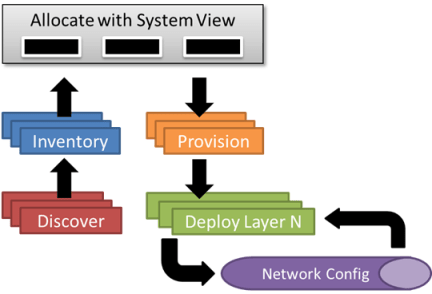
Understanding this concept is turning out to be an important but confusing differentiation for Crowbar. We’ve effectively inverted the typical deploy pattern of building up a cloud from bare metal; instead, Crowbar allows you to build a cloud from the top down.  The difference is critical – we delay hardware decisions until we have the information needed to do the correct configuration.

If Late Binding is still confusing, the concept is really very simple: “we hold off all work until you’ve decided how you want to setup your cloud.”

Late binding arose from our design objectives. We started the project with a few critical operational design objectives:

  1. Treat the nodes and application layers as an interconnected system
  2. Realize that application choices should drive down the entire application stack including BIOS, RAID and networking
  3. Expect the entire system to be in a constantly changing so we must track state and avoid locked configurations.

We’d seen these objectives as core tenets in hyperscale operators who considered bare metal and network configuration to be an integral part of their application deployment. We know it is possible to build the system in layers that only (re)deploy once the application configuration is defined.

We have all this great interconnected automation! Why waste it by having to pre-stage the hardware or networking?

In cloud, late binding is known as “elastic computing” because you wait until you need resources to deploy. But running apps on cloud virtual machines is simple when compared to operating a physical infrastructure. In physical operations, RAID, BIOS and networking matter a lot because there are important and substantial variations between nodes. These differences are what drive late binding as a one of Crowbar’s core design principles.

Late Binding Visualized

The real workloads begin: Crowbar’s Sophomore Year

Given Crowbar‘s frenetic Freshman year, it’s impossible to predict everything that Crowbar could become. I certainly aspire to see the project gain a stronger developer community and the seeds of this transformation are sprouting. I also see that community driven work is positioning Crowbar to break beyond being platforms for OpenStack and Apache Hadoop solutions that pay the bills for my team at Dell to invest in Crowbar development.

I don’t have to look beyond the summer to see important development for Crowbar because of the substantial goals of the Crowbar 2.0 refactor.

Crowbar 2.0 is really just around the corner so I’d like to set some longer range goals for our next year.

  • Growing acceptance of Crowbar as an in data center extension for DevOps tools (what I call CloudOps)
  • Deeper integration into more operating environments beyond the core Linux flavors (like virtualization hosts, closed and special purpose operating systems.
  • Improvements in dynamic networking configuration
  • Enabling more online network connected operating modes
  • Taking on production ops challenges of scale, high availability and migration
  • Formalization of our community engagement with summits, user groups, and broader developer contributions.

For example, Crowbar 2.0 will be able to handle downloading packages and applications from the internet. Online content is not a major benefit without being able to stage and control how those new packages are deployed; consequently, our goals remains tightly focused improvements in orchestration.

These changes create a foundation that enables a more dynamic operating environment. Ultimately, I see Crowbar driving towards a vision of fully integrated continuous operations; however, Greg & Rob’s Crowbar vision is the topic for tomorrow’s post.

Our Vision for Crowbar – taking steps towards closed loop operations

When Greg Althaus and I first proposed the project that would become Dell’s Crowbar, we had already learned first-hand that there was a significant gap in both the technologies and the processes for scale operations. Our team at Dell saw that the successful cloud data centers were treating their deployments as integrated systems (now called DevOps) in which configuration of many components where coordinated and orchestrated; however, these approaches feel short of the mark in our opinion. We wanted to create a truly integrated operational environment from the bare metal through the networking up to the applications and out to the operations tooling.

Our ultimate technical nirvana is to achieve closed-loop continuous deployments. We want to see applications that constantly optimize new code, deployment changes, quality, revenue and cost of operations. We could find parts but not a complete adequate foundation for this vision.

The business driver for Crowbar is system thinking around improved time to value and flexibility. While our technical vision is a long-term objective, we see very real short-term ROI. It does not matter if you are writing your own software or deploying applications; the faster you can move that code into production the sooner you get value from innovation. It is clear to us that the most successful technology companies have reorganized around speed to market and adapting to pace of change.

System flexibility & acceleration were key values when lean manufacturing revolution gave Dell a competitive advantage and it has proven even more critical in today’s dynamic technology innovation climate.

We hope that this post helps define a vision for Crowbar beyond the upcoming refactoring. We started the project with the idea that new tools meant we could take operations to a new level.

While that’s a great objective, we’re too pragmatic in delivery to rest on a broad objective. Let’s take a look at Crowbar’s concrete strengths and growth areas.

Key strength areas for Crowbar

  1. Late binding – hardware and network configuration is held until software configuration is known.  This is a huge system concept.
  2. Dynamic and Integrated Networking – means that we treat networking as a 1st class citizen for ops (sort of like software defined networking but integrated into the application)
  3. System Perspective – no Application is an island.  You can’t optimize just the deployment, you need to consider hardware, software, networking and operations all together.
  4. Bootstrapping (bare metal) – while not “rocket science” it takes a lot of careful effort to get this right in a way that is meaningful in a continuous operations environment.
  5. Open Source / Open Development / Modular Design – this problem is simply too complex to solve alone.  We need to get a much broader net of environments and thinking involved.

Continuing Areas of Leadership

  1. Open / Lean / Incremental Architecture – these are core aspects of our approach.  While we have a vision, we also are very open to ways that solve problems faster and more elegantly than we’d expected.
  2. Continuous deployment – we think the release cycles are getting faster and the only way to survive is the build change into the foundation of operations.
  3. Integrated networking – software defined networking is cool, but not enough.  We need to have semantics that link applications, networks and infrastructure together.
  4. Equilivent physical / virtual – we’re not saying that you won’t care if it’s physical or virtual (you should), we think that it should not impact your operations.
  5. Scale / Hybrid – the key element to hybrid is scale and to hybrid is scale.  The missing connection is being able to close the loop.
  6. Closed loop deployment – seeking load management, code quality, profit, and cost of operations as factor in managed operations.