The Atlantic magazine explains why Lean process rocks (and saves companies $$)

GearsI’m certain that the Atlantic‘s Charles Fishman was not thinking software and DevOps when he wrote the excellent article about “The Insourcing Boom.”  However, I strongly recommend reading this report for anyone who is interested in a practical example of the inefficiencies of software lean process (If you are impatient, jump to page 2 and search for toaster).

It’s important to realize that this article is not about software! It’s an article about industrial manufacturing and the impact that lean process has when you are making stuff.  It’s about how US companies are using Lean to make domestic plants more profitable than Asian ones.  It turns out that how you make something really matters – you can’t really optimize the system if you treat major parts like a black box.

When I talk about Agile and Lean, I am talking about proven processes being applied broadly to companies that want to make profit selling stuff. That’s what this article is about

If you are making software then you are making stuff! Your install and deploy process is your assembly line. Your unreleased code is your inventory.

This article does a good job explaining the benefits of being close to your manufacturing (DevOps) and being flexible in deployment (Agile) and being connected to customers (Lean).  The software industry often acts like it’s inventing everything from scratch. When it comes to manufacturing processes, we can learn a lot from industry.

Unlike software, industry has real costs for scrap and lost inventory. Instead of thinking “old school” perhaps we should be thinking of it as the school of hard knocks.

My Dilemma with Folsom – why I want to jump to G

When your ship sailsThese views are my own.  Based on 1×1 discussions I’ve had in the OpenStack community, I am not alone.

If you’ve read my blog then you know I am a vocal and active supporter of OpenStack who is seeking re-election to the OpenStack Board.  I’m personally and professionally committed to the project’s success. And, I’m confident that OpenStack’s collaborative community approach is out innovating other clouds.

A vibrant project requires that we reflect honestly: we have an equal measure of challenges: shadow free fall Dev, API vs implementation, forking risk and others.  As someone helping users deploy OpenStack today, I find my self straddling between a solid release (Essex) and a innovative one (Grizzly). Frankly, I’m finding it very difficult to focus on Folsom.

Grizzly excites me and clearly I’m not alone.  Based on pace of development, I believe we saw a significant developer migration during feature freeze free fall.

In Grizzly, both Cinder and Quantum will have progressed to a point where they are ready for mainstream consumption. That means that OpenStack will have achieved the cloud API trifecta of compute-store-network.

  • Cinder will get beyond the “replace Nova Volume” feature set and expands the list of connectors.
  • Quantum will get to parity with Nova Network, addresses overlapping VM IPs and goes beyond L2 with L3 feature enablement like  load balancing aaS.
  • We are having a real dialog about upgrades while the code is still in progress
  • And new projects like Celio and Heat are poised to address real use problems in billing and application formation.

Everything I hear about Folsom deployment is positive with stable code and significant improvements; however, we’re too late to really influence operability at the code level because the Folsom release is done.  This is not a new dilemma.  As operators, we seem to be forever chasing the tail of the release.

The perpetual cycle of implementing deployment after release is futile, exhausting and demoralizing because we finish just in time for the spotlight to shift to the next release.

I don’t want to slow the pace of releases.  In Agile/Lean, we believe that if something is hard then we do should it more.  Instead, I am looking at Grizzly and seeing an opportunity to break the cycle.  I am looking at Folsom and thinking that most people will be OK with Essex for a little longer.

Maybe I’m a dreamer, but if we can close the deployment time gap then we accelerate adoption, innovation and happy hour.  If that means jilting Folsom at the release altar to elope with Grizzly then I can live with that.

OpenStack Summit: Let’s talk DevOps, Fog, Upgrades, Crowbar & Dell

If you are coming to the OpenStack summit in San Diego next week then please find me at the show! I want to hear from you about the Foundation, community, OpenStack deployments, Crowbar and anything else.  Oh, and I just ordered a handful of Crowbar stickers if you wanted some CB bling.

Matt Ray (Opscode), Jason Cannavale (Rackspace) and I were Ops track co-chairs. If you have suggestions, we want to hear. We managed to get great speakers and also some interesting sessions like DevOps panel and up streaming deploy working sessions. It’s only on Monday and Tuesday, so don’t snooze or you’ll miss it.

My team from Dell has a lot going on, so there are lots of chances to connect with us:

At the Dell booth, Randy Perryman will be sharing field experience about hardware choices. We’ve got a lot of OpenStack battle experience and we want to compare notes with you.

I’m on the board meeting on Monday so likely occupied until the Mirantis party.

See you in San Diego!

PS: My team is hiring for Dev, QA and Marketing. Let me know if you want details.

Continuous Release combats disruptions of “Free Fall” development

Since I posted the “Free Fall” development post, I’ve been thinking a bit about the pros and cons of this type of off-release development.

The OpenStack Swift project does not do free fall because they are on a constant “ship ready” state for the project and only loosely flow the broader OpenStack release track.  My team at Dell also has minimal free fall development because we have a more frequent release clock and choose to have the team focus together through dev/integrate/harden cycles as much as possible.

From a Lean/Agile/CI perspective, I would work to avoid hidden development where possible.  New features are introduced by split test (they are in the code, but not active for most users) so that the all changes in incremental.  That means that refactoring, rearchitecture and new capabilities appear less disruptively.  While it may this approach appears to take more effort in the short term; my experience is that it accelerates delivery because we are less likely to over develop code.

Unfortunately, free fall development has the opposite effect.  Having code that appears in big blocks is contrary to best practices in my opinion.  Further, it rewards groups that work asynchronously and

While I think that OpenStack benefits from free fall work, I think that it is ultimately counter-productive.

Do Be Dense! Dell C8000 unit merges best of bladed and rackable servers

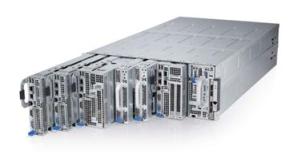
“Double wide” is not a term I’ve commonly applied to servers, but that’s one of the cool things about this new class of servers that Dell, my employer, started shipping today.

My team has been itching for the chance to start cloud and big data reference architectures using this super dense and flexible chassis. You’ll see it included in our next Apache Hadoop release and we’ve already got customers who are making it the foundation of their deployments (Texas Adv Computing Center case study).

If you’re tracking the latest big data & cloud hardware then the Dell PowerEdge C8000 is worth some investigation.

Basically, the Dell C8000 is a chassis that holds a flexible configuration of compute or storage sleds. It’s not a blade frame because the sleds minimize shared infrastructure. In our experience, cloud customers like the dedicated i/o and independence of sleds (as per the Bootstrapping clouds white paper). Those attributes are especially well suited for Hadoop and OpenStack because they support a “flat edges” and scale out design. While i/o independence is valued, we also want shared power infrastructure and density for efficiency reasons. Using a chassis design seems to capture the best of both worlds.

The novelty for the Dell PowerEdge C8000 is that the chassis are scary flexible. You are not locked into a pre-loaded server mix.

There are a plethora of sled choices so that you can mix choices for power, compute density and spindle counts. That includes double-wide sleds positively brimming with drives and expanded GPU processers. Drive density is important for big data configurations that are disk i/o hungry; however, our experience is the customer deployments are highly varied based on the planned workload. There are also significant big data trends towards compute, network, and balanced hardware configurations. Using the C8000 as a foundation is powerful because it can cater to all of these use-case mixes.

That reminds me! Mike Pittaro (our team’s Hadoop lead architect) did an excellent Deploy Hadoop using Crowbar video.

Interested in more opinions about the C8000? Check out Barton George & David Meyer.

Cloud Dev Laptop

This post is in response to multiple requests I’ve gotten from people outside of Dell.  My apologies if it is too commercial.  I work for Dell  and we make hot laptops AND clouds.
When you’re building clouds (as opposed to cloud applications), you need heavy equipment.  So it’s no surprise that I use a Precision M6600 17″ laptop that is capable of running a complete multi-node cloud data center.
IMHO, here are the core requirements for a Cloud Builder laptop:
  1. SSDs (I have two 1/4 TB of SSD):  We are constantly building/installing operating systems.  These are high I/O activities so SSDs are essential.  I’m constantly on the edge of no free space even with 1/2 TB .
  2. RAM (I have 32 Gb): It’s normal for us to run multiple VMs.  If you RAM starve your VMs (I used to have 16) then they page fault and you’re back to constrained disk I/O.  We assign 4 GB RAM per VM because it’s just faster.
  3. Many Cores: VMs w/ 1 CPU = thread contention.  Adding RAM and Disk can’t fix a threading issues.
  4. Bonus: I like a good keyboard and big display – I code, type & read a lot so the 17″ display helps.
For our devs, a normal cycle is write (desktop) -> build (in a VM) -> deploy (on additional VMs) -> full test requires >4 VMs (that’s over 16 GB RAM).  I don’t want to check in code until I complete that cycle.  On small RAM and spinning HDD  that cycle takes >1 hour.  On my laptop it is <15 minutes!
There are only a few models of laptop that can pack that type of power and they demand a premium; however, the extra umph translates into at least 3 or 4 more full cycles per day.  That’s a whole lot of extra productivity.

Open Community Access to Crowbar 2 Efforts

We’re moving along on the Crowbar2 refactoring work (`/release/rails3anddb/master` branch for now) and it’s time to start making it easier for you to participate if you are interested.

We are planning to start having TWO weekly community sprint meetings.

NOTE: Times can still shift depending on community input! We are trying to a truly global community so we need your input.

The weekly design discussions will be on Tuesdays @ 10am Central (GMT -6). The topics will be relevant to the coming sprint and we expect dialog. The topics will be determined by Greg Althaus based on progress on the refactor. You’re welcome to contact him or the list with suggestions.

The purpose of these meetings is to

  • discuss/resolve design related to the refactor
  • Document use-cases
  • identify issues that need to be addressed in the next sprint

The weekly coordination meetings will be on Thursdays @ 8am Central (GMT -6). We want to respect everyone’s time and will strictly limit these to 1 hour. This meeting is in between our internal sprint review and planning so we have flexibility to adjust our plans based on your input. It is important to us that we make it possible for you to contribute and we need your input to make sure that you are not blocked!

The coordination meetings will be structured as follows (times approximate)

  • Voice & Screencast: https://join.me/dellcrowbar
  • 25 minutes for review of current progress
  • 10 minutes for feedback/adjustments on process and workflow
  • 25 minutes for planning of next sprint
  • Online discussion & notes on the http://crowbar.sync.in/sprintMMDD etherpads
  • Identification of working groups for further discussion and coding collaboration

These meetings are the primary way that we will be making sure the community is not blocked by our development efforts.

The purpose of these meetings is

  • to synchronize quickly so that we can connect the people who should be collaborating
  • eliminate blocking items for Crowbar contributors

Of course, we will attempt to record and post all of these meetings.

Stay tuned! We will likely announce additional meetings for community collaboration.

PS: These are design meetings, they are NOT Crowbar training meetings. Please consult http://bit.ly/crowbarwiki for links and videos about learning Crowbar.

Which side of the desk are the drawers on? (Dunkelisms)

Back in 2001, I had the pleasure to have some long conversations with Phil Dunkelberger.  The impact of those meetings still resonates with me today in a collection of “Dunkelisms” that are an invaluable part of my kick-ass-and-take-names tool box.  I can’t find any Internet source, so I’ll take it on myself to archive these jewels!

Which side of the desk are the drawers on?

I was sitting with Phil and complaining that our web site was not updated and the information was inaccurate.  He looked at me and asked me “which side of the desk are the drawers on?” and completely threw me for a loop.  He explained “when you’re the boss, you sit on the side of the desk with the drawers on it.  You have the power to make changes.”

I whined back that it was Marketing’s job to update the content.  I squirmed under his glare until he asked “as a programmer, do you have ability to update the web site?”  When I said, “yes, but…” his glare wilted my desk plant and the rest of my excuse died with it.

His reply was very crisp, “you have the power to fix it because you have access to the web servers.  If it’s a real problem then the drawers are on your side of the desk.  If it’s not a real problem then help Marketing solve it or move on.”

I’m not saying it would be the right move politically, but it was amazingly powerful to acknowledge that I had the power to fix the problem if I needed.

There are many situations where we voluntarily give up power even when the drawers are on our side of the desk.  For example, when my team is planning we expect Marketing to set priorities that drive development.  Engineering goes along with this for a lot of good reasons; however, the Engineering has the drawers on what really goes into the product.

This Dunkelism helps me align priorities and eliminate roadblocks.  As I dig deeper and deeper into community driven open source projects, I find that the idea behind this expression is a mantra that drives projects forward.

I find this expression very powerful in many situations.  I hope you find it helpful too!

Ops “Late Binding” is critical best practice and key to Crowbar differentiation

From OSCON 2012: Portland's light rail understands good dev practice.Late binding is a programming term that I’ve commandeered for Crowbar’s DevOps design objectives.

We believe that late binding is a best practice for CloudOps.

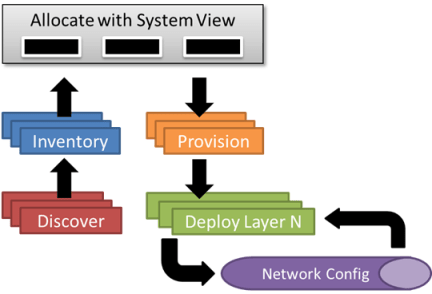
Understanding this concept is turning out to be an important but confusing differentiation for Crowbar. We’ve effectively inverted the typical deploy pattern of building up a cloud from bare metal; instead, Crowbar allows you to build a cloud from the top down.  The difference is critical – we delay hardware decisions until we have the information needed to do the correct configuration.

If Late Binding is still confusing, the concept is really very simple: “we hold off all work until you’ve decided how you want to setup your cloud.”

Late binding arose from our design objectives. We started the project with a few critical operational design objectives:

  1. Treat the nodes and application layers as an interconnected system
  2. Realize that application choices should drive down the entire application stack including BIOS, RAID and networking
  3. Expect the entire system to be in a constantly changing so we must track state and avoid locked configurations.

We’d seen these objectives as core tenets in hyperscale operators who considered bare metal and network configuration to be an integral part of their application deployment. We know it is possible to build the system in layers that only (re)deploy once the application configuration is defined.

We have all this great interconnected automation! Why waste it by having to pre-stage the hardware or networking?

In cloud, late binding is known as “elastic computing” because you wait until you need resources to deploy. But running apps on cloud virtual machines is simple when compared to operating a physical infrastructure. In physical operations, RAID, BIOS and networking matter a lot because there are important and substantial variations between nodes. These differences are what drive late binding as a one of Crowbar’s core design principles.

Late Binding Visualized

The real workloads begin: Crowbar’s Sophomore Year

Given Crowbar‘s frenetic Freshman year, it’s impossible to predict everything that Crowbar could become. I certainly aspire to see the project gain a stronger developer community and the seeds of this transformation are sprouting. I also see that community driven work is positioning Crowbar to break beyond being platforms for OpenStack and Apache Hadoop solutions that pay the bills for my team at Dell to invest in Crowbar development.

I don’t have to look beyond the summer to see important development for Crowbar because of the substantial goals of the Crowbar 2.0 refactor.

Crowbar 2.0 is really just around the corner so I’d like to set some longer range goals for our next year.

  • Growing acceptance of Crowbar as an in data center extension for DevOps tools (what I call CloudOps)
  • Deeper integration into more operating environments beyond the core Linux flavors (like virtualization hosts, closed and special purpose operating systems.
  • Improvements in dynamic networking configuration
  • Enabling more online network connected operating modes
  • Taking on production ops challenges of scale, high availability and migration
  • Formalization of our community engagement with summits, user groups, and broader developer contributions.

For example, Crowbar 2.0 will be able to handle downloading packages and applications from the internet. Online content is not a major benefit without being able to stage and control how those new packages are deployed; consequently, our goals remains tightly focused improvements in orchestration.

These changes create a foundation that enables a more dynamic operating environment. Ultimately, I see Crowbar driving towards a vision of fully integrated continuous operations; however, Greg & Rob’s Crowbar vision is the topic for tomorrow’s post.