Starting RackN – Delivering open ops by pulling an OpenCrowbar Bunny out of our hat

When Dell pulled out from OpenCrowbar last April, I made a commitment to our community to find a way to keep it going.  Since my exit from Dell early in October 2014, that commitment has taken the form of RackN.

Rack N BlackToday, we’re ready to help people run and expand OpenCrowbar (days away from v2.1!). We’re also seeking investment to make the project more “enterprise-ready” and build integrations that extend ready state.

RackN focuses on maintenance and support of OpenCrowbar for ready state physical provisioning.  We will build the community around Crowbar as an open operations core and extend it with a larger set of hardware support and extensions.  We are building partnerships to build application integration (using Chef, Puppet, Salt, etc) and platform workloads (like OpenStack, Hadoop, Ceph, CloudFoundry and Mesos) above ready state.

I’ve talked with hundreds of people about the state of physical data center operations at scale. Frankly, it’s a scary state of affairs: complexity is increasing for physical infrastructure and we’re blurring the lines by adding commodity networking with local agents into the mix.

Making this jumble of stuff work together is not sexy cloud work – I describe it as internet plumbing to non-technical friends.  It’s unforgiving, complex and full of sharp edge conditions; however, people are excited to hear about our hardware abstraction mission because it solves a real pain for operators.

I hope you’ll stay tuned, or even play along, as we continue the Open Ops journey.

Unicorn captured! Unpacking multi-node OpenStack Juno from ready state.

OpenCrowbar Packstack install demonstrates that abstracting hardware to ready state smooths install process.  It’s a working balance: Crowbar gets the hardware, O/S & networking right while Packstack takes care of OpenStack.

LAYERSThe Crowbar team produced the first open OpenStack installer back in 2011 and it’s been frustrating to watch the community fragment around building a consistent operational model.  This is not an OpenStack specific problem, but I think it’s exaggerated in a crowded ecosystem.

When I step back from that experience, I see an industry wide pattern of struggle to create scale deployments patterns that can be reused.  Trying to make hardware uniform is unicorn hunting, so we need to create software abstractions.  That’s exactly why IaaS is powerful and the critical realization behind the OpenCrowbar approach to physical ready state.

So what has our team created?  It’s not another OpenStack installer – we just made the existing one easier to use.

We build up a ready state infrastructure that makes it fast and repeatable to use Packstack, one of the leading open OpenStack installers.  OpenCrowbar can do the same for the OpenStack Chef cookbooks or Salt Formula.   It can even use Saltstack, Chef and Puppet together (which we do for the Packstack work)!  Plus we can do it on multiple vendors hardware and with different operating systems.   Plus we build the correct networks!

For now, the integration is available as a private beta (inquiries welcome!) because our team is not in the OpenStack support business – we are in the “get scale systems to ready state and integrate” business.  We are very excited to work with people who want to take this type of functionality to the next level and build truly repeatable, robust and upgradable application deployments.

Need a physical ops baseline? Crowbar continues to uniquely fill gap

Robots Everywhere!I’ve been watching to see if other open “bare metal” projects would morph to match the system-level capabilities that we proved in Crowbar v1 and honed in the re-architecture of OpenCrowbar.  The answer appears to be that Crowbar simply takes a broader approach to solving the physical ops repeatably problem.

Crowbar Architect Victor Lowther says “What makes Crowbar a better tool than Cobbler, Razor, or Foreman is that Crowbar has an orchestration engine that can be used to safely and repeatably deploy complex workloads across large numbers of machines. This is different from (and better than, IMO) just being able to hand responsibility off to Chef/Puppet/Salt, because we can manage the entire lifecycle of a machine where Cobbler, Razor and Chef cannot, we can describe how we want workloads configured at a more abstract level than Foreman can, and we do it all using the same API and UI.”

Since we started with a vision of an integrated system to address the “apply-rinse-repeat” cycle; it’s no surprise that Crowbar remains the only open platform that’s managed to crack the complete physical deployment life-cycle.

The Crowbar team realized that it’s not just about automation setting values: physical ops requires orchestration to make sure the values are set in the correct sequence on the appropriate control surface including DNS, DHCP, PXE, Monitoring, et cetera.  Unlike architectures for aaS platforms, the heterogeneous nature of the physical control planes requires a different approach.

We’ve seen that making more and more complex kickstart scripts or golden images is not a sustainable solution.  There is simply too much hardware variation and dependency thrash for operators to collaborate with those tools.  Instead, we’ve found that decomposing the provisioning operations into functional layers with orchestration is much more multi-site repeatable.

Accepting that physical ops (discovered infrastructure) is fundamentally different from cloud ops (created infrastructure) has been critical to architecting platforms that were resilient enough for the heterogeneous infrastructure of data centers.

If we want to start cleaning up physical ops, we need to stop looking at operating system provisioning in isolation and start looking at the full server bring up as just a part of a broader system operation that includes networking, management and operational integration.

OpenCrowbar 2.B to deliver multiple hardware vendor support and advanced integrations

I’ve stayed quiet on the subject of Crowbar for a few months, but that does not mean that Crowbar has been.  Activity has been picking up, after Dell pulled resources off, to complete hardware configuration.

[Disclosure: As of 10/3/2014, I am no longer a Dell employee]

With the re-addition of hardware configuration, OpenCrowbar delivers the essential requirements for Ready State and we’ve piloted integration that shows how to drive Crowbar via the API.

From BuildersKnowledge

There has been substantial burn-down on the Broom release theme of hardware workload deliverable which mainly focus on the IPMI/BMC, RAID and BIOS functions working in the framework.  It has required us to add additional out-of-band abstractions (“hammers”) and node abstractions (“quirks”).

We’ve also had a chance to work ahead on the Camshaft release theme of tools integration components like:

  •         SaltStack Integration – Crowbar sets up a Salt master and minions on discovered metal (pull request)
  •         Chef Metal Integration – a Chef Metal driver talks to the Crowbar API to claim discovered servers from an allocation pool (Judd’s repo).
  •         Puppet Integration – Crowbar is able to use the stand-alone mode to execute Puppet manifests on the nodes (as a replacement for Foreman) (puppet sa client).
  •         Chef Integration – not new, but worth including in the list so it’s not overlooked! (chef-client install)
  • We also added some essential operational configurations including Squid proxy setup and auto configuration and preparing a Consul foundation for future integration with HashiCorp tools

These initial integration are key to being able to bring in OpenStack via Packstack, Chef Cookbooks, or Salt formulas.  Since Crowbar is agnostic about OS, Hardware and Configuration Management tools (Chef, Puppet, Salt), I am seeing interest from several fronts in parallel.  There seems to be substantial interest in RDO + Centos 7 using Packstack or Chef.  Happily, OpenCrowbar.Broom is ready to sweep in those workloads.

There is significant need for Crowbar to deliver ready state under these deployers.  For example, preparing the os, disk, monitoring, cache, networking and SDN infrastructure (OVS, Contrails) are outside the scripts but essential to a sustainable deployment.

These ready state configurations are places where Crowbar creates repeatable cross-platform base that spans the operational choices.

Apply, Rinse, Repeat! How do I get that DevOps conditioner out of my hair?

I’ve been trying to explain the pain Tao of physical ops in a way that’s accessible to people without scale ops experience.   It comes down to a yin-yang of two elements: exploding complexity and iterative learning.

Science = Explosions!Exploding complexity is pretty easy to grasp when we stack up the number of control elements inside a single server (OS RAID, 2 SSD cache levels, 20 disk JBOD, and UEFI oh dear), the networks that server is connected to, the multi-layer applications installed on the servers, and the change rate of those applications.  Multiply that times 100s of servers and we’ve got a problem of unbounded scope even before I throw in SDN overlays.

But that’s not the real challenge!  The bigger problem is that it’s impossible to design for all those parameters in advance.

When my team started doing scale installs 5 years ago, we assumed we could ship a preconfigured system.  After a year of trying, we accepted the reality that it’s impossible to plan out a scale deployment; instead, we had to embrace a change tolerant approach that I’ve started calling “Apply, Rinse, Repeat.”

Using Crowbar to embrace the in-field nature of design, we discovered a recurring pattern of installs: we always performed at least three full cycle installs to get to ready state during every deployment.

  1. The first cycle was completely generic to provide a working baseline and validate the physical environment.
  2. The second cycle attempted to integrate to the operational environment and helped identify gaps and needed changes.
  3. The third cycle could usually interconnect with the environment and generally exposed new requirements in the external environment
  4. The subsequent cycles represented additional tuning, patches or redesigns that could only be realized after load was applied to the system in situ.

Every time we tried to shortcut the Apply-Rinse-Repeat cycle, it actually made the total installation longer!  Ultimately, we accepted that the only defense was to focus on reducing A-R-R cycle time so that we could spend more time learning before the next cycle started.

a Ready State analogy: “roughed in” brings it Home for non-ops-nerds

I’ve been seeing great acceptance on the concept of ops Ready State.  Technologists from both ops and dev immediately understand the need to “draw a line in the sand” between system prep and installation.  We also admit that getting physical infrastructure to Ready State is largely taken for granted; however, it often takes multiple attempts to get it right and even small application changes can require a full system rebuild.

Since even small changes can redefine the ready state requirements, changing Ready State can feel like being told to tear down your house so you remodel the kitchen.

Foundation RawA friend asked me to explain “Ready State” in non-technical terms.  So far, the best analogy that I’ve found is when a house is “Roughed In.”  It’s helpful if you’ve ever been part of house construction but may not be universally accessible so I’ll explain.

Foundation PouredGetting to Rough In means that all of the basic infrastructure of the house is in place but nothing is finished.  The foundation is poured, the plumbing lines are placed, the electrical mains are ready, the roof on and the walls are up.  The house is being built according to architectural plans and major decisions like how many rooms there are and the function of the rooms (bathroom, kitchen, great room, etc).  For Ready State, that’s like having the servers racked and setup with Disk, BIOS, and network configured.

Framed OutWhile we’ve built a lot, rough in is a relatively early milestone in construction.  Even major items like type of roof, siding and windows can still be changed.  Speaking of windows, this is like installing an operating system in Ready State.  We want to consider this as a distinct milestone because there’s still room to make changes.  Once the roof and exteriors are added, it becomes much more disruptive and expensive to make.

Roughed InOnce the house is roughed in, the finishing work begins.  Almost nothing from roughed in will be visible to the people living in the house.  Like a Ready State setup, the users interact with what gets laid on top of the infrastructure.  For homes it’s the walls, counters, fixtures and following.  For operators, its applications like Hadoop, OpenStack or CloudFoundry.

Taking this analogy back to where we started, what if we could make rebuilding an entire house take just a day?!  In construction, that’s simply not practical; however, we’re getting to a place in Ops where automation makes it possible to reconstruct the infrastructure configuration much faster.

While we can’t re-pour the foundation (aka swap out physical gear) instantly, we should be able to build up from there to ready state in a much more repeatable way.

Ops Bridges > Building a Sharable Ops Infrastructure with Composable Tool Chain Orchestration

This posted started from a discussion with Judd Maltin that he documented in a post about “wanting a composable run deck.”

Fitz and Trantrums: Breaking the Chains of LoveI’ve had several conversations comparing OpenCrowbar with other “bare metal provisioning” tools that do thing like serve golden images to PXE or IPXE server to help bootstrap deployments.  It’s those are handy tools, they do nothing to really help operators drive system-wide operations; consequently, they have a limited system impact/utility.

In building the new architecture of OpenCrowbar (aka Crowbar v2), we heard very clearly to have “less magic” in the system.  We took that advice very seriously to make sure that Crowbar was a system layer with, not a replacement to, standard operations tools.

Specifically, node boot & kickstart alone is just not that exciting.  It’s a combination of DHCP, PXE, HTTP and TFTP or DHCP and an IPXE HTTP Server.   It’s a pain to set this up, but I don’t really get excited about it anymore.   In fact, you can pretty much use open ops scripts (Chef) to setup these services because it’s cut and dry operational work.

Note: Setting up the networking to make it all work is perhaps a different question and one that few platforms bother talking about.

So, if doing node provisioning is not a big deal then why is OpenCrowbar important?  Because sustaining operations is about ongoing system orchestration (we’d say an “operations model“) that starts with provisioning.

It’s not the individual services that’s critical; it’s doing them in a system wide sequence that’s vital.

Crowbar does NOT REPLACE the services.  In fact, we go out of our way to keep your proven operations tool chain.  We don’t want operators to troubleshoot our IPXE code!  We’d much rather use the standard stuff and orchestrate the configuration in a predicable way.

In that way, OpenCrowbar embraces and composes the existing operations tool chain into an integrated system of tools.  We always avoid replacing tools.  That’s why we use Chef for our DSL instead of adding something new.

What does that leave for Crowbar?  Crowbar is providing a physical infratsucture targeted orchestration (we call it “the Annealer”) that coordinates this tool chain to work as a system.  It’s the system perspective that’s critical because it allows all of the operational services to work together.

For example, when a node is added then we have to create v4 and v6 IP address entries for it.  This is required because secure infrastructure requires reverse DNS.  If you change the name of that node or add an alias, Crowbar again needs to update the DNS.  This had to happen in the right sequence.  If you create a new virtual interface for that node then, again, you need to update DNS.   This type of operational housekeeping is essential and must be performed in the correct sequence at the right time.

The critical insight is that Crowbar works transparently alongside your existing operational services with proven configuration management tools.  Crowbar connects links in your tool chain but keeps you in the driver’s seat.

You need a Squid Proxy fabric! Getting Ready State Best Practices

Sometimes a solving a small problem well makes a huge impact for operators.  Talking to operators, it appears that automated configuration of Squid does exactly that.

Not a SQUID but...

If you were installing OpenStack or Hadoop, you would not find “setup a squid proxy fabric to optimize your package downloads” in the install guide.   That’s simply out of scope for those guides; however, it’s essential operational guidance.  That’s what I mean by open operations and creating a platform for sharing best practice.

Deploying a base operating system (e.g.: Centos) on a lot of nodes creates bit-tons of identical internet traffic.  By default, each node will attempt to reach internet mirrors for packages.  If you multiply that by even 10 nodes, that’s a lot of traffic and a significant performance impact if you’re connection is limited.

For OpenCrowbar developers, the external package resolution means that each dev/test cycle with a node boot (which is up to 10+ times a day) is bottle necked.  For qa and install, the problem is even worse!

Our solution was 1) to embed Squid proxies into the configured environments and the 2) automatically configure nodes to use the proxies.   By making this behavior default, we improve the overall performance of a deployment.   This further improves the overall network topology of the operating environment while adding improved control of traffic.

This is a great example of how Crowbar uses existing operational tool chains (Chef configures Squid) in best practice ways to solve operations problems.  The magic is not in the tool or the configuration, it’s that we’ve included it in our out-of-the-box default orchestrations.

It’s time to stop fumbling around in the operational dark.  We need to compose our tool chains in an automated way!  This is how we advance operational best practice for ready state infrastructure.

OpenCrowbar Design Principles: Attribute Injection [Series 6 of 6]

This is part 5 of 6 in a series discussing the principles behind the “ready state” and other concepts implemented in OpenCrowbar.  The content is reposted from the OpenCrowbar docs repo.

Attribute Injection

Attribute Injection is an essential aspect of the “FuncOps” story because it helps clean boundaries needed to implement consistent scripting behavior between divergent sites.

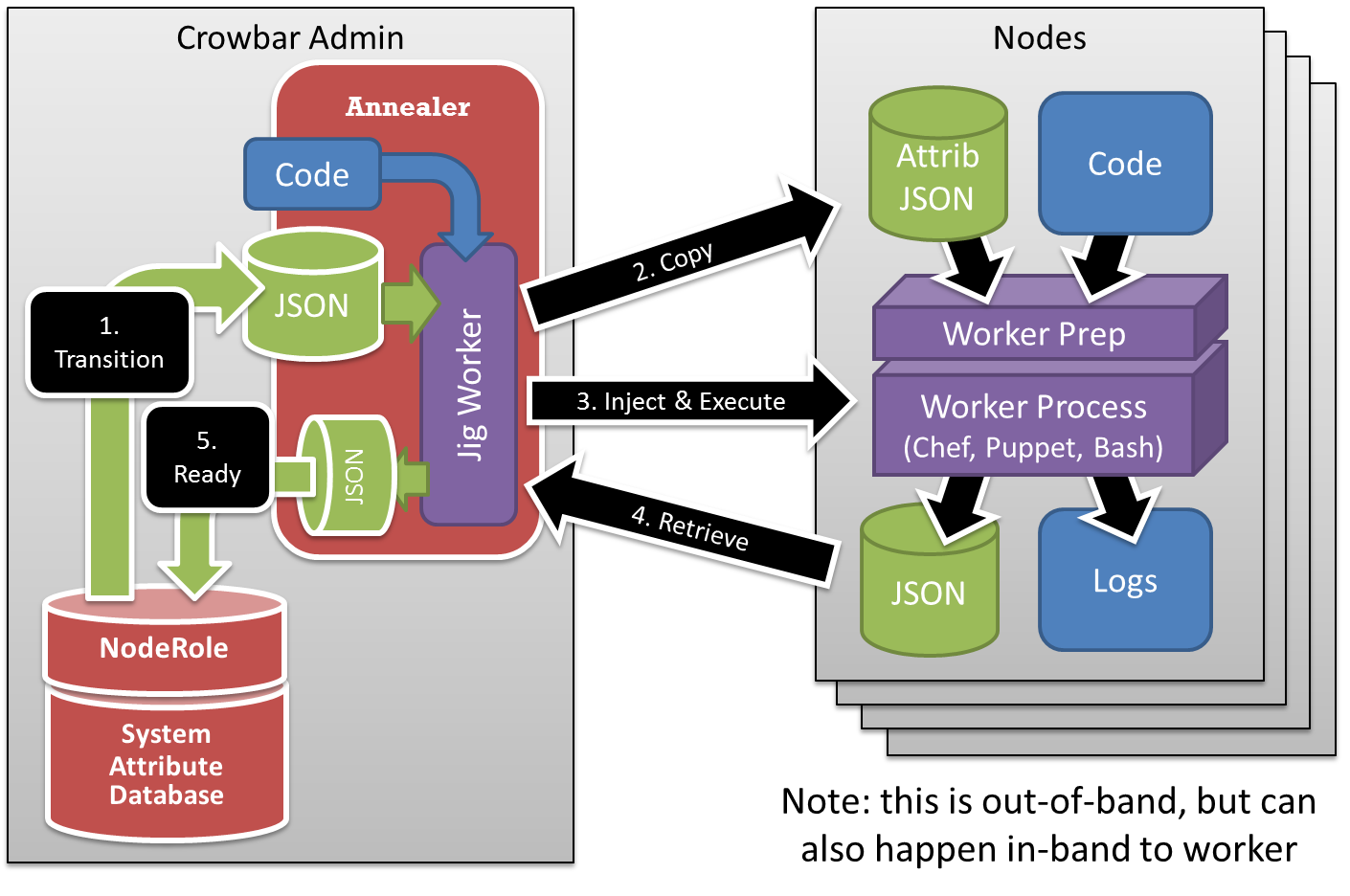
attribute_injectionIt also allows Crowbar to abstract and isolate provisioning layers. This operational approach means that deployments are composed of layered services (see emergent services) instead of locked “golden” images. The layers can be maintained independently and allow users to compose specific configurations a la cart. This approach works if the layers have clean functional boundaries (FuncOps) that can be scoped and managed atomically.

To explain how Attribute Injection accomplishes this, we need to explore why search became an anti-pattern in Crowbar v1. Originally, being able to use server based search functions in operational scripting was a critical feature. It allowed individual nodes to act as part of a system by searching for global information needed to make local decisions. This greatly added Crowbar’s mission of system level configuration; however, it also created significant hidden interdependencies between scripts. As Crowbar v1 grew in complexity, searches became more and more difficult to maintain because they were difficult to correctly scope, hard to centrally manage and prone to timing issues.

Crowbar was not unique in dealing with this problem – the Attribute Injection pattern has become a preferred alternative to search in integrated community cookbooks.

Attribute Injection in OpenCrowbar works by establishing specific inputs and outputs for all state actions (NodeRole runs). By declaring the exact inputs needed and outputs provided, Crowbar can better manage each annealing operation. This control includes deployment scoping boundaries, time sequence of information plus override and substitution of inputs based on execution paths.

This concept is not unique to Crowbar. It has become best practice for operational scripts. Crowbar simply extends to paradigm to the system level and orchestration level.

Attribute Injection enabled operations to be:

  • Atomic – only the information needed for the operation is provided so risk of “bleed over” between scripts is minimized. This is also a functional programming preference.
  • Isolated Idempotent – risk of accidentally picking up changed information from previous runs is reduced by controlling the inputs. That makes it more likely that scripts can be idempotent.
  • Cleanly Scoped – information passed into operations can be limited based on system deployment boundaries instead of search parameters. This allows the orchestration to manage when and how information is added into configurations.
  • Easy to troubleshoot – since the information is limited and controlled, it is easier to recreate runs for troubleshooting. This is a substantial value for diagnostics.

OpenCrowbar Design Principles: Emergent services [Series 5 of 6]

This is part 5 of 6 in a series discussing the principles behind the “ready state” and other concepts implemented in OpenCrowbar.  The content is reposted from the OpenCrowbar docs repo.

Emergent services

We see data center operations as a duel between conflicting priorities. On one hand, the environment is constantly changing and systems must adapt quickly to these changes. On the other hand, users of the infrastructure expect it to provide stable and consistent services for consumption. We’ve described that as “always ready, never finished.”

Our solution to this duality to expect that the infrastructure Crowbar builds is decomposed into well-defined service layers that can be (re)assembled dynamically. Rather than require any component of the system to be in a ready state, Crowbar design principles assume that we can automate the construction of every level of the infrastructure from bios to network and application. Consequently, we can hold off (re)making decisions at the bottom levels until we’ve figured out that we’re doing at the top.

Effectively, we allow the overall infrastructure services configuration to evolve or emerge based on the desired end use. These concepts are built on computer science principles that we have appropriated for Ops use; since we also subscribe to Opscode “infrastructure as code”, we believe that these terms are fitting in a DevOps environment. In the next pages, we’ll explore the principles behind this approach including concepts around simulated annealing, late binding, attribute injection and emergent design.

Emergent (aka iterative or evolutionary) design challenges the traditional assumption that all factors must be known before starting

  • Dependency graph – multidimensional relationship
  • High degree of reuse via abstraction and isolation of service boundaries.
  • Increasing complexity of deployments means more dependencies
  • Increasing revision rates of dependencies but with higher stability of APIs