Crowbar’s emergence as a DevOps enabled Cloud Provisioner

I’m going to be talking Crowbar & OpenStack at Chef Conf next week.  While I’m always excited to wave the Crowbar flag, it’s humbling to see our vision for an open source based cloud provisioner picking up momentum in the community.
Dieter Plaetinck

…I think this tool deserves more attention and should be added to your devops toolchain for the cloud (triple buzzword bonus!!!)…

Hosting News

…As an alternative to proprietary, licensed software models, Dell continues to see heavy customer interest in the OpenStack-Powered Cloud Solution, which integrates the OpenStack cloud operating system, cloud-optimized Dell PowerEdge C servers, the Dell-developed Crowbar software framework, and services…

Sys-Con Post by Mirantis

…Finally, there is Dell and Crowbar. Dell’s approach to riding the OpenStack wave is, perhaps, the most creative. Crowbar is neither a hardware appliance nor an enterprise version of OpenStack. It’s a configuration management tool built around OpSource’s Chef, designed specifically to deploy OpenStack on Dell servers. Crowbar effectively serves as the glue between the hardware and any distribution of OpenStack (and not only OpenStack)…

Robert Booth w/ Zenoss

Well if you care to only give them the best then introduce them to a set of tools that will drastically change the way they do business in a way they want to. Introduce them to Dell’s Crowbar and OpsCode Chef and you will make their job easier, faster and possibly put a stop to the finger pointing! No longer will they have to pull out the IT secret decoder ring to understand what the dev team put in the deployment docs.

Dell Cloud in the Community – events, speaking and sponsorships!

Members of various Dell Cloud teams are out and about!  You can catch us North, South, East, West and Central!

I get a lot of questions about the Dell Hosted Cloud (my team does “private hyperscale cloud“) so I’m glad to offer ACUG as a venue where people can talk to Stephen Spector and hear it from the source.

Date Topics Event Venue Sponsor
5/12 Topics: OpenStack Foundation, DevStack & Folsom Summit review. Austin OpenStack Meetup Austin, TX (Tech Ranch) Puppet Labs
5/15 Dell Public Cloud team will discuss and demonstrate vCloud running an HPC platform for highly processor intensive applications (Greenbutton and SAP) Austin Cloud User Group Austin, TX Dell Public Cloud
5/16 OpenStack Topics (TBD) including Folsom Summit review, Quantum, HyperV Boston OpenStack Meetup Boston, MA (Havard, Maxwell Dworkin 119) SUSE
5/16-17 DevOps applications for Chef on OpenStack private clouds using Crowbar. Chef User Conference San Francisco, CA Opscode
5/??
TBD
Help us kick out a rock solid Essex deploy using Crowbar and Chef. World Wide Essex Deploy Day Multiple Live & Remote Locations Dell OpenStack
5/23-24 Open source software in the government.  Specifically, I’m talking about  OpenStack, Hadoop and Crowbar.  I know that Cloudera and Canonical will be there. Military Open Source Charleston, SC Mill-OSS

PS: The slides are posted if you missed our 3-way joint session with Dell, Opscode & enStratus at the OpenStack Summit.

Dell Team at the OpenStack Spring 2012 Summit

It’s OpenStack Summit time again for my team at Dell and there’s deployment in the air. It’s been an amazing journey from the first Austin summit to Folsom today. Since those first heady days, the party has gotten a lot more crowded, founding members have faded away, recruiters became enriched as employees changed email TLDs and buckets of code was delivered.
Throughout, Dell has stayed the course: our focus from day-one has been ensuring OpenStack can be deployed into production in a way that was true to the OpenStack mission of community collaboration and Apache-2-licensed open source.

We’ve delivered on the making OpenStack deployable vision by collaborating broadly on the OpenStack components of the open source Crowbar project. I believe that our vision for sustainable open operations based on DevOps principles is the most complete strategy for production cloud deployments.

We are at the Folsom Summit in force and we’re looking forward to discussions with the OpenStack community. Here are some of the ways to engage with us:

  • Demos
    • During the summit (M-W), we’ll have our Crowbar OpenStack Essex deployments running. We kicked off Essex development with a world-wide event in early March and we want more people to come and join in.
    • During the conference (W-F), we’ll be showing off application deployments using enStratus and Chef against our field proven Diablo release.
  • Speakers
    • Thursday 1:00pm, OpenStack Gains Momentum: Customers are Speaking Up by Kamesh Pemmaraju (Dell)
    • Friday 9:50am, Deploy Apps on OpenStack using Dashboard, Chef and enStratus by Rob Hirschfeld (Dell), Matt Ray (Opscode) and Keith Hudgins (enStratus).
    • Friday 11:30am, Expanding the Community Panel
      including Joseph George (Dell)
    • This fun round trip road trip from Rackspace & Dell HQs in Austin to the summit and home again promises to be an odyssey of inclusion. Dell OpenStack/Crowbar engineer Andi Abes (@a_abes). Follow @RoadstackRV to follow along as they return home and share their thoughts about the summit!
  • Parties
    • Monday 6pm Mirantis Welcome Party, co-sponsored with Dell, at Sens Restaurant (RSVP)
    • Tuesday 5pm “Demos & Drinks” Happy Hour, co-hosted by Dell, Mirantis, Morphlabs, Canonical at the Hyatt Regency Hospitality Room off the Atrium

My team has been in the field talking to customers and doing OpenStack deployments. We are proud to talk about it and our approach.

Mostly importantly, we want to collaborate with you on our Essex deployments using Crowbar.  Get on our list, download/build crowbar, run the “essex-hack” branch and start banging on the deploy.  Let’s work together to make this one rock solid Essex deploy.

Seven Cloud Success Criteria to consider before you pick a platform

From my desk at Dell, I have a unique perspective.   In addition to a constant stream of deep customer interactions about our many cloud solutions (even going back pre-OpenStack to Joyent & Eucalyptus), I have been an active advocate for OpenStack, involved in many discussions with and about CloudStack and regularly talk shop with Dell’s VIS Creator (our enterprise focused virtualization products) teams.  And, if you go back ten years to 2002, patented the concept of hybrid clouds with Dave McCrory.

Rather than offering opinions in the Cloud v. Cloud fray, I’m suggesting that cloud success means taking a system view.

Platform choice is only part of the decision: operational readiness, application types and organization culture are critical foundations before platform.

Over the last two years at Dell, I found seven points outweigh customers’ choice of platform.

  1. Running clouds requires building operational expertise both at the application and infrastructure layers.  CloudOps is real.
  2. Application architectures matter for cloud deployment because they can redefine the SLA requirements and API expectations
  3. Development community and collaboration is a significant value because sharing around open operations offers significant returns.
  4. We need to build an accelerating pace of innovation into our core operating principles
  5. There are still significant technology gaps to fill (networking & storage) and we will discover new gaps as we go
  6. We can no longer discuss public and private clouds as distinct concepts.   True hybrid clouds are not here yet, but everyone can already see their massive shadow.
  7. There is always more than one right technological answer.  Avoid analysis paralysis by making incrementally correct decisions (committing, moving forward, learning and then re-evaluating).

OpenStack Meetup 4/12: Austin at Summit, DevStack Essex

Austin Stackers!  This Thursday is our April meetup at the Austin TechRanch.

Please RSVP so that we know how much food to get!  SUSE is this Month’s sponsor for food and my team at Dell continues to pickup the room rental.  We have 35 RSVPs as of Monday noon – this will be another popular meeting (last meeting minutes).

Topics for the meetup are:

With the Summit next week, I think it is very important that we pre-discuss Summit topics and priorities as a community.  It will help us be more productive individually and for our collective interests when we engage the larger community next week.

Open Source Cloud Bootstrapping Revisised

At the OpenStack last design conference, Greg Althaus and I presented about updates (presentation here) we were making to a Nov 2010 cloud architecture white paper.

The revised “Bootstrapping Open Source Clouds” white paper has been out for a few months so I thought it was past time to throw out a link.

I’m really pleased about this update because it reflects real world experience my team has working with customers and partners on OpenStack (and Hadoop) deployments.

Executive Summary
Bringing a cloud infrastructure online can be a daunting bootstrapping challenge. Before
hanging out a shingle as a private or public cloud service provider, you must select a platform,
acquire hardware, configure your network, set up operations services, and integrate it to work
well together. That is a lot of moving parts before you have even installed a sellable application.
This white paper walks you through the decision process to get started with an open source
cloud infrastructure based on OpenStack™ and Dell™ PowerEdge™ C servers. At the end, you’ll
be ready to design your own trial system that will serve as the foundation of your hyperscale
cloud.
2011 Revision Notes
In the year since the the original publication of this white paper, we worked with many
customers building OpenStack clouds. These clouds range in size from small six-node lab
systems to larger production deployments. Based on these experiences, we updated this white
paper to reflect lessons learned.

OpenStack’s global reach

The global reach of OpenStack has been clear from the very first “Austin” conference where we had participants from Europe and Asia; however, non-US adoption appears to be accelerating lately.

While this post is motivated by the Dell launch of my team‘s OpenStack-Powered Cloud Solution into select Europe (UK & Germany) and Asia (China) markets, it is just an indication of the overall acceleration.  This presence is bolstered by our relationships abroad (video from Martin Standtler @ Canonical).

Two weeks ago, our Essex Deploy Day gathered world wide participation that continues 24/7 on the Crowbar list and Skype channel.   Internally, I also see substantial interest and customer demand from customers and partners all over the Asia-Pacific region

I’m excited to see Dell (and the broader community) formalize international support for OpenStack.

Post Script: Hidden in that same release is some mention of our coming support for the latest  (12th!) generation of Dell servers (the R720xd and C6220).  I’m a software guy, but I have to admit that these new servers are very cool cloud nodes because they’ve got a sweet mix of fast CPU, high RAM limits and bodacious spindle counts.  These fit the hardware profile that we identified in the “bootstrapping open source clouds” white paper refresh.

Cloudera Manager Barclamp posted! (part of updated Dell | Cloudera Apache Hadoop Solution)

My team at Dell has been driving to transparency and openness around Crowbar plus our OpenStack and Hadoop powered solutions.  Specifically, our work for our coming release is maintained in the open on the Dell CloudEdge Github site.  You can see (and participate in!) our development and validation work in advance of our official release.

I’m pleased to note that our Cloudera Manager barclamp has been posted to Github!

This barclamp supersedes  the Hadoop barclamp in the next release of the Dell | Cloudera Apache Hadoop solution.  You can built it in Crowbar using the “cloudera-os-build”  branch for Crowbar.  Do not fear!  The Hadoop barclamp still exists (hadoop-os-build branch).

Both the new and original Hadoop barclamp use the Cloudera Hadoop distribution (aka CDH); however, the new barclamp is able to leverage Cloudera‘s latest management capabilities.  For the Dell solution, Cloudera Manager has always been part of the offering.  The primary difference is that we are improving the level of integration.  I promise to post more about the features of the solution as we get closer to release.

OpenStack Austin: What we’d like to see at the Design Summit

Last week, the OpenStack Austin user group discussed what we’d like to see at the upcoming OpenStack Design Summit. We had a strong turnout (48?!).

  1. To get the meeting started, Marc Padovani from HP (this month’s sponsor) provided some lessons learned from the HP OpenStack-Powered Cloud. While Marc noted that HP has not been able to share much of their development work on OpenStack; he was able to show performance metrics relating to a fix that HP contributed back to the OpenStack community. The defect related to the scheduler’s ability to handle load. The pre-fix data showed a climb and then a gap where the scheduler simply stopped responding. Post-fix, the performance curve is flat without any “dead zones.” (sharing data like this is what I call “open operations“)
  2. Next, I (Rob Hirschfeld) gave a brief overview of the OpenStack Essex Deploy Day (my summary) that Dell coordinated with world-wide participation. The Austin deploy day location was in the same room as the meetup so several of the OSEDD participants were still around.
  3. The meat of the meetup was a freeform discussion about what the group would like to see discussed at the Design Summit. My objective for the discussion was that the Austin OpenStack community could have a broader voice is we showed consensus for certain topics in advance of the meeting.

At Jim Plamondon‘s suggestion, we captured our brain storming on the OpenStack etherpad. The Etherpad is super cool – it allows simultaneous editing by multiple parties, so the notes below were crowd sourced during the meeting as we discussed topics that we’d like to see highlighted at the conference. The etherpad preserves editors, but I removed the highlights for clarity.

The next step is for me to consolidate the list into a voting page and ask the membership to rank the items (poll online!) below.

Brain storm results (unedited)

Stablity vs. Features

API vs. Code

  • What is the measurable feature set?
  • Is it an API, or an implementation?
  • Is the Foundation a formal-ish standards body?
  • Imagine the late end-game: can Azure/VMWare adopt OPenStack’s APIs and data formats to deliver interop, without running OpenStack’s code? Is this good? Are there conversations on displacing incumbents and spurring new adoption?
  • Logo issues

Documentation Standards

  • Dev docs vs user docs
  • Lag of update/fragmentation (10 blogs, 10 different methods, 2 “work”)
  • Per release getting started guide validated and available prior or at release.

Operations Focus

  • Error messages and codes vs python stack traces
  • Alternatively put, “how can we make error messages more ops-friendly, without making them less developer-friendly?”
  • Upgrade and operations of rolling updates and upgrades. Hot migrations?

If OpenStack was installable on Windows/Hyper-V as a simple MSI/Service installer – would you try it as a node?

  • Yes.

Is Nova too big?  How does it get fixed?

  • libraries?
  • sections?
  • make it smaller sub-projects
  • shorter release cycles?

nova-volume

  • volume split out?
  • volume expansion of backend storage systems
  • Is nova-volume the canonical control plane for storage provisioning?  Regardless of transport? It presently deals in block devices only… is the following blueprint correctly targeted to nova-volume?

https://blueprints.launchpad.net/nova/+spec/filedriver

Orchestration

  • Is the Donabe project dead?

Discussion about invitations to Summit

  • What is a contribution that warrants an invitation
  • Look at Launchpad’s Karma system, which confers karma for many different “contributory” acts, including bug fixes and doc fixes, in addition to code commitments

Summit Discussions

  • Is there a time for an operations summit?
  • How about an operators’ track?
  • Just a note: forums.openstack.org for users/operators to drive/show need and participation.

How can we capture the implicit knowledge (of mailing list and IRC content) in explicit content (documentation, forums, wiki, stackexchange, etc.)?

Hypervisors: room for discussion?

  • Do we want hypervisor featrure parity?
  • From the cloud-app developer’s perspective, I want to “write once, run anywhere,” and if hypervisor features preclude that (by having incompatible VM images, foe example)
  • (RobH: But “write once, run anywhere” [WORA] didn’t work for Java, right?)
  • (JimP: Yeah, but I was one of Microsoft’s anti-Java evangelists, when we were actively preventing it from working — so I know the dirty tricks vendors can use to hurt WORA in OpenStack, and how to prevent those trick from working.)

CDMI

Swift API is an evolving de facto open alternative to S3… CDMI is SNIA standards track.  Should Swift API become CDMI compliant?  Should CDMI exist as a shim… a la the S3 stuff.

OpenStack Essex Deploy Day: First Steps to Production

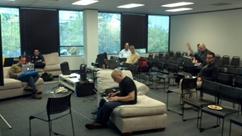
One March 8th, 70 people from around the world gathered on the Crowbar IM channel to begin building a production grade OpenStack Essex deployment. The event was coordinated as meet-ups by the Dell OpenStack/Crowbar team (my team) in two physical locations: the Nokia offices in Boston and the TechRanch in Austin.

My objective was to enable the community to begin collaboration on Essex Deployment. At that goal, we succeeded beyond my expectations.

IMHO, the top challenge for OpenStack Essex is to build a community of deploying advocates. We have a strong and dynamic development community adding features to the project. Now it is time for us to build a comparable community of deployers. By providing a repeatable, shared and open foundation for OpenStack deployments, we create a baseline that allows collaboration and co-development. Not only must we make deployments easy and predictable, we must also ensure they are scalable and production ready.

Having solid open production deployment infrastructure drives OpenStack adoption.

Our goal on the 8th was not to deliver finished deployments; it was to the start of Essex deployment community collaboration. To ensure that we could focus on getting to an Essex baseline, our team invested substantial time before the event to make sure that participants had a working Essex reference deployment.

By the nature of my team’s event leadership and our approach to OpenStack, the event was decidedly Crowbar focused. I feel like this is an acceptable compromise because Crowbar is open and provides a repeatable foundation. If everyone has the same foundation then we can focus on the truly critical challenges of ensuring consistent OpenStack deployments. Even using Crowbar, we waste a lot of time trying to figure out the differences between configurations. Lack of baseline consistency seriously impedes collaboration.

The fastest way to collaborate on OpenStack deployment is to have a reference deployment as a foundation.

Success By The Numbers

This was a truly international community collaborative event. Here are some of the companies that participated:

Dell (sponsor), Nokia (sponsor), Rackspace, Opscode, Canonical, Fedora, Mirantis, Morphlabs, Nicira, Enstratus, Deutsche Telekom Innovation Laboratories, Purdue University, Orbital Software Solutions, XepCloud and others.

PLEASE COMMENT here if I missed your company and I will add it to the list.

On the day of the event, we collected the following statistics:

  • 70 people on Skype IM channel (it’s not too late to join by pinging DellCrowbar with “Essex barclamps”).
  • 14+ companies
  • 2 physical sites with 10-15 people at each
  • 4 fold increase in traffic on the Crowbar Github to 813 hits.
  • 66 downloads of the Deploy day ISO
  • 8 videos capture from deploy day sessions.
  • World-wide participation

For over 70 people to spend a day together at this early stage in deployment is a truly impressive indication of the excitement that is building around OpenStack.

Improvements for Next Deploy Day

This was a first time that Andi Abes (Boston event lead), Rob Hirschfeld (Austin event lead) or Jean-Marie Martini (Dell event lead) had ever coordinated an event like this. We owe much of the success to efforts by Greg Althaus, Victor Lowther and the Canonical 12.04/Essex team before the event. Also, having physical sites was very helpful.

We are planning to do another event, so we are carefully tracking ways to improve.

Here are some issues we are tracking.

  • Issues with setting up a screen and voice share that could handle 70 people.
  • Lack of test & documentation on Crowbar meant too much time focused on Crowbar
  • Connectivity issues distributed voice
  • Should have started with DevStack as a baseline
  • more welcome in the comments!

Thank you!

I want to thank everyone who participated in making this event a huge success!