My Dilemma with Folsom – why I want to jump to G

When your ship sailsThese views are my own.  Based on 1×1 discussions I’ve had in the OpenStack community, I am not alone.

If you’ve read my blog then you know I am a vocal and active supporter of OpenStack who is seeking re-election to the OpenStack Board.  I’m personally and professionally committed to the project’s success. And, I’m confident that OpenStack’s collaborative community approach is out innovating other clouds.

A vibrant project requires that we reflect honestly: we have an equal measure of challenges: shadow free fall Dev, API vs implementation, forking risk and others.  As someone helping users deploy OpenStack today, I find my self straddling between a solid release (Essex) and a innovative one (Grizzly). Frankly, I’m finding it very difficult to focus on Folsom.

Grizzly excites me and clearly I’m not alone.  Based on pace of development, I believe we saw a significant developer migration during feature freeze free fall.

In Grizzly, both Cinder and Quantum will have progressed to a point where they are ready for mainstream consumption. That means that OpenStack will have achieved the cloud API trifecta of compute-store-network.

  • Cinder will get beyond the “replace Nova Volume” feature set and expands the list of connectors.
  • Quantum will get to parity with Nova Network, addresses overlapping VM IPs and goes beyond L2 with L3 feature enablement like  load balancing aaS.
  • We are having a real dialog about upgrades while the code is still in progress
  • And new projects like Celio and Heat are poised to address real use problems in billing and application formation.

Everything I hear about Folsom deployment is positive with stable code and significant improvements; however, we’re too late to really influence operability at the code level because the Folsom release is done.  This is not a new dilemma.  As operators, we seem to be forever chasing the tail of the release.

The perpetual cycle of implementing deployment after release is futile, exhausting and demoralizing because we finish just in time for the spotlight to shift to the next release.

I don’t want to slow the pace of releases.  In Agile/Lean, we believe that if something is hard then we do should it more.  Instead, I am looking at Grizzly and seeing an opportunity to break the cycle.  I am looking at Folsom and thinking that most people will be OK with Essex for a little longer.

Maybe I’m a dreamer, but if we can close the deployment time gap then we accelerate adoption, innovation and happy hour.  If that means jilting Folsom at the release altar to elope with Grizzly then I can live with that.

Interview Transcript about OpenStack, Foundation, Dell & Crowbar

Rafael Knuth, Dell Rafael Knuth (@RafaelKnuth with Dell as EMEA Social Media Community Manager) has set an ambitious objective to interview all 24 of the OpenStack Foundation Board members.  I have the privilege of being the first interview posted (Japanese version!).   Here’s the whole series.

This is not puff interview – We spent an hour together and Rafael did not shy away from asking hard questions like “Why did Dell jump into OpenStack?” and “is VMware a threat to OpenStack?”  Rather than posting the whole transcript (it’s posted here), I’m including the questions (as a teaser) below.   There is some real meat in these answers about OpenStack, Dell, Crowbar and challenges facing the project.

WARNING: My job is engineering, not marketing.  You may find my answers (which are MY OWN ANSWERS) to be more direct that you are expecting.  If you find yourself needing additional circumlocution then simply close your browser and move on.

Some highlights…

Dell’s interest in OpenStack has been very pragmatic. OpenStack is something we really see a market need for.

Rackspace …  runs on OpenStack pretty much off trunk …  That’s exactly the type of vibrant community we want to see.  At the same time, there is a growing community that wants to use OpenStack distributions with support, certifications and they are fine with being 6 months behind OpenStack off trunk. That’s good, and we want that shadow, we want that combination of pure minded early adopters and less sophisticated OpenStack users both working together.

We are working with different partners to bring OpenStack to different customers in different ways. It is confusing. Your question about Dell Crowbar was right … it is targeted at a certain class of users, and I don’t want enterprise customers who expect a lot of shiny chrome and zero touch. That’s not the target by now for Dell Crowbar. We definitely need that sort of magic decoder page to help customers understand our commercial offering.

Questions from Interview:

  1. Dell is one of the very early contributors to OpenStack. Why is Dell engaging in this project?
  2. How does Dell contribute to OpenStack?
  3. Let’s talk a bit about Dell Crowbar, your team’s deployment mechanism for OpenStack.
  4. Let’s talk a bit about OpenStack raw vs. OpenStack distributions.
  5. What are the biggest barriers to OpenStack adoption as of now?
  6. What does a customer specifically need to do when moving from OpenStack Essex to Folsom for example?
  7. My next question is around proof of concept versus production, Rob. How are customers using OpenStack and can you give examples for both scenarios?
  8. I hear very often two different statements: “Open Stack is an alternative to Amazon.” The other is: “OpenStack is an alternative to VMware … maybe, hopefully in two or three years from now.”  Which of both statements is true?
  9. How do you view VMware joining OpenStack. Is it a threat to OpenStack or does VMware add value to the project?
  10. Let us speak about market adoption. Who are the early adopters of OpenStack? And when do you expect OpenStack to hit the tipping point for mass market adoption?
  11. Rob, for all those interested in Dell’s commercial offering around OpenStack … can you give a brief overview?
  12. Dell TechCenter that provides customers an overview over our OpenStack offering: Dell Crowbar as our DevOps tool in its various shapes and forms, OpenStack distros we support … cloud services we build around OpenStack … hardware capabilities optimized for OpenStack.
  13. What are the challenges for the OpenStack Board of Directors?

Open Source is The Power of We (Blog Action Day)

This post is part of a world wide “blog action day” where thousands of bloggers post their unique insights about a single theme. For 2012, it’s the “power of we is as a celebration of people working together to make a positive difference in the world, either for their own communities or for people they will never meet half way around the world.”

I’ve choosing open source software because I think that we are establishing models for building ideas collaboratively that can be extended beyond technology into broader use. The way we solve open source challenges translates broadly because we are the tool makers of the global interaction.

I started using open source¹ as a way to solve a problem; I did not understand community or how groups of loosely connected people came together to create something new. Frankly, the whole process of creating free software seemed to be some hybrid combination of ninja coders and hippy hackers. That changed when I got involve on the ground floor of the OpenStack project (of which I am now a Foundation board member).

I was not, could not have been, prepared for the power and reality of community and collaboration that fuels OpenStack and other projects. We have the same problems as any non-profit project except that we are technologists: we can make new tools to solve our teaming and process problems.

It is not just that open source projects solve problems that help people. The idea of OpenStack and Hadoop being used by medical researches to find cures for cancer is important; however, the learning how to build collaboratively is another critical dimension. Our world is getting more connected and interconnected by technology, but the actual tools for social media are only in their earliest stages.

Not only are the tools evolving, the people using the tools are changing too! We are training each other to work together in ways that were beyond our imagine even 10 years ago. It’s the combination of both new technology and new skills that is resetting the rules for collaboration.

Just a few years ago, open source technology was considered low quality, risky and fringe. Today, open source projects like OpenStack and Hadoop are seen as more innovative and equally secure and supportable compared to licensed products. This transformation represents a surprising alignment and collaboration between individuals and entities that would normally be competing. While the motivation for this behavior comes from many sources, we all share the desire to do collaborative effectively.

I don’t think that we have figured out how to really do this the best way yet. We are making progress and getting better and better. We are building tools (like etherpad, wikis, irc, twitter, github, jenkins, etc) that improve collaboration. We are also learning building a culture of collaboration.

Right now, I’m on a train bound for the semi-annual OpenStack summit that brings a world wide audience together for 4½ days of community work. The discussions will require a new degree of openness from people and companies that are normally competitive and secretive about product development. During the summit, we’ll be doing more than designing OpenStack, we will be learning the new skills of working together. Perhaps those are the most important deliverables.

Open source projects combination of both new technologies and new skills creates the Power of We.

——————

PS¹: Open source software is a growing class of applications in which the authors publish the instructions for running the software publicly so that other people can use the software. Sometimes (but not always) this includes a usage license that allows other people to run the software without paying the author royalties. In many cases, the author’s motivation is that other users will help them test, modify and improve the software so that improves more quickly than a single creator could do alone.

Crowbar releases for OpenStack Essex and Folsom

On the eve of the OpenStack design summit, it’s worth noting that the Crowbar team at Dell cut our final Essex release (aka Betty) last week. We’ve also committed the initial Folsom deployment scripts to the 1x development trunk under “feature/folsom” if you are doing Crowbar builds from DevTool (see bit.ly/crowbardevtool).

If you don’t want to build it, I’ve cut ISOs from the open source bits and posted them to http://crowbar.zehicle.com.

Andi Abes is presenting about the new Pull From Source (pfs) feature at the Summit on Monday. There’s a feature branch for that too and I’m going to check with him and try to post and ISO for that too.

20121014-132246.jpg

OpenStack Summit: Let’s talk DevOps, Fog, Upgrades, Crowbar & Dell

If you are coming to the OpenStack summit in San Diego next week then please find me at the show! I want to hear from you about the Foundation, community, OpenStack deployments, Crowbar and anything else.  Oh, and I just ordered a handful of Crowbar stickers if you wanted some CB bling.

Matt Ray (Opscode), Jason Cannavale (Rackspace) and I were Ops track co-chairs. If you have suggestions, we want to hear. We managed to get great speakers and also some interesting sessions like DevOps panel and up streaming deploy working sessions. It’s only on Monday and Tuesday, so don’t snooze or you’ll miss it.

My team from Dell has a lot going on, so there are lots of chances to connect with us:

At the Dell booth, Randy Perryman will be sharing field experience about hardware choices. We’ve got a lot of OpenStack battle experience and we want to compare notes with you.

I’m on the board meeting on Monday so likely occupied until the Mirantis party.

See you in San Diego!

PS: My team is hiring for Dev, QA and Marketing. Let me know if you want details.

Join in Blog Action Day on 10/15

You’ll have to wait for the reveal on 10/15 but I wanted to throw out the link for blog action day and encourage fellow bloggers to participate in the event.

I participated in this event while I blogging about electric cars (I converted 96 RAV4 to EV) and energy issues.  It’s an interesting perspective to have a large focus on a single topic.  The breadth of discussion is impressive.

This year, I’m going to be topical to my latest interests and offering insights from the floor of the OpenStack summit.

Continuous Release combats disruptions of “Free Fall” development

Since I posted the “Free Fall” development post, I’ve been thinking a bit about the pros and cons of this type of off-release development.

The OpenStack Swift project does not do free fall because they are on a constant “ship ready” state for the project and only loosely flow the broader OpenStack release track.  My team at Dell also has minimal free fall development because we have a more frequent release clock and choose to have the team focus together through dev/integrate/harden cycles as much as possible.

From a Lean/Agile/CI perspective, I would work to avoid hidden development where possible.  New features are introduced by split test (they are in the code, but not active for most users) so that the all changes in incremental.  That means that refactoring, rearchitecture and new capabilities appear less disruptively.  While it may this approach appears to take more effort in the short term; my experience is that it accelerates delivery because we are less likely to over develop code.

Unfortunately, free fall development has the opposite effect.  Having code that appears in big blocks is contrary to best practices in my opinion.  Further, it rewards groups that work asynchronously and

While I think that OpenStack benefits from free fall work, I think that it is ultimately counter-productive.

Ballistic Release Cycles: Tracking the Trajectory of OpenStack Milestones

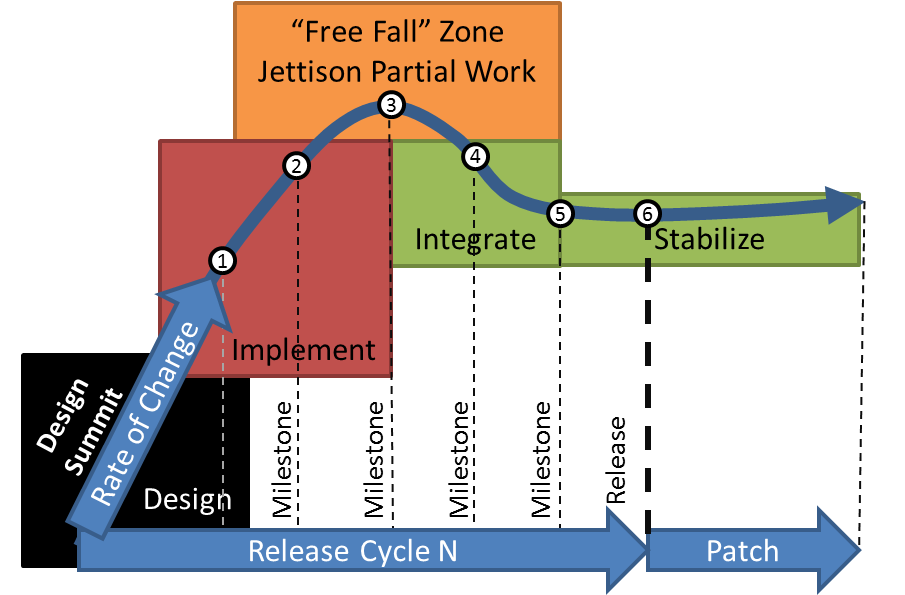
I’ve been watching a pattern emerge on the semiannual OpenStack release cycles for a while now. There is a hidden but crucial development phase that accelerates projects faster than many observers realize. In fact, I believe that substantial work is happening outside of the “normal” design cycle during what I call “free fall” development.

Understanding when the cool, innovative stuff happens is essential to getting (and giving) the most from OpenStack.

The published release cycle looms like a 6 stage ballistic trajectory. Launching at the design summit, the release features change and progress the most in the first 3 milestones. At the apogee of the release, maximum velocity is reached just as we start having to decide which features are complete enough to include in the release. Since many are not ready, we have to jettison (really, defer) partial work to ensure that we can land the release on schedule.

I think of the period where we lose potential features as free fall because thing can go in any direction. The release literally reverses course: instead of expanding, it is contracting. This process is very healthy for OpenStack. It favors code stability and “long” hardening times. For operators, this means that the code stops changing early enough that we have more time to test and operationalize the release.

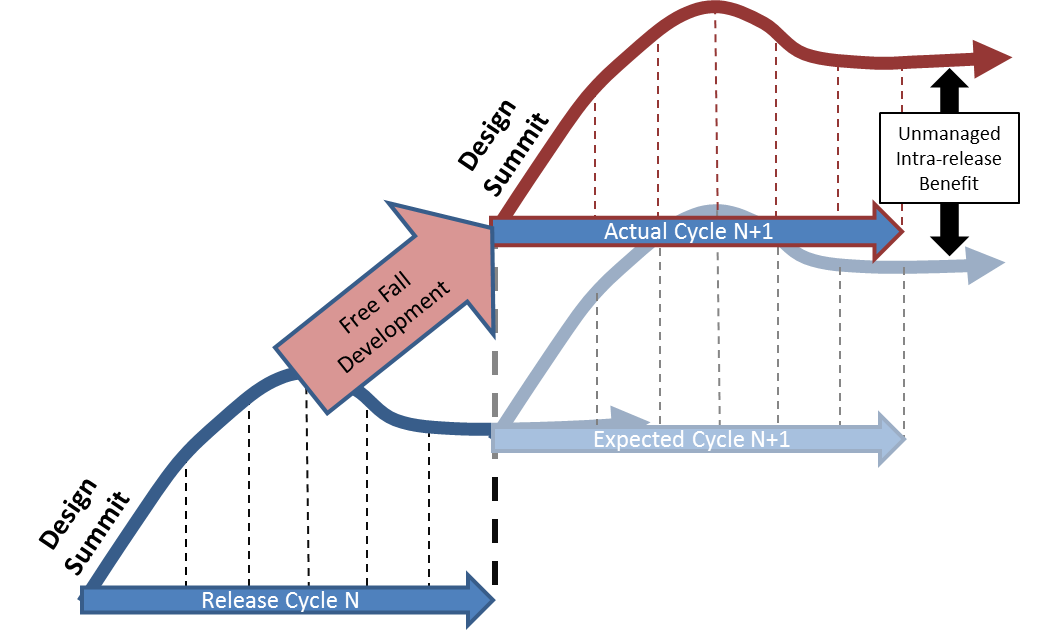
But what happens to the jettisoned work? In free fall, objects in motion stay in motion. The code does not just disappear! It continues on its original upward trajectory.

The developers who invested time in the code do not simply take a 3 month sabbatical, nor do they stop their work and start testing the code that was kept. No, after the short in/out sorting pause, the free fall work continues onward with rockets blasting. The challenge is that it is now getting outside of the orbit of the release plan and beyond the radar of many people who are tracking the release.

The consequence of this ongoing development is that developers (and the features they are working on) show up at the summit with 3 extra months of work completed. It also means that OpenStack starts each release cycle with a bucket of operationally ready code. Wow, that’s a huge advantage for the project in terms of delivered work, feature velocity and innovation. Even better, it means that the design summit can focus on practical discussions of real prototypes and functional features.

Unfortunately, this free fall work has hidden costs:

  • It is relatively hidden because it is outside of the normal release cycle.
  • It makes true design discussions less productive because the implemented code is more likely to make the next release cycle
  • Integration for the work is postponed because it continues before branching
  • Teams that are busy hardening a core feature can be left out of work on the next iteration of the same feature
  • Forking can make it hard to capture bugs caught during hardening

I think OpenStack greatly benefits from free fall development; consequently, I think we need to acknowledge and embrace it to reduce its costs. A more explicit mid-release design synchronization when or before we fork may help make this hidden work more transparent.

Cloud Dev Laptop

This post is in response to multiple requests I’ve gotten from people outside of Dell.  My apologies if it is too commercial.  I work for Dell  and we make hot laptops AND clouds.
When you’re building clouds (as opposed to cloud applications), you need heavy equipment.  So it’s no surprise that I use a Precision M6600 17″ laptop that is capable of running a complete multi-node cloud data center.
IMHO, here are the core requirements for a Cloud Builder laptop:
  1. SSDs (I have two 1/4 TB of SSD):  We are constantly building/installing operating systems.  These are high I/O activities so SSDs are essential.  I’m constantly on the edge of no free space even with 1/2 TB .
  2. RAM (I have 32 Gb): It’s normal for us to run multiple VMs.  If you RAM starve your VMs (I used to have 16) then they page fault and you’re back to constrained disk I/O.  We assign 4 GB RAM per VM because it’s just faster.
  3. Many Cores: VMs w/ 1 CPU = thread contention.  Adding RAM and Disk can’t fix a threading issues.
  4. Bonus: I like a good keyboard and big display – I code, type & read a lot so the 17″ display helps.
For our devs, a normal cycle is write (desktop) -> build (in a VM) -> deploy (on additional VMs) -> full test requires >4 VMs (that’s over 16 GB RAM).  I don’t want to check in code until I complete that cycle.  On small RAM and spinning HDD  that cycle takes >1 hour.  On my laptop it is <15 minutes!
There are only a few models of laptop that can pack that type of power and they demand a premium; however, the extra umph translates into at least 3 or 4 more full cycles per day.  That’s a whole lot of extra productivity.

Why doesn’t Chef call them “bowls” instead of roles?

The extended Crowbar team (my employer Dell and community) recently had a bit of a controversy heated discussion over the renaming of “proposals” to “configurations.” It was pretty clear that the term “proposal” confused users because an “active proposal” seems like a bit of an oxymoron. Excepting Scott Jensen, our schedule-czar and director of engineering, we had relatively few die-hard “I love proposal” advocates; however, deciding on an alternative was not quite so easy.

Ultimately, the question came down to “do we use an invented term or an intuitive term.”  The answer lies in when to use or avoid the congruity theory as articulated by Roger Cauvin.

We considered many alternatives like calling them “fixtures” to go along with the Crowbar & Barclamp tool theme. Even “Chuck Norris” was considered until copyright issues were flagged. The top alternative, “configuration” seemed just too bland. Frankly and amazingly, we originally considered it “too descriptive!”

The crux of the argument really revolved around the users’ ability to intuitively grasp a concept or to force them learn a new term. For example, we specifically chose “barclamp” instead of “module” because we felt that there were more components to a barclamp than just being a Crowbar module. In many ways, module would be sufficiently descriptive; however, we saw that there was benefit to the user tax in introducing a new term. It also fit nicely within our tool theme.

Opscode Chef is an example of investing heavily in a naming theme. For example, the concept of “cookbooks” and “recipes” seems relatively intuitive for users but starts getting stretched for “knife” because it is not immediately clear to users what that component does (it executes instructions on nodes and the server). After learning Chef, I appreciate “knife” as the universal tool but still remember having to figure it out.

A good theme is awesome, but it can quickly encumber usability.

For example, what if Chef has used “bowl” instead of role. It’s logical: you put a group of ingredients to mix into a bowl that acts as a container. While it may be logical to the initiated, it mainly extends the learning curve for new users. A role is a commonly accepted term for an operational classification so it is a much better term for users. The same is true for “node” and “data bag.”

I love a good incongruent theme as much as any meme-enabled tech geek but themes must not hinder usability. After all, we all fight for the users.