Jevon’s Paradox

I’ve been finding it necessary to quote Jevon’s paradox several times lately and realized that I have NOT referenced it here.  Quite simply, understanding Jevon’s paradox is essential to understanding cloud.

The concept of the paradox is that when we make something more efficient (for example gas in cars), the demand for that resource goes up (we move further into the exurbs because driving is cheaper).  Notably, as Moore’s law drives computer efficiency up, we are using more and more computers.  Specifically, I have more computers in my house every year even though the efficiency of just one smart phone far (far) exceeds power of my son’s Sinclair 1000.

In cloud computing, Jevon’s paradox points us to the expectation that the rush of applications and activity in the cloud will continue to accelerate.  Since I expect competition and Moore’s law to drive increasing gains in cloud efficiency (and therefore customer advantageous price signals) the market will happily convert these utilization improvements into more and more interesting capabilities.

The cloud expansion means that we can sustain more providers entering the market.  In fact, Jevon would tell us that more providers will likely INCREASE demand for cloud as competition and capacity put downward pressure on prices.  [Q: where will they make up the margin?   A: Adjacent Services]

The loser in cloud’s exploration of Jevon’s paradox are non-cloud deployments (Dell strategists are you listening?).  These systems suffer because their ability to improve their efficiency is limited.

As I look down the road on cloud, I can see many opportunities for current applications to take advantage of cheaper cloud resources to provide even more value.  For example, adding map-reduce analytics to scan a customer’s data can provide tremendous insights.  Today, it’s a luxury like flying on the Concorde.  Tomorrow, it will be part like hopping the Nerd Bird from San Jose to Austin – just a normal part of our daily lives.


Note: A shout out to Dave McCrory who introduced me to Jevon’s Paradox.

Seattle Cloud Camp, Dec 2010

While I was in Seattle for Azure training preparing for Dell’s Azure Appliance , Dave @McCrory suggested that we also attend the Seattle Cloud Camp (SCC Tweets).  This event was very well attended (200 people!).  With heavy attendance by Amazon (at their HQ), Microsoft (in the ‘hood), and Google, there was a substantial cloud vendor presence (>25% from those vendors alone).  Notable omission: VMware.

My reflection about the event by segment.

Opening Sessions:

  • Most of the opening sessions were too light for the audience.  I thought we were past the “what is cloud” level, sigh.
  • Of note, the Amazon security presentation by Steve Rileywas fun and entertaining.
  • Picking on a Dell competitor specifically: calling your cloud solution “WAS” is a branding #fail (not that DCSWA much is better).

Unpanel of self-appointed cloud extroverts experts:

  • The unpanel covered some decent topics (@adronbh captured them on twitter), unfortunately none of the answers really stood out to me.  Except for NoSQL.
  • The unpanel discussion about NoSQL drew 2 answers.  1) It’s not NoSQL, it’s eventually consistent instead of strictly consistent.  (note: I’ve been calling it “Storage++”) 2) We’ll see more and more choices in this area as we tune the models for utility then we’ll see some consolidation.  The suggestion was that NoSQL would follow the same explosion/contraction pattern of SQL databases.

Session on Cloud APIs (my suggested topic)

  • The Cloud API topic was well attended (30+).  The vast overwhelming majority or the attendees were using Amazon.
  • There was some interest in having “standard” APIs for cloud functions was not well received because it was felt to stifle innovation.  We are still to early.
  • It was postulated but not generally agreed that cloud aggregation (DeltaCloud, RightScale, etc) is workable.  This was considered a reason to not require standard clouds.
  • CloudCamp sponsor, Skytap, has their own API.  These APIs are value added and provide extra abstraction levels.
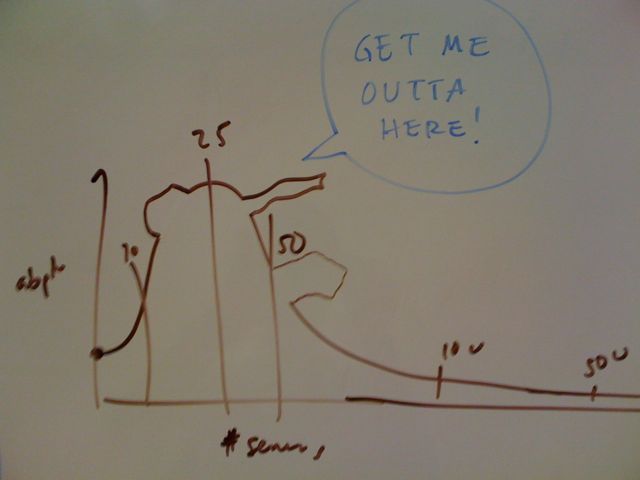
  • It was said that there are a LOT (50 now, 500 soon) smaller hosts that want to enter the cloud space.  These hosts will need an API – some are inventing their own.
  • I brought up the concept discussed at OpenStack that the logical abstraction for cloud network APIs is a “vlan.”  This created confusion because some thought that I meant actual 802.1q tags.  NO!  I just meant that is was the ABSTRACTION of a VLAN connecting VMs together.
  • There was agreement from the clouderati in the room that cloud networking was f’ed up, but most people were not ready to discuss.
  • Cloud APIs have some basics that are working (semantics around VMs) but still have lots of wholes.  Notably: networking, application, services, and identity)

Session on Google App Engine (GAE)

  • GAE is got a lot going on, especially in the social/mobile space.
  • Do not think a lack of news about GAE means that they are going slow, it’s just the opposite.  It looks like they are totally kicking ass with a very focused strategy.  I suspect that they are just waiting for the market to catch-up.
  • GAE understands what a “platform” really is.  They talk about their platform as the SERVICES that they are offering.  The code is just code.  The services are impressive and include identity, mail, analysis, SQL (business only), map (as in Map-Reduce), prediction (yes, prediction!), storage, etc.  The total list was nearly 20 distinct services.
  • GAE compared them selves to Azure, not Amazon.

Exploding the Cloud Storage Banana

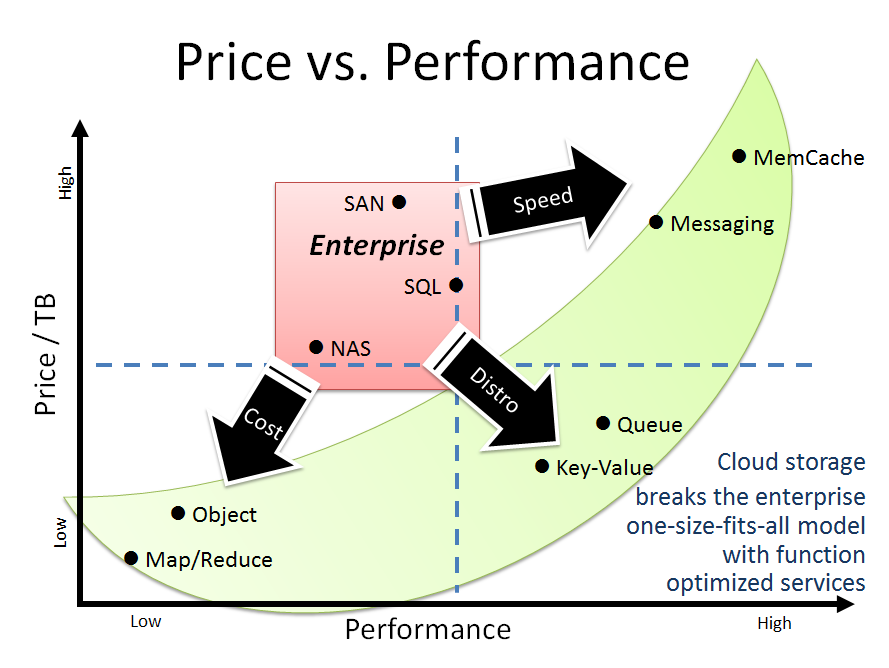
Storage Banana shows how cloud persistence is functionally diverse and optimized

Internally, my group (specifically Dave McCrory & Greg Althaus) has been kicking around some new ways of expressing clouds in an effort to help reconcile Dell’s traditional and cloud focused businesses.  We’ve found it challenging to translate CAP theorem and

externalized application state into more enterprise-ready concepts.

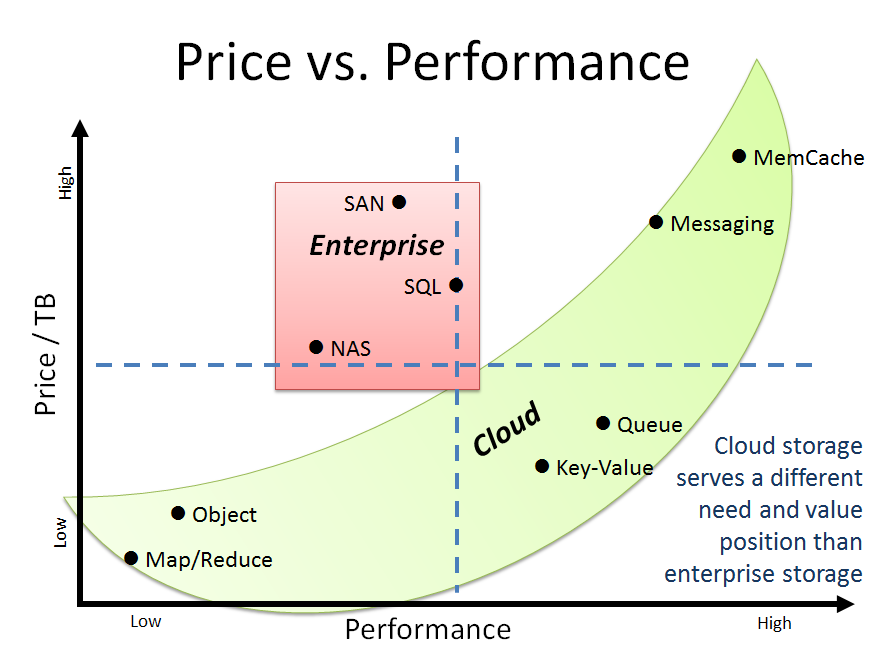
Our latest effort led to a pleasantly succinct explanation of why cloud storage is different than enterprise storage.  Ultimately, it’s a matter of control and optimization.  Cloud persistence (Cache, Queue, Tables, Objects) is functionally diverse in order to optimize for price and performance while enterprise storage (SAN, NAS, SQL) is control and centralization driven.  Unfortunately for enterprises, the data genie is out of the Pandora’s box with respect to architectures that drive much lower cost and higher performance.

The background on this irresistible transformation begins with seeing storage as a spectrum of services as per the table below.

Enterprise:

Consistent


Block (SAN) iSCSI, Infiband:

Amazon EBS, EqualLogic, EMC Symmeterix

File (NAS) NFS, CIFS:

NetApp, PowerVault, EMC Clariion

Database (ACID) MS SQL, Oracle 11g, MySQL, Postgres
Cloud:

Distributed

Partitioned

Object DX/Caringo, OpenStack Swift, EMC Atmos
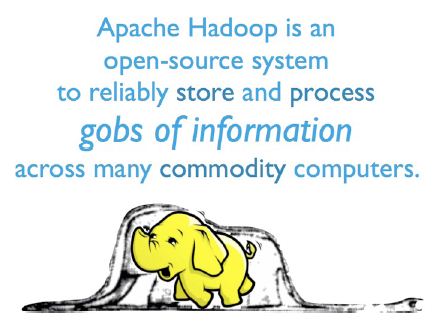
Map/Reduce Hadoop DFS
Key Value Cassandra, CouchDB, Riak, Reddis, Mongo
Queue (Bus) RabbitMQ, ActiveMQ, ZeroMQ, OpenMQ, Celery
Cloud:

Transitory


Messaging AMPQ, MSMQ (.NET)
Shared RAM MemCache, Tokyo Cabinet

From this table, I approximated the relative price and performance for each component in the storage spectrum.

The result was the “cloud storage banana” graph.  In this graph, enterprise storage is clustered in the “compromise” quadrant where there’s a high price for relatively low performance.  The cloud persistence refuses to be clustered at all.  To save cost and enable distributed data, applications will use cheap but slow object storage.  This drives the need for high speed RAM based cache and distributed buses. These approaches are required when developers build fault tolerance at the application level.

Enterprises have enjoyed the false luxury of perceived hardware reliability.  Where these assumptions are removed, applications are freed to scale more gracefully and consider resource cost in their consumption plans.

When we compare the enterprise Pandora’s box storage to the cloud persistence banana, a more general pattern emerges.  The cloud persistence pattern represents a fragmentation of monolithic, IT controlled services into a more functional driven architecture.  In this case, we see desire for speed, distribution and cost forcing change to application design patterns.

We also see similar dispersion patterns driving changes in compute and networking conventions.

So next time your corporate IT refuses to deploy Rabbit MQ or MemCacheD, just remember my mother’s sage advice for cloud architects: “time flies like an arrow, fruit flies like an banana.”

OpenStack videos peek into cloud shakers

Barton George (Dell’s cloud evangalist and cloud shouter) has posted videos from the OpenStack conference last week:

McCrory lays out VMware vision

Props are due to Dave McCrory for his fine investigative work reading the VMware cloudy tea leaves.  Over the weekend, he posted a series of articles about VMware’s Open PaaS and VMforce offerings.  This is a significant write-up based on information gleaned from their public code check-ins that he validated with them after the fact.

I have not had time to digest it yet – check back later for actual commentary.

CAP Chasm: why clouds say “no SANank you” to SANs

My personal bias against SANs in cloud architectures is well documented; however, I am in the minority at my employer (Dell) and few enterprise IT shops share my view.  In his recent post about CAP theorem, Dave McCrory has persuaded me to look beyond their failure to bask in my flawless reasoning.  Apparently, this crazy CAP thing explains why some people loves SANs (enterprise) and others don’t (clouds).

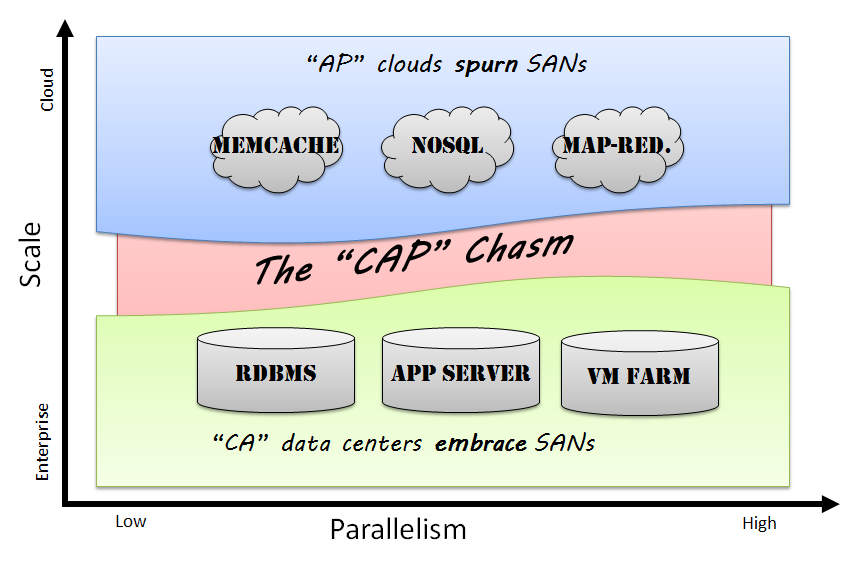
The deal with CAP is that you can only have two of Consistency, Availability, or Partitioning Tolerance.  Since everyone wants Availablity, the choice is really between Consitency or Partitioning.  Seeking Availability you’ve got two approaches:

  1. Legacy applications tried to eliminate faults to achieve Consistency with physically redundant scale up designs. 
  2. Cloud applications assume faults to achieve Partitioning Tolerance with logically redundant scale out design.

According to CAP, Legacy and cloud approaches are so fundamentally different that they create a “CAP Chasm” in which the very infrastructure fabric needed to deploy these applications is different.

As a cloud geek, I consider the inherent cost and scale limitations of a CA approach much too limited.   My first hand experience is that our customers and partners share my view: they have embraced AP patterns.  These patterns make more efficient use of resources, dictate simpler infrastructure layout, scale like hormone-crazed rabbits at a carrot farm, and can be deployed on less expensive commodity hardware.

As a CAP theorem enlightened IT professional, I can finally accept that there are other intellectually valid infrastructure models. 

See Mom?  I can play nicely with others after all.

VM != Cloud! Comparision draws ire, misses point

Having the requirement benefit of working with both Dave McCrory and Joyent on a daily basis at Dell, I cannot resist weighing in on the blog pong between them.

Dave’s post comparing VM pricing prompted Joyent to blog that VMs are not the only measure of cloud.

While I completely agree that clouds are not all about VMs, I think that Joyent is too limited in their definition of cloud in their reply.  We’re seeing an emergence of services as the differentiator between clouds.

Looking at Amazon, Azure, and Google, the clear way to reduce cloud spend is to migrate applications to consume their services (SQL, Storage, Bus, etc).

If cloud users are primarily concerned about price per hour (which I’m not convinced is the case) then they have real motivation to migrate from purely VM (or SmartMachine(tm) ) based applications to ones that use services.