OpenStack DefCore Enters Execution Phase. Help!

OpenStack DefCore Committee has established the principles and first artifacts required for vendors using the OpenStack trademark.  Over the next release cycle, we will be applying these to the Ice House and Juno releases.

Like a rockLearn more?  Hear about it LIVE!  Rob will be doing two sessions about DefCore next week (will be recorded):

  1. Tues Dec 16 at 9:45 am PST- OpenStack Podcast #14 with Jeff Dickey
  2. Thurs Dec 18 at 9:00 am PST – Online Meetup about DefCore with Rafael Knuth (optional RSVP)

At the December 2014 OpenStack Board meeting, we completed laying the foundations for the DefCore process that we started April 2013 in Portland. These are a set of principles explaining how OpenStack will select capabilities and code required for vendors using the name OpenStack. We also published the application of these governance principles for the Havana release.

  1. The OpenStack Board approved DefCore principles to explain
    the landscape of core including test driven capabilities and designated code (approved Nov 2013)
  2. the twelve criteria used to select capabilities (approved April 2014)
  3. the creation of component and framework layers for core (approved Oct 2014)
  4. the ten principles used to select designated sections (approved Dec 2014)

To test these principles, we’ve applied them to Havana and expressed the results in JSON format: Havana Capabilities and Havana Designated Sections. We’ve attempted to keep the process transparent and community focused by keeping these files as text and using the standard OpenStack review process.

DefCore’s work is not done and we need your help!  What’s next?

  1. Vote about bylaws changes to fully enable DefCore (change from projects defining core to capabilities)
  2. Work out going forward process for updating capabilities and sections for each release (once authorized by the bylaws, must be approved by Board and TC)
  3. Bring Havana work forward to Ice House and Juno.
  4. Help drive Refstack process to collect data from the field

unBIOSed? Is Redfish an IPMI retread or can vendors find unification?

Server management interfaces stink.  They are inconsistent both between vendors and within their own product suites.  Ideally, Vendors would agree on a single API; however, it’s not clear if the diversity is a product of competition or actual platform variation.  Likely, it’s both.

From RedFish SiteWhat is Redfish?  It’s a REST API for server configuration that aims to replace both IPMI and vendor specific server interfaces (like WSMAN).  Here’s the official text from RedfishSpecification.org.

Redfish is a modern intelligent [server] manageability interface and lightweight data model specification that is scalable, discoverable and extensible.  Redfish is suitable for a multitude of end-users, from the datacenter operator to an enterprise management console.

I think that it’s great to see vendors trying to get on the same page and I’m optimistic that we could get something better than IPMI (that’s a very low bar).  However, I don’t expect that vendors can converge to a single API; it’s just not practical due to release times and pressures to expose special features.  I think the divergence in APIs is due both to competitive pressures and to real variance between platforms.

Even if we manage to a grand server management unification; the problem of interface heterogeneity has a long legacy tail.

In the best case reality, we’re going from N versions to N+1 (and likely N*2) versions because the legacy gear is still around for a long time.  Adding Redfish means API sprawl is going to get worse until it gets back to being about the same as it is now.

Putting pessimism aside, the sprawl problem is severe enough that it’s worth supporting Redfish on the hope that it makes things better.

That’s easy to say, but expensive to do.  If I was making hardware (I left Dell in Oct 2014), I’d consider it an expensive investment for an uncertain return.  Even so, several major hardware players are stepping forward to help standardize.  I think Redfish would have good ROI for smaller vendors looking to displace a major player can ride on the standard.

Redfish is GREAT NEWS for me since RackN/Crowbar provides hardware abstraction and heterogeneous interface support.  More API variation makes my work more valuable.

One final note: if Redfish improves hardware security in a real way then it could be a game changer; however, embedded firmware web servers can be tricky to secure and patch compared to larger application focused software stacks.  This is one area what I’m hoping to see a lot of vendor collaboration!  [note: this should be it’s own subject – the security issue is more than API, it’s about system wide configuration.  stay tuned!]

Ironic + Crowbar: United in Vision, Complementary in Approach

This post is co-authored by Devanda van der Veen, OpenStack Ironic PTL, and Rob Hirschfeld, OpenCrowbar Founder.  We discuss how Ironic and Crowbar work together today and into the future.

Normalizing the APIs for hardware configuration is a noble and long-term goal.  While the end result, a configured server, is very easy to describe; the differences between vendors’ hardware configuration tools are substantial.  These differences make it impossible challenging to create repeatable operations automation (DevOps) on heterogeneous infrastructure.

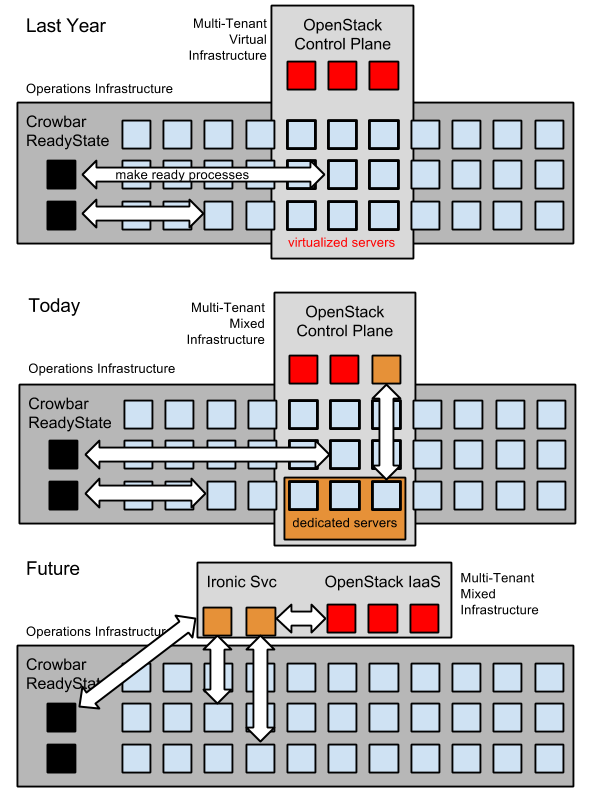
Illustration to show potential changes in provisioning control flow over time.

Illustration to show potential changes in provisioning control flow over time.

The OpenStack Ironic project is a multi-vendor community solution to this problem at the server level.  By providing a common API for server provisioning, Ironic encourages vendors to write drivers for their individual tooling such as iDRAC for Dell or iLO for HP.

Ironic abstracts configuration and expects to be driven by an orchestration system that makes the decisions of how to configure each server. That type of orchestration is the heart of Crowbar physical ops magic [side node: 5 ways that physical ops is different from cloud]

The OpenCrowbar project created extensible orchestration to solve this problem at the system level.  By decomposing system configuration into isolated functional actions, Crowbar can coordinate disparate configuration actions for servers, switches and between systems.

Today, the Provisioner component of Crowbar performs similar functions as Ironic for operating system installation and image lay down.  Since configuration activity is tightly coupled with other Crowbar configuration, discovery and networking setup, it is difficult to isolate in the current code base.  As Ironic progresses, it should be possible to shift these activities from the Provisioner to Ironic and take advantage of the community-based configuration drivers.

The immediate synergy between Crowbar and Ironic comes from accepting two modes of operation for OpenStack: bootstrapping infrastructure and multi-tenant server allocation.

Crowbar was designed as an operational platform that seeds an OpenStack ready environment.  Once that environment is configured, OpenStack can take over ownership of the resources and allow Ironic to manage and deliver “hypervisor-free” servers for each tenant.  In that way, we can accelerate the adoption of OpenStack for self-service metal.

Physical operations is messy and challenging, but we’re committed to working together to make it suck less.  Operators of the world unite!

Physical Ops = Plumbers of the Internet. Celebrating dirty IT jobs 8 bit style

I must be crazy because I like to make products that take on the hard and thankless jobs in IT.  Its not glamorous, but someone needs to do them.

marioAnalogies are required when explaining what I do to most people.  For them, I’m not a specialist in physical data center operations, I’m an Internet plumber who is part of the team you call when your virtual toilet backs up.  I’m good with that – it’s work that’s useful, messy and humble.

Plumbing, like the physical Internet, disappears from most people’s conscious once it’s out of sight under the floor, cabinet or modem closet.  And like plumbers, we can’t do physical ops without getting dirty.  Unlike cloud-based ops with clean APIs and virtual services, you can’t do physical ops without touching something physical.  Even if you’ve got great telepresence, you cannot get away from physical realities like NIC and SATA enumeration, BIOS management and network topology.  I’m delighted that cloud has abstracted away that layer for most people but that does not mean we can ignore it.

Physical ops lacks the standardization of plumbing.  There are many cross-vendor standards but innovation and vendor variation makes consistency as unlikely as a unicorn winning the Rainbow Triple Crown.

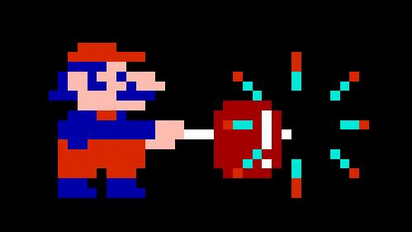
493143-donkey_kong_1For physical ops, it feels like we’re the internet’s most famous plumber, Mario, facing Donkey Kong.  We’ve got to scale ladders, jump fireballs and swing between chains.  The job is made harder because there’s no half measures.  Sometimes you can find the massive hammer and blast your way through but that’s just a short term thing.

Unfortunately, there’s a real enemy here: complexity.

Just like Donkey Kong keeps dashing off with the princess, operations continue to get more and more complex.  Like with Mario, the solution is not to bypass the complexity; it’s to get better and faster at navigating the obstacles that get thrown at you.  Physical ops is about self-reliance and adaptability.  In that case, there are a lot of lessons to be learned from Mario.

If I’m an internet plumber then I’m happy to embrace Mario as my mascot.  Plumbers of the internet unite!

Who’s the grown-up here?  It’s the VM not the Iron!

This ANALOGY exploring Virtual vs Physical Ops is Joint posting by Rob Hirschfeld, RackN, and Russel Doty, Redhat.RUSSEL DOTY

babyCompared to provisioning physical servers, getting applications running in a virtual machine is like coaching an adult soccer team – the players are ready, you just have to get them to the field and set the game in motion.  The physical servers can be compared to a grade school team – tremendous potential, but they can require a lot of coaching and intervention. And they don’t always play nice.

Russell Doty and I were geeking on the challenges of configuring physical servers when we realized that our friends in cloud just don’t have these problems.  When they ask for a server, it’s delivered to them on a platter with an SLA.  It’s a known configuration – calm, rational and well-behaved.  By comparison, hardware is cranky, irregular and sporadic.  To us, it sometimes feels like we are more in the babysitting business. Yes, we’ve had hardware with the colic!

Continuing the analogy, physical operations requires a degree of child-proofing and protection that is (thankfully) hidden behind cloud abstractions of hardware.  More importantly, it requires a level of work that adults take for granted like diaper changes (bios/raid setup), food preparation (network configs), and self-entertainment (O/S updates).

And here’s where the analogy breaks down…

The irony here is that the adults (vms) are the smaller, weaker part of the tribe.  Not only that, these kids have to create the environment that the “adults” run on.

If you’re used to dealing with adults to get work done, you’re going to be in for a shock when you ask the kids to do the same job.

That’s why the cloud is such a productive platform for software.  It’s an adults-only environment – the systems follow the rules and listen to your commands.  Even further, cloud systems know how to dress themselves (get an O/S), rent an apartment (get an IP and connect) and even get credentials (get a driver’s license).

These “little things” are taken for granted in the cloud are not automatic behaviors for physical infrastructure.

Of course, there are trade-offs – most notably performance and “scale up” scalability. The closer you need to get to hardware performance, on cpu, storage, or networks, the closer you need to get to the hardware.

It’s the classic case of standardizing vs. customization. And a question of how much time you are prepared to put into care and feeding!

why is hardware hard? Ready State Physical Ops Meetup on Tuesday 12/2 9am PT

meh.  Compared to cloud, Ops on physical infrastructure sinks.physical outlet

Unfortunately, the cloud and scale platforms need to run someone so someone’s got to deal with it.  In fact, we’ve got to deal with crates of cranky servers and flocks of finicky platforms.  It’s enough to keep a good operator down.

If that’s you, or someone you care about, join us for a physical ops support group meetup on Tuesday 9am PT (11 central).

There is a light at the end of the tunnel!  We can make it repeatable to provision OpenStack, Hadoop and other platforms.

As a community, we’re steadily bringing best practices and proven automation from cloud ops down into the physical space.   On the OpenCrowbar project, we’re accelerating this effort using the ready state concept as a hand off point for “physical-cloud equivalency” and exploring the concept of “functional operations” to make DevOps scripts more portable.

Join me and Rafael Knuth for a discussion about how operators can work together to break the cycle.

To thrive, OpenStack must better balance dev, ops and business needs.

OpenStack has grown dramatically in many ways but we have failed to integrate development, operations and business communities in a balanced way.

My most urgent observation from Paris is that these three critical parts of the community are having vastly different dialogs about OpenStack.

Clouds DownAt the Conference, business people were talking were about core, stability and utility while the developers were talking about features, reorganizing and expanding projects. The operators, unfortunately segregated in a different location, were trying to figure out how to share best practices and tools.

Much of this structural divergence was intentional and should be (re)evaluated as we grow.

OpenStack events are split into distinct focus areas: the conference for business people, the summit for developers and specialized days for operators. While this design serves a purpose, the community needs to be taking extra steps to ensure communication. Without that communication, corporate sponsors and users may find it easier to solve problems inside their walls than outside in the community.

The risk is clear: vendors may find it easier to work on a fork where they have business and operational control than work within the community.

Inside the community, we are working to help resolve this challenge with several parallel efforts. As a community member, I challenge you to get involved in these efforts to ensure the project balances dev, biz and ops priorities.  As a board member, I feel it’s a leadership challenge to make sure these efforts converge and that’s one of the reasons I’ve been working on several of these efforts:

  • OpenStack Project Managers (was Hidden Influencers) across companies in the ecosystem are getting organized into their own team. Since these managers effectively direct the majority of OpenStack developers, this group will allow
  • DefCore Committee works to define a smaller subset of the overall OpenStack Project that will be required for vendors using the OpenStack trademark and logo. This helps the business community focus on interoperability and stability.
  • Technical leadership (TC) lead “Big Tent” concept aligns with DefCore work and attempts to create a stable base platform while making it easier for new projects to enter the ecosystem. I’ve got a lot to say about this, but frankly, without safeguards, this scares people in the ops and business communities.
  • An operations “ready state” baseline keeps the community from being able to share best practices – this has become a pressing need.  I’d like to suggest as OpenCrowbar an outside of OpenStack a way to help provide an ops neutral common starting point. Having the OpenStack developer community attempting to create an installer using OpenStack has proven a significant distraction and only further distances operators from the community.

We need to get past seeing the project primarily as a technology platform.  Infrastructure software has to deliver value as an operational tool for enterprises.  For OpenStack to thrive, we must make sure the needs of all constituents (Dev, Biz, Ops) are being addressed.

Self-Exposure: Hidden Influencers become OpenStack Product Working Group

Warning to OpenStack PMs: If you are not actively involved in this effort then you (and your teams) will be left behind!

ManagersThe Hidden Influencers (now called “OpenStack Product Working Group”) had a GREAT and PRODUCTIVE session at the OpenStack (full notes):

  1. Named the group!  OpenStack Product Working Group (now, that’s clarity in marketing) [note: I was incorrect saying “Product Managers” earlier].
  2. Agreed to use the mailing list for communication.
  3. Committed to a face-to-face mid-cycle meetup (likely in South Bay)
  4. Output from the meetup will be STRATEGIC DIRECTION doc to board (similar but broader than “Win the Enterprise”)
  5. Regular meeting schedule – like developers but likely voice interactive instead of IRC.  Stefano Maffulli is leading.

PMs starting this group already direct the work for a super majority (>66%) of active contributors.

The primary mission for the group is to collaborate and communicate around development priorities so that we can ensure that project commitments get met.

It was recognized that the project technical leads are already strapped coordinating release and technical objectives.  Further, the product managers are already but independently engaged in setting strategic direction, we cannot rely on existing OpenStack technical leadership to have the bandwidth.

This effort will succeed to the extent that we can help the broader community tied in and focus development effort back to dollars for the people paying for those developers.  In my book, that’s what product managers are supposed to do.  Hopefully, getting this group organized will help surface that discussion.

This is a big challenge considering that these product managers have to balance corporate, shared project and individual developers’ requirements.  Overall, I think Allison Randall summarized our objectives best: “we’re herding cats in the same direction.”

Leveling OpenStack’s Big Tent: is OpenStack a product, platform or suite?

Question of the day: What should OpenStack do with all those eager contributors?  Does that mean expanding features or focusing on a core?

IMG_20141108_101906In the last few months, the OpenStack technical leadership (Sean Dague, Monty Taylor) has been introducing two interconnected concepts: big tent and levels.

  • Big tent means expanding the number of projects to accommodate more diversity (both in breath and depth) in the official OpenStack universe.  This change accommodates the growth of the community.
  • Levels is a structured approach to limiting integration dependencies between projects.  Some OpenStack components are highly interdependent and foundational (Keystone, Nova, Glance, Cinder) while others are primarily consumers (Horizon, Saraha) of lower level projects.

These two concepts are connected because we must address integration challenges that make it increasingly difficult to make changes within the code base.  If we substantially expand the code base with big tent then we need to make matching changes to streamline integration efforts.  The levels proposal reflects a narrower scope at the base than we currently use.

By combining big tent and levels, we are simultaneously growing and shrinking: we grow the community and scope while we shrink the integration points.  This balance may be essential to accommodate OpenStack’s growth.

UNIVERSALLY, the business OpenStack community who wants OpenStack to be a product.  Yet, what’s included in that product is unclear.

Expanding OpenStack projects tends to turn us into a suite of loosely connected functions rather than a single integrated platform with an ecosystem.  Either approach is viable, but it’s not possible to be both simultaneously.

On a cautionary note, there’s an anti-Big Tent position I heard expressed at the Paris Conference.  It’s goes like this: until vendors start generating revenue from the foundation components to pay for developer salaries; expanding the scope of OpenStack is uninteresting.

Recent DefCore changes also reflect the Big Tent thinking by adding component and platform levels.  This change was an important and critical compromise to match real-world use patterns by companies like Swiftstack (Object), DreamHost (Compute+Ceph), Piston (Compute+Ceph) and others; however, it creates the need to explain “which OpenStack” these companies are using.

I believe we have addressed interoperability in this change.  It remains to be seen if OpenStack vendors will choose to offer the broader platform or limit to themselves to individual components.  If vendors chase the components over platform then OpenStack becomes a suite of loosely connect products.  It’s ultimately a customer and market decision.

It’s not too late to influence these discussions!  I’m very interested in hearing from people in the community which direction they think the project should go.

Ops is Ops, except when it ain’t. Breaking down the impedance mismatches between physical and cloud ops.

We’ve made great strides in ops automation, but there’s no one-size-fits-all approach to ops because abstractions have limitations.

IMG_20141108_035537967Perhaps it’s my Industrial Engineering background, I’m a huge fan of operational automation and tooling. I can remember my first experience with VMware ESX and thinking that it needed tooling automation.  Since then, I’ve watched as cloud ops has revolutionized application development and deployment.  We are just at the beginning of the cloud automation curve and our continuous deployment tooling and platform services deliver exponential increases in value.

These cloud breakthroughs are fundamental to Ops and uncovered real best practices for operators.  Unfortunately, much of the cloud specific scripts and tools do not translate well to physical ops.  How can we correct that?

Now that I focus on physical ops, I’m in awe of the capabilities being unleashed by cloud ops. Looking at Netflix chaos monkeys pattern alone, we’ve reached a point where it’s practical to inject artificial failures to improve application robustness.  The idea of breaking things on purpose as an optimization is both terrifying and exhilarating.

In the last few years, I’ve watched (and lead) an application of these cloud tool chains down to physical infrastructure.  Fundamentally, there’s a great fit between DevOps configuration management (Chef, Puppet, Salt, Ansible) tooling and physical ops.  Most of the configuration and installation work (post-ready state) is fundamentally the same regardless if the services are physical, virtual or containerized.  Installing PostgreSQL is pretty much the same for any platform.

But pretty much the same is not exactly the same.  The differences between platforms often prevent us from translating useful work between frames.  In physics, we’d call that an impedance mismatch: where similar devices cannot work together dues to minor variations.

An example of this Ops impedance mismatch is networking.  Virtual systems present interfaces and networks that are specific to the desired workload while physical systems present all the available physical interfaces plus additional system interfaces like VLANs, bridges and teams.  On a typical server, there at least 10 available interfaces and you don’t get to choose which ones are connected – you have to discover the topology.  To complicate matters, the interface list will vary depending on both the server model and the site requirements.

It’s trivial in virtual by comparison, you get only the NICs you need and they are ordered consistently based on your network requests.  While the basic script is the same, it’s essential that it identify the correct interface.  That’s simple in cloud scripting and highly variable for physical!

Another example is drive configuration.  Hardware presents limitless options of RAID, JBOD plus SSD vs HDD.  These differences have dramatic performance and density implications that are, by design, completely obfuscated in cloud resources.

The solution is to create functional abstractions between the application configuration and the networking configuration.  The abstraction isolates configuration differences between the scripts.  So the application setup can be reused even if the networking is radically different.

With some of our OpenCrowbar latest work, we’re finally able to create practical abstractions for physical ops that’s repeatable site to site.  For example, we have patterns that allow us to functionally separate the network from the application layer.  Using that separation, we can build network interfaces in one layer and allow the next to assume the networking is correct as if it was a virtual machine.  That’s a very important advance because it allows us to finally share and reuse operational scripts.

We’ll never fully eliminate the physical vs cloud impedance issue, but I think we can make the gaps increasingly small if we continue to 1) isolate automation layers with clear APIs and 2) tune operational abstractions so they can be reused.