- SSDs (I have two 1/4 TB of SSD): We are constantly building/installing operating systems. These are high I/O activities so SSDs are essential. I’m constantly on the edge of no free space even with 1/2 TB .
- RAM (I have 32 Gb): It’s normal for us to run multiple VMs. If you RAM starve your VMs (I used to have 16) then they page fault and you’re back to constrained disk I/O. We assign 4 GB RAM per VM because it’s just faster.
- Many Cores: VMs w/ 1 CPU = thread contention. Adding RAM and Disk can’t fix a threading issues.
- Bonus: I like a good keyboard and big display – I code, type & read a lot so the 17″ display helps.
The power of a list with three things (reading recommendations)
Over breakfast with fellow Dell cloud thinker and general deep thinker Michael Cote, he suggested that we two options for something. I was quick to add a third and Cote objected because “having three options is a marketing thing to make you happier with the choices.” He’s right but didn’t have the sources to backup the comment. Since I was looking them up for Cote, I figured they’d be worth posting too:
- Dan Ariely’s Predictably Irrational (covers the theory and it funny)
- Rom Brafman’s Sway (very pragmatic)
- Leonard Mlodinow Drunkard’s Walk (if you like statistics)
Personally, I believe that there are always FIVE options. People generally over look the extreme choices like “do nothing” or “all in.” For example, when discussing a product architecture the two options that IMHO should always be on the table include “scrap the project” and “live with the problem.”
We never take the extra options, but they help clarify the three moderate choices. Of course, this makes more sense after you read the above books. So read the books (there are 3), don’t read the books, or setup personal interviews with the authors to get the real story. The choice is yours!
OpenStack Board needs Consensus Governance
I am humbled by the community support for my election (I finished first in the results) and have been surprised to realize that one of my unlisted credentials, 5 years as Secretary of our local public Community Development Corporation, could also be an important asset. Dealing with Texas Open Government laws around parliamentary minutia such as open discussions, voting, minutes and agendas turns out to translate directly to open source governance (which affects everyone!).
I believe that the OpenStack Board should operate by Consensus rules.
Boards can choose to operate either by Consensus or Majority. A Consensus board typically passes all resolutions unanimously while a Majority board does not need agreement on decisions (see table below).
On first blush, majority process seems more efficient; unfortunately, split votes are divisive and polarizing. The consequence of split votes is the minority positions will seek longer debate, resort to back room politics and procedural overhead. This type of behavior would be destructive for our community.
A Consensus board, which only happens by implied agreement of the members and leadership, works to ensure that decisions can be supported by all the members. This does not mean that all the members agree with the board positions, hold-hands during meetings, or participate in Polynesian drum circles! It does mean that the board as a whole considers minority positions and their motivation before calling a vote. If there is too much difference in opinion, then the majority may defer voting or minority members may abstain from voting. One common aspect of Consensus boards is that members may appear to argue against their own positions to ensure that minority views have been represented.
While the consensus model takes discipline for our Directors, it also takes patience and cooperation from the community that we serve. Board actions may take longer or be less direct than members of the community desire.
I believe that committing to a Consensus board is essential for OpenStack because our board is large (24 members!), our community is diverse and the financial impacts to members are high. So far, I’m proud that we’ve been following that model and will try to ensure we maintain that tradition.
Post Script Table: Consensus vs. Majority Governance Snapshot
| Consensus | Majority | |
| Voting | Unanimous | Split |
| Process | Flexible | Strict |
| Position in Discussions | Ambiguous | Polarized |
| Controversy | Avoided / Postponed | Forced / Decisive Wins |
| Community | Encouraged | Divided |
| Minority Interests | Incorporated | Excluded |
| Board Unity | High | Low |
Why doesn’t Chef call them “bowls” instead of roles?
The extended Crowbar team (my employer Dell and community) recently had a bit of a controversy heated discussion over the renaming of “proposals” to “configurations.” It was pretty clear that the term “proposal” confused users because an “active proposal” seems like a bit of an oxymoron. Excepting Scott Jensen, our schedule-czar and director of engineering, we had relatively few die-hard “I love proposal” advocates; however, deciding on an alternative was not quite so easy.
Ultimately, the question came down to “do we use an invented term or an intuitive term.” The answer lies in when to use or avoid the congruity theory as articulated by Roger Cauvin.
We considered many alternatives like calling them “fixtures” to go along with the Crowbar & Barclamp tool theme. Even “Chuck Norris” was considered until copyright issues were flagged. The top alternative, “configuration” seemed just too bland. Frankly and amazingly, we originally considered it “too descriptive!”
The crux of the argument really revolved around the users’ ability to intuitively grasp a concept or to force them learn a new term. For example, we specifically chose “barclamp” instead of “module” because we felt that there were more components to a barclamp than just being a Crowbar module. In many ways, module would be sufficiently descriptive; however, we saw that there was benefit to the user tax in introducing a new term. It also fit nicely within our tool theme.
Opscode Chef is an example of investing heavily in a naming theme. For example, the concept of “cookbooks” and “recipes” seems relatively intuitive for users but starts getting stretched for “knife” because it is not immediately clear to users what that component does (it executes instructions on nodes and the server). After learning Chef, I appreciate “knife” as the universal tool but still remember having to figure it out.
A good theme is awesome, but it can quickly encumber usability.
For example, what if Chef has used “bowl” instead of role. It’s logical: you put a group of ingredients to mix into a bowl that acts as a container. While it may be logical to the initiated, it mainly extends the learning curve for new users. A role is a commonly accepted term for an operational classification so it is a much better term for users. The same is true for “node” and “data bag.”
I love a good incongruent theme as much as any meme-enabled tech geek but themes must not hinder usability. After all, we all fight for the users.
I am seeking your vote(s) for the OpenStack Board
If registered, you have 8 votes to allocate as you wish. You will get a link via email – you must use that link.
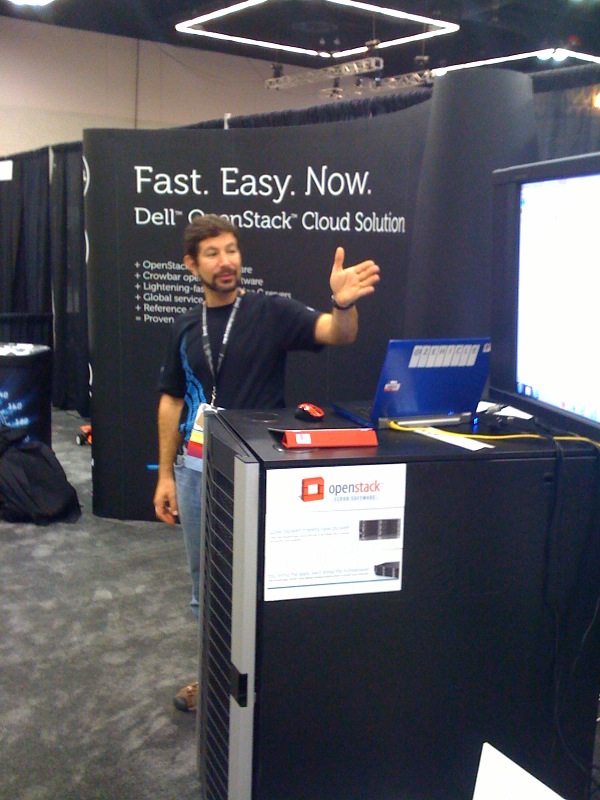
Joseph B George and I are cross-blogging this post because we are jointly seeking your vote(s) for individual member seats on the OpenStack Foundation board. This is key point in the OpenStack journey and we strongly encourage eligible voters to participate no matter who you vote for! As we have said before, success of the Foundation governance process matters just as much as the code because it ensures equal access and limits forking.
We think that OpenStack succeeds because it is collaboratively developed. It is essential that we select board members who have a proven record of community development, a willingness to partner and have demonstrated investment in the project.
Our OpenStack vision favors production operations by being operator, user and ecosystem focused. If elected, we will represent these interests by helping advance deployability, API specifications, open operations and both large and small scale cloud deployments.
Of the nominees, we best represent OpenStack users and operators (as opposed to developers). We have the most diverse experience in real-world OpenStack deployments because our solution has been deployed broadly (both as Dell and through Crowbar. We have a proven record of collaborating broadly with contributors, demonstrated skills at building the OpenStack community and doing real open source work to ensure that OpenStack is the most deployable cloud platform anywhere.
Let’s get specific about our leadership in the OpenStack project and community:
-
We have been active and vocal leaders in the OpenStack community
- our team has established two very active user groups (Austin & Boston)
- we have lead multiple world-wide deploy day events (March 2012 & May 2012).
-
We were the first OpenStack powered private cloud provider
- we have substantial experience in the field and know the challenges of running OpenStack for a wide variety of real-world deployments
- our first solution came out on Cactus! We’ve been delivering on Essex since OSCON 2012 (http://www.oscon.com/ ).
- We represent a broad range of deployment scenarios ranging from hosting, government, healthcare, retail, education, media, financial and more!
- We have broad engagements and partnerships at the infrastructure (SUSE, Canonical, Redhat), consulting (Canonical, Mirantis) and ecosystem layers (enStratus) and beyond!
- We have a proven track record of collaboration instead of forking/disrupting – a critical skill for this project reflected by our consistent actions to preserve the integrity of the project.
- We have led the “make OpenStack deployable” campaign with substantial investments (open source Crowbar, white papers, documentation & cookbooks.
- We have very long and consistent history with the project starting even before the first OpenStack summit in Austin.
Of course, we’re asking for you to consider for both of us; however, if you want to focus on just one then here’s the balance between us. Rob (bio) is a technologist with deep roots in cloud technology, data center operations and open source. Joseph is a business professional with experience new product introduction and enterprise delivery.
Not sure if you can vote? If you registered as an individual member then your name should be on the voting list. In that case, you can vote between 8/20 and 8/24.
Erlang HTTP client RESTful API Post (example code)
Sometimes I just need to feed the SEO monster for Erlang. In this case, I could not find a good post that described doing an Erlang http:request that posts with a json payload. This is to support the BDD (“Cucumber but really fast”) testing framework that I’ve included in Crowbar.
Method = post,
URL = "http://192,168.124.10:3000/node/2.0/new",
Header = [],
Type = "application/json",
Body = "{\"name\":\"foo.example.com\"}",
HTTPOptions = [],
Options = [],
R = httpc:request(Method, {URL, Header, Type, Body}, HTTPOptions, Options),
{ok, {{"HTTP/1.1",ReturnCode, State}, Head, Body}} = R.
{"id", Key} = lists:keyfind("id",1,json:parse(Body)),
Note: See the full source: https://github.com/crowbar/barclamp-crowbar/blob/master/BDD/digest_auth.erl
The Body will contain your JSON response and I used our Erlang json lib to parse that to find the ID.
In the actual BDD code, it’s a little more complex because I also use our Erlang digest auth. I hope this helps you!
I’m seeking Nominations for OpenStack Board
The OpenStack Foundation is currently seeking nominations for community representatives for the board and I am asking for you to nominate me for that position. Candidates are required to have ten (10) nominations to be considered for the election. To nominate, you can join and nominate from here. (I’m nominated, thanks!)
Rob Background:
As the OpenStack technology lead within Dell and long-time cloud deployer and developer, I made OpenStack deployability a top concern for Dell and the community. My leadership has changed the dialog around OpenStack to be balanced between Ops and Dev. I have also been pivotal in bringing open collaboration to OpenStack operations through our Crowbar project. Through my role at Dell, I am actively engaged with numerous field deployments and uniquely positioned to represent OpenStack’s developer, provider and enterprise user bases. I bring substantial process experience (Agile/Lean/CI) into my decision making. My focus will be on ensuring OpenStack is deployable and ready for use.
More? Ready my previous background post for previous OpenStack elections.
Crowbar 2.0 Design Summit Notes (+ open weekly meetings starting)
I could not be happier with the results Crowbar collaborators and my team at Dell achieved around the 1st Crowbar design summit. We had great discussions and even better participation.
The attendees represented major operating system vendors, configuration management companies, OpenStack hosting companies, OpenStack cloud software providers, OpenStack consultants, OpenStack private cloud users, and (of course) a major infrastructure provider. That’s a very complete cross-section of the cloud community.
I knew from the start that we had too little time and, thankfully, people were tolerant of my need to stop the discussions. In the end, we were able to cover all the planned topics. This was important because all these features are interlocked so discussions were iterative. I was impressed with the level of knowledge at the table and it drove deep discussion. Even so, there are still parts of Crowbar that are confusing (networking, late binding, orchestration, chef coupling) even to collaborators.
In typing up these notes, it becomes even more blindingly obvious that the core features for Crowbar 2 are highly interconnected. That’s no surprise technically; however, it will make the notes harder to follow because of knowledge bootstrapping. You need take time and grok the gestalt and surf the zeitgeist.
Collaboration Invitation: I wanted to remind readers that this summit was just the kick-off for a series of open weekly design (Tuesdays 10am CDT) and coordination (Thursdays 8am CDT) meetings. Everyone is welcome to join in those meetings – information is posted, recorded, folded, spindled and mutilated on the Crowbar 2 wiki page.
These notes are my reflection of the online etherpad notes that were made live during the meeting. I’ve grouped them by design topic.
Introduction
- Contributors need to sign CLAs
- We are refactoring Crowbar at this time because we have a collection of interconnected features that could not be decoupled
- Some items (Database use, Rails3, documentation, process) are not for debate. They are core needs but require little design.
- There are 5 key topics for the refactor: online mode, networking flexibility, OpenStack pull from source, heterogeneous/multi operating systems, being CDMB agnostic
- Due to time limits, we have to stop discussions and continue them online.
- We are hoping to align Crowbar 2 beta and OpenStack Folsom release.
Online / Connected Mode
- Online mode is more than simply internet connectivity. It is the foundation of how Crowbar stages dependencies and components for deploy. It’s required for heterogeneous O/S, pull from source and it has dependencies on how we model networking so nodes can access resources.
- We are thinking to use caching proxies to stage resources. This would allow isolated production environments and preserves the run everything from ISO without a connection (that is still a key requirement to us).
- Suse’s Crowbar fork does not build an ISO, instead it relies on RPM packages for barclamps and their dependencies.
- Pulling packages directly from the Internet has proven to be unreliable, this method cannot rely on that alone.
Install From Source
- This feature is mainly focused on OpenStack, it could be applied more generally. The principals that we are looking at could be applied to any application were the source code is changing quickly (all of them?!). Hadoop is an obvious second candidate.
- We spent some time reviewing the use-cases for this feature. While this appears to be very dev and pre-release focused, there are important applications for production. Specifically, we expect that scale customers will need to run ahead of or slightly adjacent to trunk due to patches or proprietary code. In both cases, it is important that users can deploy from their repository.
- We discussed briefly our objective to pull configuration from upstream (not just OpenStack, but potentially any common cookbooks/modules). This topic is central to the CMDB agnostic discussion below.
- The overall sentiment is that this could be a very powerful capability if we can manage to make it work. There is a substantial challenge in tracking dependencies – current RPMs and Debs do a good job of this and other configuration steps beyond just the bits. Replicating that functionality is the real obstacle.
CMDB agnostic (decoupling Chef)
- This feature is confusing because we are not eliminating the need for a configuration management database (CMDB) tool like Chef, instead we are decoupling Crowbar from the a single CMDB to a pluggable model using an abstraction layer.
- It was stressed that Crowbar does orchestration – we do not rely on convergence over multiple passes to get the configuration correct.
- We had strong agreement that the modules should not be tightly coupled but did need a consistent way (API? Consistent namespace? Pixie dust?) to share data between each other. Our priority is to maintain loose coupling and follow integration by convention and best practices rather than rigid structures.
- The abstraction layer needs to have both import and export functions
- Crowbar will use attribute injection so that Cookbooks can leverage Crowbar but will not require Crowbar to operate. Crowbar’s database will provide the links between the nodes instead of having to wedge it into the CMDB.
- In 1.x, the networking was the most coupled into Chef. This is a major part of the refactor and modeling for Crowbar’s database.
- There are a lot of notes captured about this on the etherpad – I recommend reviewing them
Heterogeneous OS (bare metal provisioning and beyond)
- This topic was the most divergent of all our topics because most of the participants were using some variant of their own bare metal provisioning project (check the etherpad for the list).
- Since we can’t pack an unlimited set of stuff on the ISO, this feature requires online mode.
- Most of these projects do nothing beyond OS provisioning; however, their simplicity is beneficial. Crowbar needs to consider users who just want a stream-lined OS provisioning experience.
- We discussed Crowbar’s late binding capability, but did not resolve how to reconcile that with these other projects.
-
Critical use cases to consider:
- an API for provisioning (not sure if it needs to be more than the current one)
- pick which Operating Systems go on which nodes (potentially with a rules engine?)
- inventory capabilities of available nodes (like ohai and factor) into a database
- inventory available operating systems
Open Community Access to Crowbar 2 Efforts
We’re moving along on the Crowbar2 refactoring work (`/release/rails3anddb/master` branch for now) and it’s time to start making it easier for you to participate if you are interested.
We are planning to start having TWO weekly community sprint meetings.
NOTE: Times can still shift depending on community input! We are trying to a truly global community so we need your input.
The weekly design discussions will be on Tuesdays @ 10am Central (GMT -6). The topics will be relevant to the coming sprint and we expect dialog. The topics will be determined by Greg Althaus based on progress on the refactor. You’re welcome to contact him or the list with suggestions.
- Voice & Screencast: https://join.me/dellcrowbar
- Online discussion & notes on the http://crowbar.sync.in/sprintMMDD etherpads
- Meetings will be limited to 1 hour.
The purpose of these meetings is to
- discuss/resolve design related to the refactor
- Document use-cases
- identify issues that need to be addressed in the next sprint
The weekly coordination meetings will be on Thursdays @ 8am Central (GMT -6). We want to respect everyone’s time and will strictly limit these to 1 hour. This meeting is in between our internal sprint review and planning so we have flexibility to adjust our plans based on your input. It is important to us that we make it possible for you to contribute and we need your input to make sure that you are not blocked!
The coordination meetings will be structured as follows (times approximate)
- Voice & Screencast: https://join.me/dellcrowbar
- 25 minutes for review of current progress
- 10 minutes for feedback/adjustments on process and workflow
- 25 minutes for planning of next sprint
- Online discussion & notes on the http://crowbar.sync.in/sprintMMDD etherpads
- Identification of working groups for further discussion and coding collaboration
These meetings are the primary way that we will be making sure the community is not blocked by our development efforts.
The purpose of these meetings is
- to synchronize quickly so that we can connect the people who should be collaborating
- eliminate blocking items for Crowbar contributors
Of course, we will attempt to record and post all of these meetings.
Stay tuned! We will likely announce additional meetings for community collaboration.
PS: These are design meetings, they are NOT Crowbar training meetings. Please consult http://bit.ly/crowbarwiki for links and videos about learning Crowbar.
Which side of the desk are the drawers on? (Dunkelisms)
Back in 2001, I had the pleasure to have some long conversations with Phil Dunkelberger. The impact of those meetings still resonates with me today in a collection of “Dunkelisms” that are an invaluable part of my kick-ass-and-take-names tool box. I can’t find any Internet source, so I’ll take it on myself to archive these jewels!
Which side of the desk are the drawers on?
I was sitting with Phil and complaining that our web site was not updated and the information was inaccurate. He looked at me and asked me “which side of the desk are the drawers on?” and completely threw me for a loop. He explained “when you’re the boss, you sit on the side of the desk with the drawers on it. You have the power to make changes.”
I whined back that it was Marketing’s job to update the content. I squirmed under his glare until he asked “as a programmer, do you have ability to update the web site?” When I said, “yes, but…” his glare wilted my desk plant and the rest of my excuse died with it.
His reply was very crisp, “you have the power to fix it because you have access to the web servers. If it’s a real problem then the drawers are on your side of the desk. If it’s not a real problem then help Marketing solve it or move on.”
I’m not saying it would be the right move politically, but it was amazingly powerful to acknowledge that I had the power to fix the problem if I needed.
There are many situations where we voluntarily give up power even when the drawers are on our side of the desk. For example, when my team is planning we expect Marketing to set priorities that drive development. Engineering goes along with this for a lot of good reasons; however, the Engineering has the drawers on what really goes into the product.
This Dunkelism helps me align priorities and eliminate roadblocks. As I dig deeper and deeper into community driven open source projects, I find that the idea behind this expression is a mantra that drives projects forward.
I find this expression very powerful in many situations. I hope you find it helpful too!