Manage Hardware like a BOSS – latest OpenCrowbar brings API to Physical Gear

A few weeks ago, I posted about VMs being squeezed between containers and metal.   That observation comes from our experience fielding the latest metal provisioning feature sets for OpenCrowbar; consequently, so it’s exciting to see the team has cut the next quarterly release:  OpenCrowbar v2.2 (aka Camshaft).  Even better, you can top it off with official software support.

Camshaft coordinates activity

Dual overhead camshaft housing by Neodarkshadow from Wikimedia Commons

The Camshaft release had two primary objectives: Integrations and Services.  Both build on the unique functional operations and ready state approach in Crowbar v2.

1) For Integrations, we’ve been busy leveraging our ready state API to make physical servers work like a cloud.  It gets especially interesting with the RackN burn-in/tear-down workflows added in.  Our prototype Chef Provisioning driver showed how you can use the Crowbar API to spin servers up and down.  We’re now expanding this cloud-like capability for Saltstack, Docker Machine and Pivotal BOSH.

2) For Services, we’ve taken ops decomposition to a new level.  The “secret sauce” for Crowbar is our ability to interweave ops activity between components in the system.  For example, building a cluster requires setting up pieces on different systems in a very specific sequence.  In Camshaft, we’ve added externally registered services (using Consul) into the orchestration.  That means that Crowbar will either use existing DNS, Database, or NTP services or set it’s own.  Basically, Crowbar can now work FIT YOUR EXISTING OPS ENVIRONMENT without forcing a dedicated Crowbar only services like DHCP or DNS.

In addition to all these features, you can now purchase support for OpenCrowbar from RackN (my company).  The Enterprise version includes additional server life-cycle workflow elements and features like HA and Upgrade as they are available.

There are AMAZING features coming in the next release (“Drill”) including a message bus to broadcast events from the system, more operating systems (ESXi, Xenserver, Debian and Mirantis’ Fuel) and increased integration/flexibility with existing operational environments.  Several of these have already been added to the develop branch.

It’s easy to setup and test OpenCrowbar using containers, VMs or metal.  Want to learn more?  Join our community in Gitteremail list or weekly interactive community meetings (Wednesdays @ 9am PT).
Showing to how others explain Ready State & OpenCrowbar

I’m working on a series for DevOps.com to explain Functional Ops (expect it to start early next week!) and it’s very hard to convey it’s east-west API nature.  So I’m always excited to see how other people explain how OpenCrowbar does ops and ready state.

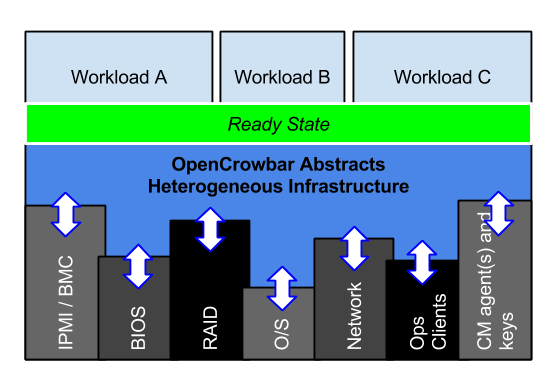
Ready State PictureThis week I was blown away by the drawing that I’ve recreated for this blog post.  It’s very clear graphic showing the operational complexity of heterogeneous infrastructure AND how OpenCrowbar normalizes it into a ready state.

It’s critical to realize that the height of each component tower varies by vendor and also by location with in the data center topology.  Ready state is not just about normalizing different vendors gear; it’s really about dealing with the complexity that’s inherent in building a functional data center.  It’s “little” things liking knowing how to to enumerate the networking interfaces and uplinks to build the correct teams.

If you think this graphic helps, please let me know.

Talking Functional Ops & Bare Metal DevOps with vBrownBag [video]

Last Wednesday (3/11/15), I had the privilege of talking with the vBrownBag crowd about Functional Ops and bare metal deployment.  In this hour, I talk about how functional operations (FuncOps) works as an extension of ready state.  FuncOps is a critical concept for providing abstractions to scale heterogeneous physical operations.

Timing for this was fantastic since we’d just worked out ESXi install capability for OpenCrowbar (it will exposed for work starting on Drill, the next Crowbar release cycle).

Here’s the brown bag:

If you’d like to see a demo, I’ve got hours of them posted:

Video Progression

Crowbar v2.1 demo: Visual Table of Contents [click for playlist]

Art Fewell and I discuss DevOps, SDN, Containers & OpenStack [video + transcript]

A little while back, Art Fewell and I had two excellent discussions about general trends and challenges in the cloud and scale data center space.  Due to technical difficulties, the first (funnier one) was lost forever to NSA archives, but the second survived!

The video and transcript were just posted to Network World as part of Art’s on going interview series.  It was an action packed hour so I don’t want to re-post the transcript here.  I thought selected quotes (under the video) were worth calling out to whet your appetite for the whole tamale.

My highlights:

  1. .. partnering with a start-up was really hard, but partnering with an open source project actually gave us a lot more influence and control.
  2. Then we got into OpenStack, … we [Dell] wanted to invest our time and that we could be part of and would be sustained and transparent to the community.
  3. Incumbents are starting to be threatened by these new opened technologies … that I think levels of playing field is having an open platform.
  4. …I was pointing at you and laughing… [you’ll have to see the video]
  5. docker and containerization … potentially is disruptive to OpenStack and how OpenStack is operating
  6. You have to turn the crank faster and faster and faster to keep up.
  7. Small things I love about OpenStack … vendors are learning how to work in these open communities. When they don’t do it right they’re told very strongly that they don’t.
  8. It was literally a Power Point of everything that was wrong … [I said,] “Yes, that’s true. You want to help?”
  9. …people aiming missiles at your house right now…
  10. With containers you can sell that same piece of hardware 10 times or more and really pack in the workloads and so you get better performance and over subscription and so the utilization of the infrastructure goes way up.
  11. I’m not as much of a believer in that OpenStack eats the data center phenomena.
  12. First thing is automate. I’ve talked to people a lot about getting ready for OpenStack and what they should do. The bottom line is before you even invest in these technologies, automating your workloads and deployments is a huge component for being successful with that.
  13. Now, all of sudden the SDN layer is connecting these network function virtualization ..  It’s a big mess. It’s really hard, it’s really complex.
  14. The thing that I’m really excited about is the service architecture. We’re in the middle of doing on the RackN and Crowbar side, we’re in the middle of doing an architecture that’s basically turning data center operations into services.
  15. What platform as a service really is about, it’s about how you store the information. What services do you offer around the elastic part? Elastic is time based, it’s where you’re manipulating in the data.
  16. RE RackN: You can’t manufacture infrastructure but you can use it in a much “cloudier way”. It really redefines what you can do in a datacenter.
  17. That abstraction layer means that people can work together and actually share scripts
  18. I definitely think that OpenStack’s legacy will more likely be the community and the governance and what we’ve learned from that than probably the code.

Want CI Consul Love? OK! Run Consul in Travis-CI [example scripts]

If you are designing an application that uses microservice registration AND continuous integration then this post is for you!  If not, get with the program, you are a fossil.

Inside The EngineSunday night, I posted about the Erlang Consul client I wrote for our Behavior Driven Development (BDD) testing infrastructure.  That exposed a need to run a Consul service in the OpenCrowbar Travis-CI build automation that validates all of our pull requests.  Basically, Travis spins up the full OpenCrowbar API and workers (we call it the annealer) which in turn registers services in Consul.

NOTE: This is pseudo instructions.  In the actual code (here too), I created a script to install consul but this is more illustrative of the changes you need to make in your .travis.yml file.

In the first snippet, we download and unzip consul.  It’s in GO so that’s about all we need for an install.  I added a version check for logging validation.

before_script:
  - wget 'https://dl.bintray.com/mitchellh/consul/0.4.1_linux_amd64.zip'
  - unzip "0.4.1_linux_amd64.zip"
  - ./consul --version

In the second step, we setup the consul service and register it to itself in the background.  That allows the other services to access it.

script: 
  - ../consul agent -server -bootstrap-expect 1 -data-dir /tmp/consul &

After that, the BDD infrastructure can register the fake services that we expect (I created an erlang consul:reg_serv(“name”) routine that makes this super easy).  Once the services are registered, OpenCrowbar will check for the services and continue without trying to instantiate them (which it cannot do in Travis).

Here’s the pull request with the changes.

too easy to bare metal? Ansible just works with OpenCrowbar

2012-01-15_10-21-12_716I’ve talked before about how OpenCrowbar distributes SSH keys automatically as part of its deployment process.  Now, it’s time to unleash some of the subsequent magic!

[5/21 Update: We added the “crowbar-access” role to the Drill release that allows you to inject/remove keys on a per node basis from the API or CLI at any point in the node life-cycle]

If you provision servers with your keys in place, then Ansible will just work with truly minimal configuration (one line in a file!).

Video Demo (steps bellow):

Here are my steps:

  1. Install OpenCrowbar and run some nodes to ready state [videos]
  2. Install Ansible [simple steps]
  3. Add hosts range “192.168.124.[81:83]  ansible_ssh_user=root” to the
    “/etc/ansible/hosts” file
  4. If you are really lazy, add “[Default] // host_key_checking = False” to your “~/.ansible.cfg” file
  5. now ping the hosts, “ansible all -m ping”
  6. pat yourself on the back, you’re done.
  7. to show off:
    1. touch all machines “ansible all -a “/bin/echo hello”
    2. look at types of Linux “ansible all -a “uname -a”

Further integration work can make this even more powerful.  

I’d like to see OpenCrowbar generate the Ansible inventory file from the discovery data and to map Ansible groups from deployments.  Crowbar could also call Ansible directly to use playbooks or even do a direct hand-off to Tower to complete an install without user intervention.

Wow, that would be pretty handy!   If you think so too, please join us in the OpenCrowbar community.

Online Meetup Today (1/13): Build a rock-solid foundation under your OpenStack cloud

Reminder: Online meetup w/ Crowbar + OpenStack DEMO TODAY

HFoundation Rawere’s the notice from the site (with my added Picture)

Building cloud infrastructure requires a rock-solid foundation. 

In this hour, Rob Hirschfeld will demo automated tooling, specifically OpenCrowbar, to prepare and integrate physical infrastructure to ready state and then use PackStack to install OpenStack.


The OpenCrowbar project started in 2011 as an OpenStack installer and had grown into a general purpose provisioning and infrastructure orchestration framework that works in parallel with multiple hardware vendors, operating systems and devops tools.  These tools create a fast, durable and repeatable environment to install OpenStack, Ceph, Kubernetes, Hadoop or other scale platforms.


Rob will show off the latest features and discuss key concepts from the Crowbar operational model including Ready State, Functional Operations and Late Binding. These concepts, built into Crowbar, can be applied generally to make your operations more robust and scalable.

OpenCrowbar v2.1 Video Tour from Metal to OpenStack and beyond

With the OpenCrowbar v2.1 out, I’ve been asked to update the video library of Crowbar demos.  Since a complete tour is about 3 hours, I decided to cut it down into focused demos that would allow you to start at an area of interest and work backwards.

I’ve linked all the videos below by title.  Here’s a visual table on contents:

Video Progression

Crowbar v2.1 demo: Visual Table of Contents [click for playlist]

The heart of the demo series is the Annealer and Ready State (video #3).

  1. Prepare Environment
  2. Bootstrap Crowbar
  3. Add Nodes ♥ Ready State (good starting point)
  4. Boot Hardware
  5. Install OpenStack (Juno using PackStack on CentOS 7)
  6. Integrate with Chef & Chef Provisioning
  7. Integrate with SaltStack

I’ve tried to do some post-production so limit dead air and focus on key areas.  As always, I value content over production values so feedback is very welcome!

Nextcast #14 Transcription on OpenStack & Crowbar > “we can’t hand out trophies to everyone”

Last week, I was a guest on the NextCast OpenStack podcast hosted by Niki Acosta (EMC) [Jeff Dickey could not join].   I’ve taken some time to transcribe highlights.

We had a great discussion nextcastabout OpenStack, Ops and Crowbar.  I appreciate Niki’s insightful questions and an opportunity to share my opinions.  I feel that we covered years of material in just 1 hour and I appreciate the opportunity to appear on the podcast.
Video from full post (youtube) and the audio for download.

Plus, a FULL TRANSCRIPT!  Here’s my Next Cast #14 Short Transcripton

The objective of this transcription is to help navigate the recording, not replace it.  I did not provide complete context for remarks.

  • 04:30 Birth of Crowbar (to address Ops battle scars)
  • 08:00 The need for repeatable Ready State baseline to help community work together
  • 10:30 Should hardware matter in OpenStack? It has to, details and topology matters not vendor.
  • 11:20 OpenCompute – people are trying to open source hardware design
  • 11:50 When you are dealing with hardware, it matters. You have to get it right.
  • 12:40 Customers are hardware heterogeneous by design (and for ops tooling). Crowbar is neutral territory
  • 14:50 It’s not worth telling people they are wrong, because they are not. There are a lot of right ways to install OpenStack
  • 16:10 Sometimes people make expensive choices because it’s what they are comfortable with and it’s not helpful for me to them they a wrong – they are not.
  • 16:30 You get into a weird corner if you don’t tell anyone no. And an equally weird corner if you tell everyone yes.
  • 18:00 Aspirations of having an interoperable cloud was much harder than the actual work to build it
  • 18:30 Community want to say yes, “bring your code” but to operators that’s very frustrating because they want to be able to make substitutions
  • 19:30 Thinking that if something is included then it’s required – that’s not clear
  • 19:50 Interlock Dilemma [see my back reference]
  • 20:10 Orwell Animal Farm reference – “all animals equal but pigs are more equal”
  • 22:20 Rob defines DefCore, it’s not big and scary
  • 22:35 DefCore is about commercial use, not running the technical project
  • 23:35 OpenStack had to make money for the companies are paying for the developers who participate… they need to see ROI
  • 24:00 OpenStack is an infrastructure project, stability is the #1 feature
  • 24:40 You have to give a reason why you are saying no and a path to yes
  • 25:00 DefCore is test driven: quantitative results
  • 26:15 Balance between whole project and parts – examples are Swiftstack (wants Object only) and Dreamhost (wants Compute only)
  • 27:00 DefCore created core components vs platform levels
  • 27:30 No vendor has said they can implement DefCore without some effort
  • 28:10 We have outlets for vendors who do not want to implement the process
  • 28:30 The Board is not in a position to make technical call about what’s in, we had to build a process for community input
  • 29:10 We had to define something that could say, “this is it and we have to move on”
  • 29:50 What we want is for people to start with the core and then bring in the other projects. We want to know what people are adding so we can make that core in time
  • 30:10 This is not a recommendation is a base.
  • 30:35 OpenStack is a bubble – does not help if we just get together to pad each other on the back, we want to have a thriving ecosystem
  • 31:15 Question: “have vendors been selfish”
  • 31:35 Rob rephrased as “does OpenStack have a tragedy of the commons” problem
  • 32:30 We need to make sure that everyone is contributing back upstream
  • 32:50 Benefit of a Benevolent Dictator is that they can block features unless community needs are met
  • 33:10 We have NOT made it clear where companies should be contributing to the community. We are not doing a good job directing community efforts
  • 33:45 Hidden Influencers becomes OpenStack Product group
  • 34:55 Hidden Influencers were not connecting at the summit in a public way (like developers were)
  • 35:20 Developers could not really make big commitments of their time without the buy in from their managers (product and line)
  • 35:50 Subtle selfishness – focusing on your own features can disrupt the whole release where things would flow better if they helped others
  • 37:40 Rob was concerned that there was a lot of drift between developers and company’s product descriptions
  • 38:20 BYLAWS CHANGES – vote! here’s why we need to change
  • 38:50 Having whole projects designated as core sucks – code in core should be slower and less changing. Innovation at the core will break interoperability
  • 39:40 Hoping that core will help product managers understand where they are using the standard and adding values
  • 41:10 All babies are ugly > with core, that’s good. We are looking for the grown ups who can do work and deliver value. Babies are things you nurture and help grow because they have potential.
  • 42:00 We undermine our credibility in the community when we talk about projects that are babies as if they were ready.
  • 43:15 DefCore’s job was to help pick projects. If everyone is core then we look like a youth soccer team where everyone is getting a trophy
  • 44:30 Question: “What do you tell to users to instill confidence in OpenStack”
  • 44:50 first thing: focus on operations and automation. Table stakes (for any cloud) is getting your deployments automated. Puppies vs Cattle.
  • 45:25 People who were successful with early OpenStack were using automated deployments against the APIs.
  • 46:00 DevOps is a fundamental part of cloud computing – if you’re hand-built and not automated then you are old school IT.
  • 46:40 Niki references Gartner “Bimodal IT” [excellent reference, go read it!]
  • 47:20 VMWare is a great crutch for OpenStack. We can use VMWare for the puppies.
  • 47:45 OpenStack is not going to run on every servers (perhaps that’s heresy) but it does not make sense in every workload
  • 48:15 One size does not fit all – we need to be good at what we’re good at
  • 48:30 OpenStack needs to focus on doing something really well. That means helping people who want to bring automated workloads into the cloud
  • 49:20 Core was about sending a signal about what’s ready and people can rely on
  • 49:45 Back in 2011, I was saying OpenStack was ready for people who would make the operational investment
  • 50:30 We use Crowbar because it makes it easier to do automated deployments for infrastructure like Hadoop and Ceph where you want access to the physical media
  • 51:00 We should be encouraging people to use OpenStack for its use cases
  • 51:30 Existential question for OpenStack: are we a suite or product. The community is split here
  • 51:30 In comparing with Amazon, does OpenStack have to implement it or build an ecosystem to compete
  • 53:00 As soon as you make something THE OpenStack project (like Heat) you are sending a message that the alternates are not welcome
  • 54:30 OpenStack ends up in a trap if we pick a single project and make it the way that we are going do something. New implementations are going to surface from WITHIN the projects and we need to ready for that.
  • 55:15 new implementations are coming, we have to be ready for that. We can make ourselves vulnerable to splitting if we do not prepare.
  • 56:00 API vs Implementation? This is something that splits the community. Ultimately we to be an API spec but we are not ready for that. We have a lot of work to do first using the same code base.
  • 56:50 DefCore has taken a balanced approach using our diversity as a strength
  • 57:20 Bylaws did not allow for enough flexibility for what is core
  • 59:00 We need voters for the quorum!
  • 59:30 Rob recommended Rocky Grober (Huawei) and Shamail Tahir (EMC) for future shows

OpenCrowbar 2.1 Released Last Week with new integrations and support

Crowbar 2.1 Release brings commercial support, hardware configs, chef and saltstack

OpenCrowbarLast week, the Crowbar community completed the OpenCrowbar “Broom” release and officially designed it as v2.1.  This release represents 8 months of hardening of the core orchestration engine (including automated testing), the addition of true hardware support (in the optional hardware workload) and preliminary advanced integration with Chef and Saltstack.

Core Features:

  • RAID – Automatically set RAID configuration parameters depending on how the system will be used.
    • Support for LSI controllers
    • Single and Dual RAID configuration
  • BIOS – Automatically set BIOS settings depending on how the system will be used.
    • Configuration setting for Dell PE series systems
  • Out of Band Support–  Configure and manage systems via their OOB interface
    • Support for IPMI and WSMan
  • RPM Installation (it riseth again!) – Install OpenCrowbar via a standard RPM instead of a Docker container

Integrations:

  • SaltStack integration – OpenCrowbar can install SaltStack as a configuration tool to take over after “Ready State”
  • Chef Provisioning (was Chef Metal) – OpenCrowbar driver allows Chef to build clusters on bare metal using the Crowbar API.

Infrastructure:

  • Automated smoke test and code coverage analysis for all pull requests.

And…v2.1 is the first release with commercial support!

RackN (rackn.com) offers consulting and support for the OpenCrowbar v2.1 release.  The company was started by Crowbar founders Greg Althaus, Scott Jensen, Dan Choquette, and myself specifically to productize and extend Crowbar.

Want to try it out?