Thanks! I’m enjoying my conversation with you

I write because I love to tell stories and to think about how actions we take today will impact tomorrow.  Ultimately, everything here is about a dialog with you because you are my sounding board and my critic.  I appreciate when people engage me about posts here and extend the conversation into other dimensions.  Feel free to call me on points and question my position – that’s what this is all about.

Thank you for being at part of my blog and joining in.  I’m looking forward to hearing more from you.

During the OpenStack Summit, I got to lead and participate in some excellent presentations and panels.  While my theme for this summit was interoperability, there are many other items discussed.

I hope you enjoy them.

Did one of these topics stand out?  Is there something I missed?  Please let me know!

We need better Gold Member criteria to help building OpenStack culture

bunny slippersDuring last OpenStack board meeting, we started a dialog that will be continued over the rest of the year.  It concerns how/if we should apply our criteria to measure the contributions of companies that are applying to become Gold members.

I believe that we should see many contribution “footprints” for companies in Foundation leadership positions.  These footprints do not have to be code in github: there are many visible ways to contribute to OpenStack including internal installs, delivered product, community meetups, open source support around code, service to the community through speaking and sponsoring and, of course, code too.

At this point in the OpenStack evolution, there is so much going on that it is easy to leave footprints because there are so many ways to engage.  Footprints are tangible evidence of community leadership and the currency of collaboration.  OpenStack thrives because we are committed to working together, being transparent in our actions and providing service to the project beyond our own needs.

I believe OpenStack Foundation’s new gold members will are great additions to our growing community; however, we need to be increasingly deliberate in accepting new Gold members to make sure that they have a history of demonstrating a culture of open source leadership and contribution.  

These applications deserve careful consideration for several reasons:

  1. there are a limited number of gold level positions (16 of the 24 are now occupied)
  2. there is no practical way to remove a gold member (but only 8 are elected to the board)
  3. there is a perception (by the applicants) that they gain additional credibility through gold membership
  4. gold and platinum members are the leaders of our community so everyone will models their behavior

It is important to remember that there is no limit or barrier (beyond $) to joining at the corporate sponsors level. So, being a gold member means that companies are seeking a broader leadership role in the project.

Over the next months, Simon Anderson (committee chair, Dreamhost) will be leading me and several other board members in an effort to refine of our Gold member review criteria.  I’ll post own list shortly and I’m interested in hearing from you about what type of “footprints” we should be considered in this process.

7 takeaways from DevOps Days Austin

Block Tables

I spent Tuesday and Wednesday at DevOpsDays Austin and continue to be impressed with the enthusiasm and collaborative nature of the DOD events.  We also managed to have a very robust and engaged twitter backchannel thanks to an impressive pace set by Gene Kim!

I’ve still got a 5+ post backlog from the OpenStack summit, but wanted to do a quick post while it’s top of mind.

My takeaways from DevOpsDays Austin:

  1. DevOpsDays spends a lot of time talking about culture.  I’m a huge believer on the importance of culture as the foundation for the type of fundamental changes that we’re making in the IT industry; however, it’s also a sign that we’re still in the minority if we have to talk about culture evangelism.
  2. Process and DevOps are tightly coupled.  It’s very clear that Lean/Agile/Kanban are essential for DevOps success (nice job by Dominica DeGrandis).  No one even suggested DevOps+Waterfall as a joke (but Patrick Debois had a picture of a xeroxed butt in his preso which is pretty close).
  3. Still need more Devs people to show up!  My feeling is that we’ve got a lot of operators who are engaging with developers and fewer developers who are engaging with operators (the “opsdev” people).
  4. Chef Omnibus installer is very compelling.  This approach addresses issues with packaging that were created because we did not have configuration management.  Now that we have good tooling we separate the concerns between bits, configuration, services and dependencies.  This is one thing to watch and something I expect to see in Crowbar.
  5. The old mantra still holds: If something is hard, do it more often.
  6. Eli Goldratt’s The Goal is alive again thanks to Gene Kims’s smart new novel, The Phoenix project, about DevOps and IT  (I highly recommend both, start with Kim).
  7. Not DevOps, but 3D printing is awesome.  This is clearly a game changing technology; however, it takes some effort to get right.  Dell brought a Solidoodle 3D printer to the event to try and print OpenStack & Crowbar logos (watch for this in the future).

I’d be interested in hearing what other people found interesting!  Please comment here and let me know.

OpenStack steps toward Interopability with Temptest, RAs & RefStack.org

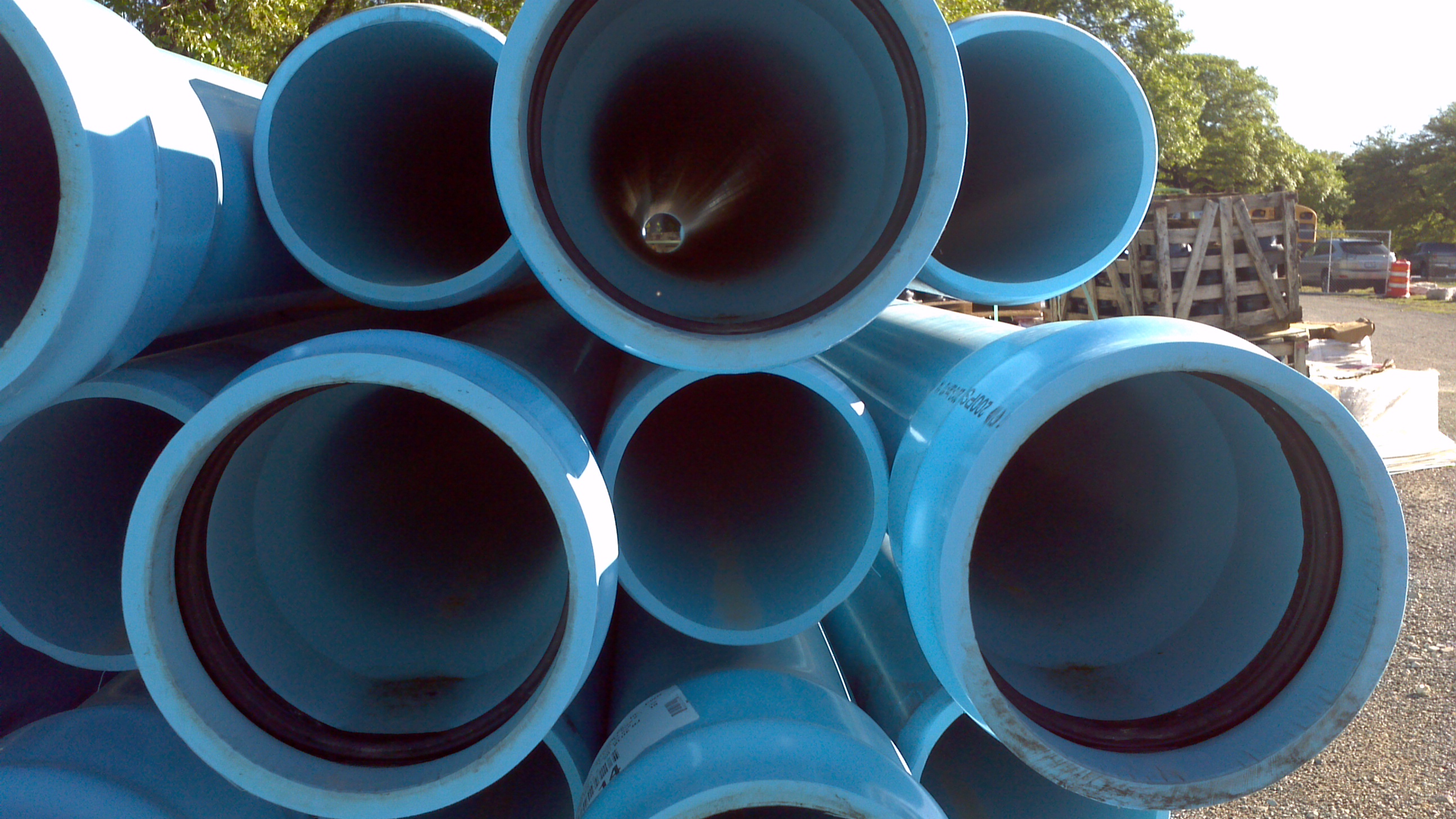
Pipes are interoperableI’m a cautious supporter of OpenStack leading with implementation (over API specification); however, it clearly has risks. OpenStack has the benefit of many live sites operating at significant scale. The short term cost is that those sites were not fully interoperable (progress is being made!). Even if they were, we are lack the means to validate that they are.

The interoperability challenge was a major theme of the Havana Summit in Portland last week (panel I moderated) .  Solving it creates significant benefits for the OpenStack community.  These benefits have significant financial opportunities for the OpenStack ecosystem.

This is a journey that we are on together – it’s not a deliverable from a single company or a release that we will complete and move on.

There were several themes that Monty and I presented during Heat for Reference Architectures (slides).  It’s pretty obvious that interop is valuable (I discuss why you should care in this earlier post) and running a cloud means dealing with hardware, software and ops in equal measures.  We also identified lots of important items like Open OperationsUpstreamingReference Architecture/Implementation and Testing.

During the session, I think we did a good job stating how we can use Heat for an RA to make incremental steps.   and I had a session about upgrade (slides).

Even with all this progress, Testing for interoperability was one of the largest gaps.

The challenge is not if we should test, but how to create a set of tests that everyone will accept as adequate.  Approach that goal with standardization or specification objective is likely an impossible challenge.

Joshua McKenty & Monty Taylor found a starting point for interoperability FITS testing: “let’s use the Tempest tests we’ve got.”

We should question the assumption that faithful implementation test specifications (FITS) for interoperability are only useful with a matching specification and significant API coverage.  Any level of coverage provides useful information and, more importantly, visibility accelerates contributions to the test base.

I can speak from experience that this approach has merit.  The Crowbar team at Dell has been including OpenStack Tempest as part of our reference deployment since Essex and it runs as part of our automated test infrastructure against every build.  This process does not catch every issue, but passing Tempest is a very good indication that you’ve got the a workable OpenStack deployment.

From orphans to open source, data matters

TMF ChildrenMy wife’s day job helps Indian orphans through the Miracle Foundation here in Austin. On the surface, our jobs are very different; however, there is lately more and more intersection in both form and substance. It was not always like that, initially the Miracle Foundation primary engagement had been an emotional appeal: “look, these orphans are sad, they need you. Did we mention that they are orphans?”

Joking aside, there are plenty of kind people who want to help children; however, there are a lots of worthy causes with equally strong appeal. The question is how do you pick which one? Donors/Contributors want one that is both emotionally appealing and effective.

While radically different in human impact, both of raising orphans and building open source rely heavily on personal engagement and passion for success. Just like non-profits, there are many open source projects that want you to invest your time in installing and contributing to their most worthy technology.

About 18 months ago, the Miracle Foundation pivoted their strategy from tending individual children towards cultivating whole orphanages (the “NEST program”, video below). They started tracking things like how much milk and fruit each child ate and if they had been vaccinated. They connected observable data like hemoglobin levels of children to their ability to pay attention in school. They were even aware of additional days girls spent in school just because they got monthly hygiene products.

NEST Spider Graph

Used with Permission, The Miracle Foundation

With this new program, the Miracle Foundation can tell you exactly how much benefit each child will receive from each dollar. These are real results derived from collecting real data, and the results are powerful.

The children the Miracle Foundation nurtures are going from subsistence to flourishing. This is not happening because people care more about these children than before. It is happening because someone is keeping the data and making sure that the support they give gets the results they want. This in turn helps donors (become one) feel confident that their emotional response is delivering tangible improvements. Both are essential to TMF’s mission.

Open source projects have a similar gestalt.

People and companies contributing time and resources to a project want to both believe in the technology and see tangible metrics to validate adoption. Open source transparency makes it easier to find active projects and people are engaged contributors, but it can be harder to determine if the project is having broader impact.

For OpenStack, these tangible metrics began to surface in the last few days. Before the summit, Stephano Muffulli, community manager, launched the OpenStack Activity Board to show commit and quality data for the project. Last Monday, Tim Bell & Ryan Lane presented the results of the first user survey which showed how and what users are adopting for OpenStack.

If you like seeing this type of data driven behavior then vote with your keyboard and become part of an active open source project. For non-profits like the Miracle Foundation, voting is even easier – you just need a credit card to join in their Mothers’ Day campaign. Your mom may not understand anything you add to open source, but she can understand when you help orphans.

Continue reading

Crowbar and our Pivot (or, how we slipped and shipped Grizzly)

Crowbar Grizzly PostMy team at Dell uses Lean process because it forces us to be honest about making hard choices. Our recent decision to pivot back to Crowbar 1.x for the OpenStack Grizzly release is a great example how the pivot process works.

4/24 note: I have a longer post and ISO for Grizzly on Crowbar waiting until we enter QA. The Crowbar community is already very active around this work and you’re encouraged to join.

Like any refactor, there was schedule risk when we started the Crowbar 2.x release. To mitigate this risk, we made two critical choices. First, we choose to advance the OpenStack barclamps on the 1.x code base in parallel with the 2.x work. Second, we chose a pivot date for the team to choose releasing Grizzly on the 1.x or 2.x trunks.

Choosing to jump back to 1.x was one of the hardest choices I’ve made in my career. I’m proud that we had the foresight to keep that as an option and prouder that our team rallied to make it happen.

I acknowledge that 1.x has gaps; however, getting Grizzly into the field for PoCs and pilots with 1.x provide substantial benefits to the community.  That said, there are barclamps for HA deployments and other production features that are under development on the 1.x branch and will be available in the community.

The 2.x code base provides important features but we are building from on the 1.x deployment recipes. This means that development, testing and tuning applied to the Grizzly barclamps will translates directly into Crowbar 2.x field readiness. In fact, more completeness on OpenStack can dramatically simplify Crowbar 2.x testing efforts.  This is especially true on the OpenStack Networking (fka Quantum) barclamps because they are new work.

Delivering solutions is a balance between features, timing and field experience.  The Crowbar team’s preference is to collaborate with operators in the field and that means making workable software available quickly.

I hope that you’ll agree with our approach and help us make Grizzly the most deployable OpenStack yet.

As OpenStack enters rapids with Grizzly, watch for strong currents, hidden rocks & eddies.

White Water

Play Boating From Wikipedia

I enjoy kayaking white water rapids – they are exhilarating and demanding. The water accelerates around obstacles and shows its power. You cannot simply ride the current; you must navigate your way around obstacles, stay clear of eddies that pull you back and watch for hidden rocks. The secret to success is to read the current and make small adjustments as you are carried along – resistance is futile.

After the summit, I see the OpenStack with the Grizzly release like water entering the rapids. The quality and capability of the code base continues to improve while the number of players with offerings in the ecosystem is also increasing rapidly. Until now, there was plenty of room to play together; however, as scope, activity and velocity increase there will more inter-vendor interactions.

As a member of the OpenStack board, I have tremendous enthusiasm for what the OpenStack community has accomplished. There have been some really positive accounts of the summit including CSC “OpenStack gains maturity…“, Silicon Angle “OpenStack has reached a Flash Point”, Randy Bias’ “OpenStack is THE Stack”, Wayne Walls “Hallway Track” and much more on the Planet OpenStack aggregator.

In fact, we’ve created such a love fest for OpenStack that I fear we are drinking our own kool aide.

I have a responsibility to be transparent and honest about challenges facing the us because it’s the Foundation’s job to guide us forward. My positions result from many conversations that I had throughout the week of the Summit. They are also the result of my first hand experiences along with my 14 years of cloud experience.

Over the next posts, I’ll explore a number of these topics with the goal of helping navigate a path through the potential turbulence. The simple fact is the OpenStack is growing quickly and that creates challenges:

  1. A growing number of new developers are joining. Since our work surface area is expanding, it’s both easier than ever to participate and harder to navigate where to begin. We need to get ahead of the design cycles.
  2. A growing number of non-devs are participating and bringing important contributions and experience. We must include them in the OpenStack meritocracy because they speak for the quality and usability of the project.
  3. A growing number of companies (many “name brands”) who are still trying to figure out how to participate and collaborate in open source projects. Lack of experience increases the risk of divergence (forking) and market confusion.
  4. A growing number of products based on OpenStack also increases forking risk as OpenStack contributors feel compelled to differentiate.
  5. A growing number of core components (compute+block+network+…) that are required to have base functionality.
  6. A growing number of incubated projects that continue to stress innovation and pace of change that challenges the very question of “what is OpenStack?”
  7. A growing number of deployed sites offering OpenStack clouds but the community lacks a way to verify (or really discuss) compatibility between the sites.

This list is a cause for celebration not a cause for alarm – every item is a challenges based on our success. The community and Foundation are already working to address the risks.

While some of us enjoy the chaos and excitement of rapids, other can take comfort from the fact that they are always followed by calm waters. Don’t worry – we’ll navigate through this together.

“Stack Shop” cover of Macklemore’s Thrift Shop

Sometimes a meme glitters too strongly for me to resist getting pulled in… that happened to great effect that just before the OpenStack Havana summit. When my code-addled mind kept swapping “poppin’ tags” for “OpenStack” on the radio edit, I stopped fighting and rewrote the Thrift Shop lyrics for OpenStack (see below the split).

With a lot of help from summit attendees (many of them are OpenStack celebrities, CEOs, VPs and members OpenStack Foundation board), I was able to create a freaking awesome cover of Macklemore’s second hand confection (NSFW).

Frankly, I don’t know everyone in the video (what, what?)!

But here’s a list of those that I do know.  I’m happy to update so the victims actors get credit.  Singers (in order):

Rob Hirschfeld (me) & Monty Taylor, Peter Poulliot, Judd Maltin, Forrest Norrod, Josh Kleinpeter, Tristan Goode, Dan Bode, Jay Pipes, Prabhakar Gopalan, Peter Chadwick, Simon Andersen, Vish Ishaya, Wayne Walls, Alex Freedland, Niki Acosta, Ops Track Monday Session 1, Ben Cherian, Eric Windisch, Brandon Draeger, Joseph B George,  Mark Collier, Joseph Heck, Tim Bell,  Chris Kemp, Kyle McDonald & Joshua McKenty,

Continue reading

OpenStack’s next hurdle: Interoperability. Why should you care?

SXSW life size Newton's Cradle

SXSW life size Newton’s Cradle

The OpenStack Board spent several hours (yes, hours) discussing interoperability related topics at the last board meeting.  Fundamentally, the community benefits when uses can operate easily across multiple OpenStack deployments (their own and/or public clouds).

Cloud interoperability: the ability to transfer workloads between systems without changes to the deployment operations management infrastructure.

This is NOT hybrid (which I defined as a workload transparently operating in multiple systems); however it is a prereq to achieve scalable hybrid operation.

Interoperability matters because the OpenStack value proposition is all about creating a common platform.  IT World does a good job laying out the problem (note, I work for Dell).  To create sites that can interoperate, we have to some serious lifting:

At the OpenStack Summit, there are multiple chances to engage on this.   I’m moderating a panel about Interop and also sharing a session about the highly related topic of Reference Architectures with Monty Tayor.

The Interop Panel (topic description here) is Tuesday @ 5:20pm.  If you join, you’ll get to see me try to stump our awesome panelists

  • Jonathan LaCour, DreamHost
  • Troy Toman, Rackspace
  • Bernard Golden,  Enstratius
  • Monty Taylor, OpenStack Board (and HP)
  • Peter Pouliot, Microsoft

PS: Oh, and I’m also talking about DevOps Upgrades Patterns during the very first session (see a preview).

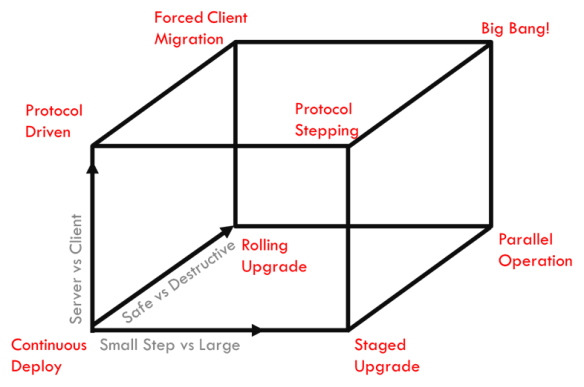
DevOps approaches to upgrade: Cube Visualization

I’m working on my OpenStack summit talk about DevOps upgrade patterns and got to a point where there are three major vectors to consider:

  1. Step Size (shown as X axis): do we make upgrades in small frequent steps or queue up changes into larger bundles? Larger steps mean that there are more changes to be accommodated simultaneously.
  2. Change Leader (shown as Y axis): do we upgrade the server or the client first? Regardless of the choice, the followers should be able to handle multiple protocol versions if we are going to have any hope of a reasonable upgrade.
  3. Safeness (shown as Z axis): do the changes preserve the data and productivity of the entity being upgraded? It is simpler to assume to we simply add new components and remove old components; this approach carries significant risks or redundancy requirements.

I’m strongly biased towards continuous deployment because I think it reduces risk and increases agility; however, I laying out all the vertices of the upgrade cube help to visualize where the costs and risks are being added into the traditional upgrade models.

Breaking down each vertex:

  1. Continuous Deploy – core infrastructure is updated on a regular (usually daily or faster) basis
  2. Protocol Driven – like changing to HTML5, the clients are tolerant to multiple protocols and changes take a long time to roll out
  3. Staged Upgrade – tightly coordinate migration between major versions over a short period of time in which all of the components in the system step from one version to the next together.
  4. Rolling Upgrade – system operates a small band of versions simultaneously where the components with the oldest versions are in process of being removed and their capacity replaced with new nodes using the latest versions.
  5. Parallel Operation – two server systems operate and clients choose when to migrate to the latest version.
  6. Protocol Stepping – rollout of clients that support multiple versions and then upgrade the server infrastructure only after all clients have achieved can support both versions.
  7. Forced Client Migration – change the server infrastructure and then force the clients to upgrade before they can reconnect.
  8. Big Bang – you have to shut down all components of the system to upgrade it

This type of visualization helps me identify costs and options. It’s not likely to get much time in the final presentation so I’m hoping to hear in advance if it resonates with others.

PS: like this visualization? check out my “magic 8 cube” for cloud hosting options.