Thinking about how to Implement OpenStack Core Definition

THIS POST IS #10 IN A SERIES ABOUT “WHAT IS CORE.”

Tied UpWe’ve had a number of community discussions (OSCON, SFO & SA-TX) around the process for OpenStack Core definition.  These have been animated and engaged discussions (video from SA-TX): my notes for them are below.

While the current thinking of a testing-based definition of Core adds pressure on expanding our test suite, it seems to pass the community’s fairness checks.

Overall, the discussions lead me to believe that we’re on the right track because the discussions jump from process to impacts.  It’s not too late!  We’re continuing to get community feedback.  So what’s next?

First…. Get involved: Upcoming Community Core Discussions

These discussions are expected to have online access via Google Hangout.  Watch Twitter when the event starts for a link.

Want to to discuss this in your meetup? Reach out to me or someone on the Board and we’ll be happy to find a way to connect with your local community!

What’s Next?  Implementation!

So far, the Core discussion has been about defining the process that we’ll use to determine what is core.  Assuming we move forward, the next step is to implement that process by selecting which tests are “must pass.”  That means we have to both figure out how to pick the tests and do the actual work of picking them.  I suspect we’ll also find testing gaps that will have developers scrambling in Ice House.

Here’s the possible (aggressive) timeline for implementation:

  • November: Approval of approach & timeline at next Board Meeting
  • January: Publish Timeline for Roll out (ideally, have usable definition for Havana)
  • March: Identify Havana must pass Tests (process to be determined)
  • April: Integration w/ OpenStack Foundation infrastructure

Obviously, there are a lot of details to work out!  I expect that we’ll have an interim process to select must-pass tests before we can have a full community driven methodology.

Notes from Previous Discussions (earlier notes):

  • There is still confusion around the idea that OpenStack Core requires using some of the project code.  This requirement helps ensure that people claiming to be OpenStack core have a reason to contribute, not just replicate the APIs.
  • It’s easy to overlook that we’re trying to define a process for defining core, not core itself.  We have spent a lot of time testing how individual projects may be effected based on possible outcomes.  In the end, we’ll need actual data.
  • There are some clear anti-goals in the process that we are not ready to discuss but will clearly going to become issues quickly.  They are:
    • Using the OpenStack name for projects that pass the API tests but don’t implement any OpenStack code.  (e.g.: an OpenStack Compatible mark)
    • Having speciality testing sets for flavors of OpenStack that are different than core.  (e.g.: OpenStack for Hosters, OpenStack Private Cloud, etc)
  • We need to be prepared that the list of “must pass” tests identifies a smaller core than is currently defined.  It’s possible that some projects will no longer be “core”
  • The idea that we’re going to use real data to recommend tests as must-pass is positive; however, the time it takes to collect the data may be frustrating.
  • People love to lobby for their favorite projects.  Gaps in testing may create problems.
  • We are about to put a lot of pressure on the testing efforts and that will require more investment and leadership from the Foundation.
  • Some people are not comfortable with self-reporting test compliance.   Overall, market pressure was considered enough to punish cheaters.
  • There is a perceived risk of confusion as we migrate between versions.  OpenStack Core for Havana seems to specific but there is concern that vendors may pass in one release and then skip re-certification.  Once again, market pressure seems to be an adequate answer.
  • It’s not clear if a project with only 1 must-pass test is a core project.  Likely, it would be considered core.  Ultimately, people seem to expect that the tests will define core instead of the project boundary.

What do you think?  I’d like to hear your opinions on this!

Taking OpenStack Core discussions to community

core flowTHIS POST IS #9 IN A SERIES ABOUT “WHAT IS CORE.”

We’ve been building up to a broad discussion about the OpenStack Core and I’d like to invite everyone in the OpenStack community to participate (review latest).

Alan Clark (Board Chairman) officially kicked off this open discussion with his post on the OpenStack blog last week.  And we’re trying to have face-to-face events for dialog like the Core meetup tonight in San Francisco.  Look for more to come!

Of course, this will also be a topic at the summit (Alan and I submitted two sessions about this).  The Board needs to move this forward in the November meeting, so NOW is the time to review and give us input.

OpenStack’s Test Driven Core > it’s where I think “what is core” discussions are heading

THIS POST IS #7 IN A SERIES ABOUT “WHAT IS CORE.”

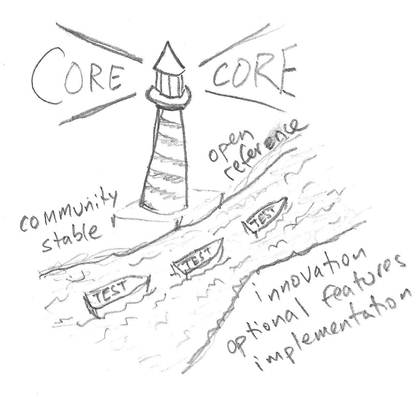
core lighthouse

In helping drive OpenStack’s “what is core” dialog, I’ve had the privilege of listening to a lot of viewpoints about what we are and should be.  Throughout the process, I’ve tried to put aside my positions and be an objective listener.  In this post, I’m expressing where I think this effort will lead us.

If OpenStack culture values implementation over API then our core definition should too.

How do we make a core definition that values implementation over API?  I think that our definition should also be based on what’s working in the field over qualitative definitional statements.  The challenge in defining core is to find a way to reinforce this culture in a quantifiable way.

The path forward lies in concrete decomposition (and not because you were talked to death on the sidewalk).

Concrete decomposition means breaking Core into small units for discussion like “is provisioning a single server critical?”  More importantly, we can use tests as the unit for decomposition.  Tests are gold when it comes to defining expected OpenStack behaviors.  In our tests, we have a description of which use-cases have been implemented.  Discussing those use-cases is much more finite than arguing over stable versus innovative development methodologies.

I believe that we are moving toward community tests playing an essential role in OpenStack.  As a believer in the value of BDD and CI, I think that placing high value on tests improves the project in fundamental ways beyond defining Core.  It creates a commercial motivation for contributors to add tests, inches us toward interoperability, and helps drive stability for users.  In these ways, using tests to measure OpenStack drives the right behaviors for the project.

Another consequence I anticipate is a new role for the User Committee (UC).  With a growing body of tests, the OpenStack Foundation needs a way to figure out the subset of tests which are required.  While the Technical Committee (TC) should demand a comprehensive suite of tests for all projects, they lack the perspective to figure out which use-cases are being implemented by our user base.  Gathering that data is already the domain of the UC so asking them to match implemented use-cases to tests seems like a natural extension of their role.

By having data supporting the elevation of tests to must-pass status, I envision a definition of Core that is based on how OpenStack is implemented.  That, in turn, will help drive our broader interoperability objectives.

Visualizing the OpenStack Core discussion points

THIS POST IS #6 IN A SERIES ABOUT “WHAT IS CORE.”

As we take the OpenStack Core discussion to a larger audience, I was asked to create the summary version the discussion points.  We needed a quick visual way to understand how these consensus statements interconnect and help provide context.  To address this need, I based it on a refined 10 core positions to create the following OpenStack Core flowchart.

core flow

The flow diagram below is grouped into three main areas: core definition (green), technical requirements (blue), and testing impacts (orange).

  1. Core Definition (green) walks through the fundamental scope and premise of the “what is core” discussion.  We are looking for the essential OpenStack: the parts that everyone needs and nothing more.  While OpenStack can be something much larger, core lives at the heart of the use-case venn diagram.  It’s the magical ice cream flavor that everyone loves like Triple Unicorn Rainbow Crunch.
  2. Technical Requirements (blue) covers some of the most contentious parts of the dialog.  This section states the expectation that OpenStack™ implementations must use parts the OpenStack code (you can’t just provide a compatible API).  It goes further to expect that we will maintain an open reference implementation and also identify places where parts of the code can be substituted with alternate implementations.  Examples of alternate implementations are plug-ins, API extensions, different hypervisors, and alternate libraries.
  3. Testing Impacts (orange) reviews some of the important new thinking around Core.  These points focus on the use of OpenStack community tests (e.g.: Tempest) to validate the total code base.  We expect users to be able to self-administer these tests or rely on an external validation.  Either way, we do not expect all tests to pass for all configurations; instead, the Foundation will identify a subset of the tests as required or must-pass.  The current thinking is that these must-pass tests will become the effective definition of OpenStack™ Core.

I hope this helps connect the dots on the core discussions so far.

I’d like to clean-up the positions to match the flow chart and cross reference.  Stay tuned!  This flowchart is a work in process – updates and suggestions are welcome!

READ POST IS #7: WHERE IS THIS GOING?

Community dialogue around “What is Core” positions

THIS POST IS #5 IN A SERIES ABOUT “WHAT IS CORE.”

by Rob Hirschfeld (cc) w/ attribution

The OpenStack Foundation Board has been having a broadening conservation about this topic.  Feeling left out?  Please don’t be!  Now is the time to start getting involved: we had to start very narrowly focused to avoid having the discussion continue to go in circles.  As we’ve expanding the dialog, we have incorporated significant feedback to drive consensus.

No matter where I go, people are passionate about the subject of OpenStack Core.

Overall, there is confusion of scope covered by “what is core” because people bring in their perspective from public, private solution, ecosystem or internal deployment objectives.  In discussion, everyone sees that we have to deal with issues around the OpenStack mark and projects first, but they are impatient to get into the deep issues.  Personally, we can get consensus on core and will always have a degree of healthy tension between user types.

The following are my notes, not my opinions.  I strive to faithfully represent a wide range of positions here.  Clarifications, comments and feedback are welcome!

Consensus Topics:

  • Reference/Alternate Implementation (not plug-in): Not using “plug-ins” to describe the idea that OpenStack projects should have a shared API with required code and clearly specified areas where code is replaceable.  It is the Technical Committee (TC) that makes these decisions.  The most meaningful language around this point is to say that OpenStack will have an open reference implementation with allowable alternate implementations.
  • Alternate implementations are useful:  We want to ensure upstream contribution and collaboration on the code base.  Reference implementations ensure that there’s a reason to keep open source OpenStack strong.  Alternate Implementations are important to innovation.
  • Small vs. Large Core: This is an ongoing debate about if OpenStack should have a lot of projects as part of core.  We don’t have an answer but people feel like we’re heading in a direction that resolves this question.
  • Everyone likes tests: We’re heading towards a definition of core that relies heavily on tests.  Everyone expresses concerns that this will place a lot of stress on Tempest (or another framework) and that needs to be addressed as we move forward.

Open Topics:

  • Monolithic vs. Granular Trademark:  We did not discuss if vendors will be able to claim OpenStack trademarks on subcomponents of the whole.  This is related to core but wide considered secondary.
  • API vs. implementation tension:  We accept that OpenStack will lead with implementation.   There’s no official policy that “we are not a standards body” but we may also have to state that tests are not a specification.  There’s a danger that tests will be considered more than they are.  What are they?  “They are an implementation and a source of information.  They are not the definition.”   We expect to have a working model that drives the API not vice versa.
  • Brouhaha about EC2 APIs:  It’s not clear if defining core helps address the OpenStack API discussion.  I hope it will but have not tested it.
  • Usability as core: I had many people insist that usability and ease of use should be as requirements for core because it supports adoption.  Our current positions do not have any statements to support this view.
  • Toxic neighbors: We have not discussed if use of the mark and criteria could be limited by what else you put in your product.  Are there implementation options that we’d consider toxic and automatically violate the mark?  Right now, the positions are worded that if you pass then you play even if you otherwise stink.
  • Which tests are required?  It appears that we’re moving towards using must-pass tests to define the core.  Moving towards tests determining core, we want actual field data to drive which tests are required. That will allow actual user experience to shape which tests are important rather than having it be a theoretical decision.  There’s some interest in asking the User Committee (UC) to recommend which tests are required.  This would be an added responsibility for the UC and needs more discussion.
  • Need visualization:  With 12 positions so far, it’s getting hard to keep it all together.  I’ve taken on an action item to create a diagram that shows which statements apply to which projects against the roles of ownership.

I’ve had some great discussions about core and am looking forward to many more.  I hope these notes help bring you up to speed.   As always, comments and discussion are welcome!

READ POST #6: VISUALIZING CORE

Twelve straw man positions to frame OpenStack “what is core” discussion

THIS POST IS #4 IN A SERIES ABOUT “WHAT IS CORE.”

Train WheelsIt’s time to move to the what from the how and why.  In my experience discussing the framework, it’s important to understand the context at this point because our objective is to define the common ground.  If you mistake the intent then it’s much harder to understand the details, but here they are…

I’m hopeful that the framework we’re defining today will ultimately be taken for granted.  Until then, relax and remember that this straw man is a work in progress.

These positions have been crafted over the course of several weeks and are constantly evolving. Next steps are to expand discussions to the OpenStack Community for input and review at the next Board Meeting on August 6th.   Ultimately, we need to close this issue at the next Summit.

I present them here for reference and encourage the community to bring up dialog on the OpenStack list (positions are sourced here).

Update Aug 13, 2013: These original 12 points have been refined down to 10.

You’re welcome to read the original 12 below, but I recommend skipping over to the refined set.

Continue reading

My insights from OpenStack “what is core” Spider > we need pluggable architectures

THIS POST IS #3 IN A SERIES ABOUT “WHAT IS CORE.”

IdeasSo what did we learn from the spider map exercise?  Above all else, the spider confirmed that to me that OpenStack is a world of paradox.  The perfect definition of core may be elusive, but I believe we can find one that is sufficient.

The goal was understanding not philosophical truth.  In a diverse and vibrant community with many objectives, understanding leads to consensus while being “right” can become very lonely.

Since our goal was not to answer the question, what did we want to accomplish?  Spider success was defined as creating a framework, really a list of agreed positions (post #4), that narrows the scope of the “what is core” dialog.

Too vague a framework leads to uncertainty about what’s included, stable and working while too rigid a baseline could drive away innovation and lead to forking.  Being too aggressively open could discourage commercial investment yet too proprietary an approach contradicts our collaboration and community values.

Having a workable framework that accommodates these diverse positions allows us to move forward.

So what did Alan and I learn from the spider to help the discussion?

  • “Plug-ins” are essential to the definition of core because they create safe places for innovation  [note: there has been much refinement of what “plug-in” means here]
  • It is possible to balance between stability and innovation if we have a way to allow implementations to evolve
  • OpenStack has a significant commercial ecosystem that needs to be accommodated in core
  • We need an approach that allows extension and improvement without having to incubate new projects
  • We need to ensure that we use brand and culture to combat forking
  • Interoperability is a worthy goal
  • Everyone thinks testing is good, but it’s still a sidebar
  • There are multiple distinct audiences with conflicting goals: some want stability and durability while others want innovation and flexibility.

Of these insights, the need to discuss how OpenStack promotes a plug-in architecture seemed address the most points of tension.  [update: in the course of discussion, we’ve defining plug-in more generally to be something like “a designated section of implementation code that can be altered without negatively changing the base function of the project.”]

This is not the only item worth discussing, but it was the one that made the most sense to cover first based on the spider map.  Our idea was that having the community find agreement on how we approach plug-ins would lead us closer to a common ground for the “what is core” discussion.

Finding a common thread shrinks the problem space so the Board, TC and Community can advance in discussion.  So far, that assessment has proven accurate enough to move the dialog forward.

READ POST IS #4: TWELVE POSITIONS

Introducing the OpenStack Spider Graph: untangling our web of interdependencies

This post is #2 in a series about “what is core.”

peaceOne of the OpenStack Foundation’s most fundamental responsibilities is to define “what is core” for the OpenStack project.  A simple yet urgent question with profound implications for the project’s success; consequently, it’s no surprise that finding a consensus answer has been a thorny problem.   In fact, the answer (it’s 42, of course) is so convoluted that we had to step back establish common ground before we could proceed. I’m proud to say that we’ve made substantial progress towards establishing a framework for the discussion.   

This post (#2) is about the process we followed.  My next post (#3) is about what we learned.  Next, we want to engage the community in discussing the baseline positions (post #4) that make up the framework.   The challenge in discussion was that the Board (and Community) lacked common baseline.  When one person talked about commercial extensions to core another would insist that core always be open.  There are compatible statements; yet, we’d often talk past each other because the question was simply too big and fuzzy.

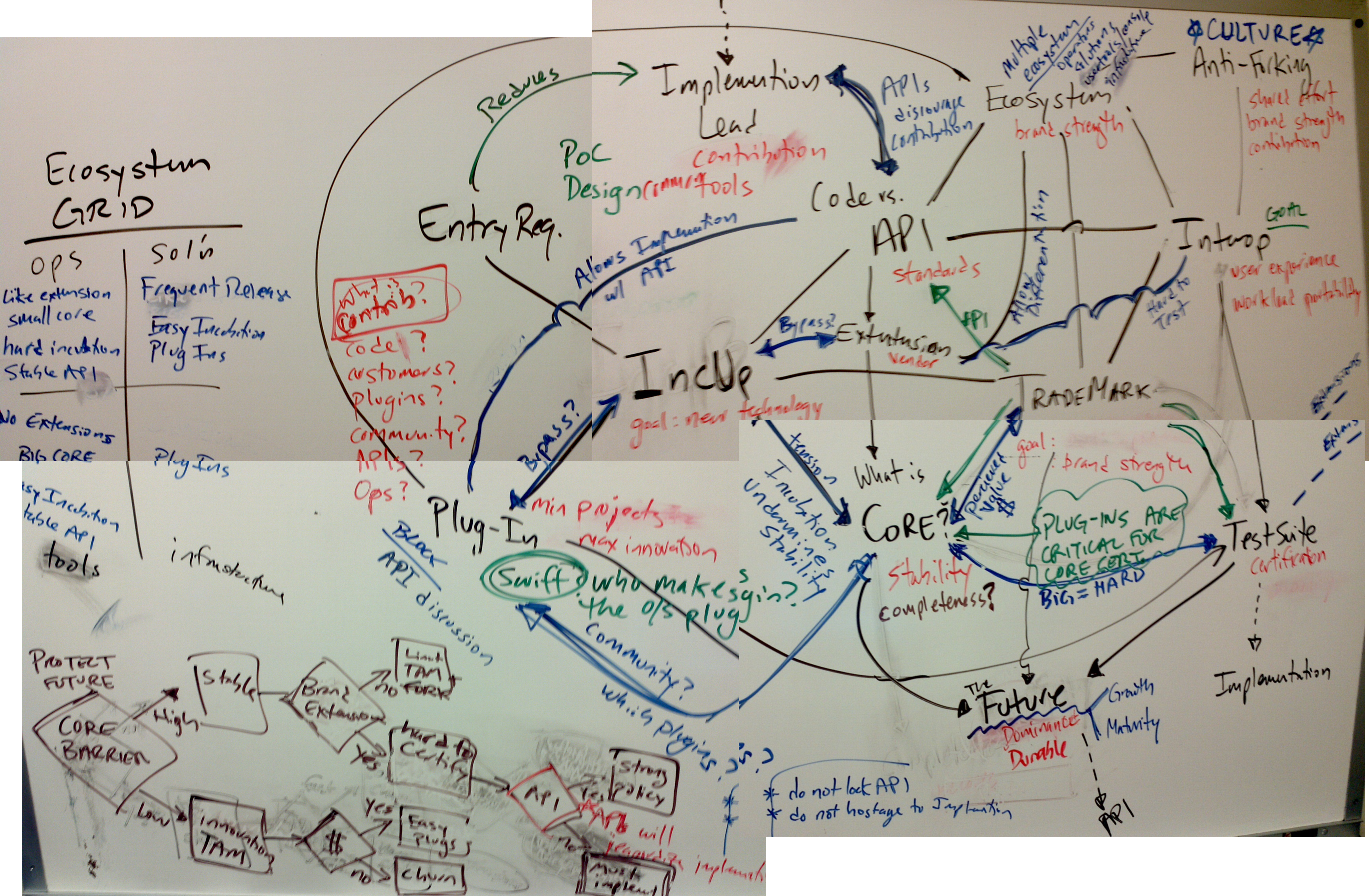
spider boardAlan Clark, Foundation Board Chairman, and I took on the task of breaking the logjam by decomposing the problem.  We used a multilayered mind map that I called the “spider” chart (yes, it’s a misnomer).  In constructing the spider, we first flagged out issue areas (the nodes) and added goals (red text) for each issue area.  Next we linked connected nodes together to form a graph.  We added blue text on connections where goals were opposed or in tension and green text where goals were aligned.

Note: Some of our text is controversial – it was our objective to find the tension.  If you are looking at the image, we also created some grid and flow charts to test the map.

We did not time capture the spider so it’s impossible to sweep back and see how the ideas progressed.  In general, we started at the center from “IncUp Discussion” which was the TC and Board’s collaboration, led by Alan, to define the process by which projects are promoted from incubation to integrated projects.

Some topics were easy like “API vs Implementation” and “Trademark” while “Implementation Led” and “Plug-ins” were more difficult.  Some clarification on those two items is worthwhile:

Implementation Led describes the OpenStack community for starting from working implementations rather than designing an API.  In my experience, this pattern serves the community well as long as we accept that APIs and implementations in incubated projects will take time to mature.   Using this approach gets us out of prolonged design by committee spirals.  It has serious pitfalls also – there’s no milk and honey approach. Plug-ins represented a big pot of politics in the community that was part of the challenge in defining what is core.  The obvious issue is that not all core projects use plug-ins and the ones that do take different approaches.  Even so, we felt that the concept of multiple implementations with a single API was a significant part of the opportunity (and challenge) for OpenStack core.

Ultimately, we decomposed the spider graph into the following table that shows some of our thoughts in raw form.  I’ll discuss the actual insights in my next post (#3) Continue reading

What makes OpenStack meaningful to the market?

THIS POST IS #2 IN A SERIES ABOUT “WHAT IS CORE.”

What gives a project a strong core? 

A strong project has utility, community, and longevity.

TelescopeUtility, community and longevity are the fundamental objectives of any project or product.  It must do something that people find useful (utility).  It’s not enough for one person to like the project, there must be a market (community).  And that useful and popular work must be sustainable over multiple “generations” (longevity).

These goals are basic.  The challenge is finding the right rules to keep OpenStack in the sustainable project zone.  Unfortunately, as an open source project, the OpenStack Foundation ultimately has very little real power (like hiring flocks of developers) to enforce use or maintenance of the code base.

The Foundation’s tools are velocity, culture, and brand.  Understanding “what is core” hones these tools to ensure they are effective.

Velocity – the rate of progress and quality of the code base.  A project at sufficient velocity is not worth forking or duplicating.  The fact that >1000 developers companies are contributing and 100s of companies are deploying OpenStack makes it profitable to remain in our community.   Make no mistake: being part of a community takes effort so there must be a return on that investment.  The foundation must ensure that commercial entities find an ROI from their participation.

Culture – open source culture strongly encourages sharing and collaboration.  I have seen that culture as a more potent force than the legalese and licenses.  While a strong culture reinforces itself, a toxic culture will rot a project like ice cream in the summerCulture maintenance is a chief foundation objective and includes fostering new users, documentation, orderly interactions and co-opetitive collaboration.

Brand – when all else fails, OpenStack can use legal means to define our brand.  This is the weakest of all the tools because the strength of the defense is only as good as the brand.  If we allow the OpenStack brand (sometimes we say it’s mark) to become weak or diluted then people have little reason to support velocity or culture.

An important insight when looking at these three control levers is that they are very different between individuals and corporations.  While individuals may highly motivated by culture they are not as motivated by brand; conversely, corporations are highly motivated by brand and compliance and minimally by culture.

As the OpenStack Foundation Board takes up the “what is core” question, we must be cognizant of the duality between individual and corporate interests.  OpenStack must be both meaningful culturally to individuals and strong brand-wise to corporations.   Both are needed to sustain OpenStack’s velocity.

READ POST IS #2: SPIDER CHART

Kicking off discussion about OpenStack Core

What's in?I’ve been leading an effort with Alan Clark to define “what is OpenStack core” for the Foundation Board.  Now that I am sitting here at OSCON and celebrating OpenStack’s third birthday, I think it’s a great time to bring the general community into the discussion.

There is significant history behind this topic.  According to Foundation governance, the Technical Committee (TC) defines which incubated projects are integrated and the Board of Directors (I am one) determines which of the integrated projects are labeled as core.

When it comes to the core label, the stakes are high.

Defining core is a convoluted topic.  To make it digestible, I’m breaking it down into multiple blog posts over a series of weeks:

  1. Why do we care about core?
  2. Decomposing the problem (“the spider”)
  3. Insights from decomposition (healthy tensions in OpenStack)
  4. 12 Positions: A Common Framework (I recommend ready the list of 10 instead)
  5. Community Feedback at OSCON 
  6. “What is Core” the visualization
  7. Where I think this is going, OpenStack’s Test Driven Core
  8. Core Positions Refined: the 10 positions behind the core visualization (above).
  9. Videos (most >90 mins).  The online meetups are easier to follow.
    1. 9/5 OpenStack Core Meetup in San Antonio
    2. 9/22 OpenStack Core Meetup in NYC
    3. online: 10/16 Online Meetup (daytime) and 10/22 Online Meetup (evening)
  10. Thinking about how to Implement OpenStack Core Definition

Too much reading?  At OSCON, Rafael Knuth shot a video of me talking about “what is core.”