OpenStack’s next hurdle: Interoperability. Why should you care?

SXSW life size Newton's Cradle

SXSW life size Newton’s Cradle

The OpenStack Board spent several hours (yes, hours) discussing interoperability related topics at the last board meeting.  Fundamentally, the community benefits when uses can operate easily across multiple OpenStack deployments (their own and/or public clouds).

Cloud interoperability: the ability to transfer workloads between systems without changes to the deployment operations management infrastructure.

This is NOT hybrid (which I defined as a workload transparently operating in multiple systems); however it is a prereq to achieve scalable hybrid operation.

Interoperability matters because the OpenStack value proposition is all about creating a common platform.  IT World does a good job laying out the problem (note, I work for Dell).  To create sites that can interoperate, we have to some serious lifting:

At the OpenStack Summit, there are multiple chances to engage on this.   I’m moderating a panel about Interop and also sharing a session about the highly related topic of Reference Architectures with Monty Tayor.

The Interop Panel (topic description here) is Tuesday @ 5:20pm.  If you join, you’ll get to see me try to stump our awesome panelists

  • Jonathan LaCour, DreamHost
  • Troy Toman, Rackspace
  • Bernard Golden,  Enstratius
  • Monty Taylor, OpenStack Board (and HP)
  • Peter Pouliot, Microsoft

PS: Oh, and I’m also talking about DevOps Upgrades Patterns during the very first session (see a preview).

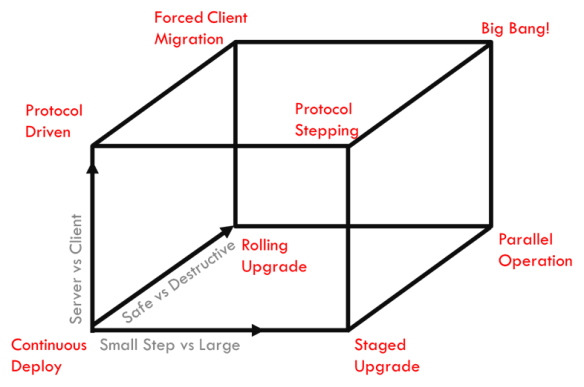
DevOps approaches to upgrade: Cube Visualization

I’m working on my OpenStack summit talk about DevOps upgrade patterns and got to a point where there are three major vectors to consider:

  1. Step Size (shown as X axis): do we make upgrades in small frequent steps or queue up changes into larger bundles? Larger steps mean that there are more changes to be accommodated simultaneously.
  2. Change Leader (shown as Y axis): do we upgrade the server or the client first? Regardless of the choice, the followers should be able to handle multiple protocol versions if we are going to have any hope of a reasonable upgrade.
  3. Safeness (shown as Z axis): do the changes preserve the data and productivity of the entity being upgraded? It is simpler to assume to we simply add new components and remove old components; this approach carries significant risks or redundancy requirements.

I’m strongly biased towards continuous deployment because I think it reduces risk and increases agility; however, I laying out all the vertices of the upgrade cube help to visualize where the costs and risks are being added into the traditional upgrade models.

Breaking down each vertex:

  1. Continuous Deploy – core infrastructure is updated on a regular (usually daily or faster) basis
  2. Protocol Driven – like changing to HTML5, the clients are tolerant to multiple protocols and changes take a long time to roll out
  3. Staged Upgrade – tightly coordinate migration between major versions over a short period of time in which all of the components in the system step from one version to the next together.
  4. Rolling Upgrade – system operates a small band of versions simultaneously where the components with the oldest versions are in process of being removed and their capacity replaced with new nodes using the latest versions.
  5. Parallel Operation – two server systems operate and clients choose when to migrate to the latest version.
  6. Protocol Stepping – rollout of clients that support multiple versions and then upgrade the server infrastructure only after all clients have achieved can support both versions.
  7. Forced Client Migration – change the server infrastructure and then force the clients to upgrade before they can reconnect.
  8. Big Bang – you have to shut down all components of the system to upgrade it

This type of visualization helps me identify costs and options. It’s not likely to get much time in the final presentation so I’m hoping to hear in advance if it resonates with others.

PS: like this visualization? check out my “magic 8 cube” for cloud hosting options.

What foo is “contribution” to open source? Mik Kersten & Tasktop @ SXSW

Nested

How do we really know who influences most in a software project?  We can easily track code commits, but there are more bits to the project than the commits.

I had the good fortune to attend Mik Kersten’s Code Graph presentation at SXSW last week. Mik started the Eclipse Mylyn project and went on to found Tasktop. Both are built on the very intriguing concepts that software development production (aka work) is organized around tasks.

His premise is that organizing around tasks provides a more manageable and actionable view of a project than a more traditional application life-cycle management (ALM) approaches.  I’m a sucker for any presentation about lean development process that includes references to both DevOps and industrial engineering (I have an MS in IE), but Mik surprised me by taking his code graph concept to a whole ‘nutha level.

The software value chain is much deeper than just the people who write code. Mik’s approach included managers, testers and operators in the interaction graphs for his projects.

By including all of the ALM artifacts in the analysis, you get a much richer picture of the influencers for a project.

For example, the development manager may never show up as a code committer; however, they are hugely influential in which work gets prioritized. If your graph includes who is touching the work assignments and stories then the manager’s influence jumps out immediately. That knowledge would completely change how and who you may interact with a team. It effectively brings a shadow contributor into the light.

The same is true for QA members who are running tests and opening defects and operators who are building deployment scripts. Ideally, it should include users who exercise different parts of the applications capabilities.

Mik’s graphs clearly showed the influence impact of managers because they touched all of the story cards for the project.  The people who own the story cards are the most potent influencers in a project, yet they are invisible in code repositories!

I would love to see an impact graph for a software project that equally reflected the wide range of contributions that people make to its life-cycle.  This type of information helps rebalance the power in a project.

Industrial engineering legend W.E. Demming‘s advice is to look at production as a system.  Finding ways to show everyone’s contributions is an important step towards bringing lean processes fully into software manufacturing.

Creating Communities: the intersection between Twitter celebrities and open source

calvin_leeOne of the unexpected perks of my Chevy SXSW experience was access to some real social media celebrities such as Josh Estrin, Calvin LeeKristin Brandt, Doug MoraSamantha Needham and Jennie Chen.  They are all amazing, fun, wicked smart and NOT INTO CLOUD COMPUTING.

While I already knew Samantha (via Dell) and Jennie (via TechRanch), all of Chevy’s guests brought totally different perspectives to Chevy’s SXSW team ranging from pop culture  and mommies to hypermilers and gearheads.

The common thread is that we are all looking to engage our communities.

We each wanted to find something that would be interesting for our very different audiences to discuss.  That meant using our experiences at SXSW, Chevy and with each other to start a conversation within our communities.  We need good content as a seed but the goal is to drive the interaction.

Josh was the most articulate about this point saying that he measured his success when his followers talked to each other more than to him.   Being able to create content that engages people to do that is a true talent.

Calvin’s focus was more on helping people connect.  He felt successful when he was able to bring people together through his extended network. In those cases and others, the goals and challenges of a social media celebrity were remarkably similar to those helping lead open source projects.

In building communities, you must measure success in member communication and interaction.

If you are intent on being at the center of the universe then your project cannot grow; however, people also need celebrities to bring them together.  The amazing thing about the the people I met at SXSW through Chevy is that they managed to both attract the attention needed to build critical mass and get out of the way so communities could form around them. That’s a skill that we all should practice and foster.

PS: I also heard clearly that “I ate …” tweets are some of their most popular.  Putting on my collaboration hat: if you’re looking to engage a community then food is the most universal and accessible discussion topic.  Perhaps I’ll have to eat crow on that one.  

Helping redefine “what is a car” on Chevy tours at SXSWi

I’m at SWSW as a guest of Chevy and enjoying the benefits of behind the scenes tours and access.  On Friday, the Volt team toured me and a collection of bloggers and journalists through the Pecan Street project and GM’s customer interaction center.

At one point, Colin Rowan compared the relatively long cell phone adoption (they first appeared  in 1973) to the likely ramp of electric cars and green homes.  Doug Moran from GearDiary pointed out the weakness of this comparison.  Cell phones are inexpensive with short life-cycles while cars are expensive durables.

However, Cell phones stopped being phones around 2007 when iPhone adoption exploded.  Smart phones are not phones – they are mobile platforms.  In fact, they are lousy phones when compared to cell phones.

Comparing electric cars to gas cars is more like comparing smart phones to dumb phones!

While both electric and gas cars can be used for transportation, electric cars have the potential to become energy transportation platforms.

You cannot use the energy stored in your car’s gas tank for anything but moving the car around.  Further, you can only get more gas from a very small set of vendors.

Electric cars are fundamentally different – the energy stored in the car’s batteries can be apply to nearly any application you want from transportation to lighting to computing to heating and refrigeration.  Further, you can get more energy for your car from nearly any source (local solar and wind or grid power).  For a hybrid like the Volt, the options are even broader because it includes gas to electricity generation.

From this perspective, electric cars are an energy mobility platform.

We need to accept that we are living in a world with unreliable power distribution due to weather, peak demand and/or carbon tax.   In this type of situation, cars with batteries are as fundamentally different from gas cars as smart phones are to rotary POTS phone.

PS: For more extra credit reading, check out the Vehicle to Grid concept

5 things keeping DevOps from playing well with others (Chef, Crowbar and Upstream Patterns)

Sharing can be hardSince my earliest days on the OpenStack project, I’ve wanted to break the cycle on black box operations with open ops. With the rise of community driven DevOps platforms like Opscode Chef and Puppetlabs, we’ve reached a point where it’s both practical and imperative to share operational practices in the form of code and tooling.

Being open and collaborating are not the same thing.

It’s a huge win that we can compare OpenStack cookbooks. The real victory comes when multiple deployments use the same trunk instead of forking.

This has been an objective I’ve helped drive for OpenStack (with Matt Ray) and it has been the Crowbar objective from the start and is the keystone of our Crowbar 2 work.

This has proven to be a formidable challenge for several reasons:

  1. diverging DevOps patterns that can be used between private, public, large, small, and other deployments -> solution: attribute injection pattern is promising
  2. tooling gaps prevent operators from leveraging shared deployments -> solution: this is part of Crowbar’s mission
  3. under investing in community supporting features because they are seen as taking away from getting into production -> solution: need leadership and others with join
  4. drift between target versions creates the need for forking even if the cookbooks are fundamentally the same -> solution: pull from source approaches help create distro independent baselines
  5. missing reference architectures interfere with having a stable baseline to deploy against -> solution: agree to a standard, machine consumable RA format like OpenStack Heat.

Unfortunately, these five challenges are tightly coupled and we have to progress on them simultaneously. The tooling and community requires patterns and RAs.

The good news is that we are making real progress.

Judd Maltin (@newgoliath), a Crowbar team member, has documented the emerging Attribute Injection practice that Crowbar has been leading. That practice has been refined in the open by ATT and Rackspace. It is forming the foundation of the OpenStack cookbooks.

Understanding, discussing and supporting that pattern is an important step toward accelerating open operations. Please engage with us as we make the investments for open operations and help us implement the pattern.

Strategy is…

Strategy is confidence and execution.

If you’ve got a process that supports your strategy, you can execute. 

You can say no to the right things and focus on the important element  Strategy is not just knowing where you are going, it’s knowing which things to say no to along the way. 

We suffer from an over-abundance of opportunity.  Success often means knowing what not to do.

OpenStack Board Voting Starts! Three thoughts about the board and election

1/18 Note: I was re-elected! Thanks everyone for your support.

OpenStack Foundation members, I have three requests for you:

  1. vote (ballots went out by email already and expire on Friday)
  2. vote for me (details below)
  3. pick the board you want, not just the candidates.

And, of course, vote according to our code of conduct: “Members should not attempt to manipulate election results. Open debate is welcome, but vote trading, ballot stuffing and other forms of abuse are not acceptable.”

To vote, you must have been a member for 6 months. Going Mad Panda? Join right now so you can vote next time!

Even if you’re not a voter, you may find my comments useful in understanding OpenStack. Remember, these positions are my own: they do not reflect those of my employer (Dell).

Vote because it’s the strongest voice the community has about OpenStack governance

I’d strongly encourage you to commit code, come to the summit and participate in the lists and chats; however, voting is more. It shows measurable impact. It shows the vitality of the community.

OpenStack is exciting to me because it’s community driven.

I have been a strong and early leader in the community:

Vote for me because of my OpenStack Operations focus

My team at Dell has been laser focused on making OpenStack operable for over 2 years. My team acts like a lean start-up inside of Dell to get products out to market early.

We’ve worked with early operators and ground-breaking ecosystem partners (plus). We’ve helped many people get OpenStack running for real workloads. Consequently, I am highly accessible and accountable to a large number of users, operators and ecosystem vendors. Few other people in the OpenStack community have my breadth of exposure to real OpenStack deployments. My team and I have been dedicated, active participants in OpenStack long before Dell’s grand OpenStack strategy coalesced.

More importantly, I am committed to open source and open operations. The Apache 2 open source Crowbar project established the baseline (and served as the foundation) for other OpenStack deployment efforts. We don’t just talk about open source, we do open source: our team works in the open (my git account).

Vote for a board because diversity of views is important

OpenStack voting allows you to throw up to 8 votes to a single candidate. While you can put all your eggs into a single basket, I recommend considering a broader slate in voting.

We have an impressive and dedicated list of candidates who will do work for the community. I ask that you consider the board as a team. If you want operators, users, diversity, change, less corporate influence or any flavor of the above then think not just about the individual.

Why should I be part of your slate? I am not a blind cheerleader. I have voiced and driven community-focused positions about the board (dev cycle, grizzly >;; folsom, consensus).

One of my core activities has been to work on addressing community concerns about affinity voting. Gold and Platinum members have little incentive to address this issue. While I’d like to see faster action, it requires changing the by-laws. Any by-law changes need to be made carefully and they also require a vote of the electorate. If you want positive change, you need board members, like me, who are persistent and knowledgeable in board dynamics.

What have I done on the Board? Quite a bit…

It would be easy to get lost in a board of 24 members, but I have not. Armed with my previous board experience, I have been a vocal advocate for the community in board meetings without creating disruption or pulling us off topic.

Why re-elect me? For community & continuity

I am a strong and active board member and I work hard to represent all OpenStack constituents: developers, operators, users and ecosystem vendors.

Working on a board is a long-term exercise. Positions and actions I’ve taken today may take months to come to fruition. I would like the opportunity continue that work and see it through.
OpenStack Board Interview Series by Rafael Knuth

Rafael Knuth, Dell Rafael Knuth (@RafaelKnuth with Dell as EMEA Social Media Community Manager) has set an ambitious objective to interview all 24 of the OpenStack Foundation Board members. I had the privilege of being the first interview posted (Japanese version!).

Here’s the series so far:

  1. Rob Hirschfeld (me!) of Dell (my summary)
  2. Boris Renski of Mirantis
  3. Randy Bias of CloudScaling
  4. Jim Curry of Rackspace
  5. Yujie Due of 99cloud
  6. Tim Bell of CERN
  7. Joshua McKenty of Piston
  8. Lew Tucker of Cisco
  9. Alan Clark (Chair) of SUSE  
  10. Joseph George of Dell (added 5/22)

These are excellent interviews and worth reviewing. They give balanced (often critical) views of OpenStack, its progress and challenges.

I update the list as he adds them.