The real workloads begin: Crowbar’s Sophomore Year

Given Crowbar‘s frenetic Freshman year, it’s impossible to predict everything that Crowbar could become. I certainly aspire to see the project gain a stronger developer community and the seeds of this transformation are sprouting. I also see that community driven work is positioning Crowbar to break beyond being platforms for OpenStack and Apache Hadoop solutions that pay the bills for my team at Dell to invest in Crowbar development.

I don’t have to look beyond the summer to see important development for Crowbar because of the substantial goals of the Crowbar 2.0 refactor.

Crowbar 2.0 is really just around the corner so I’d like to set some longer range goals for our next year.

  • Growing acceptance of Crowbar as an in data center extension for DevOps tools (what I call CloudOps)
  • Deeper integration into more operating environments beyond the core Linux flavors (like virtualization hosts, closed and special purpose operating systems.
  • Improvements in dynamic networking configuration
  • Enabling more online network connected operating modes
  • Taking on production ops challenges of scale, high availability and migration
  • Formalization of our community engagement with summits, user groups, and broader developer contributions.

For example, Crowbar 2.0 will be able to handle downloading packages and applications from the internet. Online content is not a major benefit without being able to stage and control how those new packages are deployed; consequently, our goals remains tightly focused improvements in orchestration.

These changes create a foundation that enables a more dynamic operating environment. Ultimately, I see Crowbar driving towards a vision of fully integrated continuous operations; however, Greg & Rob’s Crowbar vision is the topic for tomorrow’s post.

Crowbar Celebrates 1st Anniversary

Nearly a year ago at OSCON 2011, my team at Dell opened sourced “Crowbar, an OpenStack installer.” That first Github commit was a much more limited project than Crowbar today: there was no separation into barclamps, no distinct network configuration, one operating system option and the default passwords were all “openstack.” We simply did not know if our effort would create any interest.

The response to Crowbar has been exciting and humbling. I most appreciate those who looked at Crowbar and saw more than a bare metal installer. They are the ones who recognized that we are trying to solve a bigger problem: it has been too difficult to cope with change in IT operations.

During this year, we have made many changes. Many have been driven by customer, user and partner feedback while others support Dell product delivery needs. Happily, these inputs are well aligned in intent if not always in timing.

  • Introduction of barclamps as modular components
  • Expansion into multiple applications (most notably OpenStack and Apache Hadoop)
  • Multi-Operating System
  • Working in the open (with public commits)
  • Collaborative License Agreements

Dell‘s understanding of open source and open development has made a similar transformation. Crowbar was originally Apache 2 open sourced because we imagined it becoming part of the OpenStack project. While that ambition has faded, the practical benefits of open collaboration have proven to be substantial.

The results from this first year are compelling:

  • For OpenStack Diablo, coordination with the Rackspace Cloud Builder team enabled Crowbar to include the Keystone and Dashboard projects into Dell’s solution
  • For OpenStack Essex, the community focused work we did for the March Essex Hackday are directly linked to our ability to deliver Dell’s OpenStack-Powered Essex solution over two months earlier than originally planned.
  • For Apache Hadoop distributions for 3.x and 4.x with implementation of Cloudera Manager and eco system components.
  • We’ve amassed hundreds of mail subscribers and Github followers
  • Support for multiple releases of RHEL, Centos & Ubuntu including Ubuntu 12.04 while it was still in beta.
  • SuSE does their own port of Crowbar to SuSE with important advances in Crowbar’s install model (from ISO to package).

We stand on the edge of many exciting transformations for Crowbar’s second year. Based on the amount of change from this year, I’m hesitant to make long term predictions. Yet, just within next few months there are significant plans based on Crowbar 2.0 refactor. We have line of site to changes that expand our tool choices, improve networking, add operating systems and become more even production ops capable.

That’s quite a busy year!

What does “enable upstream recipes” mean? Not just fishing for community goodness!

One of the major Crowbar 2.0 design targets is to allow you to “upstream” operations scripts more easily.  “Upstream code” means that parts of Crowbar’s source code could be maintained in other open source repositories.  This is beyond a simple dependency (like Rails, Curl, Java or Apache): Upstreaming allows Crowbar can use code managed in the other open source repositories for more general application.  This is important because Crowbar users can leverage DevOps logic that is more broadly targeted than just Crowbar.  Even more importantly, upstreaming means that we can contribute and take advantage of community efforts to improve the upstream source.

Specifically, Crowbar maintains a set of OpenStack cookbooks that make up the core of our OpenStack deployment.  These scripts have been widely cloned (not forked) and deCrowbarized for other deployments.  Unfortunately, that means that we do not benefit from downstream improvements and the cloners cannot easily track our updates.  This happened because Crowbar was not considered a valid upstream OpenStack repository because our deployment scripts required Crowbar.  The consequence of this cloning is that incompatible OpenStack recipes have propagated like cracks in a windshield.

While there are concrete benefits to upstreaming, there are risks too.  We have to evaluate if the upstream code has been adequately tested, operates effectively, implements best practices and leverages Crowbar capabilities.  I believe strongly that untested deployment code is worse than useless; consequently, the Dell Crowbar team provides significant value by validating that our deployments work as an integrated system.  Even more importantly, we will not upstream from unmoderated sources where changes are accepted without regard for downstream impacts.  There is a significant amount of trust required for upstreaming to work.

If upstreaming is so good, why did we not start out with upstream code?  It was simply not an option at the time – Crowbar was the first (and is still!) most complete set of DevOps deployment scripts for OpenStack in a public repository.
By design, Crowbar 1.0 was tightly coupled to Opscode Chef and required users to inject Crowbar dependencies into their Chef Recipes.  This approach allowed us to more quickly integrate capabilities between recipes and with nascent Crowbar features.  Our top design requirement was that our deployment was tightly integrated between hardware, networking, operating system, operations infrastructure and the application.  Figuring out the correct place to separate concerns was impractical; consequently, we injected dependencies into our Chef code.
We have reached a point with Crowbar development that we can correctly decouple Crowbar and Chef.
The benefits to upstreaming go far beyond enabling more collaboration on OpenStack deployments.  These same changes make it easier for Crowbar to leverage community deployment scripts without one-way modifications.  If you have a working Chef Recipe then making it work with Crowbar will no longer require changes that break it outside of Crowbar; therefore, you can leverage Crowbar capabilities without losing community input and without being locked into Crowbar.

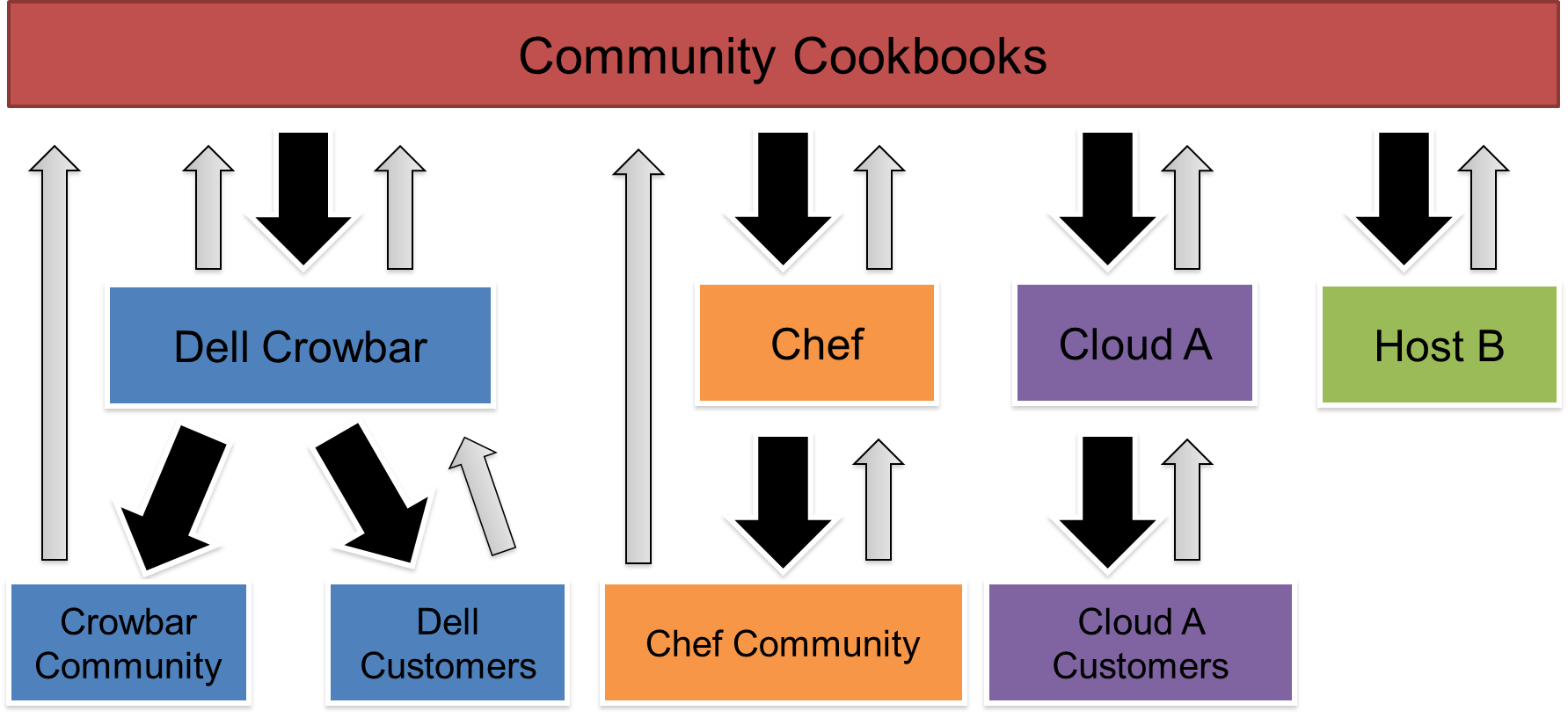
OSCON preso graphic about Upstreaming added 7/23:

Open Source Vision, Strategy & Execution: The Community Garden Analogy

I’ve been working on a white paper series about open source culture and projects based on my experience with at Dell with Crowbar and OpenStack.  I’m hoping to show off the first result of that collaboration soon, until then I’m glad to share some ideas that we’ve been throwing around to help explain the fundamental shift that we see taking place in the technology community.

It’s obvious that executing a collaborative open source project is fundamentally different than a either a licensed or an open single contributor project.

However, we have yet to describe the culture, process and success criteria needed to drive a collaborative open source project.

I am not saying that projects are not being successful – there are many great examples (OpenStack, CloudFoundry, Apache). My point is that we I do not have articulated the vision, strategy or execution needed for people grounded in traditional software delivery to understand why these projects are different and how to navigate the differences. Lack of alignment within the lead delivery team can be highly disruptive to the project.

Community gardening is all about people working together to produce something tangible that is bigger than they could accomplish individually. Each participant has an expectation of return – a garden is not a charity, it must produce; however, there is a community drive rewards a garden wide focus.

  • You could just pull weeds from your plot, but doing extra means that the garden as a whole will prosper.
  • Fixing the fence keeps the “MQ” rabbits out of your carrots and your neighbors lettuce
  • The person growing the mint also keeps out the ants and so helps the entire garden.
  • The oddball that wants inverted chinese radishes may also be an expert vermiculturist who nurtures the whole worm population as a side interest
  • While everyone may want tomatoes, they may not want to same variety or amount. You may want a small batch of heirlooms for your salad while someone making pasta sauce wants

For a community garden, like an open source project, the specific objectives of the participants do not have to be identical for the garden to florish. In fact, the very diversity of intent is what makes the garden successful. A single gardener may only plant watermelons and corn, but the community group will likely have a complete crop.

But the analogy does not end with the gardeners. A community garden is also strengthened by the cooks and dinners who enjoy the food because they are the audience.

This post was designed to plant some seeds of understanding.  I know it does not get to the meat of the vision, strategy or execution for open source, that will come in future posts.  Specifically, I’m planning to discuss how OpenStack and Crowbar measure up as they near their respective second and first anniversaries.

OpenStack Deploy Day generates lots of interest, less coding

Last week, my team at Dell led a world-wide OpenStack Essex Deploy event. Kamesh Pemmaraju, our OpenStack-powered solution product manager, did a great summary of the event results (200+ attendees!). What started as a hack-a-thon for deploy scripts morphed into a stunning 14+ hour event with rotating intro content and an ecosystem showcase (videos).  Special kudos to Kamesh, Andi Abes, Judd Maltin, Randy Perryman & Mike Pittaro for leadership at our regional sites.

Clearly, OpenStack is attracting a lot of interest. We’ve been investing time in content to help people who are curious about OpenStack to get started.

While I’m happy to be fueling the OpenStack fervor with an easy on-ramp, our primary objective for the Deploy Day was to collaborate on OpenStack deployments.

On that measure, we have room for improvement. We had some great discussions about how to handle upgrades and market drivers for OpenStack; however, we did not spend the time improving Essex deployments that I was hoping to achieve. I know it’s possible – I’ve talked with developers in the Crowbar community who want this.

If you wanted more expert interaction, here are some of my thoughts for future events.

  • Expert track did not get to deploy coding. I think that we need to simply focus more even tightly on to Crowbar deployments. That means having a Crowbar Hack with an OpenStack focus instead of vice versa.
  • Efforts to serve OpenStack n00bs did not protect time for experts. If we offer expert sessions then we won’t try to have parallel intro sessions. We’ll simply have to direct novices to the homework pages and videos.
  • Combining on-site and on-line is too confusing. As much as I enjoy meeting people face-to-face, I think we’d have a more skilled audience if we kept it online only.
  • Connectivity! Dropped connections, sigh.
  • Better planning for videos (not by the presenters) to make sure that we have good results on the expert track.
  • This event was too long. It’s just not practical to serve Europe, US and Asia in a single event. I think that 2-3 hours is a much more practical maximum. 10-12am Eastern or 6-8pm Pacific would be much more manageable.

Do you have other comments and suggestions? Please let me know!

OpenStack Essex Deploy Day 3/8 – Get involved and install with us

My team at Dell has been avidly tracking the upsdowns, and breakthroughs of the OpenStack Essex release.  While we still have a few milestones before the release is cut, we felt like the E4 release was a good time to begin the work on Essex deployment.  Of course, the final deployment scripts will need substantial baking time after the final release on April 5th; however, getting deployments working will help influence the quality efforts and expand the base of possible testers.

To rally behind Essex Deployments, we are hosting a public work day on Thursday March 8th.

For this work day, we’ll be hosting all-day community events online and physically in Austin and Boston.  We are getting commitments from other Dell teams, partners and customers around the world to collaborate.  The day is promising to deliver some real Essex excitement.

The purpose of these events is to deliver the core of a working OpenStack Essex deployment.  While my team is primarily focused on deploys via Crowbar/Chef, we are encouraging anyone interested in laying down OpenStack Essex to participate.  We will be actively engaged on the OpenStack IRC and mailing lists too.

We have experts in OpenStack, Chef, Crowbar and Operating Systems (Canonical, SUSE, and RHEL) engaged in these activities.

This is a great time to start learning about OpenStack (or Crowbar) with hands-on work.  We are investing substantial upfront time (checkout out the Crowbar wiki for details) to ensure that there is a working base OpenStack Essex deploy on Ubuntu 12.04 beta.  This deploy includes the Crowbar 1.3 beta with some new features specifically designed to make testing faster and easier than ever before.

In the next few days, I’ll cut a 12.04 ISO and OpenStack Barclamp TARs as the basis for the deploy day event.  I’ll also be creating videos that help you quickly get a test lab up and running.  Visit the wiki or meetup sites to register and stay tuned for details!

Crowbar community support and 111111 sprint plan

The Dell Crowbar team is working to improve road map transparency. In the last few weeks, the Crowbar community has become more active on our lists, testing builds, and helping with documentation.

We love the engagement and continue to make supporting the list a priority.

Participation in Crowbar, OpenStack and Hadoop has been exceeding our expectations and we’re working to implement more community support and process. Thank you!!!

Our next steps:

  1. I’ve committed to post sprint plans and summary pages (this is the first)
  2. New Crowbar Twitter account
  3. I’m going to setup feature voting on the Crowbar Facebook page (like to vote)
  4. Continue to work the listserv and videos. We need help converting those to documentation on the crowbar wiki.
  5. Formalize collaborator agreements – we’re working with legal on this
  6. Exploring the option of a barclamp certification program and Crowbar support
  7. Moving to a gated trunk model for internal commits to improve quality
  8. Implementing a continuous integration system that includes core and barclamps. This will be part of our open source components.

We are working towards the 1.2 release (Beta 1) . That release is focused on supporting OpenStack but includes enhancements for upgrades, Hadoop, and additional OS support.

Our Sprint 111111 plan.

Source: Crowbar Wiki: [[sprint 111111]]

  • Theme: OpenStack Diablo Final release candidate.
  • Core Work: Refine Deployment for Nova, Glance, Nova Dashboard (horizon), keystone, swift
  • New additions: mySQL barclamp, Nova HA networking, kong
  • Crowbar internals: expose error states for proposals, allow packages to be included with barclamps to make upgrades easier, barclamp group pages
  • Operating system: added CentOS
  • Documentation: we’ve split the user guides into distinct books so Crowbar, OpenStack, and Hadoop each have their own user guide.
  • Pending action: expose the Hadoop barclamps
  • OS note: OpenStack is being tested (at Dell) against Ubuntu 10.10 only. Hadoop was tested against RHEL 5.7 and we expect it to work against CentOS also.

Cloudcast interview with Dell Cloud Solutions Team (quotes with time stamps)

Lloyds BarbershopTheCloudcast.net – Thank you for such a great series of questions. Wow, nearly 36+ minutes of cloudicious interview about the work my team at Dell is doing!

Thanks to our hosts for putting together a great series! They are:

Highlights from Episode 16: Dell, Dude you’re getting a cloud

  • 3:40 JBG “we are listening to our customers tell us what they want to accomplish”
  • 4:40 RAH “humility is part of [what we’re] doing … cloud is about learning and collaboration”
  • 6:40 RAH “OpenStack filled a niche. It was the first open source community cloud. … Not just open source, its open community.”
  • 7:15 RAH “We’re beyond critical mass. We’re seeing acceleration… we are transitioning into a community development.”
  • 7:30 RAH “It’s accelerating. It happening so fast.”
  • 8:00 RAH “We felt it was really important for people to be able to use it. We felt that it was important to get away from just people developing into people using. “
  • 8:57 – RAH “Cloud is not just one thing. You have to have all the pieces.”
  • 10: 15 – RAH “Cloud is always ready, never finished”
  • 10:50 – RAH “OpenStack is an alternative to public cloud including hosting providers seeking to offer their own cloud”
  • 12:40 – AD “Dell has been in the Big data space for many years now”
  • 20:15 – JBG “There’s a legacy of great partnerships that we leverage”
  • 20:48 – JBG “Conflicts have not come up because we are focused on the customer”
  • 21:30 – RAH “Shout out to Greg Althaus for solving these problems in such an elegant way. And we rewrote it 3 times”
  • 22:02 – RAH “Crowbar started from our frustration of bringing up a cloud quickly … so we took a DevOps approach.”
  • 22:41 – RAH “You had to have a system view AND a boot strapping view simultaneously”
  • 23:50 – JBG “Crowbar was born out of necessity because we were setting up and blowing away our clouds over and over and over again. “
  • 24:40 – JBG “We realized there were not many people thinking about all the pieces before OpenStack was installed”
  • 25:20 – RAH “We don’t think customers have all the answers before we show up. This is not unique to OpenStack.”
  • 28:20 – JBG “We’re seeing the community pick up Crowbar as a way to deploy”

The OpenStack Rocket: How Citrix, Dell & Rackspace collaboration propels OpenStack

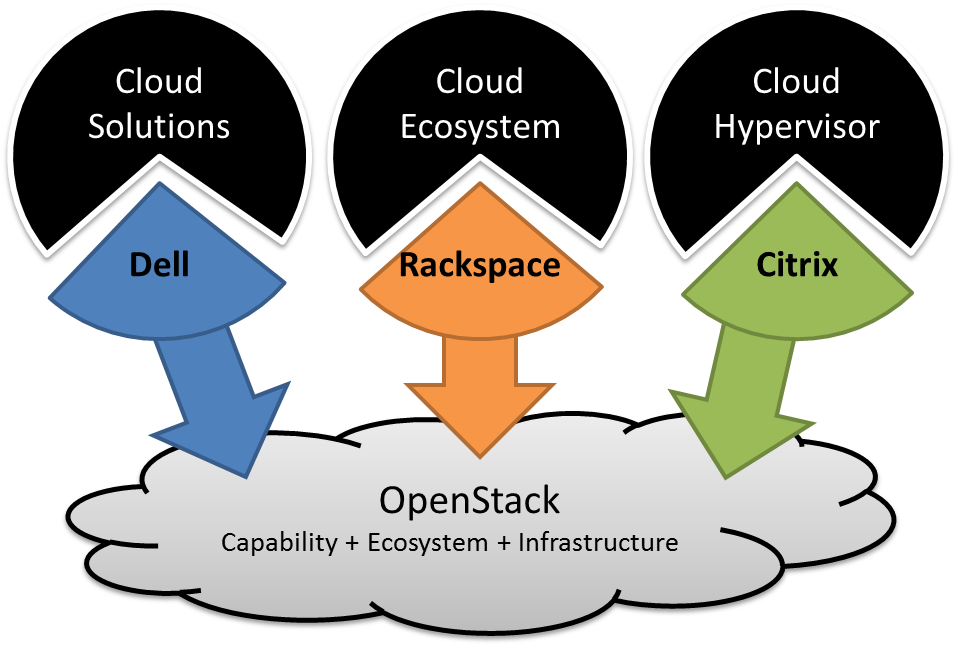
OpenStack has grown amazingly and picked up serious corporate support in its first year.  Understanding how helps to explain why the initiative has legs and where adopters should invest.  While OpenStack has picked up a lot of industry partners, early participation by Dell and Citrix have been important to a meteoric trajectory.

So why are we (Dell) working so hard to light a fire under OpenStack?

To explain OpenStack support and momentum, we have to start with a self-reflective fact: Dell (my employer), Citrix and Rackspace are seeking to gain the dominate positions in their respective areas of “cloud.”  Individually, we have competitors in more entrenched positions for cloud silos in solutions, ecosystem, and hypervisor; however, our competitors are not acting in concertto maintain their position.   

OpenStack offers an opportunity for companies trying to gain market share to leverage the strengths of partners against their competitors.

The surprising aspect of OpenStack is how much better this collaboration is working in practice than in theory.  This, dare I say it, synergistic benefit comes to OpenStack from all the partners (Dell, Citrix, Rackspace and others) working together because:

  1. Real scale clouds are big and complex with a lot of moving pieces (too big for a single vendor)
  2. A vibrant ecosystem needs to see commercial commitment from large players (and avoids lock-in)
  3. Having alternatives drives innovation and manages costs (because differentiation is still needed)
  4. Interlocking expertise is required (because no vendor has all the pieces)
  5. Customer needs are diverse and changing (since cloud is accelerating the rate of innovation)

Today, three major cloud players are standing together to demonstrate commitment to the community.  This announcement is a foundation for the OpenStack ecosystem.  In the next few months, I expect to see more and more collaborative announcements as the community proves the value of working together.

By aligning around an open platform, we collectively out flank previously dominant players who choose to go it alone.  The technology is promising; however, the power of OpenStack flows mainly from the ecosystem that we are building together.

OpenStack Design Conference Observations (plus IPv6 thread)

I’m not going to post OpenStack full conference summary because I spent more time talking 1 on 1 with partners and customers than participating in sessions.  Other members of the Dell team (@galthaus) did spend more time (I’ll see if he’ll post his notes).

I did lead an IPv6 unconference and those notes are below.

Overall, my observations from the conference are:

  • A constantly level of healthy debate.  For OpenStack to thrive, the community must be able to disagree, discuss and reach consensus.   I saw that going in nearly every session and hallway.  There were some pitched battles with forks and branches but no injuries.
  • Lots of adopters.  For a project that’s months old, there were lots of companies that were making plans to use OpenStack in some way.
  • Everyone was in a rush.  There’s been something of a log jam for decision making because the market is changing so fast companies seem to delay committing waiting for the “next big thing.”
  • Service Providers and implementers were out in force.
  • IPv6 is interesting to a limited audience, but consistently injected.

While IPv6 deserves more coverage here, I thought it would be worthwhile to at least preserve my notes/tweets from the IPv6 unconference discussion (To IP or not to IPv6? That will be the question.) at the OpenStack Design Summit.

NOTE: My tweets for this topic are notes, not my own experience/opinions

  • RT @opnstk_com_mgr #openstack unconference in camino real today < #IPv6 session going now – good size crowd
  • #NTT has IPv6 for VMs and tests for IPv6. If you set the mac, then you will know what the address will be.
  • it will be helpful to break out VMs to multiple networks – could have a VM on both IPv6 & IPv4
  • @zehicle @sjensen1850 (Dell) if IPv6 100% then may break infrastructure products – inside, easier to stay v4
    • you don’t want to paint yourself into a corner – IPv6 should not become your major feature requirement
  • typing IPv6 address not that hard to remember. DNS helps, but not required if you want to get to machines.
  • using IPv6 not hard – issue is the policy to do it. Until it’s forced. We need to find a path for DUAL operation.
  • chicken/egg problem. Our primary job is to make sure it works and is easy to adopt.
    • we are missing information on what options we have for transforms
  • where is the responsibility to do the translation? floating IP scheme needs to be worked out. IPv6 can make this easier.
  • idea, IPv6 should be the default. Fill gap with IPv4 as a Service? Floating needs NAT – v4aaS is LB/Proxy
  • unconference session was great! Good participation and ideas. Lots of opinions.

We had a hallway conversation after the unconference about what would force the switch.  In a character, it’s $.

Votes for IPv6 during the keynote (tweet: I’d like to hear from audience here if that’s important to them. RT to vote).  Retweeters: