Quantum: Network Virtualization in the OpenStack Essex Release

This post is part of my notes from the 2/1 Boston OpenStack meetup.

Quantum

David Lapsley from Nicira gave the Quantum presentation (his slides). My notes include additional explication and interpretation so he is not to blame for errors (but I’ll share credit for clarity).

The objective for Quantum is to replace the current networking modes (flat, vlan, dhcp, dhcp ha) with a programmatic networking API. The idea is that cloud users would use the API to request the network topology they wanted to implement rather than have it imposed by the infrastructure’s network mode. To accomplish this, the API must allow users to create complex & hierarchical network topologies without being aware of the underlying network infrastructure (aka “an abstraction layer”).

In simpler terms: Quantum allows users to design their own isolated networks without knowing how the network is actually deployed.

Quantum is a stand-alone service with its own API. It is not simply an extension of the Nova API. The Quantum API an extensibility model similar to Nova and it also has a plug-in architecture so that it can be implementation agnostic. The plug-ins are needed to map the user’s API abstraction into actual networking. For example, if the user requests a network tunnel between two VMs then the plug in may choose to implement a tagged VLAN, OpenFlow connections, IPtable filters, or encapsulated tunnels. The goal is that the implementation of the API should not matter to the user of the API!

For (hopefully) obvious reasons, the use cases the Quantum are similar to the Amazon EC2 VPC. The notable exception is service injection. Quantum wants to allow vendors/providers to innovate around value-added services. This should result in a diversity of choices as vendors offer additional network services such as load balancers, IPS, IDS, etc. While this is a great concept, it’s important to note that Quantum is currently limited to a single plug-in!  [see note in comments by Quantum PTL Dan Wendlandt (@danwendlandt)]

The expectation is that cloud users will want to create traditional application topologies with different tiers of access. For example, applications may require a dedicated network between web and database tiers or a DMZ between web and load balancer. The challenge is that these are patterns not rigid requirements. Ultimately, the simplest solution for the feature is to allow users to create “virtual VLANs.”

Essentially, the current Quantum API is creating virtual VLANs.

The Quantum API has four basic abstractions: interface, network, port and attachment. These primitives are used to build up a virtual network just as they are in physical networks.

  • Interface: cloud / tenant / server / GUID / eth0
  • Network: cloud / tenant / network / GUID
  • Port: cloud ID / tenant / network / GUID / port / GUID
  • Attachement : interface & network & port

To use the Quantum API, you must create a network, add ports (to network) and interfaces (to vms) then attach the network, interface, and port together. This gives users very fine grained control over their network topology. It is up to the plug-in to translate these primitives into a working physical topology.

According to my teammate and OSBOS organizer, Andi Abes, the Quantum API reached consensus in the community quickly because these it started with this basic but extensible API. In the meeting, I added that this approach is typical for OpenStack where it is considered better to demonstrate working core functionality than build extra complexity into the initial delivery. This approach links back to the API vs. Implementation debate I’ve discussed before. This simple API also provides room for innovation – while providing the basic constructs it is light, and does not encumber mappings of this API to different underlying technologies with lots of extras. OEM Vendors and service providers this have an easier time differentiating their offerings be it equipment or services.

In my experience, people often link OpenFlow and Quantum into a single technology base. I have certainly been guilty making that generalization. Quantum does not require OpenFlow or vice versa; however, they are highly complementary. OpenFlow takes over the switches’ “flow table” and allows administrators to control how every packet that touches the switch is routed. The potential for OpenFlow is to create highly dynamic and controlled network conduits. Quantum needs exactly that functionality to most directly map the virtual network requests into a physical fabric. In this way, OpenFlow is the most direct approach to building a fully enabled Quantum plug-in.

In the Essex release, progress has been made (and still is being made) towards integrating Nova and Quantum. The workflow of attaching a VIF (virtual interface) to the right network, and assigning it an appropriate IP (using Melange – the OpenStack IP address management project) are making headway. That said, the dashboard integration still lags and more progress is required.

Overall, my impression is that Quantum has great potential; however, I think that Nova in Essex will be sufficient for real applications without Quantum. As my freshman roommate used to say, “potential means you’ve got to keep working on it.”

Why Governance Matters in Open Source: Discussing the OpenStack Foundation

This post is part of my notes from the 2/1 Boston OpenStack meetup.

OpenStack Foundation

Your’s truly (Rob Hirschfeld) gave the presentation about the OpenStack Foundation.  To readers of this blog, it’s obvious that I’m a believer in the OpenStack mission; however, it’s not obvious how creating a foundation helps with that mission and why OpenStack needs its own. As one person at the meetup put it, “Why not? Every major project needs a foundation!”

Governance does not sound sexy compared to writing code and deploying clouds, but it’s very important to the success of the project.

Here are my notes without the poetic elocution I exuded during the meetup…

The basics:

  • What: Creating a neutral body to govern OpenStack. Rackspace has been leading OpenStack. This means that they own the copyrights, name and also pay the people who organize the community. They committed (to executives at Dell and others) that they would ultimately setup a standalone body to govern the project before the project was public and endorsed by those early partners. Dell (my employer), Citrix, Accenture and NASA were some of biggest names at the Austin conference launch.
  • Why: A neutral body is needed because a lot of companies are committing significant time and money to the project. They cannot risk their investments on Rackspace good will alone. This may mean many things. It could be they don’t like Rackspace direction or they feel that Rackspace is not investing enough.
  • When: Right now and over the next few releases.  You should give feedback right now on the OpenStack Foundations mission.  The actual foundation will take more time to establish because it requires legal work and funding commitments.
  • Who: The community – all stakeholders. This is important stuff! While trying to standup a financially independent Foundation, which requires moneys, the little guys are not left out. There is a clear realization and desire to enable independent developers and contributors and small players to have a seat at the table.
  • How Much: The amounts are unclear, but establishing a foundation will require a significant ongoing investment from highly involved and moneyed parties (Rackspace, Dell, Cisco, HP, Citrix, NTT, startups?, etc).  The funding will pay salaries for people dedicated to the community doing the things that I’ll discuss below.  Overall, the ROI for those investments must be clear!

The foundation does “governance.” But, what does that mean? Here is a list of vitally important work that the foundation is responsible for.

  • Branding – Protecting, certifying, and promoting the OpenStack brand is important because it ensures that “OpenStack” has a valuable and predictable meaning to contributors and users. A strong the brand also means a stronger temptation for people to abuse the brand by claiming compatibility, participation and integration.
  • API – Many would assume that the OpenStack API is the very heart of the project and there is merit to this position. As more and more OpenStack implementations emerge, it is essential that we have a body that can certify which implementations (and even which versions of the implementation!) are valid. This is a substantial value to the community because API integrity ensures project continuity and helps the ecosystem monetize the project. Note: my opinion differs from others here because I think we should favor API over implementation
  • Community – The OpenStack community is not an accident. It is the function of deliberate actions and choices made by Rackspace and supported by key contributors. That community requires virtual and physical places to coalesce and leaders to organize and manage those meeting places. The excellent conferences, wikis, blogs, media awareness, documentation and meetups are a product of consistent community management.
  • Arbitration – An open source community is a family and siblings do not always get along. Today, Rackspace must be very careful about balancing their own interests because they are like the oldest sibling playing the parent role – you can get away with it until something serious happens. We need a neutral party so that Rackspace can protect their own interests (alternate spin: because Rackspace protects their own interests at the expense of the community).
  • Leadership – OpenStack today is a collection of projects with individual leadership. We will increasingly need coordinated leadership as the number of projects and users increases. Centralized leadership is essential because the good of the project as a whole may mean sacrifices within individual projects. It may even mean that some projects chose to leave the OpenStack tent. Stewarding these challenges will require a new level of leadership.
  • Legal – This is a function of all the above but also something more. From a legal stand point, OpenStack be able to represent itself. There is a significant amount of intellectual property being created. It would be foolish to overlook that this property is valuable and needs adequate legal representation.

I used “vitally important” to describe the above items. Is that an exaggeration? Our goal is collaboration and that requires some infrastructure and rules to make it sustainable. We must have a foundation that encourages innovation (multiple implementations) and collaboration (discourages forking). Innovation and collaboration are the heartbeat of an open source project.

The foundation is vitally important because collaboration by competitors is fragile.

In addition to the core areas above, the foundation needs to handle routine tactical items such as:

  • Delivering on milestones & releases
  • Moving new subprojects into OpenStack
  • Electing and maintaining Project Policy Board
  • Electing and maintaining Project Technical Leads
  • Ensuring adherence and extensions to the current bylaws

At the end of the day, OpenStack monetization is the central value for the Foundation.

In order for the OpenStack project, and thus its foundation, to flourish, the contributors, ecosystem, sponsors and users of the project must be able to see a reasonable return (ROI) on their investment. I would love to believe that the foundation is allow about people banding together to solve important problems for the benefit of all; however, it is more realistic to embrace that we can both collaborate and profit simultaneously. Acknowledging the pragmatic self-interested view allows us to create the right incentives and processes as embodied by the OpenStack foundation.

OpenStack Keystone makes smart & bold move to improve quality

Just after the OpenStack
Essex 3 milestone, Ziad Sawalha of Rackspace announced a major shift in the Keystone code base. I applaud the clarity of Ziad’s email but want to restate my understanding of the changes here rather than simply parrot him.

These changes improve Keystone and OpenStack in several ways.

The Keystone team is keeping the current APIs while swapping their implementation. They recommend switching back to an implementation based on the Rackspace Cloud Builder’s Keystone Light code base. I say switching back because my team at Dell has some experience with the Keystone Light (KSL) code. KSL was used with our first Diablo release work while legacy Keystone (Diablo Keystone?) was being readied for release. Upon reflection, the confusion around Keystone readiness for Diablo may have been an indicator to some disconnects that ultimately contributed to last week’s decision.

This is not an 11th hour rewrite. Keystone Light (now Essex Keystone?) offers

  • An existing code base that has been proven in real deployments
  • Stronger identity pluggability, better EC2 compatibility and higher production readiness
  • An existing testing framework and proven extensibility and flexibility
  • Plus, the team has committed to ensure a simple migration path

Beyond the code and Keystone, making a change like this takes confidence and guts.

This change is not all sunshine and rainbows. Making a major change midway through the release cycle introduces schedule and delivery risk. Even though not fully graduated to core project status, Keystone is already an essential component in OpenStack. People will certainly raise valid questions about production readiness and code churn within the project. Changes like these are the reality for any major project and doubly so for platforms.

The very fact that this change is visible and discussed by the OpenStack community shows our strength.

Acknowledging and quickly fixing a weakness in the OpenStack code base is exactly the type of behavior that the community needs to be successful and converge towards a great platform. The fact that maintaining the API is a priority shows that OpenStack is moving in the direction of more API based standards. While the Keystone change is not a recommendation for dual implementations (the Diablo Keystone fork will likely die out), it should help set the stage for how the community will handle competing implementations. If nothing else, it is a strong argument for maintaining API tests and compliance.

The Keystone change is a forward looking one. Our Crowbar team will investigate how we will incorporate it.  As part of OpenStack, the new Keystone code will (re)surface for the Essex deployment and that code will be part of the Dell OpenStack-Powered Cloud.  This work, like the previous, will be done in the open as part of the OpenStack barclamps that we maintain on the Crowbar github.

Crowbar+OpenStack Insights for the week: Food Fight Podcast & Boston Meetup 2/1

Please don’t confuse a lack of posts with a lack of activity!  I’ve been in the center of a whirlwind of Crowbar, OpenStack and Hadoop for my team at Dell.  I’ve also working on an interesting side project with Liquid Leadership author (and would-be star ship captain) Brad Szollose.

I just don’t have time to post all of the awesomeness.  I can tell you that my team is very focused on Hadoop (RHEL 6.2/CentOS 6.2 + open Cloudera Distro) barclamps as we get some Diablo deployments done.  Also the Crowbar list has been very active about Diablo.  If you’re looking for advanced information, there is  some inside scoop on the Crowbar FoodFight podcast I did with Bryan Berry & Matt Ray.

I’ll be in BOSTON THIS WEDNESDAY 2/1 for the OpenStack Meetup there.  We’re going to be talking about Quantum and the OpenStack Foundation.  I suspect that Keystone will come up too (but that’s the subject of another post).  Of course, it’s not just your humble blogger: the whole Dell CloudEdge OpenStack/Crowbar team will be on hand!  So put on your cloud geek hat and take a trip to Harvard for the meetup!

CloudOps white paper explains “cloud is always ready, never finished”

I don’t usually call out my credentials, but knowing the I have a Masters in Industrial Engineering helps (partially) explain my passion for process as being essential to successful software delivery. One of my favorite authors, Mary Poppendiek, explains undeployed code as perishable inventory that you need to get to market before it loses value. The big lessons (low inventory, high quality, system perspective) from Lean manufacturing translate directly into software and, lately, into operation as DevOps.

What we have observed from delivering our own cloud products, and working with customers on thier’s, is that the operations process for deployment is as important as the software and hardware. It is simply not acceptable for us to market clouds without a compelling model for maintaining the solution into the future. Clouds are simply moving too fast to be delivered without a continuous delivery story.

This white paper [link here!] has been available since the OpenStack conference, but not linked to the rest of our OpenStack or Crowbar content.

Austin OpenStack Meetup (January Minutes) + OpenStack Foundation Web Cast!

Sorry for the brevity… At the last Austin OpenStack meetup, we had >60 stackers!  Some from as far away as Portland and Boston (as in Oregon and Massachusetts).

Notes:

  • Suse introduced their OpenStack beta and talked about their Suse Studio that can deploy images against the OpenStack APIs
  • I showed off DevStack.org code that can setup the truck of OpenStack (now Essex) in about 10 minutes on a single node.  Great for developers!
  • I showed an OpenStack Diablo Final deployment from Crowbar.  I focused mainly on Dashboard and used our reference architecture (see below) as illustration of the many parts.
  • Matt Ray suggested everyone watch the webcasts about the OpenStack Foundation (Thurs 6pm central  & Friday 9am central)
  • We planned the next few meetups.
    • For February, we’ll talk about Swift and Dashboard.
    • For March, we’ll talk about Essex and DevStack to prep for the next design summit (in SF).
    • For April, we’ll debrief the conference

Thank you Suse and Dell (my employer) for sponsoring!   The next meetup is sponsored by Canonical.

January OpenStack Meetup next Tuesday 1/10 focus on Operation/Install

A reminder that we’re having an OpenStack meetup in Austin next Tuesday (http://www.meetup.com/OpenStack-Austin/events/44184682/).

We’ll have OpenStack fellow-up and general topics including planning our next meeting.

The primary topic for this meeting is Operating OpenStack.  According to the group poll, the plan is to show an hands on OpenStack installation and peel back the covers on configuration.

I’m expecting to use Dell’s Crowbar tool to setup the Rackspace cloud builder distro.  I’m hoping that someone can also show DevStack and some other installations.

It’s not too late to vote: http://www.meetup.com/OpenStack-Austin/polls/444322/

Thanks to Suse and Dell for sponsoring!

Note: If you’re the Boston Area, the next meetup there is 2/1

Details: http://www.foggysoftware.com/2011/12/openstack-in-community.html

February 1, 2012 at 6:30PM EST
Boston OpenStack User Group Meetup
Harvard University, Maxwell Dworkin Building, Rm 119, 33 Oxford St, Cambridge, MA

To register: http://www.meetup.com/Openstack-Boston/

2012: A year of Cloud Coalescence (whatever that means)

This post is a collaboration between three Dell Cloud activists: Rob Hirschfeld (@zehicle), Joseph B George (@jbgeorge) and Stephen Spector (@SpectoratDell).

We’re not making predictions for the “whole” Cloud market, this is a relatively narrow perspective based on technologies that on our daily radar. These views are strictly our own and based on publicly available data. They do not reflect plans, commitments, or internal data from our employer (Dell).

The major 2012 theme is cloud coalescence.  However, Rob worries that we’ll see slower adoption due to lack of engineers and confusing names/concepts.

Here are our twelve items for 2012:

  1. Open source continues to be a disruptive technology delivery model. It’s not “free” software – there’s an emerging IT culture that is doing business differently, including a number of large enterprises. The stable of sleeping giant vendors are waking up to this in 2012 but full engagement will take time.
  2. Linux. It is the cloud operating system and had a great 2012. It seems silly pointing this out since it seems obvious, but it’s the foundation for open source acceleration.
  3. Tight market for engineering and product development talent will get tighter. The catch-22 of this is that potential mentors are busy breaking new ground and writing code, making it hard for new experts to be developed.
  4. On track, OpenStack moves into its awkward adolescence. It is still gangly and rebelling against authority, but coming into its own. Expect to see a groundswell of installations and an expected wave of issues and challenges that will drive the community. By the “F” release, expect to see OpenStack cement itself as a serious, stable contender with notable public deployments and a significant international private deployment foot print.
  5. We’ll start seeing OpenStack Quantum (networking) in near-production pilots by year end. OpenStack Quantum is the glue that holds the big players in OpenStack Nova together. The potential for next generation cloud networking based on open standards is huge, but it will emerge without a killer app (OpenStack Nova in this case) pushing it forward. The OpenStack community will pull together to keep Quantum on track.
  6. Hadoop will cross into mainstream awareness as the need for big data analysis grows exponentially along with the data. Hadoop is on fire in select circles and completely obscure in others. The challenge for Hadoop is there are not enough engineers who know how to operate it. We suspect that lack of expertise will throttle demand until we get more proprietary tools to simplify analysis. We also predict a lot of very rich entrepreneurs and VCs emerging from this market segment.
  7. DevOps will enter mainstream IT discussions. Marketers from major IT brands will struggle and fail to find a better name for the movement. Our prediction is that by 2015, it will just be the way that “IT” is done and the name won’t matter.
  8. KVM continues to gain believers as the open source hypervisor. In 2011, I would not have believed this prediction but KVM making great strides and getting a lot of love from the OpenStack community, though Xen is also a key open source technology as well. I believe that Libvirt compatibility between LXE & KVM will further accelerate both virtualization approaches. 
      
  9. Big Data and NoSQL will continue to converge. While NoSQL enthusiasm as a universal replacement for structured databases appears to be deflating, real applications will win.
  10. Java will continue to encounter turbulence as a software platform under Oracle’s overly heady handed management.
  11. PaaS continues to be a confusing term. Cloud players will struggle with a definition but I don’t think a common definition will surface in 2012. I think the big news will be convergence between DevOps and PaaS; however, that will be under the radar since most of the market is still getting educated on both of those concepts.
  12. Hybrid cloud will continue to make strides but will not truly emerge in 2012 – we’ll try to develop this technology, and expose gaps that will get us there ultimately (see PaaS and Quantum above)

Thoughts?  We’d love to hear your comments.

Rob, JBG, and Stephen

You can follow Rob at www.RobHirschfeld.com or @zehicle on Twitter.
You can follow Joseph at www.JBGeorge.net or @jbgeorge on Twitter.

You can follow Stephen at http://en.community.dell.com/members/dell_2d00_stephen-sp/blogs/default.aspx or @SpectoratDell on Twitter.

Crowbar 1.2 released includes OpenStack Diablo Final

With the holiday rush, I neglected to post about Monday’s Crowbar v1.2 release (ISO here)!

The core focus for this release was to support the OpenStack Diablo Final bits (which my employer, Dell, includes as part of the “Dell OpenStack Powered Cloud Solution“); however, we added a lot of other capability as we continue to iterate on Crowbar.

I’m proud of our team’s efforts on this release on both on features and quality.  I’m equally delighted about the Crowbar community engagement via the Crowbar list server.  Crowbar is not hardware or operating system specific so it’s encouraging to hear about deployments on other gear and see the community helping us port to new operating system versions.

We driving more and more content to Crowbar’s Github as we are working to improve community visibility for Crowbar.  As such, I’ve been regularly updating the Crowbar Roadmap.  I’m also trying to make videos for Crowbar training (suggestions welcome!).  Please check back for updates about upcoming plans and sprint activity.

Crowbar Added Features in v1.2:

  • Central feature was OpenStack Diablo Final barclamps (tag “openstack-os-build”)
  • Improved barclamp packaging
  • Added concepts for “meta” barclamps that are suites of other barclamps
  • Proposal queue and ordering
  • New UI states for nodes & barclamps (led spinner!)
  • Install includes self-testing
  • Service monitoring (bluepill)

Looking forward

Dell has a long list of pending Hadoop and OpenStack deployments using these bits so you can expect to see updates and patches matching our field experiences.  We are very sensitive to community input and want to make Crowbar the best way to deliver a sustainable repeatable reference deployment of OpenStack, Hadoop and other cloud technologies.

OpenStack Deployments Abound at Austin Meetup (12/9)

I was very impressed by the quality of discussion at the Deployment topic meeting for Austin OpenStack Meetup (#OSATX). Of the 45ish people attending, we had representations for at least 6 different OpenStack deployments (Dell, HP, ATT, Rackspace Internal, Rackspace Cloud Builders, Opscode Chef)!  Considering the scope of those deployments (several are aiming at 1000+ nodes), that’s a truly impressive accomplishment for such a young project.

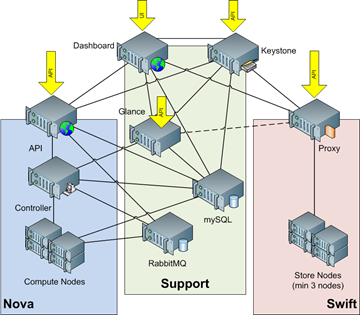
Even with the depth of the discussion (notes below), we did not go into details on how individual OpenStack components are connected together.  The image my team at Dell uses is included below.  I also recommend reviewing Rackspace’s published reference architecture.

Figure 1 Diablo Software Architecture. Source Dell/OpenStack (cc w/ attribution)

Notes

Our deployment discussion was a round table so it is difficult to link statements back to individuals, but I was able to track companies (mostly).

  • HP
    • picked Ubuntu & KVM because they were the most vetted. They are also using Chef for deployment.
    • running Diablo 2, moving to Diablo Final & a flat network model. The network controller is a bottleneck. Their biggest scale issue is RabbitMQ.
    • is creating their own Nova Volume plugin for their block storage.
    • At this point, scale limits are due to simultaneous loading rather than total number of nodes.
    • The Nova node image cache can get corrupted without any notification or way to force a refresh – this defect is being addressed in Essex.
    • has setup availability zones are completely independent (500 node) systems. Expecting to converge them in the future.
  • Rackspace
    • is using the latest Ubuntu. Always stays current.
    • using Puppet to setup their cloud.
    • They are expecting to go live on Essex and are keeping their deployment on the Essex trunk. This is causing some extra work but they expect it to pay back by allowing them to get to production on Essex faster.
    • Deploying on XenServer
    • “Devs move fast, Ops not so much.”  Trying to not get behind.
  • Rackspace Cloud Builders (RCB) is running major releases being run through an automated test suite. The verified releases are being published to https://github.com/cloudbuilders (note: Crowbar is pulling our OpenStack bits from this repo).
  • Dell commented that our customers are using Crowbar primarily pilots – they are learning how to use OpenStack
    • Said they have >10 customer deployments pending
    • ATT is using OpenSource version of Crowbar
    • Need for Keystone and Dashboard were considered essential additions to Diablo
  • Hypervisors
    • KVM is considered the top one for now
    • Libvirt (which uses KVM) also supports LXE which people found to be interesting
    • XenServer via XAPI are also popular
    • No so much activity on ESX & HyperV
    • We talked about why some hypervisors are more popular – it’s about the node agent architecture of OpenStack.
  • Storage
    • NetApp via Nova Volume appears to be a popular block storage
  • Keystone / Dashboard
    • Customers want both together
    • Including keystone/dashboard was considered essential in Diablo. It was part of the reason why Diablo Final was delayed.
    • HP is not using dashboard
OpenStack API
  • Members of the Audience made comments that we need to deprecate the EC2 APIs (because it does not help OpenStack long term to maintain EC2 APIs over its own).  [1/5 Note: THIS IS NOT OFFICIAL POLICY, it is a reflection of what was discussed]
  • HP started on EC2 API but is moving to the OpenStack API

Meetup Housekeeping

  • Next meeting is Tuesday 1/10 and sponsored by SUSE (note: Tuesday is just for this January).  Topic TBD.
  • We’ve got sponsors for the next SIX meetups! Thanks for Dell (my employeer), Rackspace, HP, SUSE, Canonical and PuppetLabs for sponsoring.
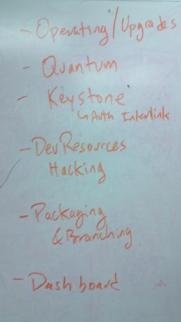
  • We discussed topics for the next meetings (see the post image). We’re going to throw it to a vote for guidance.
  • The OSATX tag is also being used by Occupy San Antonio.  Enjoy the cross chatter!