Why Governance Matters in Open Source: Discussing the OpenStack Foundation

This post is part of my notes from the 2/1 Boston OpenStack meetup.

OpenStack Foundation

Your’s truly (Rob Hirschfeld) gave the presentation about the OpenStack Foundation.  To readers of this blog, it’s obvious that I’m a believer in the OpenStack mission; however, it’s not obvious how creating a foundation helps with that mission and why OpenStack needs its own. As one person at the meetup put it, “Why not? Every major project needs a foundation!”

Governance does not sound sexy compared to writing code and deploying clouds, but it’s very important to the success of the project.

Here are my notes without the poetic elocution I exuded during the meetup…

The basics:

  • What: Creating a neutral body to govern OpenStack. Rackspace has been leading OpenStack. This means that they own the copyrights, name and also pay the people who organize the community. They committed (to executives at Dell and others) that they would ultimately setup a standalone body to govern the project before the project was public and endorsed by those early partners. Dell (my employer), Citrix, Accenture and NASA were some of biggest names at the Austin conference launch.
  • Why: A neutral body is needed because a lot of companies are committing significant time and money to the project. They cannot risk their investments on Rackspace good will alone. This may mean many things. It could be they don’t like Rackspace direction or they feel that Rackspace is not investing enough.
  • When: Right now and over the next few releases.  You should give feedback right now on the OpenStack Foundations mission.  The actual foundation will take more time to establish because it requires legal work and funding commitments.
  • Who: The community – all stakeholders. This is important stuff! While trying to standup a financially independent Foundation, which requires moneys, the little guys are not left out. There is a clear realization and desire to enable independent developers and contributors and small players to have a seat at the table.
  • How Much: The amounts are unclear, but establishing a foundation will require a significant ongoing investment from highly involved and moneyed parties (Rackspace, Dell, Cisco, HP, Citrix, NTT, startups?, etc).  The funding will pay salaries for people dedicated to the community doing the things that I’ll discuss below.  Overall, the ROI for those investments must be clear!

The foundation does “governance.” But, what does that mean? Here is a list of vitally important work that the foundation is responsible for.

  • Branding – Protecting, certifying, and promoting the OpenStack brand is important because it ensures that “OpenStack” has a valuable and predictable meaning to contributors and users. A strong the brand also means a stronger temptation for people to abuse the brand by claiming compatibility, participation and integration.
  • API – Many would assume that the OpenStack API is the very heart of the project and there is merit to this position. As more and more OpenStack implementations emerge, it is essential that we have a body that can certify which implementations (and even which versions of the implementation!) are valid. This is a substantial value to the community because API integrity ensures project continuity and helps the ecosystem monetize the project. Note: my opinion differs from others here because I think we should favor API over implementation
  • Community – The OpenStack community is not an accident. It is the function of deliberate actions and choices made by Rackspace and supported by key contributors. That community requires virtual and physical places to coalesce and leaders to organize and manage those meeting places. The excellent conferences, wikis, blogs, media awareness, documentation and meetups are a product of consistent community management.
  • Arbitration – An open source community is a family and siblings do not always get along. Today, Rackspace must be very careful about balancing their own interests because they are like the oldest sibling playing the parent role – you can get away with it until something serious happens. We need a neutral party so that Rackspace can protect their own interests (alternate spin: because Rackspace protects their own interests at the expense of the community).
  • Leadership – OpenStack today is a collection of projects with individual leadership. We will increasingly need coordinated leadership as the number of projects and users increases. Centralized leadership is essential because the good of the project as a whole may mean sacrifices within individual projects. It may even mean that some projects chose to leave the OpenStack tent. Stewarding these challenges will require a new level of leadership.
  • Legal – This is a function of all the above but also something more. From a legal stand point, OpenStack be able to represent itself. There is a significant amount of intellectual property being created. It would be foolish to overlook that this property is valuable and needs adequate legal representation.

I used “vitally important” to describe the above items. Is that an exaggeration? Our goal is collaboration and that requires some infrastructure and rules to make it sustainable. We must have a foundation that encourages innovation (multiple implementations) and collaboration (discourages forking). Innovation and collaboration are the heartbeat of an open source project.

The foundation is vitally important because collaboration by competitors is fragile.

In addition to the core areas above, the foundation needs to handle routine tactical items such as:

  • Delivering on milestones & releases
  • Moving new subprojects into OpenStack
  • Electing and maintaining Project Policy Board
  • Electing and maintaining Project Technical Leads
  • Ensuring adherence and extensions to the current bylaws

At the end of the day, OpenStack monetization is the central value for the Foundation.

In order for the OpenStack project, and thus its foundation, to flourish, the contributors, ecosystem, sponsors and users of the project must be able to see a reasonable return (ROI) on their investment. I would love to believe that the foundation is allow about people banding together to solve important problems for the benefit of all; however, it is more realistic to embrace that we can both collaborate and profit simultaneously. Acknowledging the pragmatic self-interested view allows us to create the right incentives and processes as embodied by the OpenStack foundation.
Crowbar+OpenStack Insights for the week: Food Fight Podcast & Boston Meetup 2/1

Please don’t confuse a lack of posts with a lack of activity!  I’ve been in the center of a whirlwind of Crowbar, OpenStack and Hadoop for my team at Dell.  I’ve also working on an interesting side project with Liquid Leadership author (and would-be star ship captain) Brad Szollose.

I just don’t have time to post all of the awesomeness.  I can tell you that my team is very focused on Hadoop (RHEL 6.2/CentOS 6.2 + open Cloudera Distro) barclamps as we get some Diablo deployments done.  Also the Crowbar list has been very active about Diablo.  If you’re looking for advanced information, there is  some inside scoop on the Crowbar FoodFight podcast I did with Bryan Berry & Matt Ray.

I’ll be in BOSTON THIS WEDNESDAY 2/1 for the OpenStack Meetup there.  We’re going to be talking about Quantum and the OpenStack Foundation.  I suspect that Keystone will come up too (but that’s the subject of another post).  Of course, it’s not just your humble blogger: the whole Dell CloudEdge OpenStack/Crowbar team will be on hand!  So put on your cloud geek hat and take a trip to Harvard for the meetup!

Austin OpenStack Meetup (January Minutes) + OpenStack Foundation Web Cast!

Sorry for the brevity… At the last Austin OpenStack meetup, we had >60 stackers!  Some from as far away as Portland and Boston (as in Oregon and Massachusetts).

Notes:

  • Suse introduced their OpenStack beta and talked about their Suse Studio that can deploy images against the OpenStack APIs
  • I showed off DevStack.org code that can setup the truck of OpenStack (now Essex) in about 10 minutes on a single node.  Great for developers!
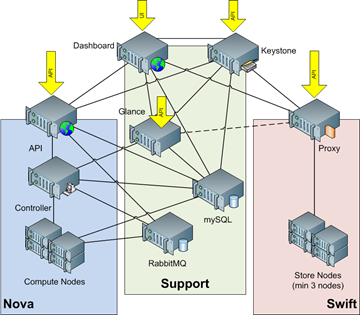
  • I showed an OpenStack Diablo Final deployment from Crowbar.  I focused mainly on Dashboard and used our reference architecture (see below) as illustration of the many parts.
  • Matt Ray suggested everyone watch the webcasts about the OpenStack Foundation (Thurs 6pm central  & Friday 9am central)
  • We planned the next few meetups.
    • For February, we’ll talk about Swift and Dashboard.
    • For March, we’ll talk about Essex and DevStack to prep for the next design summit (in SF).
    • For April, we’ll debrief the conference

Thank you Suse and Dell (my employer) for sponsoring!   The next meetup is sponsored by Canonical.

January OpenStack Meetup next Tuesday 1/10 focus on Operation/Install

A reminder that we’re having an OpenStack meetup in Austin next Tuesday (http://www.meetup.com/OpenStack-Austin/events/44184682/).

We’ll have OpenStack fellow-up and general topics including planning our next meeting.

The primary topic for this meeting is Operating OpenStack.  According to the group poll, the plan is to show an hands on OpenStack installation and peel back the covers on configuration.

I’m expecting to use Dell’s Crowbar tool to setup the Rackspace cloud builder distro.  I’m hoping that someone can also show DevStack and some other installations.

It’s not too late to vote: http://www.meetup.com/OpenStack-Austin/polls/444322/

Thanks to Suse and Dell for sponsoring!

Note: If you’re the Boston Area, the next meetup there is 2/1

Details: http://www.foggysoftware.com/2011/12/openstack-in-community.html

February 1, 2012 at 6:30PM EST
Boston OpenStack User Group Meetup
Harvard University, Maxwell Dworkin Building, Rm 119, 33 Oxford St, Cambridge, MA

To register: http://www.meetup.com/Openstack-Boston/

OpenStack Deployments Abound at Austin Meetup (12/9)

I was very impressed by the quality of discussion at the Deployment topic meeting for Austin OpenStack Meetup (#OSATX). Of the 45ish people attending, we had representations for at least 6 different OpenStack deployments (Dell, HP, ATT, Rackspace Internal, Rackspace Cloud Builders, Opscode Chef)!  Considering the scope of those deployments (several are aiming at 1000+ nodes), that’s a truly impressive accomplishment for such a young project.

Even with the depth of the discussion (notes below), we did not go into details on how individual OpenStack components are connected together.  The image my team at Dell uses is included below.  I also recommend reviewing Rackspace’s published reference architecture.

Figure 1 Diablo Software Architecture. Source Dell/OpenStack (cc w/ attribution)

Notes

Our deployment discussion was a round table so it is difficult to link statements back to individuals, but I was able to track companies (mostly).

  • HP
    • picked Ubuntu & KVM because they were the most vetted. They are also using Chef for deployment.
    • running Diablo 2, moving to Diablo Final & a flat network model. The network controller is a bottleneck. Their biggest scale issue is RabbitMQ.
    • is creating their own Nova Volume plugin for their block storage.
    • At this point, scale limits are due to simultaneous loading rather than total number of nodes.
    • The Nova node image cache can get corrupted without any notification or way to force a refresh – this defect is being addressed in Essex.
    • has setup availability zones are completely independent (500 node) systems. Expecting to converge them in the future.
  • Rackspace
    • is using the latest Ubuntu. Always stays current.
    • using Puppet to setup their cloud.
    • They are expecting to go live on Essex and are keeping their deployment on the Essex trunk. This is causing some extra work but they expect it to pay back by allowing them to get to production on Essex faster.
    • Deploying on XenServer
    • “Devs move fast, Ops not so much.”  Trying to not get behind.
  • Rackspace Cloud Builders (RCB) is running major releases being run through an automated test suite. The verified releases are being published to https://github.com/cloudbuilders (note: Crowbar is pulling our OpenStack bits from this repo).
  • Dell commented that our customers are using Crowbar primarily pilots – they are learning how to use OpenStack
    • Said they have >10 customer deployments pending
    • ATT is using OpenSource version of Crowbar
    • Need for Keystone and Dashboard were considered essential additions to Diablo
  • Hypervisors
    • KVM is considered the top one for now
    • Libvirt (which uses KVM) also supports LXE which people found to be interesting
    • XenServer via XAPI are also popular
    • No so much activity on ESX & HyperV
    • We talked about why some hypervisors are more popular – it’s about the node agent architecture of OpenStack.
  • Storage
    • NetApp via Nova Volume appears to be a popular block storage
  • Keystone / Dashboard
    • Customers want both together
    • Including keystone/dashboard was considered essential in Diablo. It was part of the reason why Diablo Final was delayed.
    • HP is not using dashboard
OpenStack API
  • Members of the Audience made comments that we need to deprecate the EC2 APIs (because it does not help OpenStack long term to maintain EC2 APIs over its own).  [1/5 Note: THIS IS NOT OFFICIAL POLICY, it is a reflection of what was discussed]
  • HP started on EC2 API but is moving to the OpenStack API

Meetup Housekeeping

  • Next meeting is Tuesday 1/10 and sponsored by SUSE (note: Tuesday is just for this January).  Topic TBD.
  • We’ve got sponsors for the next SIX meetups! Thanks for Dell (my employeer), Rackspace, HP, SUSE, Canonical and PuppetLabs for sponsoring.
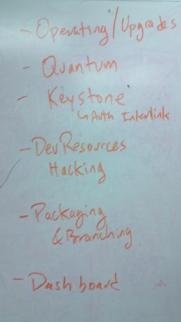
  • We discussed topics for the next meetings (see the post image). We’re going to throw it to a vote for guidance.
  • The OSATX tag is also being used by Occupy San Antonio.  Enjoy the cross chatter!

OpenStack Quantum Update – what I got wrong and where it’s headed

I’m glad to acknowledge that I incorrectly reported the OpenStack Quantum project would require licensed components for implementation!   I fully stand behind Quantum as being OpenStack’s “killer app” and am happy to post more information about it here.

Side note: My team at Dell is starting to get Crowbar community pings about collaboration on a Quantum barclamp.  Yes, we are interested!

This updates comes via Dan Wendlandt from Nicira who pointed out my error in the Seattle Meetup notes (you can read his comment on that post).  Rather than summarize his information, I’ll let Dan talk for himself…

Dan’s comments about open source Quantum implementation:

There’s a full documentation on how to use Open vSwitch to implement Quantum (see http://docs.openstack.org/incubation/openstack-network/admin/content/ and http://openvswitch.org/openstack/documentation/), and [Dan] even sent a demo link out to the openstack list a while back (http://wiki.openstack.org/QuantumOVSDemo). Open vSwitch is completely open source and free. Some other plugins may require proprietary hardware and/or software, but there is definitely a (very) viable and completely open source option for Quantum networking.

Dan’s comments about Quantum OpenStack project status in the D-E-F release train:

At the end of the Diablo cycle, Quantum applied to become an incubated project, which means it will be incubated for Essex. At the end of the Essex cycle, we plan to apply to be a core project, meaning that if we are accepted, we would be a core project for the F-series release.

Its worth noting, however, that [Dan] knows of many people planning on putting Quantum in production before then, which is the real indicator of a project’s maturity (regardless of whether it is technically “core” or not).

OpenStack Seattle Meetup 11/30 Notes

We had an informal OpenStack meetup after the Opscode Summit in Seattle.

This turned out to be a major open cloud gab fest! In addition to Dell OpenStack leads (Greg and I), we had the Nova Project Technical Lead (PTL, Vish Ishaya, @vish), HP’s Cloud Architect (Alex Howells, @nixgeek), Opscode OpenStack cookbook master (Matt Ray, @mattray). We were joined by several other Chef Summit attendees with OpenStack interest including a pair of engineers from Spain.

We’d planned to demo using Knife-OpenStack against the Crowbar Diablo build.  Unfortunately, the knife-openstack is out of date (August 15th?!).  We need Keystone support.  Anyone up for that?

Highlights

There’s no way I can recapture everything that was said, but here are some highlights I jotted down the on the way home.

  • After the miss with Keystone and the Diablo release, solving the project dependency problem is an important problem. Vish talked at length about the ambiguity challenge of Keystone being required and also incubated. He said we were not formal enough around new projects even though we had dependencies on them. Future releases, new projects (specifically, Quantum) will not be allowed to be dependencies.
  • The focus for Essex is on quality and stability. The plan is for Essex to be a long-term supported (LTS) release tied to the Ubuntu LTS. That’s putting pressure on all the projects to ensure quality, lock features early, and avoid unproven dependencies.
  • There is a lot of activity around storage and companies are creating volume plug-ins for Nova. Vish said he knew of at least four.
  • Networking has a lot of activity. Quantum has a lot of activity, but may not emerge as a core project in time for Essex. There was general agreement that Quantum is “the killer app” for OpenStack and will take cloud to the next level.  The Quantum Open vSwitch implementaiton is completely open source and free. Some other plugins may require proprietary hardware and/or software, but there is definitely a (very) viable and completely open source option for Quantum networking.
  • HP has some serious cloud mojo going on. Alex talked about defects they have found and submitted fixes back to core. He also hinted about some interesting storage and networking IP that’s going into their OpenStack deployment. Based on his comments, I don’t expect those to become public so I’m going to limit my observations about them here.
  • We talked about hypervisors for a while. KVM and XenServer (via XAPI) were the primary topics. We did talk about LXE & OpenVZ as popular approaches too. Vish said that some of the XenServer work is using Xen Storage Manager to manage SAN images.
  • Vish is seeing a constant rise in committers. It’s hard to judge because some committers appear to be individuals acting on behalf of teams (10 to 20 people).

Note: cross posted on the OpenStack Blog.

Reminder: 12/8 Meetup @ Austin!

Missed this us in Seattle? Join us at the 12/8 OpenStack meetup in Austin co-hosted by Dell and Rackspace.

Based on our last meetup, it appears deployment is a hot topic, so we’ll kick off with that – bring your experiences, opinions, and thoughts! We’ll also open the floor to other OpenStack topics that would be discussed – open technical and business discussions – no commercials please!

We’ll also talk about organizing future OpenStack meet ups! If your company is interested in sponsoring a future meetup, find Joseph George at the meetup and he can work with you on details.

Seattle meetup on 11/30 (will bring massive laptops for OpenStack, Hadoop & Crowbar demos)

After Greg Althaus and I are done attending the sold out Opcode Community Summit (11/29-30), Opscode has offered to let us have an informal meetup at Opscode HQ from 6:30 to 8pm on 11/30.  I’ve proposed this as an official Seattle OpenStack Meetup (waiting on confirmation from @heckj).

We’re not limiting the agenda to OpenStack!  We’ll happily talk about Hadoop, Crowbar, Opscode or any other cloud technology that’s on your mind.  For 90 minutes, we’re offering Cloud Geeking as a Service (CGaaS).

Not in Seattle?  Never fear!  You can hook up with other members of my team at Dell in Boston on 11/29 & Austin 12/8.

Greg Althaus at 11/15 Austin Cloud User Group meeting (annotated 90 min audio)

Greg Althaus did a 90 minute Crowbar deep dive at this week’s Austin Cloud User Group.  Brad Knowles recorded audio and posted it so I thought I’d share the link and my annotations.  There are a lot more times to catch up with our team at Dell in Austin, Boston, and Seattle.

Video Annotations –  (##:## time stamp)

  • 00:00 Intros & Meeting Management
  • 12:00 Joseph George Introduction / Sponsorship
  • 16:00 Greg Starts – why Crowbar
  • 19:00 DevOps slides
  • 21:00 What does Crowbar do for DevOps
    • make it easier to manage
    • make it easier to repeat
  • 24:00 What’s included – how we grow / where to start
  • 27:20 Starting to show crowbar – what’s included as barclamps
    • pluggable / configuration
    • Barclamps!
  • 28:10 What is a barclamp
    • discussion about the barclamps in the base
  • 34:30: We ❤ Chef. Puppet vs Chef
  • 36:00 Why barclamps are more than cookbooks
  • 36:30 State machine & transitions
  • Q&A Section
    • 38:50 Reference Architectures
    • 43:00 Barclamps work outside of Crowbar?
    • 44:15 Hardware models supported
    • 47:30 Storage Queston
    • 49:00 HA progress
    • 53:00 Ceph as a distributed cloud on all nodes
    • 56:20 Deployer has a map of how to give out roles
  • 58:00 Demo Fails
  • 58:30 Crowbar Architecture
  • 62:00 How Crowbar can be extended
  • 63:00 Workflow & Proposals
  • 65:40 Meta Barclamps
  • 71:10 Chef Environments
  • 73:40 Taking OpenStack releases and Environments
  • 75:00 The case for remove recipes
  • 77:33 Git Hub Tour
  • 79:00 Network Barclamp deep dive
  • 84:00 Adding switch config (roadmap topic)
  • 86:30 Conduits
  • 87:40 Barclamp Extensions / Services
  • 89:00 Questions
    • 89:20 Proposal operations
    • 93:30 OpenStack Readiness & Crowbar Design Approach
    • 93:10 Network Teaming
    • 94:30 Which OS & Hypervisors
    • 96:30 Continuous Integration & Tools
    • 98:40 BDD (“cucumberesque”) & Testing
    • 99:40 Build approach & barclamp construction
  • 100:00 Wrap up by Joseph

Talk with Team Crowbar! Online 11/8, Austin 11/15, Boston 11/29 & 11/29 & Seattle 11/30

My team at Dell has been getting a great response from our community about Crowbar. Thanks! We’re actively working a rock solid OpenStack deployment that will raise the bar on ease of deploy and drive operational excellence.

We have also heard that we need to improve access to the team; consequently, I’m delighted to announce a long list of places and dates where you can access us online AND in person.

Here’s the list:

Or in a calendar view:

Sun Mon Tuesday Wed Thursday Fri Sat
11/8 Online
Crowbar Chat
11/15 Austin
Cloud User
11/29 Boston
OpenStack Meetup
11/30 Seattle
Crowbar Drinks TBD
12/6 Boston
Opscode BoaF
12/8 Austin
OpenStack Meetup