OpenStack Deployments Abound at Austin Meetup (12/9)

I was very impressed by the quality of discussion at the Deployment topic meeting for Austin OpenStack Meetup (#OSATX). Of the 45ish people attending, we had representations for at least 6 different OpenStack deployments (Dell, HP, ATT, Rackspace Internal, Rackspace Cloud Builders, Opscode Chef)!  Considering the scope of those deployments (several are aiming at 1000+ nodes), that’s a truly impressive accomplishment for such a young project.

Even with the depth of the discussion (notes below), we did not go into details on how individual OpenStack components are connected together.  The image my team at Dell uses is included below.  I also recommend reviewing Rackspace’s published reference architecture.
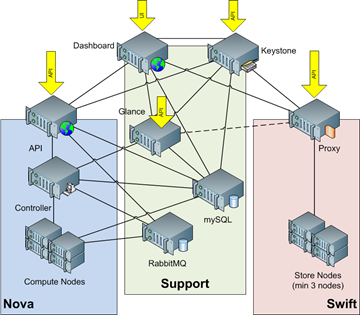
Figure 1 Diablo Software Architecture. Source Dell/OpenStack (cc w/ attribution)

Notes

Our deployment discussion was a round table so it is difficult to link statements back to individuals, but I was able to track companies (mostly).

  • HP
    • picked Ubuntu & KVM because they were the most vetted. They are also using Chef for deployment.
    • running Diablo 2, moving to Diablo Final & a flat network model. The network controller is a bottleneck. Their biggest scale issue is RabbitMQ.
    • is creating their own Nova Volume plugin for their block storage.
    • At this point, scale limits are due to simultaneous loading rather than total number of nodes.
    • The Nova node image cache can get corrupted without any notification or way to force a refresh – this defect is being addressed in Essex.
    • has setup availability zones are completely independent (500 node) systems. Expecting to converge them in the future.
  • Rackspace
    • is using the latest Ubuntu. Always stays current.
    • using Puppet to setup their cloud.
    • They are expecting to go live on Essex and are keeping their deployment on the Essex trunk. This is causing some extra work but they expect it to pay back by allowing them to get to production on Essex faster.
    • Deploying on XenServer
    • “Devs move fast, Ops not so much.”  Trying to not get behind.
  • Rackspace Cloud Builders (RCB) is running major releases being run through an automated test suite. The verified releases are being published to https://github.com/cloudbuilders (note: Crowbar is pulling our OpenStack bits from this repo).
  • Dell commented that our customers are using Crowbar primarily pilots – they are learning how to use OpenStack
    • Said they have >10 customer deployments pending
    • ATT is using OpenSource version of Crowbar
    • Need for Keystone and Dashboard were considered essential additions to Diablo
  • Hypervisors
    • KVM is considered the top one for now
    • Libvirt (which uses KVM) also supports LXE which people found to be interesting
    • XenServer via XAPI are also popular
    • No so much activity on ESX & HyperV
    • We talked about why some hypervisors are more popular – it’s about the node agent architecture of OpenStack.
  • Storage
    • NetApp via Nova Volume appears to be a popular block storage
  • Keystone / Dashboard
    • Customers want both together
    • Including keystone/dashboard was considered essential in Diablo. It was part of the reason why Diablo Final was delayed.
    • HP is not using dashboard
OpenStack API
  • Members of the Audience made comments that we need to deprecate the EC2 APIs (because it does not help OpenStack long term to maintain EC2 APIs over its own).  [1/5 Note: THIS IS NOT OFFICIAL POLICY, it is a reflection of what was discussed]
  • HP started on EC2 API but is moving to the OpenStack API
Meetup Housekeeping

  • Next meeting is Tuesday 1/10 and sponsored by SUSE (note: Tuesday is just for this January).  Topic TBD.
  • We’ve got sponsors for the next SIX meetups! Thanks for Dell (my employeer), Rackspace, HP, SUSE, Canonical and PuppetLabs for sponsoring.
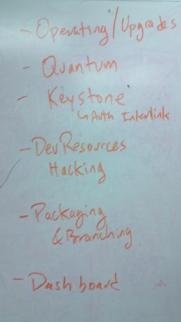
  • We discussed topics for the next meetings (see the post image). We’re going to throw it to a vote for guidance.
  • The OSATX tag is also being used by Occupy San Antonio.  Enjoy the cross chatter!
Extending Chef’s reach: “Managed Nodes” for External Entities.

Note: this post is very technical and relates to detailed Chef design patterns used by Crowbar. I apologize in advance for the post’s opacity. Just unleash your inner DevOps geek and read on. I promise you’ll find some gems.

At the Opscode Community Summit, Dell’s primary focus was creating an “External Entity” or “Managed Node” model. Matt Ray prefers the term “managed node” so I’ll defer to that name for now. This model is needed for Crowbar to manage system components that cannot run an agent such as a network switch, blade chassis, IP power distribution unit (PDU), and a SAN array. The concept for a managed node is that there is an instance of the chef-client agent that can act as a delegate for the external entity. We’ve been reluctant to call it a “proxy” because that term is so overloaded.

My Crowbar vision is to manage an end-to-end cloud application life-cycle. This starts from power and network connections to hardware RAID and BIOS then up to the services that are installed on the node and ultimately reaches up to applications installed in VMs on those nodes.

Our design goal is that you can control a managed node with the same Chef semantics that we already use. For example, adding a Network proposal role to the Switch managed node will force the agent to update its configuration during the next chef-client run. During the run, the managed node will see that the network proposal has several VLANs configured in its attributes. The node will then update the actual switch entity to match the attributes.

Design Considerations

There are five key aspects of our managed node design. They are configuration, discovery, location, relationships, and sequence. Let’s explore each in detail.

A managed node’s configuration is different than a service or actuator pattern. The core concept of a node in chef is that the node owns the configuration. You make changes to the nodes configuration and it’s the nodes job to manage its state to maintain that configuration. In a service pattern, the consumer manages specific requests directly. At the summit (with apologies to Bill Clinton), I described Chef configuration as telling a node what it “is” while a service provide verbs that change a node. The critical difference is that a node is expected to maintain configuration as its composition changes (e.g.: node is now connected for VLAN 666) while a service responds to specific change requests (node adds tag for VLAN 666). Our goal is the maintain Chef’s configuration management concept for the external entities.

Managed nodes also have a resource discovery concept that must align with the current ohai discovery model. Like a regular node, the manage node’s data attributes reflect the state of the managed entity; consequently we’d expect a blade chassis managed node to enumerate the blades that are included. This creates an expectation that the manage node appears to be “root” for the entity that it represents. We are also assuming that the Chef server can be trusted with the sharable discovered data. There may be cases where these assumptions do not have to be true, but we are making them for now.

Another essential element of managed nodes is that their agent location matters because the external resource generally has restricted access. There are several examples of this requirement. Switch configuration may require a serial connection from a specific node. Blade SANs and PDUs management ports are restricted to specific networks. This means that the manage node agents must run from a specific location. This location is not important to the Chef server or the nodes’ actions against the managed node; however, it’s critical for the system when starting the managed node agent. While it’s possible for managed nodes to run on nodes that are outside the overall Chef infrastructure, our use cases make it more likely that they will run as independent processes from regular nodes. This means that we’ll have to add some relationship information for managed nodes and perhaps a barclamp to install and manage managed nodes.

All of our use cases for managed nodes have a direct physical linkage between the managed node and server nodes. For a switch, it’s the ports connected. For a chassis, it’s the blades installed. For a SAN, it’s the LUNs exposed. These links imply a hierarchical graph that is not currently modeled in Chef data – in fact, it’s completely missing and difficult to maintain. At this time, it’s not clear how we or Opscode will address this. My current expectation is that we’ll use yet more roles to capture the relationships and add some hierarchical UI elements into Crowbar to help visualize it. We’ll also need to comprehend node types because “managed nodes” are too generic in our UI context.

Finally, we have to consider the sequence of action for actions between managed nodes and nodes.  In all of our uses cases, steps to bring up a node requires orchestration with the managed node.  Specifically, there needs to be a hand-off between the managed node and the node.  For example, installing an application that uses VLANs does not work until the switch has created the VLAN,  There are the same challenges on LUNs and SAN and blades and chassis.  Crowbar provides orchestration that we can leverage assuming we can declare the linkages.

For now, a hack to get started…

For now, we’ve started on a workable hack for managed nodes. This involves running multiple chef-clients on the admin server in their own paths & processes. We’ll also have to add yet more roles to comprehend the relationships between the managed nodes and the things that are connected to them. Watch the crowbar listserv for details!

Extra Credit

Notes on the Opscode wiki from the Crowbar & Managed Node sessions

OpenStack Seattle Meetup 11/30 Notes

We had an informal OpenStack meetup after the Opscode Summit in Seattle.

This turned out to be a major open cloud gab fest! In addition to Dell OpenStack leads (Greg and I), we had the Nova Project Technical Lead (PTL, Vish Ishaya, @vish), HP’s Cloud Architect (Alex Howells, @nixgeek), Opscode OpenStack cookbook master (Matt Ray, @mattray). We were joined by several other Chef Summit attendees with OpenStack interest including a pair of engineers from Spain.

We’d planned to demo using Knife-OpenStack against the Crowbar Diablo build.  Unfortunately, the knife-openstack is out of date (August 15th?!).  We need Keystone support.  Anyone up for that?

Highlights

There’s no way I can recapture everything that was said, but here are some highlights I jotted down the on the way home.

  • After the miss with Keystone and the Diablo release, solving the project dependency problem is an important problem. Vish talked at length about the ambiguity challenge of Keystone being required and also incubated. He said we were not formal enough around new projects even though we had dependencies on them. Future releases, new projects (specifically, Quantum) will not be allowed to be dependencies.
  • The focus for Essex is on quality and stability. The plan is for Essex to be a long-term supported (LTS) release tied to the Ubuntu LTS. That’s putting pressure on all the projects to ensure quality, lock features early, and avoid unproven dependencies.
  • There is a lot of activity around storage and companies are creating volume plug-ins for Nova. Vish said he knew of at least four.
  • Networking has a lot of activity. Quantum has a lot of activity, but may not emerge as a core project in time for Essex. There was general agreement that Quantum is “the killer app” for OpenStack and will take cloud to the next level.  The Quantum Open vSwitch implementaiton is completely open source and free. Some other plugins may require proprietary hardware and/or software, but there is definitely a (very) viable and completely open source option for Quantum networking.
  • HP has some serious cloud mojo going on. Alex talked about defects they have found and submitted fixes back to core. He also hinted about some interesting storage and networking IP that’s going into their OpenStack deployment. Based on his comments, I don’t expect those to become public so I’m going to limit my observations about them here.
  • We talked about hypervisors for a while. KVM and XenServer (via XAPI) were the primary topics. We did talk about LXE & OpenVZ as popular approaches too. Vish said that some of the XenServer work is using Xen Storage Manager to manage SAN images.
  • Vish is seeing a constant rise in committers. It’s hard to judge because some committers appear to be individuals acting on behalf of teams (10 to 20 people).

Note: cross posted on the OpenStack Blog.

Reminder: 12/8 Meetup @ Austin!

Missed this us in Seattle? Join us at the 12/8 OpenStack meetup in Austin co-hosted by Dell and Rackspace.

Based on our last meetup, it appears deployment is a hot topic, so we’ll kick off with that – bring your experiences, opinions, and thoughts! We’ll also open the floor to other OpenStack topics that would be discussed – open technical and business discussions – no commercials please!

We’ll also talk about organizing future OpenStack meet ups! If your company is interested in sponsoring a future meetup, find Joseph George at the meetup and he can work with you on details.

Barclamps: now with added portability!

I had a question about moving barclamps between solutions.  Since Victor just changed the barclamp build to create a tar for each barclamp (with the debs/rpms), I thought it was the perfect time to explain the new feature.

You can find the barclamps on the Crowbar ISO under “/dell/barclamps” and you can install the TAR onto a Crowbar system using “./barclamp_install foo.tar.gz” where foo is the name of your barclamp.

Here’s a video of how to find and install barclamp tars:

Note: while you can install OpenStack into a Hadoop system, that combination is NOT tested.  We only test OpenStack on Ubuntu 10.10 and Hadoop on RHEL 5.7.   Community help in expanding support is always welcome!

Opscode Summit Recap – taking Chef & DevOps to a whole new level

Opscode Summit Agenda created by open space

I have to say that last week’s Opscode Community Summit was one of the most productive summits that I have attended. Their use of the open-space meeting format proved to be highly effective for a team of motivated people to self-organize and talk about critical topics. I especially like the agenda negations (see picture for an agenda snapshot) because everyone worked to adjust session times and locations based on what else other sessions being offered. Of course, is also helped to have an unbelievable level of Chef expertise on tap.

Overall

Overall, I found the summit to be a very valuable two days; consequently, I feel some need to pay it forward with some a good summary. Part of the goal was for the community to document their sessions on the event wiki (which I have done).

The roadmap sessions were of particular interest to me. In short, Chef is converging the code bases of their three products (hosted, private and open). The primary change on this will moving from CouchBD to a SQL based DB and moving away the API calls away from Merb/Ruby to Erlang. They are also improving search so that we can make more fine-tuned requests that perform better and return less extraneous data.

I had a lot of great conversations. Some of the companies represented included: Monster, Oracle, HP, DTO, Opscode (of course), InfoChimps, Reactor8, and Rackspace. There were many others – overall >100 people attended!

Crowbar & Chef

Greg Althaus and I attended for Dell with a Crowbar specific agenda so my notes reflect the fact that I spent 80% of my time on sessions related to features we need and explaining what we have done with Chef.

Observations related to Crowbar’s use of Chef

  1. There is a class of “orchestration” products that have similar objectives as Crowbar. Ones that I remember are Cluster Chef, Run Deck, Domino
  2. Crowbar uses Chef in a way that is different than users who have a single application to deploy. We use roles and databags to store configuration that other users inject into their recipes. This is dues to the fact that we are trying to create generic recipes that can be applied to many installations.
  3. Our heavy use of roles enables something of a cookbook service pattern. We found that this was confusing to many chef users who rely on the UI and knife. It works for us because all of these interactions are automated by Crowbar.
  4. We picked up some smart security ideas that we’ll incorporate into future versions.

Managed Nodes / External Entities

Our primary focus was creating an “External Entity” or “Managed Node” model. Matt Ray prefers the term “managed node” so I’ll defer to that name for now. This model is needed for Crowbar to manage system components that cannot run an agent such as a network switch, blade chassis, IP power distribution unit (PDU), and a SAN array. The concept for a managed node is that that there is an instance of the chef-client agent that can act as a delegate for the external entity. I had so much to say about that part of the session, I’m posting it as its own topic shortly.

Seattle meetup on 11/30 (will bring massive laptops for OpenStack, Hadoop & Crowbar demos)

After Greg Althaus and I are done attending the sold out Opcode Community Summit (11/29-30), Opscode has offered to let us have an informal meetup at Opscode HQ from 6:30 to 8pm on 11/30.  I’ve proposed this as an official Seattle OpenStack Meetup (waiting on confirmation from @heckj).

We’re not limiting the agenda to OpenStack!  We’ll happily talk about Hadoop, Crowbar, Opscode or any other cloud technology that’s on your mind.  For 90 minutes, we’re offering Cloud Geeking as a Service (CGaaS).

Not in Seattle?  Never fear!  You can hook up with other members of my team at Dell in Boston on 11/29 & Austin 12/8.

Greg Althaus at 11/15 Austin Cloud User Group meeting (annotated 90 min audio)

Greg Althaus did a 90 minute Crowbar deep dive at this week’s Austin Cloud User Group.  Brad Knowles recorded audio and posted it so I thought I’d share the link and my annotations.  There are a lot more times to catch up with our team at Dell in Austin, Boston, and Seattle.

Video Annotations –  (##:## time stamp)

  • 00:00 Intros & Meeting Management
  • 12:00 Joseph George Introduction / Sponsorship
  • 16:00 Greg Starts – why Crowbar
  • 19:00 DevOps slides
  • 21:00 What does Crowbar do for DevOps
    • make it easier to manage
    • make it easier to repeat
  • 24:00 What’s included – how we grow / where to start
  • 27:20 Starting to show crowbar – what’s included as barclamps
    • pluggable / configuration
    • Barclamps!
  • 28:10 What is a barclamp
    • discussion about the barclamps in the base
  • 34:30: We ❤ Chef. Puppet vs Chef
  • 36:00 Why barclamps are more than cookbooks
  • 36:30 State machine & transitions
  • Q&A Section
    • 38:50 Reference Architectures
    • 43:00 Barclamps work outside of Crowbar?
    • 44:15 Hardware models supported
    • 47:30 Storage Queston
    • 49:00 HA progress
    • 53:00 Ceph as a distributed cloud on all nodes
    • 56:20 Deployer has a map of how to give out roles
  • 58:00 Demo Fails
  • 58:30 Crowbar Architecture
  • 62:00 How Crowbar can be extended
  • 63:00 Workflow & Proposals
  • 65:40 Meta Barclamps
  • 71:10 Chef Environments
  • 73:40 Taking OpenStack releases and Environments
  • 75:00 The case for remove recipes
  • 77:33 Git Hub Tour
  • 79:00 Network Barclamp deep dive
  • 84:00 Adding switch config (roadmap topic)
  • 86:30 Conduits
  • 87:40 Barclamp Extensions / Services
  • 89:00 Questions
    • 89:20 Proposal operations
    • 93:30 OpenStack Readiness & Crowbar Design Approach
    • 93:10 Network Teaming
    • 94:30 Which OS & Hypervisors
    • 96:30 Continuous Integration & Tools
    • 98:40 BDD (“cucumberesque”) & Testing
    • 99:40 Build approach & barclamp construction
  • 100:00 Wrap up by Joseph

Dell is open sourcing Crowbar Apache Hadoop barclamps!

I’m very excited to announce that my team at Dell will be open sourcing our Apache Hadoop Crowbar barclamps by the end of the month.

This release raises the bar on open Hadoop deployments by making them faster, scalable, more integrated and repeatable.

These barclamps were developed in conjunction with our licensed Dell | Cloudera Solution. The licensed solution is for customers seeking large scale and professionally supported big data solutions. The purpose of the open barclamps (which pull the open source parts from the Cloudera distro) is to help you get started with Hadoop and reduce your learning curve. Our team invested significant testing effort in ensuring that these barclamps work smoothly because they are the foundational layer of our for-pay Hadoop solution.

Included in the Hadoop barclamp suite are Hadoop Map Reduce, Hive, Pig, ZooKeeper and Sqoop running on RHEL 5.7. These barclamps cover the core parts of the Hadoop suite. Like other Crowbar deployments (see OpenStack), the barclamps automatically discover the service configurations and interoperate. One of our team members (call him Scott Jensen) said it very simply “I can deploy a fully an integrated Hadoop cluster in a few hours. That friggin’ rocks!” I just can’t put it more eloquently than that!

I’ll post again when we flip the “open” bit and invite our community to dig in and help us continue to set the standards on open Hadoop deployments.

For more perspectives on this release, check out posts by Barton George (just for devs), Joseph George (About Hadoop) and Aurelian Dumitru

Barton posted these two videos of me talking about the release too:

Hadoop & Crowbar:

Dev’s Only Short:

Talk with Team Crowbar! Online 11/8, Austin 11/15, Boston 11/29 & 11/29 & Seattle 11/30

My team at Dell has been getting a great response from our community about Crowbar. Thanks! We’re actively working a rock solid OpenStack deployment that will raise the bar on ease of deploy and drive operational excellence.

We have also heard that we need to improve access to the team; consequently, I’m delighted to announce a long list of places and dates where you can access us online AND in person.

Here’s the list:

Or in a calendar view:

Sun Mon Tuesday Wed Thursday Fri Sat
11/8 Online
Crowbar Chat
11/15 Austin
Cloud User
11/29 Boston
OpenStack Meetup
11/30 Seattle
Crowbar Drinks TBD
12/6 Boston
Opscode BoaF
12/8 Austin
OpenStack Meetup

The 451 Group Cloudscape report strikes chord misses harmony (DevOps, Hybrid Cloud, Orchestration)

It’s impossible to resist posting about this month’s  451 Group Cloudscape report when it calls me out by name as a leading cloud innovator:

… ProTier founders Dave McCrory and Rob Hirschfeld. ProTier [note: now part of Quest] was, indeed, the first VMware ecosystem vendor to be tracked by The 451 Group. In the face of a skeptical world, these entrepreneurs argued that virtualization needed automation in order to realize its full potential, and that the test lab was the low-hanging fruit. Subsequent events have more than vindicated their view (pg. 33).

It’s even better when the report is worth reading and offers insights into forces shaping the industry.  It’s nice to be “more than vindicated” on an amazing journey we started over 10 years ago!

Rather than recite 451’s points (hybrid cloud = automation + orchestration + devops + pixie dust), I’d rather look at the problem different way as a counterpoint.

The problem is “how do we deal with applications that are scattered over multiple data centers?”

I do not think orchestration is the complete answer.  Current orchestration is too focused on moving around virtual machines (aka workloads).

Ultimately, the solution lies in application architecture; however, I feel that is also a misdirection because cloud is redefining what an “application architecture” means.

Applications are a dynamic mix of compute, storage, and connectivity.

We’re entering an age when all of these ingredients will be delivered as elastic services that will be managed by the applications themselves.  The concept of self management is an extension of DevOps principles that fuse application function and deployment. There are missing pieces, but I’m seeing the innovation moving to fill those gaps.

If you want to see the future of cloud applications then look at the network and storage services that are emerging.  They will tell you more about the future than orchestration.