Austin OpenStack Meetup (January Minutes) + OpenStack Foundation Web Cast!

Sorry for the brevity… At the last Austin OpenStack meetup, we had >60 stackers!  Some from as far away as Portland and Boston (as in Oregon and Massachusetts).

Notes:

  • Suse introduced their OpenStack beta and talked about their Suse Studio that can deploy images against the OpenStack APIs
  • I showed off DevStack.org code that can setup the truck of OpenStack (now Essex) in about 10 minutes on a single node.  Great for developers!
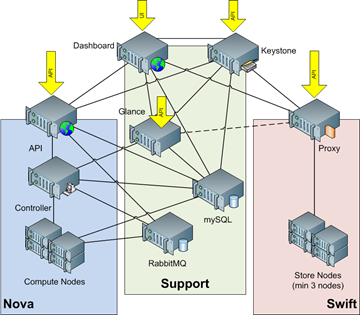
  • I showed an OpenStack Diablo Final deployment from Crowbar.  I focused mainly on Dashboard and used our reference architecture (see below) as illustration of the many parts.
  • Matt Ray suggested everyone watch the webcasts about the OpenStack Foundation (Thurs 6pm central  & Friday 9am central)
  • We planned the next few meetups.
    • For February, we’ll talk about Swift and Dashboard.
    • For March, we’ll talk about Essex and DevStack to prep for the next design summit (in SF).
    • For April, we’ll debrief the conference

Thank you Suse and Dell (my employer) for sponsoring!   The next meetup is sponsored by Canonical.

2012: A year of Cloud Coalescence (whatever that means)

This post is a collaboration between three Dell Cloud activists: Rob Hirschfeld (@zehicle), Joseph B George (@jbgeorge) and Stephen Spector (@SpectoratDell).

We’re not making predictions for the “whole” Cloud market, this is a relatively narrow perspective based on technologies that on our daily radar. These views are strictly our own and based on publicly available data. They do not reflect plans, commitments, or internal data from our employer (Dell).

The major 2012 theme is cloud coalescence.  However, Rob worries that we’ll see slower adoption due to lack of engineers and confusing names/concepts.

Here are our twelve items for 2012:

  1. Open source continues to be a disruptive technology delivery model. It’s not “free” software – there’s an emerging IT culture that is doing business differently, including a number of large enterprises. The stable of sleeping giant vendors are waking up to this in 2012 but full engagement will take time.
  2. Linux. It is the cloud operating system and had a great 2012. It seems silly pointing this out since it seems obvious, but it’s the foundation for open source acceleration.
  3. Tight market for engineering and product development talent will get tighter. The catch-22 of this is that potential mentors are busy breaking new ground and writing code, making it hard for new experts to be developed.
  4. On track, OpenStack moves into its awkward adolescence. It is still gangly and rebelling against authority, but coming into its own. Expect to see a groundswell of installations and an expected wave of issues and challenges that will drive the community. By the “F” release, expect to see OpenStack cement itself as a serious, stable contender with notable public deployments and a significant international private deployment foot print.
  5. We’ll start seeing OpenStack Quantum (networking) in near-production pilots by year end. OpenStack Quantum is the glue that holds the big players in OpenStack Nova together. The potential for next generation cloud networking based on open standards is huge, but it will emerge without a killer app (OpenStack Nova in this case) pushing it forward. The OpenStack community will pull together to keep Quantum on track.
  6. Hadoop will cross into mainstream awareness as the need for big data analysis grows exponentially along with the data. Hadoop is on fire in select circles and completely obscure in others. The challenge for Hadoop is there are not enough engineers who know how to operate it. We suspect that lack of expertise will throttle demand until we get more proprietary tools to simplify analysis. We also predict a lot of very rich entrepreneurs and VCs emerging from this market segment.
  7. DevOps will enter mainstream IT discussions. Marketers from major IT brands will struggle and fail to find a better name for the movement. Our prediction is that by 2015, it will just be the way that “IT” is done and the name won’t matter.
  8. KVM continues to gain believers as the open source hypervisor. In 2011, I would not have believed this prediction but KVM making great strides and getting a lot of love from the OpenStack community, though Xen is also a key open source technology as well. I believe that Libvirt compatibility between LXE & KVM will further accelerate both virtualization approaches. 
      
  9. Big Data and NoSQL will continue to converge. While NoSQL enthusiasm as a universal replacement for structured databases appears to be deflating, real applications will win.
  10. Java will continue to encounter turbulence as a software platform under Oracle’s overly heady handed management.
  11. PaaS continues to be a confusing term. Cloud players will struggle with a definition but I don’t think a common definition will surface in 2012. I think the big news will be convergence between DevOps and PaaS; however, that will be under the radar since most of the market is still getting educated on both of those concepts.
  12. Hybrid cloud will continue to make strides but will not truly emerge in 2012 – we’ll try to develop this technology, and expose gaps that will get us there ultimately (see PaaS and Quantum above)

Thoughts?  We’d love to hear your comments.

Rob, JBG, and Stephen

You can follow Rob at www.RobHirschfeld.com or @zehicle on Twitter.
You can follow Joseph at www.JBGeorge.net or @jbgeorge on Twitter.

You can follow Stephen at http://en.community.dell.com/members/dell_2d00_stephen-sp/blogs/default.aspx or @SpectoratDell on Twitter.

Hadoop Crowbar released to open source! (plus AN HOUR of videos!)

I’m proud to announce that my team at Dell has open sourced our Apache Hadoop barclamps!  This release follows our Dell | Cloudera Hadoop Solution open source commitment from Hadoop World earlier this month.

As part of this release, we’ve created nearly AN HOUR of video content showing the Hadoop Barclamps in action, installing Crowbar (on CentOS), building Crowbar ISOs in the cloud and specialized developer focused builds.

If you want to talk to the Crowbar team.  We’re attending events in Boston 11/29, Seattle 11/30, and Austin 12/8.

Here are links to the videos:

More Hadoop perspectives from Dell:  Joseph George on what it means and  Barton George‘s backgrounder about barclamps.

Rackspace unveils OpenStack reference architecture & private cloud offering

Yesterday, Rackspace Cloud Builders unveiled both their open reference architecture (RA) and a private cloud offering (on GigaOM) based upon the RA.  The RA (which is well aligned with our Dell OpenStack RA) does a good job laying out the different aspects of an OpenStack deployment.  It also calls for the use of Dell C6100 servers and the open source version of Crowbar.

The Rackspace RA and Crowbar deployment barclamps share the same objective: sharing of best practices for OpenStack operations.

Over the last 12+ months, my team at Dell has had the opportunity to work with many customers on OpenStack deployment designs.  While no two of these are identical, they do share many similarities.  We are pleased to collaborate with Rackspace and others on capturing these practices as operational code (or “opscode” if you want a reference to the Chef cookbooks that are an intrinsic part of Crowbar’s architecture).

In our customer interactions, we hear clearly that Crowbar must remain flexible and ready to adapt to both customer on-site requirements and evolution within the OpenStack code base.  You are also telling us that there is a broader application space for Crowbar and we are listening to that too.

I believe that it will take some time for the community and markets to process today’s Rackspace announcements.  Rackspace is showing strong leadership in both sharing information and commercialization around OpenStack.  Both of these actions will drive responses from the community members.

Dell is open sourcing Crowbar Apache Hadoop barclamps!

I’m very excited to announce that my team at Dell will be open sourcing our Apache Hadoop Crowbar barclamps by the end of the month.

This release raises the bar on open Hadoop deployments by making them faster, scalable, more integrated and repeatable.

These barclamps were developed in conjunction with our licensed Dell | Cloudera Solution. The licensed solution is for customers seeking large scale and professionally supported big data solutions. The purpose of the open barclamps (which pull the open source parts from the Cloudera distro) is to help you get started with Hadoop and reduce your learning curve. Our team invested significant testing effort in ensuring that these barclamps work smoothly because they are the foundational layer of our for-pay Hadoop solution.

Included in the Hadoop barclamp suite are Hadoop Map Reduce, Hive, Pig, ZooKeeper and Sqoop running on RHEL 5.7. These barclamps cover the core parts of the Hadoop suite. Like other Crowbar deployments (see OpenStack), the barclamps automatically discover the service configurations and interoperate. One of our team members (call him Scott Jensen) said it very simply “I can deploy a fully an integrated Hadoop cluster in a few hours. That friggin’ rocks!” I just can’t put it more eloquently than that!

I’ll post again when we flip the “open” bit and invite our community to dig in and help us continue to set the standards on open Hadoop deployments.

For more perspectives on this release, check out posts by Barton George (just for devs), Joseph George (About Hadoop) and Aurelian Dumitru

Barton posted these two videos of me talking about the release too:

Hadoop & Crowbar:

Dev’s Only Short:

Talk with Team Crowbar! Online 11/8, Austin 11/15, Boston 11/29 & 11/29 & Seattle 11/30

My team at Dell has been getting a great response from our community about Crowbar. Thanks! We’re actively working a rock solid OpenStack deployment that will raise the bar on ease of deploy and drive operational excellence.

We have also heard that we need to improve access to the team; consequently, I’m delighted to announce a long list of places and dates where you can access us online AND in person.

Here’s the list:

Or in a calendar view:

Sun Mon Tuesday Wed Thursday Fri Sat
11/8 Online
Crowbar Chat
11/15 Austin
Cloud User
11/29 Boston
OpenStack Meetup
11/30 Seattle
Crowbar Drinks TBD
12/6 Boston
Opscode BoaF
12/8 Austin
OpenStack Meetup

Dell Crowbar Project: Open Source Cloud Deployer expands into the Community

Note: Cross posted on Dell Tech Center Blogs.

Background: Crowbar is an open source cloud deployment framework originally developed by Dell to support our OpenStack and Hadoop powered solutions.  Recently, it’s scope has increased to include a DevOps operations model and other deployments for additional cloud applications.

It’s only been a matter of months since we open sourced the Dell Crowbar Project at OSCON in June 2011; however, the progress and response to the project has been over whelming.  Crowbar is transforming into a community tool that is hardware, operating system, and application agnostic.  With that in mind, it’s time for me to provide a recap of Crowbar for those just learning about the project.

Crowbar started out simply as an installer for the “Dell OpenStack™-Powered Cloud Solution” with the objective of deploying a cloud from unboxed servers to a completely functioning system in under four hours.  That meant doing all the BIOS, RAID, Operations services (DNS, NTP, DHCP, etc.), networking, O/S installs and system configuration required creating a complete cloud infrastructure.  It was a big job, but one that we’d been piecing together on earlier cloud installation projects.  A key part of the project involved collaborating with Opscode Chef Server on the many system configuration tasks.  Ultimately, we met and exceeded the target with a complete OpenStack install in less than two hours.

In the process of delivering Crowbar as an installer, we realized that Chef, and tools like it, were part of a larger cloud movement known as DevOps.

The DevOps approach to deployment builds up systems in a layered model rather than using packaged images.  This layered model means that parts of the system are relatively independent and highly flexible.  Users can choose which components of the system they want to deploy and where to place those components.  For example, Crowbar deploys Nagios by default, but users can disable that component in favor of their own monitoring system.  It also allows for new components to identify that Nagios is available and automatically register themselves as clients and setup application specific profiles.  In this way, Crowbar’s use of a DevOps layered deployment model provides flexibility for BOTH modularized and integrated cloud deployments.

We believe that operations that embrace layered deployments are essential for success because they allow our customers to respond to the accelerating pace of change.  We call this model for cloud data centers “CloudOps.”

Based on the flexibility of Crowbar, our team decided to use it as the deployment model for our Apache™ Hadoop™ project (“Dell | Apache Hadoop Solution”).  While a good fit, adding Hadoop required expanding Crowbar in several critical ways.

  1. We had to make major changes in our installation and build processes to accommodate multi-operating system support (RHEL 5.6 and Ubuntu 10.10 as of Oct 2011).
  2. We introduced a modularization concept that we call “barclamps” that package individual layers of the deployment infrastructure.  These barclamps reach from the lowest system levels (IPMI, BIOS, and RAID) to the highest (OpenStack and Hadoop).

Barclamps are a very significant architecture pattern for Crowbar:

  1. They allow other applications to plug into the framework and leverage other barclamps in the solution.  For example, VMware created a Cloud Foundry barclamp and Dream Host has created a Ceph barclamp.  Both barclamps are examples of applications that can leverage Crowbar for a repeatable and predictable cloud deployment.
  2. They are independent modules with their own life cycle.  Each one has its own code repository and can be imported into a live system after initial deployment.  This allows customers to expand and manage their system after initial deployment.
  3. They have many components such as Chef Cookbooks, custom UI for configuration, dependency graphs, and even localization support.
  4. They offer services that other barclamps can consume.  The Network barclamp delivers many essential services for bootstrapping clouds including IP allocation, NIC teaming, and node VLAN configuration.
  5. They can provide extensible logic to evaluate a system and make deployment recommendations.  So far, no barclamps have implemented more than the most basic proposals; however, they have the potential for much richer analysis.

Making these changes was a substantial investment by Dell, but it greatly expands the community’s ability to participate in Crowbar development.  We believe these changes were essential to our team’s core values of open and collaborative development.

Most recently, our team moved Crowbar development into the open.  This change was reflected in our work on OpenStack Diablo (+ Keystone and Dashboard) with contributions by Opscode and Rackspace Cloud Builders.  Rather than work internally and push updates at milestones, we are now coding directly from the Crowbar repositories on Github.  It is important to note that for licensing reasons, Dell has not open sourced the optional BIOS and RAID barclamps.  This level of openness better positions us to collaborate with the crowbar community.

For a young project, we’re very proud of the progress that we’ve made with Crowbar.  We are starting a new chapter that brings new challenges such as expanding community involvement, roadmap transparency, and growing Dell support capabilities.  You will also begin to see optional barclamps that interact with proprietary and licensed hardware and software.  All of these changes are part of growing Crowbar in framework that can support a vibrant and rich ecosystem.

We are doing everything we can to make it easy to become part of the Crowbar community.  Please join our mailing list, download the open source code or ISO, create a barclamp, and make your voice heard.  Since Dell is funding the core development on this project, contacting your Dell salesperson and telling them how much you appreciate our efforts goes a long way too.
Cote & Rob interview: Crowbar+OpenStack Summit/Conference Reflections (40 mins)

I’m working on a larger post about the OpenStack Summit around API Implementation vs. Specification. You can have a preview of that AND A LOT OF OTHER STUFF (OpenStack, Crowbar, lunch) in this 40 minute interview w/ Michael Cote.

Setting: Dell World
Interview w/ @Cote at the Hilton Hotel Lobby on 6th street in Austin.

I know that Cote’s post does not have a time marker for easy navigation; however, I added them to help guide your navigation in the interview (link for audio) if you want to jump around.

  • 0:00 Introductions
  • 1:00 OpenStack
    • 1:00 Essex Conference – what is it, naming conventions
    • 2:45 Diablo is adding projects from incubation (Keystone, Dashboard,Quantum,
    • 5:30 OpenStack vs. Amazon – “OpenStack has ambitions.” We see it as a “platform for innovation.”
    • 6:30 OpenStack is a competitor for Amazon. It implements the EC2 APIs.
    • 7:30 How are people managing the evolving nature?
    • 8:20 We’re going to see OpenStack in production for the next release based on what we see in our deal flow.
    • 9:00 Every user that comes on adds momentum
    • 9:30 Rackspace setting up the OpenStack foundation is a reflection of the speed of adoption
    • 11:15 Our message is “we’re doing it, we’re in the field.” We are very hands on
    • 11:15 We chose early on to focus on helping deployment to help drive adoption
    • 12:00 “Our first test for partners is: Are you contributing back to the community?”
    • 12:44 The community told us “if you are participating then you are going to open source.” Our commits for OpenStack are live and in the open on our github.
    • 13:40 Why Github? We’re happy with it.
    • 14:20 OpenStack is using Gerrit because they have a gated trunk. They are migrated to Github
    • 15:20 APIs have been a big topic for OpenStack
    • 16:00 Do you track who is forking and following? Yes. We also have a listserv. We are trying to do a better job managing the Crowbar community. We know we need to do a better job.
    • 17:30 OpenStack is defined by its Implementation. That’s “an effective way to move the project forward quickly;” however, we’re getting to a point where people want to use alternate implementations.
    • 19:20 Implementation vs Specification is like the SOAP vs REST debate
    • 20:05 This is something the community needs to wrestle with
    • 21:45 Specification would allow the efforts to scale. The more people consume the API, the more people care about how it operates
    • 22:30 “Bugs can become the API”
    • 23:10 Asia and Europe are very active. We are seeing a ton of activity overseas.
  • 23:30 Crowbar
    • 24:00 Crowbar arose out of our need to deploy cloud software regardless of customer infrastructure
    • 24:45 We would show up and the customer needed all this cloud infrastructure. We created Crowbar because we always needed this
    • 26:00 We extended Chef because we had to do the initial bring-up including BIOS and RAID
    • 26:45 We added a state machine and an orchestration layer
    • 27:45 Updating the system is a huge component. Every month you may be upgrading the infrastructure!
    • 28:30 In our lab, we build whole clouds multiple times a day
    • 29:45 Crowbar is the “cloud unboxer”
    • 30:00 We modularized Crowbar with barclamps. Hadoop and OpenStack are a series of barclamps. Over 5 for each
    • 31:00 Barclamps are applied as layers. We are using that as a term to define DevOps
    • 31:15 We are using Crowbar to help message that we understand DevOps
    • 31:45 Soup vs Sandwich analogy – Images are like soup while DevOps is like a sandwich.
    • 32:45 If you don’t want something in a 1000 server deployment, DevOps lets you make a small change. Gives you flexibility.
    • 33:45 We added Cloud Foundry
    • 34:00 We’ve made it so easy with barclamps that partners are coming to us with ideas for barclamps. It’s like “changing the meat for the sandwich.”
    • 34:30 Dreamhost Ceph team created a barclamp and was actually running a majority of the Crowbar demos at the OpenStack conference
  • 35:25 What’s the future for Crowbar?
    • 35:30 More aspects of the infrastructure as open source
    • 35:45 More Hardware
    • 36:00 Multiple operating systems at the same time (XenServer, ESX, etc)
    • 36:30 Larger scale
    • 36:50 More types of infrastructure: storage & network
    • 37:40 Scalr shout out
    • 38:00 We know we need to collaborate more with our community
    • 38:30 The first step is to download it and try. Read my blog and sign up for the list serve
    • 39:00 CROWBAR IS NOT DELL SPECIFIC – we are working with people who want to create support for other vendor’s hardware. This benefits Dell.
    • 39:40 We don’t pretend that our customers are single vendor


Crowbar OpenStack deployment video (15 mins): Diablo + Keystone + Dashboard

This week at the OpenStack Design Summit and Conference in Boston, my team unveiled the Diablo+ Crowbar deployments. The OpenStack deployment that’s included with Crowbar reflects a collaborative effort between Dell, Opscode, and Rackspace and pulls packages from the Rackspace repository. It was important for us to use the Rackspace repos so that we could include integrated Keystone and Dashboard components that were omitted from the Diablo (current) release. Our decision to include these Essex (coming) components is based on customer feedback.

Since some of you cannot make it to the show and see the demo in person, we’ve captured it as a video for your enjoyment. The OpenStack deployment is available in our open source distribution. We are currently in QA for the overall solution so expect additional refinement as we progress towards our next OpenStack solution release.

REMINDER: Dell Hardware is NOT required to use Crowbar for OpenStack.  The open source version has everything you need – the BIOS and RAID barclamps are optional (but handy).