OpenStack Seattle Meetup 11/30 Notes

We had an informal OpenStack meetup after the Opscode Summit in Seattle.

This turned out to be a major open cloud gab fest! In addition to Dell OpenStack leads (Greg and I), we had the Nova Project Technical Lead (PTL, Vish Ishaya, @vish), HP’s Cloud Architect (Alex Howells, @nixgeek), Opscode OpenStack cookbook master (Matt Ray, @mattray). We were joined by several other Chef Summit attendees with OpenStack interest including a pair of engineers from Spain.

We’d planned to demo using Knife-OpenStack against the Crowbar Diablo build.  Unfortunately, the knife-openstack is out of date (August 15th?!).  We need Keystone support.  Anyone up for that?

Highlights

There’s no way I can recapture everything that was said, but here are some highlights I jotted down the on the way home.

  • After the miss with Keystone and the Diablo release, solving the project dependency problem is an important problem. Vish talked at length about the ambiguity challenge of Keystone being required and also incubated. He said we were not formal enough around new projects even though we had dependencies on them. Future releases, new projects (specifically, Quantum) will not be allowed to be dependencies.
  • The focus for Essex is on quality and stability. The plan is for Essex to be a long-term supported (LTS) release tied to the Ubuntu LTS. That’s putting pressure on all the projects to ensure quality, lock features early, and avoid unproven dependencies.
  • There is a lot of activity around storage and companies are creating volume plug-ins for Nova. Vish said he knew of at least four.
  • Networking has a lot of activity. Quantum has a lot of activity, but may not emerge as a core project in time for Essex. There was general agreement that Quantum is “the killer app” for OpenStack and will take cloud to the next level.  The Quantum Open vSwitch implementaiton is completely open source and free. Some other plugins may require proprietary hardware and/or software, but there is definitely a (very) viable and completely open source option for Quantum networking.
  • HP has some serious cloud mojo going on. Alex talked about defects they have found and submitted fixes back to core. He also hinted about some interesting storage and networking IP that’s going into their OpenStack deployment. Based on his comments, I don’t expect those to become public so I’m going to limit my observations about them here.
  • We talked about hypervisors for a while. KVM and XenServer (via XAPI) were the primary topics. We did talk about LXE & OpenVZ as popular approaches too. Vish said that some of the XenServer work is using Xen Storage Manager to manage SAN images.
  • Vish is seeing a constant rise in committers. It’s hard to judge because some committers appear to be individuals acting on behalf of teams (10 to 20 people).

Note: cross posted on the OpenStack Blog.

Reminder: 12/8 Meetup @ Austin!

Missed this us in Seattle? Join us at the 12/8 OpenStack meetup in Austin co-hosted by Dell and Rackspace.

Based on our last meetup, it appears deployment is a hot topic, so we’ll kick off with that – bring your experiences, opinions, and thoughts! We’ll also open the floor to other OpenStack topics that would be discussed – open technical and business discussions – no commercials please!

We’ll also talk about organizing future OpenStack meet ups! If your company is interested in sponsoring a future meetup, find Joseph George at the meetup and he can work with you on details.
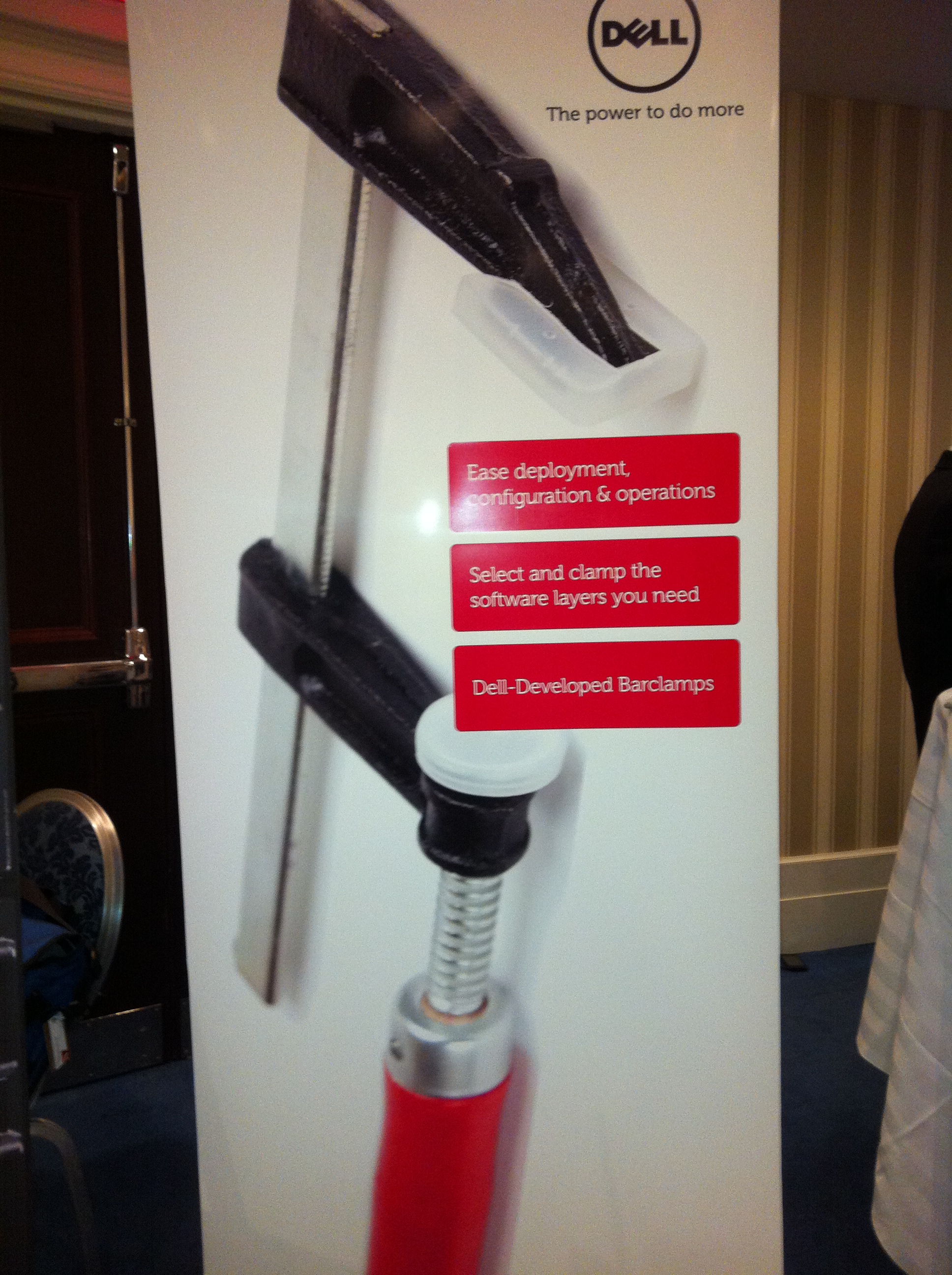
Barclamps: now with added portability!

I had a question about moving barclamps between solutions.  Since Victor just changed the barclamp build to create a tar for each barclamp (with the debs/rpms), I thought it was the perfect time to explain the new feature.

You can find the barclamps on the Crowbar ISO under “/dell/barclamps” and you can install the TAR onto a Crowbar system using “./barclamp_install foo.tar.gz” where foo is the name of your barclamp.

Here’s a video of how to find and install barclamp tars:

Note: while you can install OpenStack into a Hadoop system, that combination is NOT tested.  We only test OpenStack on Ubuntu 10.10 and Hadoop on RHEL 5.7.   Community help in expanding support is always welcome!

Opscode Summit Recap – taking Chef & DevOps to a whole new level

Opscode Summit Agenda created by open space

I have to say that last week’s Opscode Community Summit was one of the most productive summits that I have attended. Their use of the open-space meeting format proved to be highly effective for a team of motivated people to self-organize and talk about critical topics. I especially like the agenda negations (see picture for an agenda snapshot) because everyone worked to adjust session times and locations based on what else other sessions being offered. Of course, is also helped to have an unbelievable level of Chef expertise on tap.

Overall

Overall, I found the summit to be a very valuable two days; consequently, I feel some need to pay it forward with some a good summary. Part of the goal was for the community to document their sessions on the event wiki (which I have done).

The roadmap sessions were of particular interest to me. In short, Chef is converging the code bases of their three products (hosted, private and open). The primary change on this will moving from CouchBD to a SQL based DB and moving away the API calls away from Merb/Ruby to Erlang. They are also improving search so that we can make more fine-tuned requests that perform better and return less extraneous data.

I had a lot of great conversations. Some of the companies represented included: Monster, Oracle, HP, DTO, Opscode (of course), InfoChimps, Reactor8, and Rackspace. There were many others – overall >100 people attended!

Crowbar & Chef

Greg Althaus and I attended for Dell with a Crowbar specific agenda so my notes reflect the fact that I spent 80% of my time on sessions related to features we need and explaining what we have done with Chef.

Observations related to Crowbar’s use of Chef

  1. There is a class of “orchestration” products that have similar objectives as Crowbar. Ones that I remember are Cluster Chef, Run Deck, Domino
  2. Crowbar uses Chef in a way that is different than users who have a single application to deploy. We use roles and databags to store configuration that other users inject into their recipes. This is dues to the fact that we are trying to create generic recipes that can be applied to many installations.
  3. Our heavy use of roles enables something of a cookbook service pattern. We found that this was confusing to many chef users who rely on the UI and knife. It works for us because all of these interactions are automated by Crowbar.
  4. We picked up some smart security ideas that we’ll incorporate into future versions.

Managed Nodes / External Entities

Our primary focus was creating an “External Entity” or “Managed Node” model. Matt Ray prefers the term “managed node” so I’ll defer to that name for now. This model is needed for Crowbar to manage system components that cannot run an agent such as a network switch, blade chassis, IP power distribution unit (PDU), and a SAN array. The concept for a managed node is that that there is an instance of the chef-client agent that can act as a delegate for the external entity. I had so much to say about that part of the session, I’m posting it as its own topic shortly.

Hadoop Crowbar released to open source! (plus AN HOUR of videos!)

I’m proud to announce that my team at Dell has open sourced our Apache Hadoop barclamps!  This release follows our Dell | Cloudera Hadoop Solution open source commitment from Hadoop World earlier this month.

As part of this release, we’ve created nearly AN HOUR of video content showing the Hadoop Barclamps in action, installing Crowbar (on CentOS), building Crowbar ISOs in the cloud and specialized developer focused builds.

If you want to talk to the Crowbar team.  We’re attending events in Boston 11/29, Seattle 11/30, and Austin 12/8.

Here are links to the videos:

More Hadoop perspectives from Dell:  Joseph George on what it means and  Barton George‘s backgrounder about barclamps.

Seattle meetup on 11/30 (will bring massive laptops for OpenStack, Hadoop & Crowbar demos)

After Greg Althaus and I are done attending the sold out Opcode Community Summit (11/29-30), Opscode has offered to let us have an informal meetup at Opscode HQ from 6:30 to 8pm on 11/30.  I’ve proposed this as an official Seattle OpenStack Meetup (waiting on confirmation from @heckj).

We’re not limiting the agenda to OpenStack!  We’ll happily talk about Hadoop, Crowbar, Opscode or any other cloud technology that’s on your mind.  For 90 minutes, we’re offering Cloud Geeking as a Service (CGaaS).

Not in Seattle?  Never fear!  You can hook up with other members of my team at Dell in Boston on 11/29 & Austin 12/8.

Greg Althaus at 11/15 Austin Cloud User Group meeting (annotated 90 min audio)

Greg Althaus did a 90 minute Crowbar deep dive at this week’s Austin Cloud User Group.  Brad Knowles recorded audio and posted it so I thought I’d share the link and my annotations.  There are a lot more times to catch up with our team at Dell in Austin, Boston, and Seattle.

Video Annotations –  (##:## time stamp)

  • 00:00 Intros & Meeting Management
  • 12:00 Joseph George Introduction / Sponsorship
  • 16:00 Greg Starts – why Crowbar
  • 19:00 DevOps slides
  • 21:00 What does Crowbar do for DevOps
    • make it easier to manage
    • make it easier to repeat
  • 24:00 What’s included – how we grow / where to start
  • 27:20 Starting to show crowbar – what’s included as barclamps
    • pluggable / configuration
    • Barclamps!
  • 28:10 What is a barclamp
    • discussion about the barclamps in the base
  • 34:30: We ❤ Chef. Puppet vs Chef
  • 36:00 Why barclamps are more than cookbooks
  • 36:30 State machine & transitions
  • Q&A Section
    • 38:50 Reference Architectures
    • 43:00 Barclamps work outside of Crowbar?
    • 44:15 Hardware models supported
    • 47:30 Storage Queston
    • 49:00 HA progress
    • 53:00 Ceph as a distributed cloud on all nodes
    • 56:20 Deployer has a map of how to give out roles
  • 58:00 Demo Fails
  • 58:30 Crowbar Architecture
  • 62:00 How Crowbar can be extended
  • 63:00 Workflow & Proposals
  • 65:40 Meta Barclamps
  • 71:10 Chef Environments
  • 73:40 Taking OpenStack releases and Environments
  • 75:00 The case for remove recipes
  • 77:33 Git Hub Tour
  • 79:00 Network Barclamp deep dive
  • 84:00 Adding switch config (roadmap topic)
  • 86:30 Conduits
  • 87:40 Barclamp Extensions / Services
  • 89:00 Questions
    • 89:20 Proposal operations
    • 93:30 OpenStack Readiness & Crowbar Design Approach
    • 93:10 Network Teaming
    • 94:30 Which OS & Hypervisors
    • 96:30 Continuous Integration & Tools
    • 98:40 BDD (“cucumberesque”) & Testing
    • 99:40 Build approach & barclamp construction
  • 100:00 Wrap up by Joseph

Crowbar community support and 111111 sprint plan

The Dell Crowbar team is working to improve road map transparency. In the last few weeks, the Crowbar community has become more active on our lists, testing builds, and helping with documentation.

We love the engagement and continue to make supporting the list a priority.

Participation in Crowbar, OpenStack and Hadoop has been exceeding our expectations and we’re working to implement more community support and process. Thank you!!!

Our next steps:

  1. I’ve committed to post sprint plans and summary pages (this is the first)
  2. New Crowbar Twitter account
  3. I’m going to setup feature voting on the Crowbar Facebook page (like to vote)
  4. Continue to work the listserv and videos. We need help converting those to documentation on the crowbar wiki.
  5. Formalize collaborator agreements – we’re working with legal on this
  6. Exploring the option of a barclamp certification program and Crowbar support
  7. Moving to a gated trunk model for internal commits to improve quality
  8. Implementing a continuous integration system that includes core and barclamps. This will be part of our open source components.

We are working towards the 1.2 release (Beta 1) . That release is focused on supporting OpenStack but includes enhancements for upgrades, Hadoop, and additional OS support.

Our Sprint 111111 plan.

Source: Crowbar Wiki: [[sprint 111111]]

  • Theme: OpenStack Diablo Final release candidate.
  • Core Work: Refine Deployment for Nova, Glance, Nova Dashboard (horizon), keystone, swift
  • New additions: mySQL barclamp, Nova HA networking, kong
  • Crowbar internals: expose error states for proposals, allow packages to be included with barclamps to make upgrades easier, barclamp group pages
  • Operating system: added CentOS
  • Documentation: we’ve split the user guides into distinct books so Crowbar, OpenStack, and Hadoop each have their own user guide.
  • Pending action: expose the Hadoop barclamps
  • OS note: OpenStack is being tested (at Dell) against Ubuntu 10.10 only. Hadoop was tested against RHEL 5.7 and we expect it to work against CentOS also.

Agile Analogy: sprints are way points on a road trip

Happy 111111!  I’m working on a BIG AGILE post discussing the “interlock dilemma” that challenges big companies (like my employer Dell) as we become more lean in our development approaches.  That thought exercise turned up an analogy that is worth sharing.

We use sprints like we are driving on a long road trip.  As we travel, we want to stop at regular intervals to:

  • make sure we’re still going in the right direction (check the map)
  • see if we’re going to fast (overheating the engine)
  • see if we need to go faster (storms behind us)
  • avoid traffic (market is congested)
  • linger if there’s something interesting around (customers?!)
  • abandon the whole trip (kids are fighting in the back seat)
  • change our destination (saw a cool billboard)
  • pick-up a hitch hiker (partnering)

It just does not make sense to drive forward blindly hoping everything works out.  We need to inject decision points into our journey so that we take the right path.  And we have to remember, the right path is rarely that exact one that we started on!

If your product journey is predictable enough to navigate without frequent checks then your problem is not unique enough to generate much value.

Rackspace unveils OpenStack reference architecture & private cloud offering

Yesterday, Rackspace Cloud Builders unveiled both their open reference architecture (RA) and a private cloud offering (on GigaOM) based upon the RA.  The RA (which is well aligned with our Dell OpenStack RA) does a good job laying out the different aspects of an OpenStack deployment.  It also calls for the use of Dell C6100 servers and the open source version of Crowbar.

The Rackspace RA and Crowbar deployment barclamps share the same objective: sharing of best practices for OpenStack operations.

Over the last 12+ months, my team at Dell has had the opportunity to work with many customers on OpenStack deployment designs.  While no two of these are identical, they do share many similarities.  We are pleased to collaborate with Rackspace and others on capturing these practices as operational code (or “opscode” if you want a reference to the Chef cookbooks that are an intrinsic part of Crowbar’s architecture).

In our customer interactions, we hear clearly that Crowbar must remain flexible and ready to adapt to both customer on-site requirements and evolution within the OpenStack code base.  You are also telling us that there is a broader application space for Crowbar and we are listening to that too.

I believe that it will take some time for the community and markets to process today’s Rackspace announcements.  Rackspace is showing strong leadership in both sharing information and commercialization around OpenStack.  Both of these actions will drive responses from the community members.

Dell is open sourcing Crowbar Apache Hadoop barclamps!

I’m very excited to announce that my team at Dell will be open sourcing our Apache Hadoop Crowbar barclamps by the end of the month.

This release raises the bar on open Hadoop deployments by making them faster, scalable, more integrated and repeatable.

These barclamps were developed in conjunction with our licensed Dell | Cloudera Solution. The licensed solution is for customers seeking large scale and professionally supported big data solutions. The purpose of the open barclamps (which pull the open source parts from the Cloudera distro) is to help you get started with Hadoop and reduce your learning curve. Our team invested significant testing effort in ensuring that these barclamps work smoothly because they are the foundational layer of our for-pay Hadoop solution.

Included in the Hadoop barclamp suite are Hadoop Map Reduce, Hive, Pig, ZooKeeper and Sqoop running on RHEL 5.7. These barclamps cover the core parts of the Hadoop suite. Like other Crowbar deployments (see OpenStack), the barclamps automatically discover the service configurations and interoperate. One of our team members (call him Scott Jensen) said it very simply “I can deploy a fully an integrated Hadoop cluster in a few hours. That friggin’ rocks!” I just can’t put it more eloquently than that!

I’ll post again when we flip the “open” bit and invite our community to dig in and help us continue to set the standards on open Hadoop deployments.

For more perspectives on this release, check out posts by Barton George (just for devs), Joseph George (About Hadoop) and Aurelian Dumitru

Barton posted these two videos of me talking about the release too:

Hadoop & Crowbar:

Dev’s Only Short: