Joining in the blackout; however, I’ll defer to more articulate bloggers on this topic.
Concerns about SOPA
Reply
Joining in the blackout; however, I’ll defer to more articulate bloggers on this topic.
I don’t usually call out my credentials, but knowing the I have a Masters in Industrial Engineering helps (partially) explain my passion for process as being essential to successful software delivery. One of my favorite authors, Mary Poppendiek, explains undeployed code as perishable inventory that you need to get to market before it loses value. The big lessons (low inventory, high quality, system perspective) from Lean manufacturing translate directly into software and, lately, into operation as DevOps.
What we have observed from delivering our own cloud products, and working with customers on thier’s, is that the operations process for deployment is as important as the software and hardware. It is simply not acceptable for us to market clouds without a compelling model for maintaining the solution into the future. Clouds are simply moving too fast to be delivered without a continuous delivery story.
This white paper [link here!] has been available since the OpenStack conference, but not linked to the rest of our OpenStack or Crowbar content.
 Sorry for the brevity… At the last Austin OpenStack meetup, we had >60 stackers! Some from as far away as Portland and Boston (as in Oregon and Massachusetts).
Thank you Suse and Dell (my employer) for sponsoring! The next meetup is sponsored by Canonical.
 My team at Dell is still figuring out some big items for the 1.3 release; however, somethings were just added that is worth calling out.
Also, I’ve spun new open source ISOs with the new features. User beware!
 A reminder that we’re having an OpenStack meetup in Austin next Tuesday (http://www.meetup.com/OpenStack-Austin/events/44184682/).
We’ll have OpenStack fellow-up and general topics including planning our next meeting.
The primary topic for this meeting is Operating OpenStack. According to the group poll, the plan is to show an hands on OpenStack installation and peel back the covers on configuration.
I’m expecting to use Dell’s Crowbar tool to setup the Rackspace cloud builder distro. I’m hoping that someone can also show DevStack and some other installations.
It’s not too late to vote: http://www.meetup.com/OpenStack-Austin/polls/444322/
Thanks to Suse and Dell for sponsoring!
Note: If you’re the Boston Area, the next meetup there is 2/1
Details: http://www.foggysoftware.com/2011/12/openstack-in-community.html
February 1, 2012 at 6:30PM EST
Boston OpenStack User Group Meetup
Harvard University, Maxwell Dworkin Building, Rm 119, 33 Oxford St, Cambridge, MA
To register: http://www.meetup.com/Openstack-Boston/
This post is a collaboration between three Dell Cloud activists: Rob Hirschfeld (@zehicle), Joseph B George (@jbgeorge) and Stephen Spector (@SpectoratDell).
We’re not making predictions for the “whole” Cloud market, this is a relatively narrow perspective based on technologies that on our daily radar. These views are strictly our own and based on publicly available data. They do not reflect plans, commitments, or internal data from our  employer (Dell).
The major 2012 theme is cloud coalescence. However, Rob worries that we’ll see slower adoption due to lack of engineers and confusing names/concepts.
Here are our twelve items for 2012:
 Big Data and NoSQL will continue to converge. While NoSQL enthusiasm as a universal replacement for structured databases appears to be deflating, real applications will win.
Thoughts? We’d love to hear your comments.
Rob, JBG, and Stephen
You can follow Rob at www.RobHirschfeld.com or @zehicle on Twitter.
You can follow Joseph at www.JBGeorge.net or @jbgeorge on Twitter.
You can follow Stephen at http://en.community.dell.com/members/dell_2d00_stephen-sp/blogs/default.aspx or @SpectoratDell on Twitter.
 With the holiday rush, I neglected to post about Monday’s Crowbar v1.2 release (ISO here)!
The core focus for this release was to support the OpenStack Diablo Final bits (which my employer, Dell, includes as part of the “Dell OpenStack Powered Cloud Solution“); however, we added a lot of other capability as we continue to iterate on Crowbar.
I’m proud of our team’s efforts on this release on both on features and quality. I’m equally delighted about the Crowbar community engagement via the Crowbar list server. Crowbar is not hardware or operating system specific so it’s encouraging to hear about deployments on other gear and see the community helping us port to new operating system versions.
We driving more and more content to Crowbar’s Github as we are working to improve community visibility for Crowbar. As such, I’ve been regularly updating the Crowbar Roadmap. I’m also trying to make videos for Crowbar training (suggestions welcome!). Please check back for updates about upcoming plans and sprint activity.
Dell has a long list of pending Hadoop and OpenStack deployments using these bits so you can expect to see updates and patches matching our field experiences. We are very sensitive to community input and want to make Crowbar the best way to deliver a sustainable repeatable reference deployment of OpenStack, Hadoop and other cloud technologies.
I was very impressed by the quality of discussion at the Deployment topic meeting for Austin OpenStack Meetup (#OSATX). Of the 45ish people attending, we had representations for at least 6 different OpenStack deployments (Dell, HP, ATT, Rackspace Internal, Rackspace Cloud Builders, Opscode Chef)! Considering the scope of those deployments (several are aiming at 1000+ nodes), that’s a truly impressive accomplishment for such a young project.
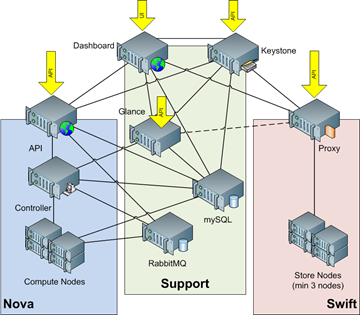
Even with the depth of the discussion (notes below), we did not go into details on how individual OpenStack components are connected together. The image my team at Dell uses is included below. I also recommend reviewing Rackspace’s published reference architecture.
Figure 1 Diablo Software Architecture. Source Dell/OpenStack (cc w/ attribution)
Our deployment discussion was a round table so it is difficult to link statements back to individuals, but I was able to track companies (mostly).
 Note: this post is very technical and relates to detailed Chef design patterns used by Crowbar. I apologize in advance for the post’s opacity. Just unleash your inner DevOps geek and read on. I promise you’ll find some gems.
At the Opscode Community Summit, Dell’s primary focus was creating an “External Entity” or “Managed Node” model. Matt Ray prefers the term “managed node” so I’ll defer to that name for now. This model is needed for Crowbar to manage system components that cannot run an agent such as a network switch, blade chassis, IP power distribution unit (PDU), and a SAN array. The concept for a managed node is that there is an instance of the chef-client agent that can act as a delegate for the external entity. We’ve been reluctant to call it a “proxy” because that term is so overloaded.
My Crowbar vision is to manage an end-to-end cloud application life-cycle. This starts from power and network connections to hardware RAID and BIOS then up to the services that are installed on the node and ultimately reaches up to applications installed in VMs on those nodes.
Our design goal is that you can control a managed node with the same Chef semantics that we already use. For example, adding a Network proposal role to the Switch managed node will force the agent to update its configuration during the next chef-client run. During the run, the managed node will see that the network proposal has several VLANs configured in its attributes. The node will then update the actual switch entity to match the attributes.
There are five key aspects of our managed node design. They are configuration, discovery, location, relationships, and sequence. Let’s explore each in detail.
A managed node’s configuration is different than a service or actuator pattern. The core concept of a node in chef is that the node owns the configuration. You make changes to the nodes configuration and it’s the nodes job to manage its state to maintain that configuration. In a service pattern, the consumer manages specific requests directly. At the summit (with apologies to Bill Clinton), I described Chef configuration as telling a node what it “is” while a service provide verbs that change a node. The critical difference is that a node is expected to maintain configuration as its composition changes (e.g.: node is now connected for VLAN 666) while a service responds to specific change requests (node adds tag for VLAN 666). Our goal is the maintain Chef’s configuration management concept for the external entities.
Managed nodes also have a resource discovery concept that must align with the current ohai discovery model. Like a regular node, the manage node’s data attributes reflect the state of the managed entity; consequently we’d expect a blade chassis managed node to enumerate the blades that are included. This creates an expectation that the manage node appears to be “root” for the entity that it represents. We are also assuming that the Chef server can be trusted with the sharable discovered data. There may be cases where these assumptions do not have to be true, but we are making them for now.
Another essential element of managed nodes is that their agent location matters because the external resource generally has restricted access. There are several examples of this requirement. Switch configuration may require a serial connection from a specific node. Blade SANs and PDUs management ports are restricted to specific networks. This means that the manage node agents must run from a specific location. This location is not important to the Chef server or the nodes’ actions against the managed node; however, it’s critical for the system when starting the managed node agent. While it’s possible for managed nodes to run on nodes that are outside the overall Chef infrastructure, our use cases make it more likely that they will run as independent processes from regular nodes. This means that we’ll have to add some relationship information for managed nodes and perhaps a barclamp to install and manage managed nodes.
All of our use cases for managed nodes have a direct physical linkage between the managed node and server nodes. For a switch, it’s the ports connected. For a chassis, it’s the blades installed. For a SAN, it’s the LUNs exposed. These links imply a hierarchical graph that is not currently modeled in Chef data – in fact, it’s completely missing and difficult to maintain. At this time, it’s not clear how we or Opscode will address this. My current expectation is that we’ll use yet more roles to capture the relationships and add some hierarchical UI elements into Crowbar to help visualize it. We’ll also need to comprehend node types because “managed nodes” are too generic in our UI context.
Finally, we have to consider the sequence of action for actions between managed nodes and nodes. In all of our uses cases, steps to bring up a node requires orchestration with the managed node. Specifically, there needs to be a hand-off between the managed node and the node. For example, installing an application that uses VLANs does not work until the switch has created the VLAN, There are the same challenges on LUNs and SAN and blades and chassis. Crowbar provides orchestration that we can leverage assuming we can declare the linkages.
For now, we’ve started on a workable hack for managed nodes. This involves running multiple chef-clients on the admin server in their own paths & processes. We’ll also have to add yet more roles to comprehend the relationships between the managed nodes and the things that are connected to them. Watch the crowbar listserv for details!
Notes on the Opscode wiki from the Crowbar & Managed Node sessions
 I’m glad to acknowledge that I incorrectly reported the OpenStack Quantum project would require licensed components for implementation! I fully stand behind Quantum as being OpenStack’s “killer app” and am happy to post more information about it here.
Side note: My team at Dell is starting to get Crowbar community pings about collaboration on a Quantum barclamp. Yes, we are interested!
This updates comes via Dan Wendlandt from Nicira who pointed out my error in the Seattle Meetup notes (you can read his comment on that post). Rather than summarize his information, I’ll let Dan talk for himself…
There’s a full documentation on how to use Open vSwitch to implement Quantum (see http://docs.openstack.org/incubation/openstack-network/admin/content/ and http://openvswitch.org/openstack/documentation/), and [Dan] even sent a demo link out to the openstack list a while back (http://wiki.openstack.org/QuantumOVSDemo). Open vSwitch is completely open source and free. Some other plugins may require proprietary hardware and/or software, but there is definitely a (very) viable and completely open source option for Quantum networking.
At the end of the Diablo cycle, Quantum applied to become an incubated project, which means it will be incubated for Essex. At the end of the Essex cycle, we plan to apply to be a core project, meaning that if we are accepted, we would be a core project for the F-series release.
Its worth noting, however, that [Dan] knows of many people planning on putting Quantum in production before then, which is the real indicator of a project’s maturity (regardless of whether it is technically “core” or not).

