Notes from 10/27 OpenStack Austin Meetup (via Stephen Spector)

Stephen Spector (now a Dell Services employee!) gave me permission to repost his excellent notes from the first OpenStack Austin (#OSATX) Meetup Group.

Here are his notes:

[Stephen] wanted to update everyone on the Austin OpenStack Meetup last night at the Austin TechRanch sponsored by Joseph and Rob (that’s me!) of the Dell OpenStack team (I think I got that right?). You can find all the tweets from the event at https://twitter.com/#!/search/%23osatx as we created a new hashtag for tweeting during the event, #osatx.

Here are some highlights from the event:

  • About 60 or so attendees with a good amount from Dell (Barton George, Logan McCloud)and Rackspace, Opscode (Matt Ray), Puppet Labs, SUSE talked about their OpenStack commitment (http://t.co/bBnIO7xv), and Ubuntu folks as well
  • Jon Dickinson who is the Project Technical Lead for Swift (Object Storage) was there and presented information on the current Swift offering; It is interesting to note that Swift releases continuously when most of OpenStack releases during the 6 month development cycle like Nova (Compute)
  • Stephen and Jim Plamondon from Rackspace presented information on the overall community and talked about the announcement yesterday from Internap about their Compute public cloud and the information on the MercadoLibre 600 Node Compute cloud running their business:

“With 58 million users of MercadoLibre.com and growing rapidly, we need to provide our teams instant access to computing resources without heavy administrative layers. With OpenStack, our internal users can instantly provision what they need without having to wait for a system administrator,” said Alejandro Comisario, Infrastructure Senior Engineer, MercadoLibre, the largest online trading platform in Latin America. “With our success running OpenStack Compute in production, we plan to roll OpenStack Diablo out more broadly across the company, and have appreciated the community support in this venture, especially through the OpenStack Forums, where we are also global moderators.”

  • Discussion on the OpenStack API Issue which is a significant open issue at this time – should OpenStack focus on creating an API specification and then let multiple implementations of that API move forward or build 1 implementation of the API as official OpenStack (see my post for more on this).
  • Greg Althaus gave a demo of the Nova Dashboard
  • Future Meetings
  • Three organizations have offered to help host (pizza $ and TechRanch space $) but we always need more!  You can offer to sponsor via the meetup site.
  • There will be future OpenStack Austin Meetups so sign up for the group and you’ll be notified automatically.
Pictures…

Continue reading

OpenStack: Five Challenges & Conference Observations

I was part of the Dell contingent at the OpenStack design conference earlier in the month.  The conference opened a new chapter for the project because the number of contributing companies reached critical mass.  That means that the core committers are no longer employed by just one or two entities; instead, there are more moneyed interests rubbing elbows and figuring out how to collaborate.

From my perspective (from interview with @Cote ), this changed the tone of the conference from more future looking to pragmatic.

That does not mean that everything is sunshine and rainbows for OpenStack clouds, there are real issues to be resolved.  IMHO, the top issues for OpenStack are:

  1. API implementation vs specification
  2. Building up coverage on continuous integration
  3. Ensuring that we can deploy consistently in multi-node systems
  4. Getting contributions from new members
  5. Figuring out which projects are core, satellite, missing or junk.  [xref 2014 DefCore]

Of these issues, I’ve been reconsidering my position favoring API via Implementation over specification (past position).  This has been a subject of debate on my team at Dell and I like Greg Althaus’ succinct articulation of the problem with implementation driven API: “it is not fair.”  This also ends up being a branding issues for OpenStack because governance needs to figure out which is a “real” OpenStack cloud deployment that can use the brand.  Does it have to be 100% of the source?  What about extensions?  What if it uses the API with an alternate implementation?

Of the other issues, most are related to maturity.  I think #2 needs pressure by and commitment from the larger players (Dell very much included).  Crowbar and the deployment blueprint is our answer #3.  Shouting the “don’t fork it up” chorus from the roof tops addresses contributions while #5 will require some strong governance and inevitably create some hurt feelings.

Austin OpenStack Cloud Meetup: Thursday 10/27 6:30 PM at TechRanch Austin

OpenStack Enthusiasts, you are OFFICIALLY INVITED to Austin’s first post-Diablo OpenStack community event.

Dell is sponsoring an Austin OpenStack Meet Up help connect the Austin community around OpenStack and open source clouds!

Link: http://www.meetup.com/OpenStack-Austin/events/37908242/

We’ve got members of the Rackspace Cloud Builders Training team in town and Dell’s own Crowbar team attending.  We’re planning to do OpenStack demos and talk about the project in detail – and we’ll have plenty of pizza and sodas to keep the cloud juices flowing.

This is a great way to learn about the OpenStack cloud project and meet other people who are developing/deploying the hottest open source cloud around.

PLEASE SPREAD THE WORD – we’re trying to make this inaugural OpenStack meetup a big success!

See you there,

Joseph @jbgeorge George & Rob @Zehicle Hirschfeld

Cote & Rob interview: Crowbar+OpenStack Summit/Conference Reflections (40 mins)

I’m working on a larger post about the OpenStack Summit around API Implementation vs. Specification. You can have a preview of that AND A LOT OF OTHER STUFF (OpenStack, Crowbar, lunch) in this 40 minute interview w/ Michael Cote.

Setting: Dell World
Interview w/ @Cote at the Hilton Hotel Lobby on 6th street in Austin.

I know that Cote’s post does not have a time marker for easy navigation; however, I added them to help guide your navigation in the interview (link for audio) if you want to jump around.

  • 0:00 Introductions
  • 1:00 OpenStack
    • 1:00 Essex Conference – what is it, naming conventions
    • 2:45 Diablo is adding projects from incubation (Keystone, Dashboard,Quantum,
    • 5:30 OpenStack vs. Amazon – “OpenStack has ambitions.” We see it as a “platform for innovation.”
    • 6:30 OpenStack is a competitor for Amazon. It implements the EC2 APIs.
    • 7:30 How are people managing the evolving nature?
    • 8:20 We’re going to see OpenStack in production for the next release based on what we see in our deal flow.
    • 9:00 Every user that comes on adds momentum
    • 9:30 Rackspace setting up the OpenStack foundation is a reflection of the speed of adoption
    • 11:15 Our message is “we’re doing it, we’re in the field.” We are very hands on
    • 11:15 We chose early on to focus on helping deployment to help drive adoption
    • 12:00 “Our first test for partners is: Are you contributing back to the community?”
    • 12:44 The community told us “if you are participating then you are going to open source.” Our commits for OpenStack are live and in the open on our github.
    • 13:40 Why Github? We’re happy with it.
    • 14:20 OpenStack is using Gerrit because they have a gated trunk. They are migrated to Github
    • 15:20 APIs have been a big topic for OpenStack
    • 16:00 Do you track who is forking and following? Yes. We also have a listserv. We are trying to do a better job managing the Crowbar community. We know we need to do a better job.
    • 17:30 OpenStack is defined by its Implementation. That’s “an effective way to move the project forward quickly;” however, we’re getting to a point where people want to use alternate implementations.
    • 19:20 Implementation vs Specification is like the SOAP vs REST debate
    • 20:05 This is something the community needs to wrestle with
    • 21:45 Specification would allow the efforts to scale. The more people consume the API, the more people care about how it operates
    • 22:30 “Bugs can become the API”
    • 23:10 Asia and Europe are very active. We are seeing a ton of activity overseas.
  • 23:30 Crowbar
    • 24:00 Crowbar arose out of our need to deploy cloud software regardless of customer infrastructure
    • 24:45 We would show up and the customer needed all this cloud infrastructure. We created Crowbar because we always needed this
    • 26:00 We extended Chef because we had to do the initial bring-up including BIOS and RAID
    • 26:45 We added a state machine and an orchestration layer
    • 27:45 Updating the system is a huge component. Every month you may be upgrading the infrastructure!
    • 28:30 In our lab, we build whole clouds multiple times a day
    • 29:45 Crowbar is the “cloud unboxer”
    • 30:00 We modularized Crowbar with barclamps. Hadoop and OpenStack are a series of barclamps. Over 5 for each
    • 31:00 Barclamps are applied as layers. We are using that as a term to define DevOps
    • 31:15 We are using Crowbar to help message that we understand DevOps
    • 31:45 Soup vs Sandwich analogy – Images are like soup while DevOps is like a sandwich.
    • 32:45 If you don’t want something in a 1000 server deployment, DevOps lets you make a small change. Gives you flexibility.
    • 33:45 We added Cloud Foundry
    • 34:00 We’ve made it so easy with barclamps that partners are coming to us with ideas for barclamps. It’s like “changing the meat for the sandwich.”
    • 34:30 Dreamhost Ceph team created a barclamp and was actually running a majority of the Crowbar demos at the OpenStack conference
  • 35:25 What’s the future for Crowbar?
    • 35:30 More aspects of the infrastructure as open source
    • 35:45 More Hardware
    • 36:00 Multiple operating systems at the same time (XenServer, ESX, etc)
    • 36:30 Larger scale
    • 36:50 More types of infrastructure: storage & network
    • 37:40 Scalr shout out
    • 38:00 We know we need to collaborate more with our community
    • 38:30 The first step is to download it and try. Read my blog and sign up for the list serve
    • 39:00 CROWBAR IS NOT DELL SPECIFIC – we are working with people who want to create support for other vendor’s hardware. This benefits Dell.
    • 39:40 We don’t pretend that our customers are single vendor


OpenStack Hardware Sessions Slides & Updates to “Bootstrapping Hyperscale Clouds”

Disclaimer: I work for Dell and we make very fine cloud optimized hardware.  This presentation is NOT slanted towards Dell hardware, it simply reflects lessons learned from listening to our customers.  Of course, people buying Dell servers, networking and storage products pays my salary and WE LOVE OUR CLOUD CUSTOMERS!

This presentation OpenStack Hardware Oct 2011 was the outline for our revisiting of the hyperscale white paper from last fall.  I’m in the process of updating this to reflect lessons learned.

Here are some highlights:

  1. Fault zones are not as critical as expected – customers are putting in more redundancy instead of striping apps
  2. 10 GbE is more popular than expected
  3. Logically segmented redundant networking (teamed) is more popular than physical isolate
  4. Customers are starting small (AnyScale instead of HyperScale)

Shout, chat and whisper with Dell at OpenStack Design Summit & Conference

My team at Dell has been very (very) busy delivering a lot of great materials for the Fall 2011 OpenStack Design Summit & Conference in Boston MA next week.

Our motto for this conference is “DOING IS DOING” or, perhaps, “DIABLO IS DOING.”

You can count on Dell to be walking the walk with deliverables that advance OpenStack.  In fact, you can watch what we’re doing because it’s posted live as we work with the community to build it.

First, we’ll have our Crowbar demo rack showcasing LIVE MULTI-NODE DIABLO DEPLOYMENTS and some IMPORTANT FEATURE AND COMMUNITY ADDITIONS.  No spoilers here – you’ll have to come by.  Of course, it’s in the git hub too, but we’ve put a bow on it.

Second, there’s a DEPLOYMENT BLUE PRINT discussion about getting better interlocks between OpenStack development and deployment.  We really need to reduce the pain and lag between adding great features and using those features.

Next, we’ve got a limited audience CONCEPT SNEAK PEEK for something from our labs that we think is very interesting and we’d like to get input about.  Unfortunately, we’re very limited with space & time for this whisper session so you’ll need to contact OpenStack@Dell.com to request an invitation.

Finally, at the Conference, you can see OUR TEAM IN ACTION:

  • Thurs 11:30 – Dell Keynote by John Igoe
  • Thurs 3:30 – Private Cloud Panel w/ Rob Hirschfeld
  • Thurs 4:30 – Hardware Infrastructure w/ Rob Hirschfeld & Greg Althaus
  • Friday 11:00 – Deployments w/ Greg Althaus
  • Friday 3:15 – Crowbar!! w/ Scott Jensen (yes, he does it with the !!)
  • Friday 4:15 – KVM & OpenStack

More conference posts: JB Gorge & Barton George.

Dell Crowbar to deploy OpenStack Diablo Cloud

Direction in the Cloud

Photo by JB George

This week, some of the Crowbar/Dell OpenStack-Powered Cloud team, plus Matt Ray from Opscode, have been working with our partners at Rackspace in San Antonio (see Opscode post about collaboration). Our target is to have Crowbar deliver a core Diablo deployment by the October 2011 design conference (sponsored in part by Dell). This is a collaborative effort and we invite community participation – we are trying to be open and communicative (via the Crowbar listserv) while also respecting that there is a mountain of work if we are to meet deadlines.

We are doing the work in the open on the Crowbar Github so you have access to the very latest capabilities and it also means that the head the Crowbar may be unstable while we add capabilities. We feel like this is an important trade off because it allows us to keep up with the rapid pace of development in OpenStack (and other projects). This is the motivation for the recent modularization work and will continue to be a feature driver for Crowbar enhancements because it allows Crowbar users to easily bring in updated bits.


Technical details of pending Crowbar changes

We’re testing a HUGE batch of changes to Crowbar before we commit them. The changes support the barclamp modularization work and also include the addition of RHEL and network barclamp update.

You may be eager to dig in; however, disruptiveness of these changes means that we are taking extra time to make sure that the build and install still work.

Here’s what you’ll see when we commit the changes:

  • Changes in naming to be more generic
    • Crowbar server user/pass is now crowbar/crowbar (was openstack/openstack)
    • Rails app path now crowbar_framework (was openstack_manager )
  • The pre-split barclamps (/change-image/dell/barclamps/*) have been moved into individual github repos (barclamp-*).
    • Barclamps are pulled into the build using “git submodule”
    • Chef scripts for barclamps are no longer copied and comingled together in the chef directory. They remain in their source directories (default /opt/dell/barclamps)
  • Inside the barclamps, you’ll find
    • A crowbar configuration file to direct the barclamp installer including localization and menu extensions.
    • Path changes to better align with the destination paths (command_line -> bin, app ->crowbar_framework)
    • App views moved under subdirectories
  • Changes to installation scripts
    • Barclamp installation changed to a ruby library so it can do more and be used individually outside of the install process. This allows barclamps to be imported or updated after installation.
    • Changes to create accommodate multiple operating systems
  • Addition of a “redhat-5.6-extra” directory with the RHEL 5.6 installation build components.
    • The RHEL version installs Opcode Chef Server 0.10 (Ubuntu is still 0.9 – community help here?)
  • Crowbar framework Rails app runs under Rainbow instead of Apache.
  • The code for the framework and the barclamp installer has been moved into the crowbar barclamp.
    • The installer bootstraps the crowbar barclamp to install itself.
  • The network barclamp has been substantially changed – that will require additional documentation. Features include
    • Concept of “conduits” that are constructed on nodes to be shared between barclamps
    • Ability to map adapters in a general way to deal with inconsistent enumeration
    • Mapping conduits to adapters allows for new teaming and multiple teaming configurations

We’ll post to the Crowbar listserv when changes. They will be posted to Crowbar HEAD. If you want the current build, we have created a “v1.0” tag.

WHIR Webinar Notes: Prying Open the Cloud with Dell Crowbar & OpenStack

Panelists: Me (@zehicle) & Joseph B. George (@jbgeorge), Director, Cloud and Big Data Solutions, Dell

Moderator: Liam Eagle (@theWHIR) , Editor-in-Chief, Web Host Industry Review

Wow, this Webinar was an hour of OpenStack insights (see the whole thing). If you don’t have the hour then you can use my time line nodes to jump to what you want to hear.

  • 2:50: Presentation Starts (introductions are over)
  • 3:40: Joseph coins the word “dynormous” for dynamic & large scale clouds
  • 4:40: Customers want to know how they are going to maintain a cloud
  • 4:50: Customers don’t want a 9 month cycle for features, want it faster. DevOps gives us the flexibility to meet our customer needs as quickly as they want to.
  • 7:11: Massive scalability… their (Rackspace & NASA) business is about scale
  • 8:00: Rackspace and NASA started from the beginning to build a community
  • 8:50: We have the data that this has staying power
  • 10:10: We see a lot of companies joining in the community
  • 11:56: Shout out to Opscode Chef
  • 12:40: From bare metal to a fully functioning cloud in under 2 hours. Crowbar allows you to introduce new elements into the environment
  • 13:40: Crowbar leverages our experience with cloud deployments
  • 14:33: Dell was the only provider there from day 1. We have the most experience.
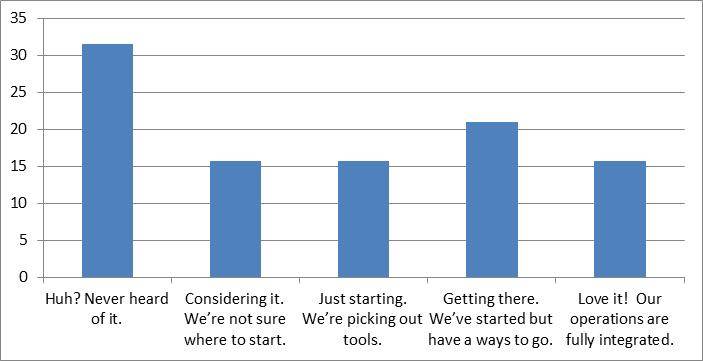
  • 17:27: DevOps Poll
  • 18:40: DevOps is a significant trend that you should consider. Hosters have a lot of operational chops.
  • 19:34: There are a lot of right ways to do cloud. You need to pick what’s best for your business model
  • 20:23: We could get hardware and software, but operational expertise was missing.
  • 21:33: We’re more making the complexity of a cloud go away. We are getting our customers a head start. We are chipping away at the learning curve.
  • 22:05: The cloud is always ready, never finished. Cloud is an ongoing operational environment: DevOps!
  • 23:30: Crowbar bakes a lot of operational experience into the deployment.
  • 25:17: Core tenant of DevOps: there is no single OpenStack image. Cloud is too complex. We build it in layers.
  • 26:26: Before you deploy, you can change the configuration.
  • 27:30: Barclamps are modules that execute a function. We are inviting community participation
  • 28:40: Crowbar process view – Crowbar is a “PXE state machine” is a very simplified description.
  • 29:57: You can go through a tuning cycle where you can get it working, make sure it’s right, flush and reset. That ensures you have an automated system.
  • 30:34: Screen shots with descriptions
  • 33:25: Event the core state machine that runs Crowbar is deployed as a barclamp
  • 35:00: You can download OpenStack and install it yourself from our github. We don’t want to talk about OpenStack, we want to DO OpenStack.
  • Poll Results (see to the right)
  • 38:00: Online resources
  • 40:00: Question 1: Timeline for RHEL. Answer: RHEL is part of Hadoop, will make it into OpenStack by end of year (or sooner based on market demand)
  • 42:17: Question 2: What led Dell to get involved in OpenStack? Answer: It’s about experience. We like being able to fix and change if we needed. There is a lot of active community
  • 45:30: Question 3: How does a hardware maker play with open source software? Answer: It’s a solution for us. We wanted to make sure that people cloud deploy the software. Adding DevOps takes it to another level.
  • 48:00 Question 4: What elements of Diablo are most exciting? Answer: Keystone (centralized authentication) is a big deal. Networking changes that “bust the top” of the networking hurdles.
  • 50:25: Question 5: Where is OpenStack going long term? Answer: We’re pleasantly surprised about how much it’s picked up. We’ll see more standards in the community. We have high hopes for OpenStack and have invested heavily. We’ll see more as-a-service capabilities to build on a common infrastructure: both open and commercial.
  • 52:47: Question 6: What’s the biggest barrier to operating at scale? Answer: learning how to operate is the biggest hurdle. We took a learning approach to help customers get started. We are hosting a training with Rackspace.
  • 55:00: Question 7: Where does Dell and Rackspace overlap? Answer: We see Rackspace Cloud Builders that the premier experts. Dell Services is involved with all of it. Dell takes the phone call and deals with our customers directly.

Please support me for the OpenStack Policy Board

I’m posting my OpenStack bio here and asking for support putting me on the Policy Board by voting for me.  NOTE: You can only vote if you’re registered and you got the “Poll: OpenStack Governance Elections” email.

Project Policy Board Objective

I am seeking a role on the OpenStack Policy Board to further the adoption of OpenStack within and beyond the community.  As the OpenStack technology lead within Dell, I am the engineer who is most actively engaged with field deployments; consequently, I am uniquely positioned to represent our development community, hosters and enterprise user bases.  I bring substantial process experience (Agile/Lean/CI) into my decision making.  My focus will be on ensuring OpenStack is deployable and ready for use.

Background

I am a Principal Engineer at Dell working as the lead for our OpenStack cloud initiative (http://dell.com/openstack).  My team at Dell is responsible for bringing hyper-scale cloud solutions to market and works closely with our cloud optimized hardware division (DCS).  Before working on the OpenStack project, I was involved in cloud projects for Azure, Eucalyptus, and Joyent at Dell.
My involvement with OpenStack goes back to the very earliest days before the project was launched where I was part of the evaluation team that advocated for Dell to join the project.  Since then, I have been active participant at every design conference.  It was my recommendation that Dell focus on making deployment capabilities for OpenStack and to ensure that those contributions are open sourced (Apache 2).  At this point in the project, I am Dell’s technical authority on OpenStack for community and customer interactions.
My team is responsible for the Crowbar cloud deployer (http://github.com/dellcloudedge/crowbar).  The purpose of this project is to ensure that OpenStack is be quickly and reliably deployed in a wide range of configurations on any hardware platform.  I believe that ease of deployability is essential for the success of OpenStack as a project because it ensure adoption by non-developers.  I also believe strongly in continuous integration and am working to adapt Crowbar as a CI platform.  I have been the primary driver to ensure that the Crowbar project is open sourced and accepting of input from the community.
My team also designs technical reference architectures (RAs) for OpenStack.  These RAs help drive adoption by providing crisp guidance on how deploy OpenStack.  I am a vocal proponent of open operations (keeping best practices public) and following a DevOps approach for ongoing cloud deployment life-cycles.
In addition to my work at Dell, I work to ensure community access and communication.  My independent blog provides technical detail and insights about the OpenStack and other cloud initiatives.  My blog also focuses on Agile and Lean practices that I believe are essential to success in technology innovation.
I have been working with cloud computing since 2001.  The company I founded with Dave McCrory (@mccrory), now owned by Quest, was the first multi-server VMware ESX deployment ouside of VMware.  We pioneered the concept of elastic vm management (look up the patents!) so I have a very deep understanding of the problems and architectures required.